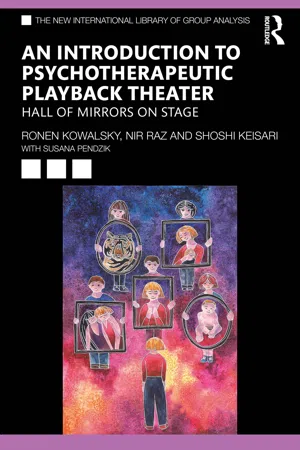
An Introduction to Psychotherapeutic Playback Theater is a comprehensive book presenting Psychotherapeutic Playback Theater as a unique form of group psychotherapy.
This pioneering book is the first of its kind, examining this new approach, the theory behind it, and the numerous considerations and diverse possibilities involved in using the technique to promote a significant reflective process among participants. Informed by years of Psychotherapeutic Playback Theater practice and research, the authors detail a collective-creative method that allows for the creation of a therapeutic experience centered on feelings of belonging, acceptance, visibility and liberation. It is presented to the reader as a path toward their development and growth as a conductor working in this newly evolving field of group therapy.
The book will be of great interest to dramatherapy students, trainees and professionals, and group therapists who wish to reflect upon their practice through the mirror of Psychotherapeutic Playback Theater as well as facilitators and actors working with Playback Theater or other improvised genres.
Chapter 1 The storyA picture from the photo album of the mind
Ronen Kowalsky, Nir Raz, Shoshi Keisari
DOI: 10.4324/9781003167822-2
Figure1.1
People tell stories. They use them to explain their lives to themselves and others. Self-identity develops as a story, which features places and times, a plot, characters and central themes. One’s life story may be based on biographical facts, but it is interwoven with interpretations, cultural influences, associations and connections, culminating in the creation of a coherent internalized myth of the self, whose very existence provides one’s life with meaning. A coherent internalized life story allows the individual to live a life of purpose and supports the formation of a positive identity (McAdams, 2001). This chapter discusses the personal story and the way it is retold within the context of the shared experience of Psychotherapeutic Playback Theater.
Human experience is organized in the form of stories and the capacity for storytelling is thus the key to understanding the world (Bruner, 1990). The self emerges through the act of storytelling and our self-perception is shaped by the stories we tell ourselves and those that others tell about us (Schafer, 1983). Stories of the past – including one’s personal story – create the meaning of one’s life, both in the present and regarding one’s expectations of the future. The interweaving of experiences and events captures a thematic pattern, which represents the individual’s interpretation of the meaning of their life (Rosenthal, 1993).
People share important autobiographical memories with one another, carefully choosing to tell those stories which help them explain and present themselves. This process has a reciprocal influence on both the teller and the listener, as the telling of a memory naturally gives rise to insights and meaning in both parties (Bruner, 2004). This intersubjective encounter and the emerging dialogue create a space for the development of meaning and insight, influencing the emerging story and, through it, the manner in which both teller and listener construct their social identity (Gergen, 1991; Gergen & Gergen, 1988).
Thus, the story’s essence is flexible, dynamic and adapted to the place and time in which it is being told. At the same time, it is also aimed toward the future (Barclay, 1994). Because the nature of a person’s life story is dynamic, developing in accordance with their emerging identity and the different social situations they encounter (Gergen & Gergen, 1988; Greimas, 1991), it is only natural that, as it is repeatedly told and retold over time, this story is revised and reconstructed again and again. This dynamic quality also makes it possible to help an individual reconstruct their life story in a way that is better suited to and more effective for their developing self. Such a reconstructed story should expand one’s perspective, enabling new discoveries for both teller and listener.
Yaniv, a 32-year-old man, tells the group that he is about to get married and, as his wedding day approaches, he finds himself increasingly withdrawn and consumed by profound sadness and confusion. He shares that he had felt a great deal of joy and wholeness in his relationship with his partner, until the moment they decided to get married – though both of them had felt that this decision was right and natural at the time. “It’s as if there’s something inside me that won’t let me be happy, to partake in the experience of togetherness. I don’t understand myself. It’s supposed to be the most beautiful and meaningful moment of my life.” Later on, to illustrate this, he tells the group about a weekend he spent with his partner at his parents and gets carried away in lengthy depictions of the pastoral farmland in which he grew up and the great atmosphere at his parents’ place. He recalls driving a tractor through the fields of the small town as a teenager and how everything felt perfect back then. Yaniv talks about how tight-knit his family felt, about looking forward to celebrating birthdays and holidays together, about a special sense of esprit de corps surrounding his belonging to his family and the small town’s community. He adds that he feels very open with his parents and tends to consult them about every major life decision he makes. He also adds that, when that weekend was over, he found it difficult to leave his parents’ house.
By observing the story, the pastoral portrayal of Yaniv’s childhood environment and his idyllic family atmosphere contextualizes the impending wedding. The latter symbolizes his final departure from his childhood home, the establishment of his own nuclear family and the need to confront his changing identity. From an identity that relies on being a “small town boy” and his parents’ son, with all the esprit de corps these entail, he is now shifting to being an adult, with his own intrinsic identity and self-worth. In this sense, his decision to present this story to the Psychotherapeutic Playback Theater group can be seen as a kind of unconscious request that the group accompany him in his process of separating from his family of origin.
Each culture has its own stories, whose function is to preserve community identity and cohesiveness as well as to serve as means of entertainment, education and transmission of values. In all early human civilizations, stories helped to clarify human existence, convey knowledge, teach people about their tribal roles and facilitate the internalization of social norms. These stories were handed down from generation to generation in the tribe, through recollection and imitation. The earliest manifestations of storytelling included a variety of gestures and expressions. For example, pre-historic cultures painted on their cave walls symbols from the stories they heard, in an attempt to help the storyteller remember the story and pass it on. In later eras, the story was passed on by means of a narrative that included verbal, auditory (musical), visual (cave paintings) and movement (dance) aspects. Gestures, such as throwing sand in the air, using leaves and making wood carvings, were used to help the teller illustrate certain parts of the story, build tension and create drama. In this way, the verbal narrative became imbued with additional types of artistic expression, including theater; after all, as Shakespeare put it, “all the world’s a stage, and all the men and women merely players…” (Shakespeare 1603/2009, set II).
In the 21st century, stories are still at the heart of human existence. In addition to the personal, social and cultural discourse expressed in literature, theater, film and journalism, personal stories are passed on via digital media, the internet and social networks (by posting on social media platforms, such as Facebook and Instagram, or sharing one’s story on instant messaging apps). It is important to note that most social sciences approaches do not differentiate between the concepts of “narrative” and “story” (Riessman, 2008). This chapter focuses on personal narrative and the concept through which we chose to describe the processes related to its construction in Psychotherapeutic Playback Theater is the personal story.
Every story must have the elements of a dramatic scene: scenery, plot, protagonists, secondary characters, conflicts and resolutions. One’s life story is constructed for an audience, whether external, such as friends and family members, or internal, like the super-ego, an internalized attachment object or God (McAdams, 2001; Polkinghorne, 1988). This basic assumption makes the introduction of one’s story into theatrical and dramatic space a very natural and necessary process.
In Psychotherapeutic Playback Theater, the teller’s personal story becomes a story in which all group members are involved and to which they all respond. The other members listen to the story with empathy and respond to it in a creative, improvised manner. They witness the telling and then resonate the mental and emotional materials to which it gives rise within them. In the playing space, the story takes on a life of its own: its different aspects become tangible and the teller becomes an observer of their own story, a witness to their own personal experience. This position grants them a new perspective, from which they can observe and explore the story, while maintaining aesthetic distance (Keisari, 2021; Keisari, Yaniv et al., 2018). The story expands through its encounter with others, as the playing members help the teller-observer discover new meanings and points of view.
This is illustrated through the theatrical response the group presented in response to Yaniv’s story. The conductor asked Yaniv to choose a member who will play his role and that member then entered the playing space along with two others. Other member plays the song Cheek to Cheek by Louis Armstrong in the background, its opening line – “Heaven, I’m in heaven” – sounding throughout the playing space. The three playing members moved through the playing space huddled together, performing dance moves that involved a great deal of skin-to-skin contact. They smiled at each other, giving the impression that they have a good connection and that they are merged with each other. After about 30 seconds, a fourth member entered the playing space and stood at its other end. She and “Yaniv” made eye contact and smiled at each other. The two members who were dancing with Yaniv’s character kept dancing as they did before, but his movement gradually changed. Every now and again, he stepped out to dance with the figure standing on the sideline and then came back to them. Little by little, his movement became less smooth and he seemed increasingly confused and torn between the two dances. At some point, he stopped, stood between these two “options” and reached out his arms to both sides, trying with all his might to grab hold of both at the same time – but to no avail. After the theatrical response was concluded, Yaniv said that he could see the different feelings he experienced in the situation he described. He added that images from his childhood room at his parents’ house came to him and that he felt close to tears. During the sharing circle, the other members brought up stories from their own lives surrounding significant moments of development, in which they experienced “growing pains” and realized that development is not possible without a certain degree of separation and relinquishment.
The photo album of the mind
In this section, we examine what happens to the psychic material of the story when submitted to the creative group process of Psychotherapeutic Playback Theater. Human experience is, unsurprisingly, vaster than any story that seeks to capture it. Lived experience contains thoughts, feelings, tastes and smells, values, points of view and meanings which are never fully and exhaustively expressed in any given verbal story. The personal story can be seen as a picture in one’s mental photo album. The teller leafs through their personal album and chooses a single picture. It may be an old black-and-white photograph which carries memories, smells, tastes and feelings. The teller offers us a tour, a glimpse into their inner world.
At this stage, our role as conductors is to help the teller focus on a certain part of the photo they chose. This process allows careful observation of each and every detail: the background, the landscape, the characters and their relationships, objects, facial expressions, body positions, atmosphere, emotions, etc. The aim of this process is to bring the picture to life by exposing new colors and details, emphasizing pre-existing elements, expanding its present limits and discovering new elements. Finally, all the details need to be combined in order to create a new, integrated picture, which holds both the pre-existing and the newly discovered elements. This new picture is re-inserted into the personal photo album, more integrated through the insights gained in the Psychotherapeutic Playback Theater process and freshly colored with the qualities of acceptance, sharing, listening and presence. It is as if the teller has come back from a long journey, during which he collected various souvenirs, experiences and gifts – new shades, additional perspectives and the qualities of a deep, interpersonal encounter. Taken together, these newfound elements have imbued the teller’s pre-existing experience with a new light.
In Yaniv’s story, one can see how the theatrical response presents his relationships with his parents and his partner from a novel perspective, which highlights the pain he is feeling in the process of separating from his parents as the key difficulty surrounding his upcoming marriage. This clarification is an initial step toward the change that needs to happen in Yaniv’s view of his relationship with his parents in order to facilitate his further development as an individual and the formation of his own nuclear family.
The journey of the personal story
The main focus of this chapter is the exploration of the different stages in the journey of the personal story – starting with its transition from the teller to the playing space and, through the Psychotherapeutic Playback Theater group process, back to the teller: (1) selection – the story that is chosen to come to light emerges as a result of particular motives and needs; (2) the theatrical response – responds to the story and contains several components: theatrical mirroring of the story’s conscious parts, the deconstruction of the narrative into different elements and, finally, their reintegration into a new, complete structure; (3) back to the teller – after the theatrical response, the teller responds by sharing any thoughts and feelings that arose during the response; (4) the sharing circle – group members share personal stories which came up in response to the story or the feelings they experienced during the theatrical response and (5) the red thread – the conductor recapitulates the various stories and responses and proposes an interpretation designed to tie them all together.
Choosing the story that asks to “come to light”
In Psychotherapeutic Playback Theater groups, members are invited to share their personal stories. The stories presented to the group are the starting point of the therapeutic process, providing the necessary materials for dramatic response. As the group process unfolds, stories begin to touch on deeper and deeper issues and the group’s creative processing becomes more meaningful for both the teller and the other members. Members use their stories to present their inner world, their motives, the ways in which they define their identity and the choices that give their lives direction and meaning. These stories create a sense of continuity and tie together past, present and future. They often contain internal conflicts, feelings of lack or longing, inhibitions or obstacles to one’s desire to act and conflicting emotions.
A study conducted on a sample of 27 elderly members in a Psychotherapeutic Playback Theater group found that 16 members shared stories that focused on unresolved issues from their past (Keisari, Gesser-Edelsburg et al., 2020). Group members oscillated between wanting to share themselves and their experiences with the group and explore their stories as a path for growth and development and having difficulties sharing feelings of pain, vulnerability and weakness and worrying that such exposure will have a negative outcome. As the group progressed, members felt safer, dared to share increasingly personal stories with the group and were better able to rely on the safety of the group space in coping with difficult life events, pain, vulnerability and weakness. In this manner, they were able to achieve personal g...
Table of contents
Cover
Half Title Page
Title Page
Copyright Page
Dedication
Table of Contents
Acknowledgments
Foreword
Learning theraplayback / cheli tal shalem
Introduction – a house on the bridge
1 The story – a picture from the photo album of the mind
2 Theatrical mirroring
3 A bypass to the depths of the psyche
4 Opposites and integration
5 Expansion of the self through the other
6 From the playground to the stage
7 Such stuff as containers are made on – levels of structuring in Psychotherapeutic Playback Theater
8 Theatrical forms in Psychotherapeutic Playback Theater
9 Approaching personal stories through dramatic resonances in group work by Susana Pendzik
10 Psychotherapeutic Playback Theater as a group dream about the story: Surrealism as the theatrical language of the inner world
Afterword – from a house to a village on the bridge
Bibliography
Index
Trusted by 375,005 students
Access to over 1.5 million titles for a fair monthly price.
Study more efficiently using our study tools.
Frequently asked questions
Yes, you can cancel anytime from the Subscription tab in your account settings on the Perlego website. Your subscription will stay active until the end of your current billing period. Learn how to cancel your subscription
No, books cannot be downloaded as external files, such as PDFs, for use outside of Perlego. However, you can download books within the Perlego app for offline reading on mobile or tablet. Learn how to download books offline
Perlego offers two plans: Essential and Complete
Essential is ideal for learners and professionals who enjoy exploring a wide range of subjects. Access the Essential Library with 800,000+ trusted titles and best-sellers across business, personal growth, and the humanities. Includes unlimited reading time and Standard Read Aloud voice.
Complete: Perfect for advanced learners and researchers needing full, unrestricted access. Unlock 1.5M+ books across hundreds of subjects, including academic and specialized titles. The Complete Plan also includes advanced features like Premium Read Aloud and Research Assistant.
Both plans are available with monthly, semester, or annual billing cycles.
We are an online textbook subscription service, where you can get access to an entire online library for less than the price of a single book per month. With over 1.5 million books across 990+ topics, we’ve got you covered! Learn about our mission
Look out for the read-aloud symbol on your next book to see if you can listen to it. The read-aloud tool reads text aloud for you, highlighting the text as it is being read. You can pause it, speed it up and slow it down. Learn more about Read Aloud
Yes! You can use the Perlego app on both iOS and Android devices to read anytime, anywhere — even offline. Perfect for commutes or when you’re on the go. Please note we cannot support devices running on iOS 13 and Android 7 or earlier. Learn more about using the app
Yes, you can access An Introduction to Psychotherapeutic Playback Theater by Ronen Kowalsky,Nir Raz,Shoshi Keisari in PDF and/or ePUB format, as well as other popular books in Psychology & Theatre. We have over 1.5 million books available in our catalogue for you to explore.