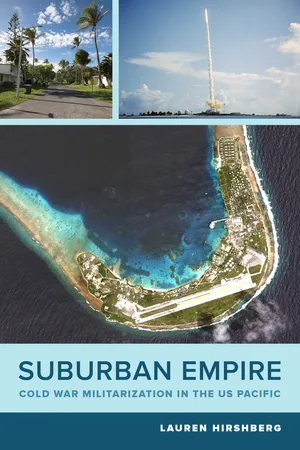
Suburban Empire takes readers to the US missile base at Kwajalein Atoll in the Marshall Islands, at the matrix of postwar US imperial expansion, the Cold War nuclear arms race, and the tide of anti-colonial struggles rippling across the world. Hirshberg shows that the displacement of indigenous Marshallese within Kwajalein Atoll mirrors the segregation and spatial politics of the mainland US as local and global iterations of US empire took hold. Tracing how Marshall Islanders navigated US military control over their lands, Suburban Empire reveals that Cold War–era suburbanization was perfectly congruent with US colonization, military testing, and nuclear fallout. The structures of suburban segregation cloaked the destructive history of control and militarism under a veil of small-town innocence.
- 386 pages
- English
- ePUB (mobile friendly)
- Available on iOS & Android
eBook - ePub
About this book
Information
1 From Wartime Victory to Cold War Containment in the Pacific
BUILDING THE POSTWAR US SECURITY STATE ON MARSHALLESE INSECURITY
In terms of world society, Micronesia is inconsequential.
—Lt. John Useem, US Naval Reserves, 1946
Don’t Americans realize that every life is precious?
—Rongelapese woman, speaking in the 1985 documentary Half Life: A Parable for the Nuclear Age
THE UNENDING WAR IN THE PACIFIC
John Heine was barely nine years old when war came to his home island of Jabwot in the Marshall Islands. For Heine the war first came through sound. He recalled sitting outside his parent’s house under a coconut tree when he heard gunfire overhead, followed by “American planes all over the place dropping bombs everywhere.”1 He recalled that “about 100 Marshallese died in that bombing.”2 Heine survived the war, hiding on various islands after the Japanese military separated him from his family. In the nightmare that had come to his island home Heine witnessed the Japanese beheading his father, who they believed was a potential spy for the United States. Following the war, Heine became a scout for the United States and in time made his way to Kwajalein Island to work for the US Navy.3
Heine arrived at Kwajalein after the United States had invaded and captured the island in late January 1944. This campaign on Kwajalein involved more than forty-one thousand US troops.4 Following the costly battle at Tarawa, where the United States had faced formidable Japanese defenses and suffered significant casualties, the strategy for Operation Flintlock at Kwajalein became one of complete destruction. During the weeklong invasion, the United States dropped thirty-six thousand shells, making Kwajalein the most concentrated bombing site of the entire Pacific War.5 When victory was declared on February 5, Kwajalein’s landscape was left scarred by ordnance dropped at levels “roughly equivalent to the destructive power of a 20-kilton atomic bomb.”6 Only one tree remained standing. The island appeared to one American soldier as if it had been “picked up to 20,000 feet and then dropped.”7
Characterized by naval historian Samuel Eliot Morison as “one of the most complicated amphibious campaigns in history,” the invasion of Kwajalein would be recounted and commemorated by Americans for decades in ways that celebrated American courage and sacrifice while erasing any Marshallese experiences of the battle in their homelands.8 In addition to excluding memories like those of John Heine, these recollections abstracted the island from its local geography and history, contributing to a broader perception of a war fought in a Pacific theater that lacked any Pacific Islander history or ongoing presence.
Heine recalled in later years the uncertainty and fear that gripped him in the wake of the war, a legacy of postwar insecurity shared by many other Marshallese and Pacific Islander survivors of wartime destruction and devastation. Heine noted that while he could not speak for the entire Marshall Islands population, many his age remained “by-products of the Pacific war,” a conflict, he emphasized, “we were not a part of.”9 He continued, “We had no business in it; but we were drawn into it. As a result it is not easy for any of us in the islands to predict our futures.”10
The ongoing insecurity described by Heine persisted long after the war’s conclusion. While the US military came to the Marshall Islands in the 1940s to defeat Japanese forces, declarations of victory would not signal US departure from the region. The US military has instead remained in the Marshall Islands from the 1940s through today. This ongoing military presence that brought devastation to land and life would continue to create the conditions of an unpredictable future for Marshallese. A wartime dynamic in which US security came at the expense of Marshallese insecurity would become an enduring condition. As the navy used Marshallese lands to remain in a perpetual state of wartime preparedness, the distinction between having one’s home at the center of a hot versus a “cold” war seemingly became negligible. This “unending war” saw the US military move from testing nuclear bombs to ICBMs as wartime targets shifted seamlessly from a Japanese to a communist enemy over time.
This chapter examines World War II and early Cold War contexts that contributed to positioning the Marshall Islands as a space of entitlement for the emerging US security state. Beginning in the 1940s, cultural and political histories articulated through US war stories and postwar political agreements collectively worked to frame US control over Micronesia as essential to national and global security. The chapter begins by considering how US war stories positioned the Pacific, and Kwajalein specifically, as sites of American sacrifice and self-defense. Over time, these narratives began to frame the region as an object of US possession and entitlement. With signing of the Trusteeship Agreement in 1947, US political leaders drew upon a context of US wartime sacrifice to further position Micronesia—and importantly, indefinite US control of this region—as essential to postwar security. The Trusteeship Agreement framed US imperial expansion into Micronesia as both strategic and benevolent, through dual mandates of regional control for US security and support for Micronesian self-determination. No event more clearly illustrated US disregard for the latter obligation, exemplifying the destructive, colonial nature of US control in the region, than the nuclear-testing campaign. As this chapter turns to that campaign, which lasted from 1946 to 1958, it examines how the impacts of destruction, displacement, and irradiation reveal the contradictions in the American postwar premise that US national security was equivalent to global security. Such claims must be weighed against the ongoing insecurity of those living with the legacies of historic and ongoing US weapons testing in their homelands.
The political tensions of this US imperial project unfolded in an era of global decolonization. The chapter concludes by tracing how, during the 1950s and 1960s, US political leaders, military and civilian administrators, and UN representatives disavowed the destructive impact of US expansion into Micronesia during the Cold War and drew upon colonizing tropes of native incapacity for self-governance to justify indefinite US control. This deeply rooted American cultural perception of indigenous peoples as unfit to self-govern helped situate control over the region as a project of benevolent tutelage in helping a “backward” and “savage” people move slowly toward civilization. For US military and Trust Territory officials, civilizational ideology helped soften a contradictory stance of supporting self-determination alongside a commitment to imperial control. By the 1960s, Marshallese political leaders would zero in on these contradictions as they challenged such tropes by using the United Nations as a platform to decry US colonialism and destruction in their homelands. In doing so they added their voices to the growing tide of global anti-colonial protest.
FROM BATTLES TO BASES: REMEMBERING WAR IN THE PACIFIC
The relative paucity of published accounts like that of John Heine reflects a historic erasure of the costs of the Pacific War for those whose homelands comprised its “stage.” Examining some of the earliest and ongoing iterations of the Kwajalein battle story, this section unearths a pattern of US storytelling that unfolded over more than five decades to frame Kwajalein as a place where history began with US sacrifice and moved inevitably toward permanent US possession. A trajectory in which “battles become bases,” which anthropologist Catherine Lutz has traced across the global US base imperium over time, appeared so fated in Kwajalein battle commemorations that to question this path would be equivalent to questioning the broader sacrosanct narrative of US national security.11
Most US histories of the Pacific War have largely obscured the voices of Micronesians, narrating the war instead as a battle between two enemies taking place on a “theater” devoid of any local history. The incapacity to perceive these islands as homes for generations of Pacific Islanders came through in some of the earliest political and military categorizations of such homes as “stepping stones” in a broader campaign across the region. Few US historians have taken the time to recover the voices of Micronesians in recounting the war. It is only in the past two decades that stories like John Heine’s have begun to fill the pages of a limited number of collections on Micronesian experiences of World War II, researched by a small cohort of historians, anthropologists, and Pacific studies scholars. In one of these volumes, Marshallese survivor Ato Lankio described his experience of losing his home island of Kwajalein during the war. Lankio recalled how when Kwajalein became a major Japanese base in late 1939, the Japanese forced many Kwajalein people to relocate to Namu Island. He recounted, “This was a decision that brought a great deal of sadness, and it was also fairly difficult in terms of the life that we Marshallese led and our own customs. This is because Kwajalein was a location that was extremely important to us . . . there was no negotiation about it, and no one discussed it with us.”12 For countless other Marshallese like Heine and Lankio, World War II proved a life-altering experience, colored by suffering, loss, displacement, and chaos. Memories captured in anthropology collections reveal the trauma of wartime bombardments, violence, and family separations, alongside experiences of survival and resilience and the complexity of postwar relationships and connections between Americans and Pacific Islanders in the war’s aftermath. Within these recollections, stories also captured the anguish experienced by many Marshallese and other Micronesians whose lives had become intertwined in social and familial ways with prewar Japanese and Korean settlers after the United States repatriated those settlers following the war. Kwajalein landowner and wartime survivor Handel Dribo reflected on the shock that accompanied the immediate postwar transition from Japanese to US power.13 In an interview for a 1991 documentary film, Dribo explained that he and thirty-two other Marshallese survived the Kwajalein battle by hiding in a bunker he had built on the island.14 He said Marshallese on Kwajalein had total confidence in the Japanese capacity to win. Dribo’s awareness of the power differential only became clear after seeing the damage wrought by US bombings. He recalled seeing fire all over the island and nothing left standing, not a single coconut or breadfruit tree; “there was not even a single house; everything was burnt.”15 He concluded, “That’s how bad it was and that’s how powerful the Americans were.”16
Dribo’s account, alongside those of other Marshallese collected decades after the war, detailed both the trauma of witnessing such destruction on Kwajalein and the anxiety of not knowing what would come next under US control. While these recollections reveal how the war indelibly shaped the lives of countless individuals whose homes were chosen by foreigners as sites for battle, Pacific Islander stories remain peripheral, when even present at all, in US accounts and commemorations of the war. Absent any acknowledgment of Marshallese or Micronesian atolls and islands as homes to people with their own histories, American commemorations of the Pacific War have worked to obscure the nature of ongoing US colonial control in the region long after the war concluded. Pacific studies scholars Vicente M. Diaz and Keith L. Camacho have traced this pattern of US celebrations of wartime sacrifice and liberation on Guam and the Northern Marianas, respectively.17 Likewise, Pacific studies scholar Greg Dvorak analyzed this trope as it appeared in photographs taken on Kwajalein during and following Operation Flintlock.18 In these images, the “liberation story” visually worked to erase not only Marshallese memories of loss and sacrifice, but also those of Japanese, Okinawans, and Koreans.19
Abstracted from any Marshallese context, the Kwajalein battle story was presented as unfolding in a theater in which Pacific Islands became “stepping stones” in a campaign across the ocean. Both Presidents Franklin D. Roosevelt and Harry S. Truman voiced some of the earliest iterations of this narrative in presidential speeches in 1945.20 While each reinforced an image of the Pacific as an unpeopled theater upon which the US drama of wartime victory unfolded from the executive platform, the ground-level story of soldiers’ accounts mirrored this erasure of Marshallese from narratives of the Kwajalein battle.21 The 1948 and 1966 special issues of the Kwajalein Hour Glass, the daily publication serving Kwajalein’s US military residential population, featured play-by-play narratives of Operation Flintlock and delineated Japanese and American casualties. Neither issue included any mention of Marshallese present at, or lost in, the battle.22 In the 1966 issue, author E. H. Bryan Jr. echoed the earlier presidential discourse framing Kwajalein’s role as “a stepping stone in the island hopping advance across the Pacific.”23
In a postwar context of increasing US security interests in Micronesia, the tropes framing the Kwajalein battle story expanded from the theme of abstraction f...
Table of contents
- Subvention
- Title Page
- Copyright
- Dedication
- Epigraph
- Contents
- List of Illustrations
- A Note on Language
- Introduction—Home on the Range: US Empire and Innocence in the Cold War Pacific
- 1. From Wartime Victory to Cold War Containment in the Pacific: Building the Postwar US Security State on Marshallese Insecurity
- 2. New Homes for New Workers: Colonialism, Contract, and Construction
- 3. Domestic Containment in the Pacific: Segregation and Surveillance on Kwajalein
- 4. “Mayberry by the Sea”: Americans Find Home in the Marshall Islands
- 5. Reclaiming Home: Operation Homecoming and the Path toward Marshallese Self-Determination
- 6. US Empire and the Shape of Marshallese Sovereignty in the “Postcolonial” Era
- Conclusion: Kwajalein and Ebeye in a New Era of Insecurity
- Acknowledgments
- Notes
- Works Cited
- Index
Trusted by 375,005 students
Access to over 1.5 million titles for a fair monthly price.
Study more efficiently using our study tools.
Frequently asked questions
Yes, you can cancel anytime from the Subscription tab in your account settings on the Perlego website. Your subscription will stay active until the end of your current billing period. Learn how to cancel your subscription
No, books cannot be downloaded as external files, such as PDFs, for use outside of Perlego. However, you can download books within the Perlego app for offline reading on mobile or tablet. Learn how to download books offline
Perlego offers two plans: Essential and Complete
- Essential is ideal for learners and professionals who enjoy exploring a wide range of subjects. Access the Essential Library with 800,000+ trusted titles and best-sellers across business, personal growth, and the humanities. Includes unlimited reading time and Standard Read Aloud voice.
- Complete: Perfect for advanced learners and researchers needing full, unrestricted access. Unlock 1.5M+ books across hundreds of subjects, including academic and specialized titles. The Complete Plan also includes advanced features like Premium Read Aloud and Research Assistant.
We are an online textbook subscription service, where you can get access to an entire online library for less than the price of a single book per month. With over 1.5 million books across 990+ topics, we’ve got you covered! Learn about our mission
Look out for the read-aloud symbol on your next book to see if you can listen to it. The read-aloud tool reads text aloud for you, highlighting the text as it is being read. You can pause it, speed it up and slow it down. Learn more about Read Aloud
Yes! You can use the Perlego app on both iOS and Android devices to read anytime, anywhere — even offline. Perfect for commutes or when you’re on the go.
Please note we cannot support devices running on iOS 13 and Android 7 or earlier. Learn more about using the app
Please note we cannot support devices running on iOS 13 and Android 7 or earlier. Learn more about using the app
Yes, you can access Suburban Empire by Lauren Hirshberg in PDF and/or ePUB format, as well as other popular books in Histoire & Histoire de l'Australie et de l'Océanie. We have over 1.5 million books available in our catalogue for you to explore.