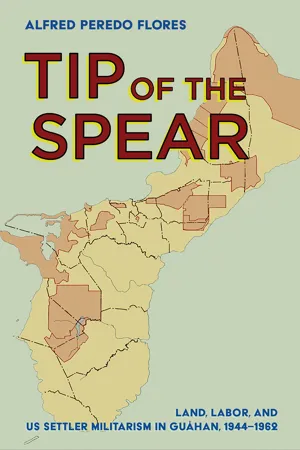
Tip of the Spear
eBook - ePub

Tip of the Spear

Land, Labor, and US Settler Militarism in GuĂ„han, 1944–1962

  1. 216 pages
  2. English
  3. ePUB (mobile friendly)
  4. Available on iOS & Android
eBook - ePub

Tip of the Spear

Land, Labor, and US Settler Militarism in GuĂ„han, 1944–1962

About this book

In Tip of the Spear, Alfred Peredo Flores argues that the US occupation of the island of GuÄhan (Guam), one of the most heavily militarized islands in the western Pacific Ocean, was enabled by a process of settler militarism. During World War II and the Cold War, GuÄhan was a launching site for both covert and open US military operations in the region, a strategically significant role that turned GuÄhan into a crucible of US overseas empire. In 1962, the US Navy lost the authority to regulate all travel to and from the island, and a tourist economy eventually emerged that changed the relationship between the Indigenous CHamoru population and the US military, further complicating the process of settler colonialism on the island.

The US military occupation of GuÄhan was based on a co-constitutive process that included CHamoru land dispossession, discursive justifications for the remaking of the island, the racialization of civilian military labor, and the military's policing of interracial intimacies. Within a narrative that emphasizes CHamoru resilience, resistance, and survival, Flores uses a working class labor analysis to examine how the militarization of GuÄhan was enacted by a minority settler population to contribute to the US government's hegemonic presence in Oceania.

Frequently asked questions

Yes, you can cancel anytime from the Subscription tab in your account settings on the Perlego website. Your subscription will stay active until the end of your current billing period. Learn how to cancel your subscription.
At the moment all of our mobile-responsive ePub books are available to download via the app. Most of our PDFs are also available to download and we're working on making the final remaining ones downloadable now. Learn more here.
Perlego offers two plans: Essential and Complete
  • Essential is ideal for learners and professionals who enjoy exploring a wide range of subjects. Access the Essential Library with 800,000+ trusted titles and best-sellers across business, personal growth, and the humanities. Includes unlimited reading time and Standard Read Aloud voice.
  • Complete: Perfect for advanced learners and researchers needing full, unrestricted access. Unlock 1.4M+ books across hundreds of subjects, including academic and specialized titles. The Complete Plan also includes advanced features like Premium Read Aloud and Research Assistant.
Both plans are available with monthly, semester, or annual billing cycles.
We are an online textbook subscription service, where you can get access to an entire online library for less than the price of a single book per month. With over 1 million books across 1000+ topics, we’ve got you covered! Learn more here.
Look out for the read-aloud symbol on your next book to see if you can listen to it. The read-aloud tool reads text aloud for you, highlighting the text as it is being read. You can pause it, speed it up and slow it down. Learn more here.
Yes! You can use the Perlego app on both iOS or Android devices to read anytime, anywhere — even offline. Perfect for commutes or when you’re on the go.
Please note we cannot support devices running on iOS 13 and Android 7 or earlier. Learn more about using the app.
Yes, you can access Tip of the Spear by Alfred Peredo Flores in PDF and/or ePUB format, as well as other popular books in History & Military & Maritime History. We have over one million books available in our catalogue for you to explore.

Table of contents

  1. Acknowledgments
  2. Note on Language
  3. Abbreviations
  4. Introduction
  5. 1. CHamoru Land Stewardship and Military Land Taking
  6. 2. The Remaking of GuÄhan
  7. 3. The Civilian Military Workers of GuÄhan
  8. 4. Militarized Intimacies
  9. 5. From Breadbasket to Naval Air Station
  10. Conclusion
  11. Notes
  12. Bibliography
  13. Index