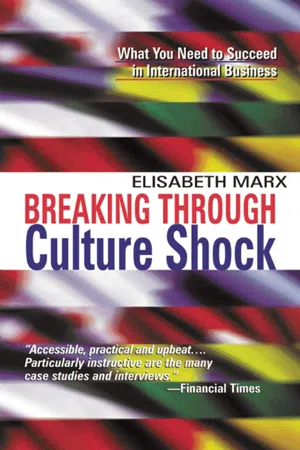
This work looks at the international manager on a professional and personal level, however long- or short-term the assignment may be. It is a practical guide with checklists and exercises, offering step-by-step guidance for those embarking on an international career, and with essential advice for organizations on how to develop and manage their international staff. There is also expert advice on career management and on the effects that international work can have on families, and guidance on returning - reverse culture shock often being the greatest culture shock of all.
eBook - ePub
Breaking Through Culture Shock
What You Need to Succeed in International Business
- 258 pages
- English
- ePUB (mobile friendly)
- Available on iOS & Android
eBook - ePub
About this book
Information
Experiencing Culture Shock — Learning to Adapt
1
The Culture Shock Triangle
Imagine that you have just come back from a meeting with your boss. Your job has been going extremely well and you had great expectations before your discussion. These were more than surpassed when you were offered an international role, either a foreign assignment or a short-term international project. This is exactly what you wanted. You are ambitious and you know that if you want to succeed, you need the international experience.
At the same time, your exhilaration is slightly dampened by uncertainty about how you are going to adapt, how this change will affect your personal life and how you will be able to develop quickly in the international arena.
The future you envisage will depend to a great extent on your personality. If you are an optimist, you will probably picture an ideal scenario and identify with this international executive:
“I always wanted to work abroad; I left university and wanted to go and see the world – work hard and play hard. The oil industry seemed ideal for this purpose. I saw myself as a nomad since I left my home country when I was 11 years old to do my education abroad. I worked in a number of countries, often with very little organizational support. I started my first assignment in my early twenties and developed a flexibility and an understanding of what others do. The most important factor was having an easy-going personality. As a consequence of long-term international work, I feel I am able to see things from many angles and I regard it as a particularly broadening experience.”
This is the way we all like to see ourselves: an early international orientation, a flexible and easy-going personality, an ability to look at situations from different perspectives and a high degree of tolerance.
However, if you are more of a pessimist, you may envisage something similar to the following scenario:
“My adaptation was appallingly difficult. I thought I knew the French, but I only knew them socially and not in a working environment. The French manager had been fired but he had recruited all of the French employees and so the French employees thought that the manager was badly treated. I found that all the normal ways of managing people in the UK did not work in France. The things I said were not perceived the way I intended and, in turn, I did not understand exactly what they were saying. What I found was a lot of bad will. At first, I tried to charm them and in the end I had to get rid of them. It took 18 months to sort out the situation and it was only really resolved after my car tires were slashed and it was in a way an attempt at murder. I was driving with my family at high speed for 100 km before I noticed because of the way they were slashed. What really helped me was having a strong outside interest and strong religious beliefs.”
Or there is an even more pessimistic scenario:
“I was a 45-year-old American and had come to Asia to work on a three-year assignment. Although I saw myself as a very sociable and adaptable man, my work pattern became erratic, which was noted by my company. I would be late and sometimes not turn up at all – at other times, I seemed to work around the clock. My colleagues seemed to be used to the ‘eccentric’ behavior of foreigners and did not think too much about it.
After six months, I fetched a boat to an island in a neighboring country; on arrival, I took off my clothes, and threatened the local population with a gun in a stark-naked state. Eventually, I succumbed to the police and was brought back to my home country. It was clear that I could not stay abroad and function in my job – I returned ‘home to recover’.”
All three examples are from real life. They are accounts by Italian, British and American international managers who are well educated and in senior positions, working in different parts of the world. All were confronted with the same basic challenge: being effective at an international level and adapting to a new culture. The scenarios show a range of effects that foreign encounters can have: from exhilaration and developing confidence to serious intercultural problems and even the worst-case scenario of a ‘nervous breakdown’.
Fortunately, most international managers experience a mixture of these scenarios: they go through some difficult phases but eventually develop effective international skills.
The basic proposition of this book is a positive one: the majority of us can be internationally effective if we put real effort into developing our ability to adapt. In the past, most books on international managers have concentrated on specific aspects of intercultural work, with a particular focus on understanding the cultural dimensions of management. This is obviously necessary, but it isn’t sufficient – it doesn’t look at the international manager as a human being with development needs at a professional and personal level. We need to think differently in a new culture, but we also have to adapt to the challenge socially and emotionally.
Culture shock
Working in a new culture can produce a variety of reactions, such as:

All of these are possible reactions to culture shock, the shock we experience when we are confronted with the unknown and the ‘foreign’. The term ‘culture shock’, now part of our everyday vocabulary, was coined by the anthropologist Oberg (1960), who explained both the symptoms and the process of adapting to a different culture. The experience of a new culture is seen as an unpleasant surprise or shock – a shock that occurs when expectations do not coincide with reality.
In his original article, Oberg lists six main aspects of culture shock:
It is a myth that experiencing culture shock is a weakness or a negative indication of future international success. Culture shock in all its diverse forms is completely normal and is part of a successful process of adaptation. A study of Canadian expatriates in Africa showed that those who experienced culture shock were ultimately the most effective (Hawes and Kealey, 1981). Expatriates who were most aware of themselves and their emotions experienced the most intense culture shock, but it was exactly because of this intense awareness of differences that they were also able to adapt more effectively later on.
In contrast, expatriates who were not affected by culture shock and generalized their own views to the other culture did not adapt very well. Culture shock is therefore a positive sign on the road to international adaptation.
Symptoms of culture shock
Although we use the term culture shock all the time, there is very little information on its most frequent symptoms and the degree to which managers experience them. This is an area I looked at in conjunction with the UK’s Centre for International Briefing (Marx, 1998).
We asked 73 managers who worked all over the world to complete a questionnaire in the first six months of their international assignments. The majority were in fairly senior positions, typically regional directors within a functional area.
The following examples show different experiences of culture shock.
“Culture shock – still going on after five weeks here.” (A manager in Indonesia who reported symptoms including feelings of isolation, anxiety, helplessness and performance deficit)
“Experienced symptoms from month three to six. I accepted that it would happen and worked through it.” (A manager in Poland)
“The culture shock lasted about three to four months; the only way out was to remind myself of what I had achieved in previous jobs under difficult circumstances and set myself achievement targets on a daily and weekly basis.” (A manager working in Russia taking a very structured approach)
How long does culture shock last?
Most people think of culture shock as a ‘short and sharp’, disorientating experience in a foreign place. Few realize that its effects can be much deeper and more prolonged if it is not dealt with effectively.
On average, managers in my study experienced culture shock symptoms for about seven weeks: 70 percent of managers reported these lasting up to five weeks and 30 percent had symptoms for up to ten weeks.
In order of priority, the symptoms most often found were:
The inclusion of ‘high energy’ may be surprising, but it could be nervous energy, or a high ene...
Table of contents
- Cover Page
- Title Page
- Copyright Page
- Contents
- Acknowledgments
- Preface to the paperback edition
- Part One Experiencing Culture Shock – Learning to Adapt
- Part Two Conquering Culture Shock – Achieving Success
- References
- Index
Trusted by 375,005 students
Access to over 1.5 million titles for a fair monthly price.
Study more efficiently using our study tools.
Frequently asked questions
Yes, you can cancel anytime from the Subscription tab in your account settings on the Perlego website. Your subscription will stay active until the end of your current billing period. Learn how to cancel your subscription
No, books cannot be downloaded as external files, such as PDFs, for use outside of Perlego. However, you can download books within the Perlego app for offline reading on mobile or tablet. Learn how to download books offline
We are an online textbook subscription service, where you can get access to an entire online library for less than the price of a single book per month. With over 1.5 million books across 990+ topics, we’ve got you covered! Learn about our mission
Look out for the read-aloud symbol on your next book to see if you can listen to it. The read-aloud tool reads text aloud for you, highlighting the text as it is being read. You can pause it, speed it up and slow it down. Learn more about Read Aloud
Yes! You can use the Perlego app on both iOS and Android devices to read anytime, anywhere — even offline. Perfect for commutes or when you’re on the go.
Please note we cannot support devices running on iOS 13 and Android 7 or earlier. Learn more about using the app
Please note we cannot support devices running on iOS 13 and Android 7 or earlier. Learn more about using the app
Yes, you can access Breaking Through Culture Shock by Elizabeth Marx in PDF and/or ePUB format, as well as other popular books in Business & International Business. We have over 1.5 million books available in our catalogue for you to explore.