Direct marketing just got easier
Picking the right promotional mix is not easy. Whatever is done it must be effective, and also cost-effective, and both budgets and time are no doubt limited. Business does not arrive unbidden (or very little of it does), nor does it magically arrive just by crossing your fingers and shouting 'Promotion!'; so something must be done and time and effort must be expended to make sure it works.Even in this electronic age, direct mail remains a popular form of promotion. It can certainly find and hold customers and do so cost-effectively too. But, you may have noticed, it does not have the best image - the words 'junk mail' are frequently used in relation to direct mail offerings! However, used carefully, it can work for seller and buyer alike. This book sets out how to utilize direct marketing formaximum benefit for both.If you position the use of direct mail effectively within the totality of your promotional mix, and make it work well - and that means systematically making sure that every element of it works well, from a letter and brochure to an envelope and much more - it can be an important part of your business generating process. In this book, in seven succinct chapters, we review how to make that so.Each of the seven chapters in Direct Marketing In A Week covers a different aspect:
- Sunday: The recipients: database considerations
- Monday: The core elements of direct mail
- Tuesday: The component mix
- Wednesday: Creatively enhancing persuasiveness
- Thursday: Follow-up activity
- Friday: Email approaches: as easy as 'click'
- Saturday: Future campaigns
eBook - ePub
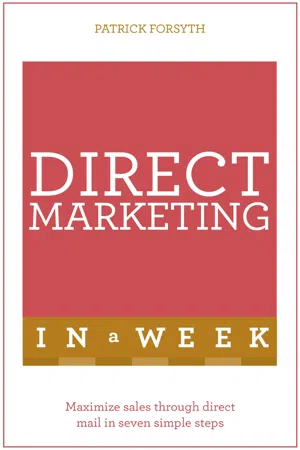
Direct Marketing In A Week
Maximize Sales Through Direct Mail In Seven Simple Steps
- 128 pages
- English
- ePUB (mobile friendly)
- Available on iOS & Android
eBook - ePub
About this book
Information

Deciding and writing the message you send out is vital and a good deal was said about this in the last chapter. But one element was ignored. That is the fact that the message is spread around, and to a degree repeated, in a number of different places. These can vary, but four are most often in evidence:
• a letter
• a brochure of some sort
• a reply vehicle (a card to send back, for instance)
• an envelope (or wrapper).
The success of the total message is not just dependent on how it is written, but how it appears in total across the shot. Today we examine these components in turn and also investigate factors important to organizing the whole shot.
What is sent out is put together from essentially four elements: brochures or leaflets, a covering letter, a reply facility and, of course, an envelope. While the envelope is always necessary (unless you use postcards or wrap your shot in plastic, though this too can carry a message), the other components can be varied. A ‘shot’ might consist only of a letter, or only of a brochure, or of a brochure that incorporates a reply coupon; or it might be more elaborate – a letter plus two or three brochures and a reply form and a return envelope. Clearly, many permutations are possible.

Together the package must carry the total message and that message must be sufficiently persuasive to prompt action from a number of recipients, numerous enough to make the whole exercise profitable.

The word ‘mailshot’ implies one such mailing, while a ‘campaign’ implies a number of shots over time which may be about different elements of the range, each being separate, except that they are clearly from the same source. Alternatively, shots may be closer together and linked, meaning one message is stretched across, say, two separate entities, so that repetition reinforces the impact.
Next we look at the basic considerations regarding each element (we look at the process of putting the promotion together creatively later, and will revisit some of these elements).
In every case a range of possible approaches, styles and details are identified. Any mailshot using them all would simply sink under the profusion of its own gimmicks and become self-defeating. Each technique does have its place, however, and, carefully orchestrated, various combinations can be very effective. It is perhaps important not to take a censorious line in considering them. Of course, there are dangers of inappropriate approaches, but bear your customer in mind and remember that what one person finds pushy another finds persuasive; what one finds crass another finds fun or interesting. What matters ultimately is what causes a satisfactory response and nothing that does so in a way customers find acceptable should be overlooked. Remember, also, that the many detailed factors involved throughout the package build up a number of points, which individually seem of little significance, but may together increase the response rate noticeably. That said, let us start by taking a look at what the recipient sees first.
The envelope
This must be serviceable. This sounds obvious, but if there are a number of enclosures the envelope must get them to their destination unscathed. Some feel quality directly affects response rates, believing that a white envelope is better than a manila one. Like many of the possible permutations that are being reviewed, this can be tested.
An ‘If undelivered return to address’ message should sensibly be included. This will help to avoid waste and prompt updates to the list by identifying when things are wrongly addressed, people have gone away and so on.
Of course, some business recipients will not see the envelopes, as their secretaries or central administration will open the mail. But some will and some intermediaries will clip an informative envelope to the contents before passing it on. So you may consider having the first part of the message printed on the envelope. The purpose of the envelopes carrying such a message is not so much to help ensure they are opened (research actually shows that most are), it is more to influence the frame of mind in which they are opened, aiming to generate some, albeit small, interest even a...
Table of contents
- Cover
- Title
- About the Author
- Contents
- Introduction
- Sunday The recipients: database considerations
- Monday The core elements of direct mail
- Tuesday The component mix
- Wednesday Creatively enhancing persuasiveness
- Thursday Follow-up activity
- Friday Email approaches: as easy as ‘click’
- Saturday Future campaigns
- 7 × 7
- Further reading
- Answers
- Copyright
Trusted by 375,005 students
Access to over 1.5 million titles for a fair monthly price.
Study more efficiently using our study tools.
Frequently asked questions
Yes, you can cancel anytime from the Subscription tab in your account settings on the Perlego website. Your subscription will stay active until the end of your current billing period. Learn how to cancel your subscription
No, books cannot be downloaded as external files, such as PDFs, for use outside of Perlego. However, you can download books within the Perlego app for offline reading on mobile or tablet. Learn how to download books offline
Perlego offers two plans: Essential and Complete
- Essential is ideal for learners and professionals who enjoy exploring a wide range of subjects. Access the Essential Library with 800,000+ trusted titles and best-sellers across business, personal growth, and the humanities. Includes unlimited reading time and Standard Read Aloud voice.
- Complete: Perfect for advanced learners and researchers needing full, unrestricted access. Unlock 1.5M+ books across hundreds of subjects, including academic and specialized titles. The Complete Plan also includes advanced features like Premium Read Aloud and Research Assistant.
We are an online textbook subscription service, where you can get access to an entire online library for less than the price of a single book per month. With over 1.5 million books across 990+ topics, we’ve got you covered! Learn about our mission
Look out for the read-aloud symbol on your next book to see if you can listen to it. The read-aloud tool reads text aloud for you, highlighting the text as it is being read. You can pause it, speed it up and slow it down. Learn more about Read Aloud
Yes! You can use the Perlego app on both iOS and Android devices to read anytime, anywhere — even offline. Perfect for commutes or when you’re on the go.
Please note we cannot support devices running on iOS 13 and Android 7 or earlier. Learn more about using the app
Please note we cannot support devices running on iOS 13 and Android 7 or earlier. Learn more about using the app
Yes, you can access Direct Marketing In A Week by Patrick Forsyth in PDF and/or ePUB format, as well as other popular books in Business & Marketing. We have over 1.5 million books available in our catalogue for you to explore.