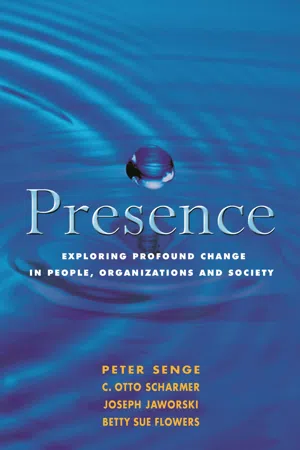
Presence: Exploring Profound Change in People, Organisations and Society gives the reader an intimate look at the development of a new theory about change and learning. In wide-ranging conversations held over a year and a half, Senge, Scharmer, Jaworski and Flowers explore their own experiences and those of one hundred and fifty scientists and social and business entrepreneurs in an effort to explain how profound collective change occurs. Their journey of discovery articulates a new way of seeing the world, and of understanding our part in creating it - as it is and as it might be. Radical and hopeful - Presence synthesises leading-edge thinking, first-hand knowledge and ancient wisdom to explore the living fields that connect us to one another, to life more broadly, and, potentially, to what is 'seeking to emerge'. Seven capacities underlie out ability to see, sense, and realise new possibilities. Developing these capacities accesses a deeper level of learning that is the key to creating change that serves the whole - ourselves, our organisations, and the communities of which we are a part.
eBook - ePub
Presence
Exploring Profound Change in People, Organizations and Society
- 304 pages
- English
- ePUB (mobile friendly)
- Available on iOS & Android
eBook - ePub
Presence
Exploring Profound Change in People, Organizations and Society
About this book
Information
1. The Requiem Scenario
November 2000
The four of us were sitting in a circle in the study of Otto’s home on Maple Avenue in Cambridge, Massachusetts. Outside, a light snow was falling. Inside, under the windows, Otto had placed bright red poinsettias. The walls were covered with charts, several with a large U drawn on them. Books were neatly stacked everywhere, and in one corner a computer hummed quietly.

“When Otto said that Jurassic Park was written in this house, I couldn’t help thinking how ironic it was, given our conversations,” said Betty Sue. “Now here we are sitting in the ‘house of the dinosaurs’ talking about a real-life nightmare scenario: the destruction of our environment; the growing social divide between rich and poor; the potential dangers of things like biotechnology; and escalating violence around the world.”
“Isn’t it ironic the way people talk about dinosaurs?” Peter said. “Today we say an organization is ‘just like a dinosaur’ when we mean it’s slow and can’t adjust to change. But you know, the dinosaurs did manage to survive over a hundred times longer than humans have so far. Whatever beings might take our place here in the future will probably say, ‘Just like the human beings—too bad they didn’t have the adaptive capabilities of dinosaurs!’”
Betty Sue shuddered. “Hearing human beings talked about in the past tense like that is terribly chilling. I guess we all know that since we have the means to destroy ourselves, it’s possible that we will. The unthinkable is possible, but it’s still very difficult to consider. The poet Auden said, ‘We must love one another or die.’ No one thinks we’re very close to loving one another just yet, but we also don’t seem willing to consider the consequences of not doing so.”
“And that’s why we don’t change,” Peter replied. “I was speaking at a conference on business and the environment last week, and stayed at a conference center that I first visited twenty years ago. This center hosts a conference every year at which a prestigious environmental sustainability award is given, so you would expect it to be a showcase for environmentally sound practices, but I’m sure this place generates more waste per customer than they did twenty years ago.
“Everything is individually wrapped—coffee, sugar, shampoo—and each container will be thrown away. The materials used in the room were no more environmentally sound then they had been twenty years ago—the wood hadn’t been sustainably harvested, the plastics and materials couldn’t be recycled, and the appliances couldn’t be remanufactured. I had asked for a room where I could open the windows. They didn’t have any because they relied on central air-conditioning and heating. The electricity that drove the air conditioning undoubtedly came mostly from power plants that burned coal and other fossil fuels—heating up the earth in order to cool off our rooms. Then I saw this silly little bar of soap, individually wrapped. Somehow it epitomized the whole situation.
“Those soaps end up being ninety percent wasted—waste that is completely unnecessary. They could easily be replaced by liquid soap dispensers that create almost no waste. There are even biodegradable liquid soaps now. One is manufactured by a supplier in Sweden, partly owned by Scandic, which has gone from a mediocre, financially strapped business to one of Sweden’s most financially successful hotel chains, in part through its commitment to ‘the sustainable hotel room.’ There’s no reason being environmentally smart can’t be good for business as well—at least in Sweden.
“So I stood there looking at this little bar of soap, listening to my air conditioner whir in the background, feeling angrier and angrier, and wondered why this American conference center still hadn’t learned in twenty years what the Swedish hotel chain had learned in a few years. Why were we even still bothering to hold conferences about environmental business practices? Do we Americans care at all about the effects we’re having on the natural environment that all life must share? Then I saw the only artifact of environmental consciousness in the whole room—a little card that said, ‘In order to help the environment, we won’t do your linens if you don’t ask us to.’ Give me a break! After twenty years, all we’ve accomplished is they won’t wash our linens if we don’t ask them to!”
“We’ve all known the frustration and discouragement you were feeling,” said Betty Sue. “At least I have. But are you saying that we avoid these issues to avoid the discouragement?”
“Not quite.” Peter paused and continued quietly, “I had a difficult meditation this morning. It was very disturbing, as sometimes they are. I seemed to be in touch with an extraordinary fear—just the fear by itself, no thoughts or associations.
“This fear is probably present more than I’m willing to see, except when it suddenly pokes through like it did this morning. The anger I felt at the hotel came from this deeper fear. I’ve known about the threats to the environment for so long—but the changes we’ve made are so small, given what’s needed and what we’re capable of achieving.
“If the future is going to be different, we have to go far beyond these little piecemeal gestures and begin to see the systems in which we’re embedded—and I guess I have doubts if we’re up for this. The question isn’t, ‘Do you want your bed linens changed?’ It’s more like, ‘Do you want to change the way you live?’ But this question sits on top of an immense fear, and I think that, Betty Sue, is one reason we prefer not to think, or talk, about these things.”
Joseph leaned forward. “But isn’t that why we’re here? Haven’t we come together to answer one fundamental question: Why don’t we change? What would it take to shift the whole?”
“We don’t change because we think we’re immortal.” Otto’s tone was matter-of-fact. “Like teenagers, we might be afraid, but we still think we’ll go on forever.”
“Perhaps that’s true,” said Joseph, shaking his head. “I recently read an article that’s been circulating in the foundation community written by a man named Jack Miles, a senior adviser to the J. Paul Getty Trust, called ‘Global Requiem.’1 It’s a speculation about what would happen if we started to realize that humankind might not overcome these problems, that we might not develop a sustainable society—that the human race might perish. It’s an exploration of the unthinkable.”
“But don’t scenarios like that evoke the very fear Peter is talking about?” Otto asked. “As he showed, this sort of fear is usually met by denial or simply makes us feel hopeless.”
“But that doesn’t have to happen,” Joseph replied. “I’ve seen many instances where imagining alternative futures, even negative futures, can actually open people up.”
“Scenarios can alter people’s awareness,” Betty Sue agreed. “If they’re used artfully, people actually begin to think about a future that they’ve ignored or denied. The key is to see the different future not as inevitable, but as one of several genuine possibilities.
“Maybe if people really believed we could be headed for extinction, we would do collectively what many people do individually when they know they may actually die—we would suddenly see our lives very clearly.”
“If we could actually face our collective mortality—and simply tell the truth about the fear, rather than avoiding it—perhaps something would shift,” said Peter.
“Several years ago in one of our leadership workshops, a Jamaican man from the World Bank named Fred told a story that moved people very deeply. A few years earlier he had been diagnosed with a terminal disease. After consulting a number of doctors, who all confirmed the diagnosis, he went through what everyone does in that situation. For weeks he denied it. But gradually, with the help of friends, he came to grips with the fact that he was only going to live a few more months. ‘Then something amazing happened,’ he said. ‘I simply stopped doing everything that wasn’t essential, that didn’t matter. I started working on projects with kids that I’d always wanted to do. I stopped arguing with my mother. When someone cut me off in traffic or something happened that would have upset me in the past, I didn’t get upset. I just didn’t have the time to waste on any of that.’
“Near the end of this period, Fred began a wonderful new relationship with a woman who thought that he should get more opinions about his condition. He consulted some doctors in the States and soon after got a phone call saying, ‘We have a different diagnosis.’ The doctor told him he had a rare form of a very curable disease. And then came the part of the story I’ll never forget. Fred said, ‘When I heard this over the telephone, I cried like a baby—because I was afraid my life would go back to the way it used to be.’
“It took a scenario that he was going to die for Fred to wake up. It took that kind of shock for his life to be transformed. Maybe that’s what needs to happen for all of us, for everyone who lives on Earth. That could be what a requiem scenario offers us.”
There was silence for a moment.
“You know,” said Joseph quietly, “When all is said and done, the only change that will make a difference is the transformation of the human heart.”
2. Seeing Our Seeing
In the movie The Truman Show, actor Jim Carey plays a man whose entire life is a television show, broadcast to millions, unknown to Truman himself. From his point of view, he is just living his life. In the middle of the movie, a group of reporters interview “the director,” the Godlike figure played by Ed Harris who literally determines Truman’s life—whether it’s going to rain or be sunny, the plot for the next week’s story, whether or not things will turn out OK for Truman. One interviewer asks the director, “How do you explain that Truman has never figured out that his whole life is just a television show?” The director responds, “We all accept reality as it is presented to us.”
Like Truman, our awareness presents itself to us as immediate and unmistakable. A table. A book. A sentence or word. Yet there is always much more than we “see.”1 In the table are also a factory and workers, a tree, a forest, water and soil, and rain clouds. Indeed, a book contains all of these as well. And a simple word or sentence that moves us speaks of a lifetime—of schools and teachers, of questions and dreams, of current problems and possibilities. With just the slightest pause, we can begin to appreciate the symphony of activities and experiences, past and present, that come together in each simple moment of awareness. Yet out of the symphony we typically hear only one or two notes. And these, almost always, are the ones most familiar to us.
The problems that arise from taking our everyday awareness as “given” are anything but “merely philosophical,” especially when our world is changing.
In the early 1980s, executives from U.S. auto companies started making regular trips to Japan to find out why the Japanese automakers were outperforming their U.S. counterparts. Speaking with one Detroit executive after such a visit, Peter could see that the executive hadn’t been impressed by the competition. “They didn’t show us real plants,” the Detroit executive said.
“Why do you say that?” Peter asked.
“Because there were no inventories. I’ve seen plenty of assembly facilities in my life, and these were not real plants. They’d been staged for our tour.”
Within a few years, it became painfully obvious how wrong this assessment was. These managers had been exposed to a radically different type of “just-in-time” production system, and they were not prepared to see what they were being exposed to. They were unprepared for an assembly facility that didn’t have huge piles of inventory.2 What they saw was bounded by what they already knew. They hadn’t developed the capacity for seeing with fresh eyes.
With hindsight, it’s easy to dismiss the “seeing” problem of the Detroit executives as idiosyncratic. But this problem is universal. Most change initiatives that end up going nowhere don’t fail because they lack grand visions and noble intentions. They fail because people can’t see the reality they face. Likewise, studies of corporate mortality show that most Fortune 500 companies fail to outlast a few generations of management not because of resource constraints but because they are unable to “see” the threats they face and the imperative to change. “The signals of threat are always abundant and recognized by many,” says Arie de Geus. “Yet somehow they fail to penetrate the corporate immune system response to reject the unfamiliar.”
The Capacity to Suspend
Seeing freshly starts with stopping our habitual ways of thinking and perceiving. According to cognitive scientist Francisco Varela, developing the capacity for this sort of stopping involves “suspension, removing ourselves from the habitual stream [of thought].” Varela called suspension the first basic “gesture” in enhancing awareness. As the noted physicist David Bohm used to say, “Normally, our thoughts have us rather than we having them.”3 Suspending does not require destroying our existing mental models of reality—which would be impossible even if we tried—or ignoring them. Rather, it entails what Bohm called “hanging our assumptions in front of us.”4 By doing so, we begin to notice our thoughts and mental models as the workings of our own mind. And as we become aware of our thoughts, they begin to have less influence on what we see. Suspension allows us to “see our seeing.”
Sometimes it’s easier for people to understand suspension physically than conceptually. A very simple physical practice to appreciate suspension starts with sitting on a chair and grabbing its sides. Now hold the sides of the chair more tightly. You might even imagine that there is no gravity and that if you let go, you would float right up out of the chair. Notice how your body feels as you hold tightly to the chair: the tension in your arms, your shoulders and back, stomach and neck. Now release your hold on the chair. Feel all these muscles relax. Often we hold on to our thoughts in much the same way. Suspension starts when we release the hold and simply notice our current thoughts, like noticing the chair you are sitting on. The thoughts may not go away immediately, but we no longer have as much energy tied up in holding on to them.
When we begin to develop a capacity for suspension, we almost immediately encounter the “fear, judgment, and chattering of the mind” that Michael Ray calls the “Voice of Judgment.” Ray, creator of highly popular Stanford Business School courses on creativity,5 starts with three assumptions: (1) that creativity “is essential for health, happiness, and success in all areas of life, including business”; (2) that “creativity is within everyone”; and (3) that even though it’s within everyone, it’s “covered over by the Voice of Judgement.”6
When Otto and Joseph interviewed him, Ray recalled a study by Howard Gardner’s Project Zero at Harvard that involved developing intelligence tests for babies. The project also tested older subjects. The researchers found that up to age four, almost all the children were at the genius level, in terms of the multiple frames of intelligence that Gardner talks about—spatial, kinesthetic, musical, interpersonal, mathematical, intrapersonal, and linguistic. But by age twenty, the percentage of children at genius level was down to 10 percent, and over twenty, the genius level proportion of the subjects sank to 2 percent.7
“Everyone asks, ‘Where did it go?’ It didn’t go anywhere; it’s covered over by the Voice of Judgment,” said Ray. “What we’re trying to do is set up situations where people can attack the Voice of Judgment and access their deeper creativity.” Ray believes that we can consistently bring our creativity into our lives by “paying attention to it” and by building the capacity to suspend the judgments that arise in our mind (“That’s a stupid idea,” “You can’t do that”) that limit creativity.
In practice, suspension requires patience and a willingness not to impose preestablished frameworks or mental models on what we are seeing. If we can simply observe without forming conclusions as to what our observations mean and allow ourselves to sit with all the seemingly unrelated bits and pieces of information we see, fresh ways to understand a situation can eventually emerge. For example, when the economist Brian Arthur and his colleague, the sociologist Geoffrey McNicoll, were working in Bangladesh in the 1970s, they spent months observing, gathering information, and “doing nothing.” This was at a time when it was common for Western economists and institutions such as the World Bank to analyze needs of developing countries such as Bangladesh by simply applying traditional economic models without really questioning them. Eventually, Arthur and McNicoll developed a fresh understanding of how “the goals and structure of the whole” functioned, according to Arthur. They showed how conditions such as landlessness and large families were self-reinforcing over time and how standard “Band-Aid” fixes prescribed by international aid institutions only served to “prop up the status quo.” What they saw was new, and the paper they wrote helped shift the focus of these institutions toward addressing fundamental socioeconomic conditions rather than just standard economic indicators of development.8
Suspending Together
The Voice of Judgment can stifle creativity for groups as surely as for individuals. It is what we typically call “groupthink,” the continual, albeit often subtle, censoring of honesty and authenticity in a team. This collective Voice of Judgment...
Table of contents
- Cover Page
- Title Page
- Copyright Page
- Dedication
- Contents
- Introduction
- Part 1 Learning to See
- Part 2 Into the Silence
- Part 3 Becoming a Force of Nature
- Part 4 Meeting Our Future
- Epilogue: “With Man Gone, Will There Be Hope For Gorilla?”
- Notes
- Acknowledgments
- About the Authors
- About the Organizations
- Index
- Reader Comments
Trusted by 375,005 students
Access to over 1.5 million titles for a fair monthly price.
Study more efficiently using our study tools.
Frequently asked questions
Yes, you can cancel anytime from the Subscription tab in your account settings on the Perlego website. Your subscription will stay active until the end of your current billing period. Learn how to cancel your subscription
No, books cannot be downloaded as external files, such as PDFs, for use outside of Perlego. However, you can download books within the Perlego app for offline reading on mobile or tablet. Learn how to download books offline
Perlego offers two plans: Essential and Complete
- Essential is ideal for learners and professionals who enjoy exploring a wide range of subjects. Access the Essential Library with 800,000+ trusted titles and best-sellers across business, personal growth, and the humanities. Includes unlimited reading time and Standard Read Aloud voice.
- Complete: Perfect for advanced learners and researchers needing full, unrestricted access. Unlock 1.5M+ books across hundreds of subjects, including academic and specialized titles. The Complete Plan also includes advanced features like Premium Read Aloud and Research Assistant.
We are an online textbook subscription service, where you can get access to an entire online library for less than the price of a single book per month. With over 1.5 million books across 990+ topics, we’ve got you covered! Learn about our mission
Look out for the read-aloud symbol on your next book to see if you can listen to it. The read-aloud tool reads text aloud for you, highlighting the text as it is being read. You can pause it, speed it up and slow it down. Learn more about Read Aloud
Yes! You can use the Perlego app on both iOS and Android devices to read anytime, anywhere — even offline. Perfect for commutes or when you’re on the go.
Please note we cannot support devices running on iOS 13 and Android 7 or earlier. Learn more about using the app
Please note we cannot support devices running on iOS 13 and Android 7 or earlier. Learn more about using the app
Yes, you can access Presence by Betty Sue Flowers,C. Otto Scharmer,Joseph Jaworski,Peter M. Senge in PDF and/or ePUB format, as well as other popular books in Business & Organisational Behaviour. We have over 1.5 million books available in our catalogue for you to explore.