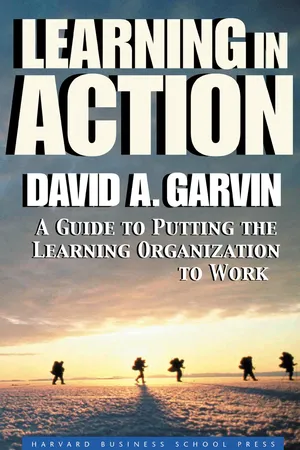
Most managers today understand the value of building a learning organization. Their goal is to leverage knowledge and make it a key corporate asset, yet they remain uncertain about how best to get started. What they lack are guidelines and tools that transform abstract theory—the learning organization as an ideal—into hands-on implementation. For the first time in Learning in Action, David Garvin helps managers make the leap from theory to proven practice. Garvin argues that at the heart of organizational learning lies a set of processes that can be designed, deployed, and led. He starts by describing the basic steps in every learning process—acquiring, interpreting, and applying knowledge—then examines the critical challenges facing managers at each of these stages and the various ways the challenges can be met. Drawing on decades of scholarship and a wealth of examples from a wide range of fields, Garvin next introduces three modes of learning—intelligence gathering, experience, and experimentation—and shows how each mode is most effectively deployed. These approaches are brought to life in complete, richly detailed case studies of learning in action at organizations such as Xerox, L. L. Bean, the U. S. Army, and GE. The book concludes with a discussion of the leadership role that senior executives must play to make learning a day-to-day reality in their organizations.
- 272 pages
- English
- ePUB (mobile friendly)
- Available on iOS & Android
eBook - ePub
About this book
Information
I
FOUNDATIONS
1
From Individual to Organizational Learning
Learning is the most natural of activities. It is an essential part of the human experience, and something that we as individuals do throughout our lives. Yet more often than not, our progress as learners goes unrecognized or unheeded. It happens as if by magic: one day we are ignorant, then time passes and suddenly we possess a wealth of new knowledge.
Children provide the most obvious example, for they are instinctive, intuitive learners. Much of childhood is spent expanding one’s horizons and acquiring new perspectives, abilities, and skills. But the work of development does not end in childhood. Countless studies have shown that individuals continue to adapt and grow as they age.1 Self-directed learning projects, for example, are quite common. According to pioneering research conducted in the early 1970s, the average adult engages in approximately eight learning projects per year, and roughly 90 percent of adults can cite at least one such project that they pursued in the previous year.2 Typically, adults devote one hundred hours annually to each learning project, even though fewer than 1 percent are undertaken for credit. Moreover, these projects are extremely diverse, ranging from general occupational skills, such as accounting, shorthand, and tool design, to specific job knowledge, such as advertising strategy and the needs of disadvantaged adolescents, to personal interests and home-related responsibilities, such as cooking skills, child and baby care, and playing a musical instrument. Most projects are motivated by a major life transition either at home or on the job, are problem-focused, and are intimately linked to a desire for self-renewal and personal growth.
Today, corporations face similar needs. They too are in the midst of massive transformations requiring renewal and growth; for this reason, many have jumped on the learning bandwagon. The most obvious manifestation of their commitment is company-sponsored education and training. In the U.S. alone, spending on corporate education has grown at 5 percent a year for the past decade; it now totals nearly $60 billion annually.3 A number of leading companies, including Motorola, General Electric, and McDonald’s, have established their own corporate “universities,” offering a wide range of technical, business, and remedial courses. Others, such as Intel and Andersen Consulting, now spend as much as 6 percent of payroll on education and training, while requiring two weeks of class time per year for all employees.4
Yet even with these commitments, most managers remain surprisingly ambivalent about learning. Many give lip service to its importance, voicing strong public support for efforts to broaden employees’ knowledge and skills. But when pressed, they usually express very different feelings. For all too many managers, learning is of questionable value because it diverts employees’ attention from “real work.”
Executives are action-oriented, and their goal is to get things done. Any activity that does not produce immediate, tangible results is therefore viewed with a certain degree of suspicion. Programs to stimulate learning frequently fall into this category, especially if they require time for reflection, synthesis, and review. The result is a clash of values, as a leading proponent of learning has observed:
The most difficult challenge is developing a culture that values … learning. A colleague once … told me of a dialogue with a loading dock foreman who, in great frustration, finally said to him, “Look, I can either ship product or talk about it. Which do you want me to do?” The correct answer can only be “Both,” but it is hard to make that answer a reality.5
The implicit analogy is to academic scholarship, with its overtones of bookishness, ivory-tower impracticality, and leisurely reflection. Professors are devoted to the life of the mind; they have chosen lives that give them ample opportunity to hone their arguments to a razor’s edge. Managers see themselves at the opposite end of the spectrum: doers rather than thinkers, pressured for time and thus willing to rely on workable rather than ideal solutions. This view is well represented by a story that Charles Handy, the British futurist, tells about a presentation he made sketching out the organization of the future, which stressed the importance of intelligence, information, and ideas. “Increasingly,” he said to a group of chief executives, “your corporations will come to resemble universities or colleges.” “Then God help us all,” one of them replied.6
In the same spirit, learning is seen by many managers as a New Age phenomenon, whose goal is releasing human potential rather than improving the bottom line. Here, scholars are partly to blame, for their discussions of learning organizations have often been reverential and utopian. Peter Senge, who popularized learning organizations in his book The Fifth Discipline, describes them as places “where people continually expand their capacity to create the results they truly desire, where new and expansive patterns of thinking are nurtured, where collective aspiration is set free, and where people are continually learning how to learn together.”7 Ikujiro Nonaka, a Japanese scholar, uses similar language, characterizing knowledge-creating companies as places where “inventing new knowledge is not a specialized activity … it is a way of behaving, indeed, a way of being, in which everyone is a knowledge worker.”8 These descriptions, while uplifting, lack a framework for action, and thus provide little comfort to practical-minded managers.
An additional source of unease comes from managers’ quest for stability and predictability. At most companies, efficiency is a hallowed goal, best served by well-established routines. Yet learning demands constant questioning and repeated reevaluations of established practice. Skepticism and open-mindedness are essential. But because many managers “cannot bear to have their cherished beliefs challenged … on a continuing basis … evaluation and organization … are to some extent contradictory terms.”9
For all these reasons, learning has yet to establish a secure beachhead at many corporations. It occurs, of course, but more often through benign neglect than active support. All too many managers continue to regard time spent learning as a necessary but unproductive evil. Such views are unfortunate because they reflect an extraordinarily narrow conception of the potential impact of learning. Nor do they recognize the many guises in which new knowledge appears. Far from being academic, philosophical, and inefficient, corporate learning is much more likely to be practical, applied, and intimately linked to the bottom line.
LEARNING IN ACTION
Consider the following examples:
- Thirty continuous casters, all designed by the same supplier but installed at different steel makers, took widely varying times to reach anticipated production levels. Start-up periods—the elapsed time from the first pouring of steel through a caster until the unit was producing at full capacity—varied from 7.5 months to over 6 years. The median start-up took 24 months. A rough calculation suggested that the lost contribution from these delays totaled $137 million, primarily because of slow and inadequate learning.10
- In industries as varied as banking, computers, health care, and oil, the typical intrafirm transfer of a best practice—from first identification of the practice to successful performance at the receiving unit—took nearly three years. The primary barriers were not motivational (a bias against ideas “not-invented here”) but knowledge-related: limited understanding of the elements of successful practice and difficulty in absorbing new knowledge and insights.11 The associated costs were significant. A study of intrafirm transfers of manufacturing technology found that over 50 percent experienced severe productivity problems. The initial productivity loss at the receiving plants averaged 34 percent, with a low of 4 percent and a high of 150 percent. The time to recover the lost productivity ranged from 1 to 13 months; at 20 percent of the facilities, the original levels were never regained.12
- When radical or disruptive technologies are involved, conventional marketing research is of little help. This is especially true if current customers are the primary sources of information. The disk-drive industry provides a telling example. As the industry shifted from 14-inch to 8-inch to 5.25-inch to 3.5-inch drives, virtually all of the leading firms were displaced. Each time, they failed to shift to the next-generation technology, largely because their current customers were expressing satisfaction with existing products while demand was coming from newer organizations that they were neither serving nor surveying. The failure was one of learning, not technological prowess.13 Much the same displacement occurred in the semiconductor industry as it shifted from vacuum tubes to semiconductors to microprocessors.14
- In late 1994 Intel discovered a flaw in its Pentium processor. The problem, due to a design error in the chip, caused a rounding error in division once every nine billion calculations. The company knew of the problem early, considered it to be minor, and developed a policy of reassurance and occasional replacement. But it vastly underestimated the ensuing public reaction. Once the problem was publicized, the press was highly critical, as were customers and industry experts. After several months of analysis, reflection, and review—in other words, intensive learning—Intel announced a completely new policy: it would replace the offending part for anyone who wanted it changed. The cost? A $475 million write-off.15
At first glance, these examples involve seemingly unrelated challenges: installing new equipment, transferring best practices, responding to technological changes, and interpreting customer feedback. But at a deeper level, they are remarkably similar. Each illustrates the difficulties of effective implementation and, by implication, the power and potential of improved organizational learning.
There are several common denominators. First, in each of these cases success requires additional knowledge. Whether the task is operating an unfamiliar piece of equipment or understanding an emerging market, learning is essential to achieving desired results. Sometimes the knowledge is new and has to be created from scratch; at other times it already exists and has to be transferred elsewhere in the organization. Either way, the required insights are practical, applied, and focused on the task at hand. Learning is not desired for learning’s sake, or for abstract, academic purposes. It is needed to get the job done.
Second, in each case improved learning has direct links to the bottom line. Both costs and revenues are affected. On the cost side, smoother transfers of best practices yield impressive gains in productivity. A sense for the size of the payoffs can be obtained by comparing the best and worst transferrers of manufacturing technology, whose productivity losses differed by a factor of 40. On the revenue side, better processing of customer and market information would undoubtedly improve the odds of succeeding with next-generation products, leading to more accurate market positioning and increased sales. The continuous caster example shows that where capacity is a constraint, more rapid ramp-ups to full production yield large increases in sales and contribution. Again, a sense for the payoffs can be gained by comparing the best and worst performers; their startup periods differed by a factor of 10.
Third and perhaps most important, managers seldom use the term learning when describing these situations. Typically, they reserve it for other purposes, primarily discussions of education and training programs or workshops where knowledge sharing is the stated goal. When learning is embedded in real work, managers normally use other language; frequently, they overlook learning’s role completely. Yet situations like these—where learning is essential for completing a task, yet is neither recognized nor publicly acknowledged—are extraordinarily common. Entrepreneurship, for example, invariably involves new skills and behaviors, as do most business development projects. Effective mergers and acquisitions demand learning on both sides of the table. The same is true of most cost-reduction and quality-improvement programs, where process and operating knowledge must be deepened and expanded.
Because these situations arise so frequently, all organizations learn at some point in their lives. A few learn repeatedly but largely by happenstance. Long-successful companies, however, such as IBM and Johnson & Johnson, are invariably committed, conscientious learners.16 In fact, it is almost a truism to say that such organizations learn, for they have prospered for decades while facing diverse and varied conditions. Revolutionary technologies, shifting markets, and unanticipated competitors have all required innovative responses. How else would these companies have survived if they were not continually learning something new?
One implication of this argument is that we need to view organizational effectiveness through a different lens. Corporate success is best judged by adaptability and flexibility, not the usual short-term measures of profitability and productivity. The latter present mere snapshots in time; a more appropriate metric would take into account long-term survival and growth:
If we view organizations as adaptive, problem-solving, organic structures, then inferences about effectiveness have to be made, not from static measures of output, but on the basis of the processes through which the organization approaches problems… . The measure of health is flexibility, the freedom to learn through experience, the freedom to change with changing internal and external circumstances… .17
Examples include Microsoft’s 1995 shift from operating systems and applications software to Internet offerings, which required a wholly new strategy as well as the broadening of programming and software skills, and 3M’s continued outpouring of new products, often far removed from its base in adhesives and abrasives. Such adaptability is common in learning organizations.
LEARNING ORGANIZATIONS
Surprisingly, a clear definition of learning organizations has proved to be elusive over the years. Organizational theorists have studied learning for a long time, but as the quotations in Table 1–1 suggest, there is still considerable disagreement.18 Most scholars agree that learning is a process that unfolds over time and link it with knowledge acquisition, deeper understanding, and improved performance. But they differ on ...
Table of contents
- Cover Page
- Title Page
- Copyright Page
- Dedication Page
- Contents
- Preface
- Acknowledgments
- Part I. Foundations
- Part II. Types of Learning
- Part III. The Leadership Challenge
- Notes
- About the Author
Trusted by 375,005 students
Access to over 1.5 million titles for a fair monthly price.
Study more efficiently using our study tools.
Frequently asked questions
Yes, you can cancel anytime from the Subscription tab in your account settings on the Perlego website. Your subscription will stay active until the end of your current billing period. Learn how to cancel your subscription
No, books cannot be downloaded as external files, such as PDFs, for use outside of Perlego. However, you can download books within the Perlego app for offline reading on mobile or tablet. Learn how to download books offline
Perlego offers two plans: Essential and Complete
- Essential is ideal for learners and professionals who enjoy exploring a wide range of subjects. Access the Essential Library with 800,000+ trusted titles and best-sellers across business, personal growth, and the humanities. Includes unlimited reading time and Standard Read Aloud voice.
- Complete: Perfect for advanced learners and researchers needing full, unrestricted access. Unlock 1.5M+ books across hundreds of subjects, including academic and specialized titles. The Complete Plan also includes advanced features like Premium Read Aloud and Research Assistant.
We are an online textbook subscription service, where you can get access to an entire online library for less than the price of a single book per month. With over 1.5 million books across 990+ topics, we’ve got you covered! Learn about our mission
Look out for the read-aloud symbol on your next book to see if you can listen to it. The read-aloud tool reads text aloud for you, highlighting the text as it is being read. You can pause it, speed it up and slow it down. Learn more about Read Aloud
Yes! You can use the Perlego app on both iOS and Android devices to read anytime, anywhere — even offline. Perfect for commutes or when you’re on the go.
Please note we cannot support devices running on iOS 13 and Android 7 or earlier. Learn more about using the app
Please note we cannot support devices running on iOS 13 and Android 7 or earlier. Learn more about using the app
Yes, you can access Learning in Action by David A. Garvin in PDF and/or ePUB format, as well as other popular books in Business & Human Resource Management. We have over 1.5 million books available in our catalogue for you to explore.