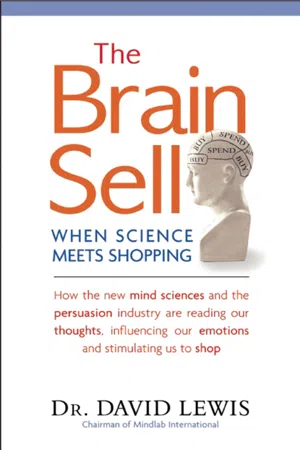
Science has made the leap from the lab to come to a store near you and the effects on us are phenomenal. Corporations in hyper-competition are now using the new mind sciences to analyze how and when we shop, and the hidden triggers that persuade us to consume. From bargains in the Big Apple to the bustling bazaars of Istanbul, from in-store to interactive and online to mobile, neuromarketing pioneer Dr. David Lewis goes behind the scenes of the persuasion industry to reveal the powerful tools and techniques, technologies and psychologies seeking to stimulate us all to buy more often without us consciously realizing it.
- 304 pages
- English
- ePUB (mobile friendly)
- Available on iOS & Android
eBook - ePub
About this book
Information
1
When Science Met Selling
More thought, more effort, and more money go to advertising now than have gone into any other campaign to change the social consciousness.
—Jean Kilbourne (2005)1
Advertising is an ancient art. Merchants in the early city-states would verbally extol the virtues of their wares to passers-by, or employ street criers, “chosen for their mellifluous voices and clear elocution,”2 to sing their products’ praises in the streets. There are obvious reasons for the development of advertising—as digital marketing specialists Damian Ryan and Calvin Jones put it in the modern age:
There are few certainties in the world of business, but one thing’s for sure: if you don’t let your customers know about your business, you won’t stay in business for very long.3
And for tens of thousands of years, the purpose of advertising was solely promotion—to “keep the client’s name in front of the people,” in the words of Albert Lasker, about whom more shortly. Success in advertising, so its practitioners firmly believed, merely required creativity, common sense, and practical experience. They saw themselves as artists who neither needed nor wanted any help from science. However, as the twentieth century dawned, all of this began to change.
From promotion to persuasion:
The rise of the subconscious mind
Early in 1901, the organizing committee of Chicago’s prestigious Agate Club invited 32-year-old Dr. Walter Dill Scott to give them an after-lunch talk. Scott, an Assistant Professor of Psychology at Northwestern University, chose as his topic “The role of psychology in advertising.” After all had enjoyed an excellent lunch and fine wine in the club’s elegant, wood-paneled dining room, the president called for silence and introduced the speaker. The audience, including many of the city’s most successful advertising executives, settled back in their leather-upholstered seats.
What Scott told them was to spark a growing preoccupation with the consumer’s subconscious mind. He explained:
Advertisements are sometimes spoken of as the nervous system of the business world. As our nervous system is constructed to give us all the possible sensations from objects, so the advertisement which is comparable to the nervous system must awaken in the reader as many different kinds of images as the object itself can excite.
He went on to describe how, as advertisers, their efforts were directed toward producing “certain effects on the minds of possible customers. Psychology is, broadly speaking, the science of the mind. Art is the doing and science is the understanding how to do, or the explanation of what has been done. If we are able to find and to express the psychological laws upon which the art of advertising is based, we shall have made a distinct advance, for we shall have added the science to the art of advertising.”4
Scott’s talk and a subsequent bestselling book, The Psychology of Advertising, had a profound effect on the way advertisers saw their craft and on the importance they attached to science, especially to psychology. And there was more to come.
“I can tell you what advertising is!”
Three years after Scott’s address to the Agate Club, John E. Kennedy, a former Royal Canadian Mounted Policeman, created a second revolution in the advertising world. And he did so with just three words. On a mild spring afternoon in 1904, Albert Lasker, one of advertising’s great pioneers, was working in his office when a messenger boy arrived with a scrawled note from a stranger who had walked unannounced into reception. “I am downstairs,” the note read, “and I can tell you what advertising is. I know that you don’t know. It will mean much to me to have you know what it is and it will mean much to you. If you wish to know what advertising is, send the word ‘yes’ down by messenger.”
Lasker hesitated. A shrewd businessman, who would go on to accumulate a personal fortune in excess of $52 million, he would have been used to being pestered by cranks and charlatans. Nevertheless, the message so intrigued him that he instructed the boy to show the man up. Their meeting, which lasted well into the night, ended with Lasker hiring Kennedy for the then enormous salary of $28,000 a year. Within two years, Kennedy, who had been scraping a living writing advertising copy for Dr. Shoop’s Restorative, was earning $75,000 a year—and advertising had a new understanding of its function.
What so impressed Lasker, and would come to revolutionize the approach of the whole industry, was Kennedy’s three-word description of advertising: “Salesmanship in print.” John O’Toole, a later chairman of Lasker’s advertising agency, commented:
It seems so simple and obvious today. But what this definition did in 1904 was to change the course of advertising completely and make possible the enormous role it now plays in our economy. By equating the function of an advertisement with the function of a salesman who calls on the prospect personally, it revealed the true nature of advertising. For the first time, the concept of persuasion, which is a prime role of a salesman, was applied to the creation of advertising.5
Two years later, in 1906, Chicago advertising executive John Lee Mahin noted the increasing importance that advertisers were placing on psychology. In his privately published Lectures on Advertising, he explained:
Advertising is making others think what you desire. It means utilising all those forces which produce impressions and crystallise opinions… The great power of advertisements is of getting into people’s minds the ideas that they carry in such a way that people think they always had them… The consumer nearly always purchases in unconscious obedience to what he or she believes to be the dictates of an authority which is anxiously consulted and respected.6
Having woken up to the fact that they were in the business of persuasion as much as promotion, advertising executives began actively to seek out psychologists, whose training, skills, and experience they now considered essential to understanding the consumer’s subconscious mind.
Enter the Freudians
By the end of the First World War, an industry that had previously relied mostly on the creativity of copywriters and the imagination of artists was being increasingly influenced by the views of, in the main, psychoanalytically trained psychologists. These experts, a majority of whom were followers of Freud, emphasized the crucial part played by emotions in appealing to the consumer. Desperate to discover new ways of influencing the public mind, many advertising executives sought guidance from Dr. Ernest Dichter.
A sprightly, jovial, balding man who wore a bow tie and horn-rimmed glasses, Dichter liked to describe himself as “Mr. Mass Motivations Himself.” On a hilltop overlooking the Hudson River, he set up the Institute for Research in Mass Motivation. Its well-equipped headquarters contained rooms for focus groups and others in which children watched television while being covertly observed from behind two-way mirrors, concealed tape recorders picking up their comments. Dichter also recruited a “psycho-panel” comprising hundreds of families whose emotional makeup had already been psychoanalyzed.
He informed his clients that by employing the methods advocated by Sigmund Freud, he would be able to provide them not only with a deep understanding of the consumer’s wants and desires, but also with techniques for “controlling their behavior.” Advertising agencies were, he claimed:
One of the most advanced laboratories in psychology… possessing the ability to manipulate human motivations and desires and develop a need for goods with which the public has at one time been unfamiliar—perhaps even undesirous of purchasing.7
One such client was a cigar manufacturer that had spent thousands of dollars on an advertisement that failed. It depicted a smiling woman handing out cigars to her husband and his friends. Although attractively painted and widely displayed, the advertisement actually led to a dramatic fall in cigar sales. Dichter explained that men smoked cigars because doing so, subconsciously, made them feel dominant and important. The cigar, he claimed, was a phallic symbol; by showing a woman encouraging men to smoke, the advertisement was psychologically neutering the company’s male customers. The illustration was promptly altered, the copy rewritten, and sales improved dramatically; although just what these subtle changes actually were is lost to posterity.
As the Second World War ended, the massive manufacturing capacity that America had built up during hostilities was rapidly switched to civilian production. With the resulting vast inventories to sell, advertisers began listening ever more attentively to the psychologists. According to these experts, society was entering the “psycho-economic” age, in which their challenge was not merely to promote mass-produced products but to mass produce consumers.
In his presidential address to the National Council on Family Relations, sociologist Clark Vincent set out this agenda clearly when he explained that the family was no longer merely a production unit, but a “viable consuming unit.”8 Increasingly, advertising executives came to view the general public not as rational, but as driven by emotion and easily manipulated. The more emotional and the less rational consumers were perceived to be, the more advertisers felt justified in indulging in sensationalist or emotional appeals. This view of the buying public was summed up by one senior advertising executive, quoting approvingly the words of a champion hog caller in Kansas:
The words don’t matter, friend, it’s feeling that counts. The great thing is feeling. You got to put passion into it. You got to make that hog believe you got something that hog wants.
By the end of the 1950s, an estimated billion dollars a year was being spent on psychological research. It was these techniques, the desire to manipulate and, as he saw it, socially engineer consumers, that led Vance Packard to write his bestselling book The Hidden Persuaders.
Among the many examples Packard cited was research conducted on behalf of American Airlines to discover why many businessmen were so afraid of flying that they did so only when no alternative form of transport was available. He used a number of projective experiments, such as the Rorschach inkblot test,9 before explaining to his clients that what these men feared was not being killed, but embarrassment and guilt at how their family would receive the news of their death. Using this information, American Airlines developed an advertising campaign directed at housewives. They extolled the advantages of flying away on holiday as a family and of the husband being able to get back home faster if he caught a plane. Airlines also went out of their way to create a “psychologically calm environment” in the cabin.10
However, it wasn’t only advertisers who were attempting to shape public attitudes and opinions. Early in the twentieth century a new profession came into being: the public relations specialist.
Edward Bernays: The King of Spin
In the UK and the US, there are now estimated to be four public relations executives for every journalist. This means that almost every news story you see on television, listen to on the radio, read in print, or peruse on the internet is there only because of public relations, or as some firms now prefer to call it, “corporate communications.” Funded by their clients’ deep pockets, major public relations companies have more money and resources than most media outlets and are in a unique position to bias stories to the favor of their clients. They also have the power to bury bad news and enhance the reputations of even the most disreputable.
Edward Bernays, the “founding father” of public relations, was a hugely influential figure in his day. He was born in Vienna in 1891, his mother Sigmund Freud’s sister and his father Freud’s wife’s brother, making him a double nephew of the founder of psychoanalysis.
During the First World War, Bernays worked for the US Committee on Public Information (CPI), a government-funded propaganda organization whose mission was to advertise and market the “war to end all wars” as the conflict that would “make the world safe for democracy.” After the war, he was instrumental in establishing what his biographer, Stuart Ewen, describes as “a fateful marriage between theories of mass psychology and schemes of corporate and political persuasion.”11
Bernays developed the strategy, still widely used today, of associating unpopular products with popular causes. During the 1920s, for example, he was commissioned by the American Tobacco Company to increase the number of female smokers by encouraging women to light up in public. He realized that the best way to promote this frowned-on action was to link it to the cause of female emancipation. With this in mind, he persuaded women’s rights campaigners to hold up Lucky Strike cigarettes as symbolic “Torches of Freedom” during a protest march down Fifth Avenue in New York. The event made headlines around America and played a significant role in changing public attitudes. Bernays wrote in 1923:
A Public Relations man’s success depends on his ability to create those symbols to which the public is ready to respond… to find those stereotypes, individual and community, which will bring favorable responses… to appeal to the instincts and universal desires is the most basic method through which he produces his results.12
However, even as Packard’s book was flying off the shelves and investment by advertising firms in psychological research had achieved an all-time high, the influence of the Freudians was waning.13 In their place came a new and super-confident group of experts who called themselves “behaviorists.” They dismissed what they considered to be the unscientific hocus-pocus of psychoanalysis and promised to transform psychology into a hard science.
Enter the behaviorists
In 1920, 42-year-old Professor John Broadus Watson was a rising star in the academic world. He had coined the term “behaviorism” in 1912 and the following year had published a widely acclaimed and highly influential paper in the Psychological Review. Here, Watson set out his manifesto for behavioral psychology, a “purely objective experimental branch of natural science” whose goal was “the prediction and control of behavior.”14
The young academic’s glittering career at Johns Hopkins University came to an abrupt end, however, when at the age of 42 he was summarily dismissed after leaving his wife to live with Rosalie Rayner, a considerably younger research student. The scandal left him unemployed and, in those socially conservative times, unemployable in academia. Undeterred, Watson set off for New York in search of new and more lucrative employment. His research had already attracted the attention of a number of senior advertising executives, who saw in behaviorism a powerful tool for influencing the masses. Soon after his arrival in the city, ...
Table of contents
- Cover Page
- Title Page
- Copyright Page
- Contents
- Introduction
- 1 When Science Met Selling
- 2 Hidden Persuaders That Shape the Way We Shop
- 3 “I Know What You’re Thinking!”
- 4 Why Shopping Isn’t “All in the Mind”
- 5 Inside the Buying Brain
- 6 The Persuasive Power of Atmospherics
- 7 Brand Love: The Engineering of Emotions
- 8 The Power of Subliminal Priming and Persuasion
- 9 When Your Television Watches You
- 10 The Marketing Power of Mobile Media
- 11 The Ultimate Brain Sell
- 12 Let the Buyer Be Aware
- Notes
- Bibliography
- Index
- Acknowledgments and Copyright Permissions
Trusted by 375,005 students
Access to over 1.5 million titles for a fair monthly price.
Study more efficiently using our study tools.
Frequently asked questions
Yes, you can cancel anytime from the Subscription tab in your account settings on the Perlego website. Your subscription will stay active until the end of your current billing period. Learn how to cancel your subscription
No, books cannot be downloaded as external files, such as PDFs, for use outside of Perlego. However, you can download books within the Perlego app for offline reading on mobile or tablet. Learn how to download books offline
We are an online textbook subscription service, where you can get access to an entire online library for less than the price of a single book per month. With over 1.5 million books across 990+ topics, we’ve got you covered! Learn about our mission
Look out for the read-aloud symbol on your next book to see if you can listen to it. The read-aloud tool reads text aloud for you, highlighting the text as it is being read. You can pause it, speed it up and slow it down. Learn more about Read Aloud
Yes! You can use the Perlego app on both iOS and Android devices to read anytime, anywhere — even offline. Perfect for commutes or when you’re on the go.
Please note we cannot support devices running on iOS 13 and Android 7 or earlier. Learn more about using the app
Please note we cannot support devices running on iOS 13 and Android 7 or earlier. Learn more about using the app
Yes, you can access The Brain Sell by David Lewis in PDF and/or ePUB format, as well as other popular books in Business & Consumer Behaviour. We have over 1.5 million books available in our catalogue for you to explore.