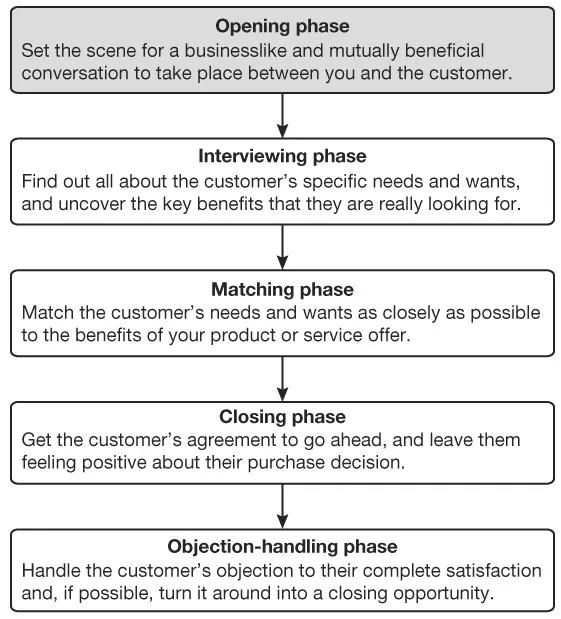
Learn how to hone your selling skills and close more sales with this easy to read guide written by someone with extensive experience of every aspect of selling and marketing in the international arena.Based on the five stage OIMCO selling model it covers: -Opening-phase selling skills, including taking control of your selling space and sizing up the customer - Interviewing-phase selling skills, including asking open-style questions, listening actively and triggering your customer's imagination- Matching-phase selling skills, including applying the SELL formula, translating benefits into real money and mastering the art of storytelling-Closing-phase selling skills, including tuning in to buying signals, manufacturing a close and perfecting the art of silence - Objection-handling-phase selling skills, including conditioning yourself positively to objections, pre-handling predictable objections and playing CATCH with every objection raised All neatly summed up in 52 skill honing sections, with skill-enhancing exercises, to perfectly suit a busy life in sales.
NOT GOT MUCH TIME?One and five-minute introductions to key principles to get you started.
AUTHOR INSIGHTSLots of instant help with common problems and quick tips for success, based on the author's many years of experience.
TEST YOURSELFTests in the book to keep track of your progress.
EXTEND YOUR KNOWLEDGEExtra online articles at www.teachyourself.com to give you a richer understanding.
THINGS TO REMEMBERQuick refreshers to help you remember the key facts.
TRY THISInnovative exercises illustrate what you've learnt and how to use it.
eBook - ePub
Close that Sale!
A guide to top selling techniques, including 52 skill-honing exercises
- 272 pages
- English
- ePUB (mobile friendly)
- Available on iOS & Android
eBook - ePub
Close that Sale!
A guide to top selling techniques, including 52 skill-honing exercises
About this book
Information
1
Opening-phase selling skills
In this chapter you will learn:
- how to set the scene for a businesslike and mutually beneficial conversation to take place between you and the customer
1 Go through a set-up routine
Picture this. You’re fully prepared for an appointment with a prospective customer. You’ve arrived at their offices with five minutes to spare, parked your car and walked into their reception area. The receptionist tells you that they will be with you shortly and invites you to take a seat. Then it happens. Your mind slips out of the present. Perhaps there is a lot happening in your life and there are other things on your mind. Maybe your head is swimming with nervous anticipation or self-doubt. Whatever the reason, the result is that when the time comes to greet the customer your mind is elsewhere and not focused on the task at hand. Sound familiar?
If you’ve ever watched an Olympic gymnast or a professional golfer in action you’ll know exactly what I mean by a ‘set-up routine’ (or a ‘habitual ritual’ as it’s sometimes called). Immediately before the gymnast performs a discipline or the golfer hits a shot he or she performs a little ritual that helps to focus the mind and put them in ‘the zone’ – a place of total concentration and mindfulness in relation to what they are about to do. Of course the routine itself will be different for a salesperson but the principle is the same. Going through a set-up routine in the few moments before meeting a prospective customer is a habit you can acquire to ensure that you’re completely focused on performing to the best of your ability every time.
Here are some examples of the set-up routines often used by top salespeople:
- Read through any notes you have made relating to the customer you’re about to see.
- Access the ‘little voice’ that’s inside your head and use positive self-talk to remind yourself of the value of your offer to the customer.
- Rehearse the exact words you’re going to use when greeting the customer by quietly repeating them several times to yourself.
- Do some slow deep-breathing exercises to centre yourself in the moment and become perfectly calm and collected.
Whenever you have a particularly important sale coming up, I’d recommend a set-up routine called ‘mental movie-making’. It works like this: by drawing on the databanks of your memory you already have the ability to make a ‘mental movie’ of any one of thousands of past experiences, and in such detail that you can quite literally ‘re-live’ that experience inside your head – right? Well, imagine that instead of making a mental movie of the past, you make one of the future – a movie relating to the next sales presentation that you’re about to make. That’s when mental movie-making can really work for you. By projecting an up-coming sales scenario onto the screen of your mind and making a movie of it, you can ‘live out’ the experience just as you want it to happen, thereby effectively conditioning yourself for a successful outcome.
Here’s how to do it. First, visualize yourself, in detail, successfully ‘acting out’ your part as the consummate professional salesperson. Second, add the ‘sound track’, so that inside your head you can hear every single piece of the dialogue between you and your customer, just the way you want it to unfold. Third, add the emotion, so that you can really feel the sense of elation and success you’re going to experience as you visualize the sale moving along towards the customer happily deciding to buy. Fourth, now that you have the finished version of your mental movie (complete with moving pictures, soundtrack and emotion), it’s important that you ‘imprint’ it by playing it over and over in your mind prior to going into your next sale.
Insight
The more you can ‘live out’ a future successful selling experience just as you want it to happen, the more likely it is that it will become your reality.
In developing your set-up routine, do understand that what works for someone else will not necessarily work for you. Everyone must develop their own uniquely personal routine. Use a process of trial and error to find one that just ‘feels right’ and works for you. While a set-up routine is no substitute for proper preparation and pre-call planning, in those few crucial moments before meeting a customer it’s a great way to de-clutter your mind, eliminate negative thinking, banish last-minute nerves and effectively ‘program’ yourself for a successful outcome.
Skill acquisition exercise
Develop a set-up routine that will put you in ‘the zone’ before every sales presentation. Test it, fine-tune it, ritualize it, and turn it into a success habit.
2 Project your professionalism
First impressions are formed in an instant. Yet their effects can last for a lifetime. Even as you walk towards a new customer, long before you are close enough to shake their hand or engage in conversation, you will have announced your credentials as a professional salesperson simply by the way you look. Just as a book is judged by its cover, in those first few seconds a customer will judge you on the basis of three visual cues:
- the clothes you wear
- your body language
- your aura.
Let’s take a closer look at each of these three interrelated aspects of the image you are projecting to your customers:
THE CLOTHES YOU WEAR
The very first thing a customer will notice about you is how you are dressed. In deciding what to wear, the key question to ask yourself is: ‘How would my customers expect a top professional salesperson in my industry to be dressed?’ – and then dress accordingly. Within these parameters, however, there are a number of general guidelines to bear in mind:
- It’s better to dress up than down.
- Avoid excessively brightly coloured clothes because they can be too distracting. You want a customer to be focused on your face and on what you’re saying, rather than on your clothes! In particular, avoid wearing bright red because in a face-to-face selling situation it has all the wrong connotations – it spells ‘stop’ and is too aggressive.
- Pay close attention to the standard of your personal grooming.
- Pay equally close attention to your choice of accessories such as the type and style of briefcase, handbag or hold-all you choose to carry. It’s important that accessories complement your overall look.
- If in doubt about any aspect of your appearance, look to your seniors as role models.
Insight
Within the first few seconds of meeting up with a new prospective customer, you will have announced your credentials as a professional salesperson simply by the way you look.
YOUR BODY LANGUAGE
The way you move, including your gestures, postures and facial expressions is the next thing your customer will notice. Most experts agree that the non-verbal signals a person communicates through their body language are at least as important as the messages they convey verbally. So, as a salesperson meeting up with a customer for the first time, you should aim to convey openness, enthusiasm and co-operation. This can be achieved by ensuring that your jacket is unbuttoned, that you are smiling frequently, maintaining an upright upper body posture and making plenty of direct eye contact. Above all, as you walk towards a customer, put a spring in your step!
YOUR AURA
Your aura can be defined as the invisible ‘energy’ or ‘vibes’ that surround your body and radiate outwards from it. Make no mistake about it: despite being invisible to the naked eye, upon meeting you for the first time the vast majority of customers will very quickly sense your aura as being either self-centred or customer-centred. Far from being something that just ‘is’, as many salespeople seem to believe, the aura you project is almost entirely within your control because it springs directly from the attitude that you bring to your job. Fundamentally, a self-centred attitude is epitomized by the stereotypical fast-talking, manipulative salesperson with pound signs in their eyes and shark’s jaws for teeth – the kind of salesperson whose only real goal is to satisfy their own needs and wants by making a sale at any cost. In sharp contrast, a customer-centred attitude is the very essence of the modern professional salesperson whose primary goals are to satisfy their customers’ needs and wants, and to gain repeat business and referrals through building mutually beneficial long-term relationships. The choice is all yours.
Skill acquisition exercise
On the screen of your mind, create a detailed picture of what a typical customer in your industry would expect a top professional salesperson to look like in terms of their standard of dress, body language and aura. Now stand in front of a full-length mirror and compare this mental image with what you see reflected in the mirror. Ask yourself: in what ways could I improve?
3 Do the handshake one-two-three-four
In a business setting where a handshake is the usual form of greeting between a buyer and seller, doing the ‘handshake one-two-three-four’ is an excellent habit to acquire. It means you will always be making the most of the opportunity a handshake presents for creating a favourable first impression and building some initial rapport with your customers. So, when shaking hands, there are four things to remember:
ONE-TWO-THREE-FOUR
Look the customer directly in the eye; not just in the general direction of their eyes, but right into the pupils of their eyes. When you do this it usually only takes one or two split seconds before both you and your new customer experience a brief ‘twinkle’ response in the pupils of each other’s eyes. According to human behaviour experts, at this instant a powerful human bonding process takes place that can have a profound effect on the way people instinctively relate to one another.
ONE-TWO-THREE-FOUR
Make sure you offer a handshake with a straight, firm grip that’s neither too firm nor too limp. This will convey an unspoken message to your new customer that you respect him or her as your equal. Above all, avoid the classic ‘I want to dominat...
Table of contents
- Cover
- Title
- Copyright
- Contents
- Meet the author
- Only got a minute?
- Introduction
- Acknowledgements
- 1 Opening-phase selling skills
- 2 Interviewing-phase selling skills
- 3 Matching-phase selling skills
- 4 Closing-phase selling skills
- 5 Objection-handling-phase selling skills
- Where to from here?
- Selling skills self-assessment questionnaire
- Postscript: a code of ethics for the professional salesperson
- Index
Trusted by 375,005 students
Access to over 1.5 million titles for a fair monthly price.
Study more efficiently using our study tools.
Frequently asked questions
Yes, you can cancel anytime from the Subscription tab in your account settings on the Perlego website. Your subscription will stay active until the end of your current billing period. Learn how to cancel your subscription
No, books cannot be downloaded as external files, such as PDFs, for use outside of Perlego. However, you can download books within the Perlego app for offline reading on mobile or tablet. Learn how to download books offline
Perlego offers two plans: Essential and Complete
- Essential is ideal for learners and professionals who enjoy exploring a wide range of subjects. Access the Essential Library with 800,000+ trusted titles and best-sellers across business, personal growth, and the humanities. Includes unlimited reading time and Standard Read Aloud voice.
- Complete: Perfect for advanced learners and researchers needing full, unrestricted access. Unlock 1.5M+ books across hundreds of subjects, including academic and specialized titles. The Complete Plan also includes advanced features like Premium Read Aloud and Research Assistant.
We are an online textbook subscription service, where you can get access to an entire online library for less than the price of a single book per month. With over 1.5 million books across 990+ topics, we’ve got you covered! Learn about our mission
Look out for the read-aloud symbol on your next book to see if you can listen to it. The read-aloud tool reads text aloud for you, highlighting the text as it is being read. You can pause it, speed it up and slow it down. Learn more about Read Aloud
Yes! You can use the Perlego app on both iOS and Android devices to read anytime, anywhere — even offline. Perfect for commutes or when you’re on the go.
Please note we cannot support devices running on iOS 13 and Android 7 or earlier. Learn more about using the app
Please note we cannot support devices running on iOS 13 and Android 7 or earlier. Learn more about using the app
Yes, you can access Close that Sale! by Roger Brooksbank in PDF and/or ePUB format, as well as other popular books in Business & Sales. We have over 1.5 million books available in our catalogue for you to explore.