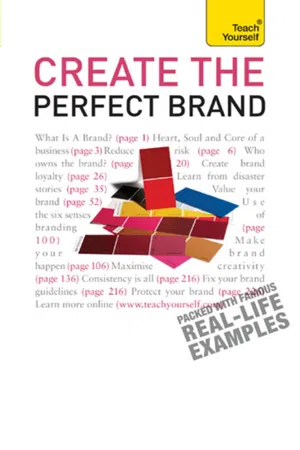
Do you see branding as the key to the success of your business but aren't sure where to start? This book, written by enthusiastic experts, will help you to maximise your brand, even in a downturn. All aspects of branding are covered including brand creation and protection. Fascinating case studies of famous brands, including the disaster stories, nail their advice in the real world.
All aspects of branding are covered including:
- what is a brand and why it is heart, soul and core of a business - brands in a recession, including the success stories - methods to value a brand - brand focus - brand creation and structure - brand audience and brand vision -importance of creativity - brand implementation - personal branding
- brand protection- trademark, intellectual property - brand delivery
Throughout the book the authors include their own extensive experiences and guidance. A multitude of fascinating case studies include Harley Davidson, IKEA, Aldi, Lego, Cadbury and the Apple iPod plus the disaster stories such as Woolworths and MFI are given throughout the book to nail the advice given in the real world. Even examples of branding behaviour such as Susan Boyle, banks and MPS are analysed!
NOT GOT MUCH TIME?One, five and ten-minute introductions to key principles to get you started.
AUTHOR INSIGHTSLots of instant help with common problems and quick tips for success, based on the author's many years of experience.
TEST YOURSELFTests in the book and online to keep track of your progress.
EXTEND YOUR KNOWLEDGEExtra online articles at www.teachyourself.com to give you a richer understanding of computing.
FIVE THINGS TO REMEMBER
Quick refreshers to help you remember the key facts.TRY THIS
Innovative exercises illustrate what you've learnt and how to use it.
eBook - ePub
Create the Perfect Brand
A practical guide to branding your business, from creation and vision to protection and delivery
- 240 pages
- English
- ePUB (mobile friendly)
- Available on iOS & Android
eBook - ePub
Create the Perfect Brand
A practical guide to branding your business, from creation and vision to protection and delivery
About this book
Information
Brand importance
1
What is a brand?
In this chapter you will learn about:
- the definition of a brand
- the classification of brands
- brand history
- how brand is the heart and soul of a business
- the importance of past, present and future for a brand
- brand ownership
Definition of a brand
Premier league football clubs are described as great brands and are owned by international entrepreneurs. Successful sportsmen, such as Michael Jordan and David Beckham, can become brands. The reality television programme The Apprentice has challenged candidates to create a brand in a week, and the experts on the popular BBC television series Dragons’ Den frequently discuss the merits of a proposed business venture by its chances of becoming a ‘strong brand’. So what exactly is a brand?
A brand is a powerful force that can influence people’s behaviour. A brand is a feeling. It can connect with people emotionally and psychologically, guide consumer understanding of value and lead to loyalty. It is a valuable asset based on reputation. The term ‘brand’ traditionally covers products, services and organizations, but can include people, places and nations.
In the 1990s the UK got a rebrand. Tony Blair’s New Labour government encouraged the ‘Cool Britannia’ branding that helped sell the UK’s vibrant culture to a global audience. Artists, musicians and creative celebrities were invited to Downing Street and celebrated as champions of contemporary Britain. The union flag was rescued from its negative associations with right-wing politics and became the logo for ‘Cool Britannia’, appearing on everything from guitars to Ginger Spice!
The brand lives in the minds of those who believe in it. Its integrity is constantly put to the test through the experiences of consumers and the actions of employees. The popularity of online social networks places brands under ever-stronger scrutiny. Reputations can easily be broken and a brand cannot rest on its laurels. To achieve sustainability it must constantly innovate to remain relevant to the consumer.
A brand must come from the heart, be honest and true. It will not work if you contrive an image based on deception. Brands are not manufactured, but spring from the instincts of entrepreneurial spirit. Success is achieved by following a unique path with conviction. Having a clear vision is the only quality that unites successful brands, but each vision is unique.
The underlying idea behind a brand becomes the ethos that drives and shapes an organization. The brand becomes the compass to success, guiding decisions and strategy in a realization of its values.
Insight
In the majority of small- to medium-sized enterprises (SMEs), the brand is an extension of the founding entrepreneur’s personality. The owner’s passion comes through their business brand. A very successful illustration of this model is Virgin. The Virgin brand is an extension of Richard Branson’s charismatic personality and the two are synonymous with each other.
Brands depend on their hard-earned reputation. We expect our Duracell batteries to go on and on, we expect Volvo to make safe cars and we expect that Gillette is the best a man can get. If our expectation is not satisfied then the brand promise has been compromised.
A brand eases the path to innovation, as consumers are more open to experiment with new ideas from a trusted source. They create a halo of confidence.
A logo is not a brand. Logos, trade marks and corporate identities are the visual signals that represent the values of a brand. A logo has a valuable role to play in building brand recognition; it is a facet of the brand but not the brand itself. The logo represents the brand and conveys its attributes; it authenticates and identifies but it is not a replacement for the experience.
Brands can be legally protected, bought, sold, franchised or licensed. It’s difficult to place an exact value on a brand, but when you have one it can mean the difference between obscurity and international recognition, profit or loss.
Brands are used as signals of personal expression. They are symbols of status and shorthand for our loves and passions. We use them to identify ourselves and they provide a coded language for social awareness. We pigeon-hole people by the brands they choose. The car you drive, the clothes you wear, the newspaper you read, the postcode you live in – they are all brands and they brand you!
Brands it seems can be many things. So, is there an exact definition for what a brand is? If you speak to a group of consultants each one will give their own interpretation. Wally Olins, co-founder of brand consultancy Wolff Olins, describes a brand as a personality. Walter Landor, founder of brand consultants Landor Associates, defined a brand as a promise. And Al Ries, author of The 22 Immutable Laws of Branding, defines a brand as the concept of singularity. Hear are a few more definitions of brands and branding.
A brand is simply an organization, or a product, or a service with a personality.
Wally Olins, author of The Brand Handbook
Branding is ultimately about nothing more (and nothing less) than heart. It’s about passion … what you care about. It’s about what’s inside – what’s inside you, what’s inside your company.
Tom Peters, author of Re-imagine
Simply put, a brand is a promise. By identifying and authenticating a product or service it delivers a pledge of satisfaction and quality.
Walter Landor
A successful branding program is based on the concept of singularity. It creates in the mind of the prospect the perception that there is no product on the market quite like your product.
Al Ries and Laura Ries, authors of The 22 Immutable Laws of Branding
A brand is the totality of perceptions – everything you see, hear, read, know, feel, think, etc. – about a product, service or business.’
Philip Kotler and Waldemar Pfoertsch, authors of B2B Brand Management
Classification of brands
Brand architecture is a grandiose name for simplifying your business strategy into an easily understandable framework. There are three broad categories – single, endorsed and branded.
SINGLE BRAND MODEL
The most popular type of brand model is the single brand. The business will use a single name and identity throughout the organization. All products and services in a single brand carry the same single message.
Most small to medium-sized enterprises (SMEs) start as a single brand and stay that way. This strategy is easier to manage because every facet of the business supports a single idea. It is economical to implement and build on brand recognition through repeated exposure. The risk of this model is that a crisis leading to loss of reputation can affect the whole business.
Examples of single brands
Heinz: Heinz Baked Beans, Heinz Spaghetti, Heinz Tomato Ketchup …
Virgin: Virgin Atlantic, Virgin Trains, Virgin Media.
Insight
The ‘Heinz 57 varieties’ slogan was inspired by a train ride. Henry J. Heinz noticed an advert for a shoe store selling 21 styles. He had over 60 products but chose the number ‘57’ because it combined his lucky number ‘5’ with his wife’s number ‘7’. The number ‘57’ has continued to have special significance for the brand and even its postal address in Pittsburgh is PO Box 57.
ENDORSED BRAND MODEL
Endorsed brands usually form part of a portfolio of individual brands, each endorsed by its parent company. This structure is suited to acquisition and allows the investor to retain the loyalty and recognition of the acquired brand’s customers, whilst placing it under the security of the parent name. The parent brand gives credibility and maintains its profile for the benefit of the shareholder.
Examples of the endorsed brand model
Nestlé: Nestlé Shreddies, Nestlé Cheerios, Nestlé Milkybar etc.
Kellogg’s: Kellogg’s Frosties, Kellogg’s Corn Flakes, Kellogg’s Rice Krispies etc.
Insight
Businesses that follow the endorsed brand model are usually in the fast-moving consumer goods (FMCG) market.
BRANDED MODEL
The branded model is a portfolio of brands owned by a parent company with a low brand profile. Quite often the customer will be unaware that the product brand is part of a larger group, for example Guinness is owned by Diageo. The branded model allows the parent company to compete at different value points in the same sector without harming consumer perception, e.g. Volkswagen Group owns Skoda, Seat, Audi and Bentley. Each brand can be sold without damaging consumer loyalty if the new custodian stays true to the brand. The downside when this model succeeds is that the parent company could be viewed as creating a market monopoly.
Examples of the branded model
Swatch: Tissot, Longines, Omega, Breguet
GlaxoSmithKline: Macleans, Lucozade, Horlicks, Ribena.
Insight
The branded model is typically used by large global businesses where a brand can be built up as an asset and sold individually.
Note: There are exceptions to the rule and some global companies will use a combination of these models, for example Kraft acquired the Cadbury brand in 2010. The Kraft Foods brand portfolio is a story of acquisition. It includes names that blur the boundaries of brand architecture: Kraft Philadelphia, Terry’s Chocolate Orange and Toblerone.
Brand history
Brands have been guiding consumer choice for centuries. One of television’s most popular and enduring programmes, The Antiques Roadshow, is a window on the evolution of the brand. It first aired on the BBC in 1979 and in the last 30 years has influenced many derivatives, including Bargain Hunt and Cash in the Attic. The show’s success thrives on our curiosity and has made amateur experts of us all at identifying heritage brands. Viewers are invited to present their family heirlooms for identification. The experts on these shows are full of anecdotes about the craftspeople behind the antiques. They inform us about the lives of the goldsmith, carpenter or potter and provide insights into how the object was produced. By watching, we learn about the manufacturing and crafts industry of the past. Recognizing the maker’s trade marks helps the identification of these product...
Table of contents
- Cover
- Title
- Copyright
- Dedication
- Contents
- Meet the authors
- Only got a minute?
- Only got five minutes?
- Acknowledgements
- Part one: Brand importance
- Part two: Brand creation
- Part three: Brand implementation
- Part four: Brand support
- Index
Trusted by 375,005 students
Access to over 1.5 million titles for a fair monthly price.
Study more efficiently using our study tools.
Frequently asked questions
Yes, you can cancel anytime from the Subscription tab in your account settings on the Perlego website. Your subscription will stay active until the end of your current billing period. Learn how to cancel your subscription
No, books cannot be downloaded as external files, such as PDFs, for use outside of Perlego. However, you can download books within the Perlego app for offline reading on mobile or tablet. Learn how to download books offline
Perlego offers two plans: Essential and Complete
- Essential is ideal for learners and professionals who enjoy exploring a wide range of subjects. Access the Essential Library with 800,000+ trusted titles and best-sellers across business, personal growth, and the humanities. Includes unlimited reading time and Standard Read Aloud voice.
- Complete: Perfect for advanced learners and researchers needing full, unrestricted access. Unlock 1.5M+ books across hundreds of subjects, including academic and specialized titles. The Complete Plan also includes advanced features like Premium Read Aloud and Research Assistant.
We are an online textbook subscription service, where you can get access to an entire online library for less than the price of a single book per month. With over 1.5 million books across 990+ topics, we’ve got you covered! Learn about our mission
Look out for the read-aloud symbol on your next book to see if you can listen to it. The read-aloud tool reads text aloud for you, highlighting the text as it is being read. You can pause it, speed it up and slow it down. Learn more about Read Aloud
Yes! You can use the Perlego app on both iOS and Android devices to read anytime, anywhere — even offline. Perfect for commutes or when you’re on the go.
Please note we cannot support devices running on iOS 13 and Android 7 or earlier. Learn more about using the app
Please note we cannot support devices running on iOS 13 and Android 7 or earlier. Learn more about using the app
Yes, you can access Create the Perfect Brand by Paul Hitchens,Julia Hitchens in PDF and/or ePUB format, as well as other popular books in Business & Marketing. We have over 1.5 million books available in our catalogue for you to explore.