'Funny, insightful and hugely informative ... a charming book'
DAILY MAIL
'Tremendous ... We all need to take stock, and this is the ideal starting point. I learnt a lot from this book and laughed a lot too.' ROSAMUND YOUNG, author of
The Secret Life of Cows
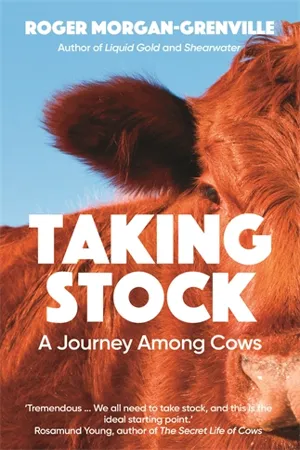
Since highland cattle ransacked his grandmother's vegetable patch when he was six, Roger Morgan-Grenville has been fascinated by cows.
So at the age of 61, with no farming experience, he signed on as a part- time labourer on a beef cattle farm to tell their side of the story. The result is this lyrical and evocative book.
For 10,000 years, cow and human lives have been intertwined. Cattle have existed alongside us, fed and shod us, quenched our thirst, and provided a thousand other tiny services, and yet most of us know little about them. We are also blissfully unaware of the de-natured lives we often ask them to lead.
Part history, part adventure and part unsentimental manifesto for how we should treat cows in the 21st century,
Taking Stock asks us to think carefully about what we eat, and to let nature back into food production.
- 304 pages
- English
- ePUB (mobile friendly)
- Available on iOS & Android
eBook - ePub
About this book
Information
1
PART 1
Then
2
1. A PREHISTORIC JOURNEY
3.5 billion years ago–20,000 BCE

‘The chicken is only an egg’s way of making another egg’
Richard Dawkins
I am not a farmer. I just happen to like cows. They press a button in my soul that other, perhaps better regarded animals simply don’t.
My sole contribution to agriculture until recently was the one late, scorched summer in 1976 that I spent doing bale-cart for Jim Bennett on his mixed farm down the road from us in the Rother Valley. Looking back at it, Jim paid me, quite literally, pence,* but he treated me well and, most important, he allowed 4me to drive the old red Massey Ferguson tractor with its articulated snake of trailers behind it. As a spotty teenager who was an angry confusion of odd attitudes, being paid anything at all to drive around our local lanes towing the winter’s hay back to the barn was a glimpse over the wall into the secret garden, and I would probably have done it for free, if he’d asked me to. In a quiet village where I sometimes felt that I amounted to little more than being my father’s son, this was a short-term leasehold on manhood. I often took the long route home just on the off-chance of being seen by more people, especially if they included my parents. To be in charge of anything, let alone an agricultural machine of fully 39 horsepower, showed that I had achieved something, and that my playing days were over. More importantly, the cash enabled me to park for a time the rather perilous income stream that flowed from my having spent that summer furtively selling the koi carp from my parents’ fish pond while they weren’t looking, to people I fondly hoped they would never meet.†
In those days, working on the land was the only possibility in our valley in terms of holiday jobs, and the only casual work that was generally available was seasonal fruit and vegetable picking: strawberries (before the strawberry field was turned into a house and garden), apples (before the trees were grubbed up too, to make way for new homes), and back-breaking Brussels sprouts on the coastal plains in the January 5frost. Nothing that I experienced in nine subsequent years of serving in the Army all over the world came close, in toughness, to my routine 30-mile round trip through the dark and freezing fog on an underpowered motorbike, sandwiching eight hours of leaning over sodden yet frosted sprout plants, being paid piece rate in competition with scarily robust women who had done it all their lives, and who made it abundantly clear that I was an idiot, and in the way.
Everything else has gone, but 40 years on, those wretched sprouts are still grown in the same bloody field. To this day, a shard of misery enters my body whenever I see a Brussels sprout.
I think my first awareness of cows was triggered by the tiny plastic black and white ones which populated the fields of My Little Town, a primitive German set of wooden houses, combined with Dinky cars that were five times the size of the livestock, in all of whose company I would pass hour after aimless hour once my older sister had gone off to primary school and I was waiting for her to return. My first sustained experience of cows, however, came during our holidays at my grandmother’s Hebridean croft, with the docile and shaggy Highland cattle that wandered right up to the dry stone walls of her garden, and sometimes, to her fury, right through them and on into her vegetable patch. To an impressionable boy who had not yet learned what he liked in life, let alone what he actually wanted to do with the years ahead of him, those Highland cattle were a compelling metaphor for a wildness and solidity that I missed down south, but which nonetheless filled me with happiness and excitement. 6
Bit by bit, and breed by breed, cows became an enduring fascination for me. Also, as a boy who enjoyed making lists, I found that I could add different breeds of cow to the rich diversity of things that I already counted up in my little notebooks: birds, planes, trains and castles, for a start. I must have been an irritating passenger in the family car as we drove around Europe on our holidays, shouting out ‘Charolais’ or ‘Évolène’ every time we drove past a field.
‘It will pass,’ said my mother. But it didn’t.

Evolution is, of course, not a planned journey with a clear direction of travel, but a gradual change in characteristics from one generation to the next brought about by the innate need to maximise the chances for subsequent generations, and the connection between a simple, ancient bacterium and our modern cow is a long and tortuous one. For the first three billion years or so, it is also extremely boring, as the bacteria bit lasts a lot longer than we might like it to.
The potted history of bovine evolution begins in earnest a quarter of a billion years ago, when the cow’s ancestors, along with those of all other mammals including humans, were cynodonts, ‘advanced mammal-like reptiles of the middle and late Triassic that were dog-like predators’,1 rather than the dinosaurs that we would secretly like them to have been. So let’s say that we need to go back around 300 million years to when we and cows shared common ancestors. It was a time when the world was covered by warm, shallow seas, and the climate was generally humid and mostly unchanging from season to 7season. Gradually, changes in jaw structure and function led to differentiations in what these creatures went on to become, changes that we can at least keep track of, since bones, unlike skin and hair, fossilise. By 50 million years ago, the cow’s ancestors had become Artiodactyla, animals with short legs and a set of teeth that suggests that they lived on herbage rather than meat. With a brain cavity that was about the size of a walnut, you can draw any unkind conclusions you choose about their mental capacities.
If their minuscule brains were actively involved in anything other than eating, which on the face of it seems rather unlikely, they were probably taken up in trying to avoid becoming a meal for one of the resident predators of the time. And as that time went by, they divided and sub-divided, first into camels and ruminants, and then further into deer, giraffe and bovines. But we can guess with some assurance that they left behind a genetic trail that led inexorably to the ruminants.
The first recognisable ruminants probably evolved around 50 million years ago and lived in forests. They would have been much smaller than the modern cow, and most likely omnivorous, ‘not unlike the primitive chevrotain, a type of small deer known as the mouse-deer, which still inhabits the rainforests of Malaysia’.2 It would have been at this point that they developed the two-way digestive system that allowed recently eaten food to come back up for a second go in the mouth, before going back down into the ‘fermentation vat’ below. This chewing of the cud has defined ruminants ever since, and is what uniquely allows them, but not competitors, to feed off what a fifth of the world is carpeted with, namely grass. It almost certainly 8evolved to allow what was a prey animal to graze swiftly in the relative danger of the forest clearings, and then get back to the safety of the deep forest to process the food at its leisure. Indeed, it is sometimes easy to overlook that these were once forest animals.
Around 750,000 years ago, one branch of the cynodont’s descendants evolved into what we now know as the aurochs, ancestor of all our cattle, and a herbivore that we would probably recognise today. It originated in what is now India, and its fossilised signature appears to us tantalisingly all over the Eurasian landmass, deprived of traces of its soft tissue but still able to articulate the journey it has taken, and passing on the occasional hint of its role as an ecological engineer that will be one of the abiding themes in this story.
So with what other animals would those early ruminants have been sharing their grazing lands, say, 50,000 years ago? If we narrow our search down to the small herd of aurochs in the Fertile Crescent of the Middle East from which cows most likely descended, they might have been seeing dwarf elephants no taller than a modern deer, wild horses, Merck’s rhinos and hippos ‘the size of a large pig’.3 And in the interests of avoiding becoming someone else’s meal, they would have been alert to the presence of predators such as man himself, spotted hyenas and steppe lions.4 As it worked its slow way westwards, the aurochs probably became a more and more substantial meal for a carnivore, as it grew ever larger.
From the very start, the aurochs had a use to the earth far beyond its status as the occasional meal for a predator, described nicely by its official biographer: 9
Grazing and browsing with their front end, trampling with heavy weight and sharp hooves with the middle, relieving themselves from their rear end, and at the end of their lives dying and becoming carcasses. All vitally important features for a multitude of species, from butterflies and microbes to fungi, birds, beetles, reptiles, plants and trees. Among the grass eaters, the aurochs with its great eating and cellulose-proces...
Table of contents
- Praise for Taking Stock
- Praise for Liquid Gold
- Praise for Shearwater
- Title Page
- Contents
- Dedication
- Gratitude
- Prologue: The Everywhere Cow
- PART 1: Then
- PART 2: Now
- PART 3: Tomorrow
- Epilogue: A Field in Devon
- Bibliography
- Acknowledgements
- Appendix 1: Alex’s Beef Shin Ragù Recipe
- About the Author
- By the same author
- Copyright
Trusted by 375,005 students
Access to over 1.5 million titles for a fair monthly price.
Study more efficiently using our study tools.
Frequently asked questions
Yes, you can cancel anytime from the Subscription tab in your account settings on the Perlego website. Your subscription will stay active until the end of your current billing period. Learn how to cancel your subscription
No, books cannot be downloaded as external files, such as PDFs, for use outside of Perlego. However, you can download books within the Perlego app for offline reading on mobile or tablet. Learn how to download books offline
Perlego offers two plans: Essential and Complete
- Essential is ideal for learners and professionals who enjoy exploring a wide range of subjects. Access the Essential Library with 800,000+ trusted titles and best-sellers across business, personal growth, and the humanities. Includes unlimited reading time and Standard Read Aloud voice.
- Complete: Perfect for advanced learners and researchers needing full, unrestricted access. Unlock 1.5M+ books across hundreds of subjects, including academic and specialized titles. The Complete Plan also includes advanced features like Premium Read Aloud and Research Assistant.
We are an online textbook subscription service, where you can get access to an entire online library for less than the price of a single book per month. With over 1.5 million books across 990+ topics, we’ve got you covered! Learn about our mission
Look out for the read-aloud symbol on your next book to see if you can listen to it. The read-aloud tool reads text aloud for you, highlighting the text as it is being read. You can pause it, speed it up and slow it down. Learn more about Read Aloud
Yes! You can use the Perlego app on both iOS and Android devices to read anytime, anywhere — even offline. Perfect for commutes or when you’re on the go.
Please note we cannot support devices running on iOS 13 and Android 7 or earlier. Learn more about using the app
Please note we cannot support devices running on iOS 13 and Android 7 or earlier. Learn more about using the app
Yes, you can access Taking Stock by Roger Morgan-Grenville in PDF and/or ePUB format, as well as other popular books in Politics & International Relations & Agricultural Public Policy. We have over 1.5 million books available in our catalogue for you to explore.