Doing the Time Warp explores how song and dance – sites of aesthetic difference in the musical – can 'warp' time and enable marginalized and semi-marginalized fans to imagine different ways of being in the world.
While the musical is a bastion of mainstream theatrical culture, it also supports a fan culture of outsiders who dream themselves into being in the strange, liminal timespaces of its musical numbers.
Through analysing musicals of stage and screen – ranging from Rent to Ragtime, Glee to Taylor Mac's A 24-Decade History of Popular Music – Sarah Taylor Ellis investigates how alienated subjects find moments of coherence and connection in musical theatre's imaginaries of song and dance.
Exploring an array of archival work and live performance, such as Larry Gelbart's papers in the UCLA Performing Arts Collections and the shadowcast performances of Los Angeles's Sins o' the Flesh, Doing the Time Warp probes the politics of musicals and consider show the genre's 'strange temporalities' can point towards new futurities for identities and communities in difference.
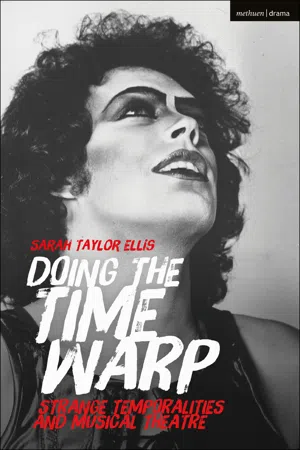
- 288 pages
- English
- ePUB (mobile friendly)
- Available on iOS & Android
eBook - ePub
About this book
Information
1
A Funny Thing Happened … to the Integrated Musical: Poetics and Politics of Queer Temporality
EVAN: Peter, you’re reading a paper with a front page announcing the deadliest month in nine years for the soldiers in Afghanistan, and you’re upset about theater? Don’t you think that’s a little … narrow?
PETER: It’s all of a piece, darling. See, that’s what the computer-savvy greasers and soshes of your generation don’t seem to understand. You flock to the interwebs for your fingerling snippets of news, and you call that ‘being informed’. But, you whiz right past all the other awful shit that exists in the day’s news. Now, me? I see all the awful. I hold it in my goddamn lap. Little awful smudges of it come off on my fingers. This paper is not a news bite, it is a news sandwich, an awful news sandwich made on awful bread with awful meat, awful lettuce, and sale-at-Penney’s dijonaise. No page of this awful paper could have been possible without the inclusion of every other awful page, and it is nothing but farce to believe otherwise. So you see, dear, it isn’t that I’m narrow, it’s that I am concerned about everything via a very specific entry point.
Philip Dawkins, The Homosexuals1
In The Homosexuals, 48-year-old regional theatre director Peter represents a familiar stereotype: the fabulously gay show queen. Playwright Philip Dawkins describes him as ‘overtly and unapologetically flamboyant. If you cut him, he would bleed glitter.’2 Peter thrives on Broadway gossip and obsesses over the Tony Awards; his everyday rhetoric is rife with theatrical references, playfully poetic imagery and double entendre. Peter’s boyfriend, an art history professor, loves how Peter’s showy attire is a controversial work of performance art; Peter immediately unsettles fashion standards upon entering a room and boldly signifies his difference from the norm. For such a show queen, style is substance.
Like Peter, I am interested in reading style as substance, engaging the poetics of musical theatre as a ‘very specific entry point’ into processes of identification. The musical’s very musicality paradoxically constitutes its mainstream popular appeal while also opening the genre to alternative appropriations; the song stuck in one’s head after the curtain closes playfully pops out of the narrative, making it ripe for recontextualization.3 Queerness and difference can always be located in this discontinuity between book and musical numbers, or what D.A. Miller calls the ‘ecstatic release from all those well-made plots’.4 The persistent binary between musicals and ‘straight’ plays further confers queerness on a genre that ‘unnaturally’ bursts into song and dance, rupturing the aesthetics of realism and its representations of normative identities. A musical’s narrative can closet an alternate ideology that is always and already implicit in the rapturous song and dance of this art form; musical numbers can create an imaginary of identities in difference and new forms of affiliation.
It is notable that Peter’s fashion sensibilities, his playfully self-aware rhetoric and his passion for musicals all sync with his idiosyncratic approach to time. ‘The future is ambiguous. Like Capri pants’, he explains. ‘I’d much rather concentrate on the here and now, on all of the many this-very-moments that make up a life.’5 Just as he signifies his difference from the norm with bold clothing, then, Peter bends time to a ‘queer temporality’ of his own creative self-fashioning. Queer temporality describes an array of alternative life narratives and relationships to time, embracing the here, the present and the now rather than a heteronormative, developmental progression of birth, marriage, reproduction and death. Jack Halberstam suggests that queer time ‘flashes into view in the heart of a crisis’, exploiting the potential of all that is transient, fleeting and contingent.6 Within the genre of musical theatre, the musical number’s showstopping qualities frequently queer time; a song lyrically, musically and choreographically expands upon an evanescent moment, temporarily displacing the linear narrative drive. Animated by song and dance, bodies in musical performance can accelerate and decelerate time, foreground repetition and circularity, dip into memory and project into the future, and physicalize dreams in a narratively open present. The historical narrative of the formally ‘integrated’ musical insists that all elements, including musical numbers, linearly progress the plot, but re-evaluating the genre through a lens of strange temporalities illuminates the potential divergence of musical numbers from the narrative. Rather than read the musical as a homogeneously integrated Gesamtkunstwerk, I locate a shifting affective relationship among the book, music, lyrics, dance, design and other elements.7 The aesthetically charged and temporally distinct musical numbers emphasize performative self-invention that ‘show queens’ find ripe for reimagining identity and valorizing alternative lifestyles.
In the context of pivotal events in the LGBTQ+ history of the United States, this chapter explores queer temporalities and identification in A Funny Thing Happened on the Way to the Forum (1962) and Rent (1996), with a brief musical interlude from A Little Night Music (1973). The narratively closeted but stylistically queer musical comedy Forum opened on Broadway early in the decade that would culminate in the Stonewall Riots (1969), while Rent – featuring several ‘out’ characters and an avid queer fan base – opened towards the end of the first wave of the HIV/AIDS epidemic (1980s and early 1990s). A Little Night Music’s ‘The Miller’s Son’ thus occupies a particularly fabulous and fleeting moment of rapturous promiscuity and excess in the 1970s and early 1980s.
While The Homosexuals’ show queen Peter exults in musical theatre’s time-warping moments of release from the normative narrative, I hesitate to essentialize the musical as an exclusively ‘gay’ genre.8 Many contemporary homosexuals, including characters in Dawkins’s play, disidentify with the show queen stereotype; and while the musical has historically been a seminal point of identification for gay men, the genre can be a haven for a multiplicity of identities who feel ‘other than’.9 This chapter focuses on identification by the gay male ‘show queen’, but later chapters consider the musical as an identificatory site for other marginalized subjects; under the umbrella of strange temporalities, queer time has been most extensively theorized, and thus the temporal analysis herein provides a valuable lens onto the strange temporalities and identifications explored in subsequent sections.
Anxieties of integration: A Funny Thing Happened on the Way to the Forum (1962)
With book by Larry Gelbart and Burt Shevelove, music and lyrics by Stephen Sondheim, and original direction by George Abbott, the Tony Award-winning musical comedy A Funny Thing Happened on the Way to the Forum has been repeatedly mounted on the Great White Way, as well as in regional and school theatres, since its Broadway premiere in 1962. Sondheim claims that the show is almost foolproof; the play holds up whether performed by a professional company or a high school.10 He attributes the show’s success to the intricate plotting, witty dialogue and brilliant situational comedy of his collaborators. However, Sondheim’s vibrant and radically disjunctive production numbers contribute just as much to Forum’s enduring success. Sondheim calls farces ‘express trains’ and musicals ‘locals’, making regular stops for their (literally) showstopping musical numbers.11 Instead of progressing the plot or elaborating character, Forum’s production numbers bring the narrative to a thrilling halt; song and dance lift out of the linear, text-dominated plot into an exuberant performance of aesthetic difference.12
Yet these ‘respites from the relentlessness of the comedy’ were not always touted for their showstopping qualities.13 The collection of Larry Gelbart’s papers in the UCLA Performing Arts Collections includes a five-page typed document considering the ‘Purpose of Songs’ in A Funny Thing Happened on the Way to the Forum.14 This detailed analysis of the function of songs in an early draft of the show demonstrates a palpable anxiety about whether the songs progress the book in the tradition of a Rodgers and Hammerstein musical drama, popularized in the 1940s and 1950s. ‘Why does he sing this song?’ the dramaturg asks. ‘The resort to song has to be for a reason.’ ‘What is the purpose of this song? I can’t see how this title and this spot for a song advances the story.’ ‘Could it be that this is incidental entertainment just interrupting here?’ This anxiety about song and dance’s ‘integration’ into Forum’s narrative is perhaps surprising since – following the show’s Broadway success – critics and scholars, as well as the creative team, openly acknowledge that Forum’s songs do not progress the plot at all. This later admission of the production numbers’ disjunction draws attention to complications in the historical narrative of the integrated musical and anxieties over how the hybrid genre of musical theatre always exceeds a straightforward story.
The integrated musical
Most histories identify Rodgers and Hammerstein’s Oklahoma! (1943) as inaugurating the Golden Age of the sophisticated, integrated musical drama, in which ‘all elements of a show – plot, character, song, dance, orchestration, and setting – should blend together into a unity, a seamless whole’.15 Rodgers and Hammerstein marketed Oklahoma! as elevating the musical comedy to a musical play, commercial fodder to a work of art: ‘Certainly the universality of the play’s appeal cannot be doubted, but what makes it noteworthy to my mind is the fact that its appeal comes from its “art” qualities and its unwillingness to compromise with commerce’, Rodgers explains. ‘The result is a thoroughly integrated evening in the theater. The scenery looks the way the music sounds and the clothes look as though they belonged to the characters rather than the management.’16 Adapting Wagner’s concept of the Gesamtkunstwerk for the American musical stage, Rodgers and Hammerstein aimed for all theatrical elements to dovetail with character and seamlessly progress the story.
Integration theory stems from a desire to elevate the musical from its ‘lower’ roots in which book and numbers are separable (minstrelsy, extravaganza, pantomime, burlesque and vaudeville) to the supposed cohesion of art works within a higher cultural stratum; the musical also notably derives from Black performance practices, which can only achieve ‘art’ status through their integration by a white creative.17 In the normative reading of an integrated musical, then, all elements are subordinated to a singular (white, masculine, heteronormative) ‘Poetic Aim’. As evidenced in Rodgers’s quotation above, this Poetic Aim stands in for the dubious claim to the ‘universal’. The books of many Golden Age musicals promote a conventional, middle-class ideology along with a heteronormative marriage, explicitly or implicitly constructed in tandem with the United States’ historical narrative of citizenship. Oklahoma!, for instance, ties two marriage plots – Curly and Laurey, Will Parker and Ado Annie – to the cooperation of the once-rival farmers and cowhands, as well as to Oklahoma’s new statehood. The Western (re)productive body is united with the productive land, poised to become part of this great, forward-moving nation.
A third marriage is also of note: the Persian (coded Jewish) merchant Ali Hakim weds the silly Gertie Cummings; this marriage – and the musical’s form – can be read as a performance of Jewish integration into the national community.18 The integrated musical, or ‘community musical’, thus structurally unites opposites and imagines a tolerant American world in which heterosexual couples unite different groups.19 For Bruce Kirle, the genre’s happy or at least uplifting endings suggest that there are no class barriers in American society and ‘that all ethnicities, races, and genders can triumph and transcend perceived notions of identity through will and desire’.20 Such an evolutionary history elides the very real ruptures, limits and barriers to acceptance and implies the ‘boundless’ and ‘irresistible’ development of mankind itself: improvements in individuals’ abilities and knowledge, as well as mankind’s collective perfectibility over generations.21
Throughout the dramaturg’s notes on A Funny Thing Happened on the Way to the Forum, several comments highlight a nervous need to advance the plot in the tradition of the 1940s and 1950s ‘integrated’ musical. That the dramaturg should be concerned with fitting this musical farce into an ‘integrated’ format is, in retrospect, rather farcical itself. In this intricately plotted musical inspired by the works of Roman playwright Plautus, a slave named Pseudolus strives for freedom by striking a deal with his young master ...
Table of contents
- Cover
- Halftitle Page
- Title Page
- Dedication Page
- Contents
- Figures
- Tables
- Acknowledgements
- Introduction: ‘I would like, ah, if I may, to take you on a strange journey … ’
- 1 A Funny Thing Happened … to the Integrated Musical: Poetics and Politics of Queer Temporality
- 2 ‘Let’s Do the Time Warp Again’: Performing Time, Genre and Spectatorship
- 3 Ragging Race: Spectral Temporality in the American Musical
- 4 ‘I Just Projected Myself Out of It’: Rehearsing Identities in Youth Musical Theatre
- 5 Just an Illusion: Identity and Musical Form
- Conclusion: ‘Everything You’re Feeling Is Appropriate’
- Notes
- Select Bibliography
- Index
- Imprint
Trusted by 375,005 students
Access to over 1.5 million titles for a fair monthly price.
Study more efficiently using our study tools.
Frequently asked questions
Yes, you can cancel anytime from the Subscription tab in your account settings on the Perlego website. Your subscription will stay active until the end of your current billing period. Learn how to cancel your subscription
No, books cannot be downloaded as external files, such as PDFs, for use outside of Perlego. However, you can download books within the Perlego app for offline reading on mobile or tablet. Learn how to download books offline
Perlego offers two plans: Essential and Complete
- Essential is ideal for learners and professionals who enjoy exploring a wide range of subjects. Access the Essential Library with 800,000+ trusted titles and best-sellers across business, personal growth, and the humanities. Includes unlimited reading time and Standard Read Aloud voice.
- Complete: Perfect for advanced learners and researchers needing full, unrestricted access. Unlock 1.5M+ books across hundreds of subjects, including academic and specialized titles. The Complete Plan also includes advanced features like Premium Read Aloud and Research Assistant.
We are an online textbook subscription service, where you can get access to an entire online library for less than the price of a single book per month. With over 1.5 million books across 990+ topics, we’ve got you covered! Learn about our mission
Look out for the read-aloud symbol on your next book to see if you can listen to it. The read-aloud tool reads text aloud for you, highlighting the text as it is being read. You can pause it, speed it up and slow it down. Learn more about Read Aloud
Yes! You can use the Perlego app on both iOS and Android devices to read anytime, anywhere — even offline. Perfect for commutes or when you’re on the go.
Please note we cannot support devices running on iOS 13 and Android 7 or earlier. Learn more about using the app
Please note we cannot support devices running on iOS 13 and Android 7 or earlier. Learn more about using the app
Yes, you can access Doing the Time Warp by Sarah Taylor Ellis in PDF and/or ePUB format, as well as other popular books in Media & Performing Arts & Theatre. We have over 1.5 million books available in our catalogue for you to explore.