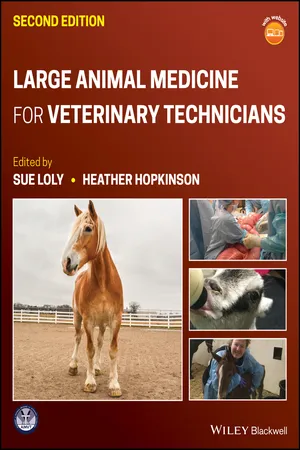
Large Animal Medicine for Veterinary Technicians
eBook - ePub

Large Animal Medicine for Veterinary Technicians

  1. English
  2. ePUB (mobile friendly)
  3. Available on iOS & Android
eBook - ePub

Large Animal Medicine for Veterinary Technicians

About this book

Large Animal Medicine for Veterinary Technicians provides comprehensive guidance on caring for horses, cattle, camelids, small ruminants, pigs, and other farm animals. Reflecting the topics required by the American Veterinary Medical Association (AMVA), this practical resource covers hospital biosecurity, restraint, physical examinations, clinical and diagnostic procedures, reproduction, nutrition, disease, and more. Detailed chapters written by expert contributors contain numerous full-color images, clinical applications, self-review questions, and accurate, species-specific information.   

The second edition features revised and new content throughout, including brand-new chapters on common surgical procedures and general anesthesia, dentistry, and popular hobby farm animals such as fowl, poultry, and pet pigs. Updated and expanded sections on neonatology, diagnostics, and imaging are supported by a wealth of new images and examples. Covering the skills and knowledge necessary for success in both Veterinary Technician Specialty (VTS) programs and in clinical practice, this must-have guide:  

  • Offers new coverage of imaging and diagnostic technologies such as dynamic endoscoping and the use of treadmills 
  • Contains more than 500 high-quality color images, multiple-choice questions with answers, and a glossary of terms 
  • Features a range of pedagogical tools including learning objectives, clinical case problems, charts and diagrams, and "Technician Tip" boxes 
  • Includes a significantly expanded companion website with self-review questions, case studies, PowerPoint slides, and an image bank to aid in breed identification 

Authored and edited by experienced trainers and certified veterinary technicians, Large Animal Medicine for Veterinary Technicians, Second Edition is an invaluable reference for all students, educators, and working professionals in the field. 

Trusted by 375,005 students

Access to over 1.5 million titles for a fair monthly price.

Study more efficiently using our study tools.

Information

Year
2021
Print ISBN
9781119688266
eBook ISBN
9781119688303
Edition
2

Chapter 1
Hospital Biosecurity

Leslie Hiber, CVT, BS

Learning Objectives

  • Describe the life cycle patterns of pathogens.
  • List and describe the three main routes of transmission.
  • List and describe ways to prevent disease in a patient.
  • Describe the biosecurity steps that should be taken prior to patient arrival and on arrival.
  • List and describe types of barrier precautions.
  • Outline the steps of putting on and taking off the personal protective equipment when entering/exiting mini‐isolation and isolation areas.
  • List categories of products used for good hand hygiene, and describe how to perform hand washing.
  • Compare and contrast disinfection and sterilization in preventing nosocomial infection.
  • Describe the role of the infection control team and the function of the veterinary technician on this team.

Clinical Case Problem 1.1

An eight‐year‐old quarter horse mare is presented to the clinic with colic‐type clinical signs. The owner reports no history of infectious diseases and has no history of traveling. The patient is treated medically and is hospitalized overnight in the main clinical area. The following day, she begins having diarrhea and a fever. What steps would you take in order to protect the other patients and staff? What type of communication needs to be dispersed and to whom? How would you follow up with cleaning?
See Clinical Case Resolution 1.1 at the end of this chapter.

Key Terms

Active surveillance
Aerosol transmission
Antibiotic stewardship
Antiseptics
Asymptomatic carrier
Biosecurity
Direct contact transmission
Disinfection
Hazard identification
Incubation period
Indirect contact transmission
Multidrug‐resistant organism (MDRO)
Nosocomial
Passive surveillance
Personal protective equipment (PPE)
Risk communication
Risk management
Risk perception
Sterilization
Vector‐borne transmission
Zoonotic diseases

Introduction

Biosecurity is security from exposure to harmful biological agents. It is emerging as a hot topic in veterinary hospitals and clinics throughout the world. As more diseases and superbugs are being discovered due to new technology, clients and communities are becoming more aware of what protocols are in place to ensure that their animals are safe while under the care of a veterinary care team. As a valuable member of this team, veterinary technicians need to understand the basics of disease transmission and how to protect the patients while in the clinic. Veterinary technicians are also evolving to become the leaders of the biosecurity team, and are referred to as the infection control (IC) team. They are often in communication with all members of the veterinary care team and fully understand the day‐to‐day operation of the hospital/clinic. It is the mission of this team to protect all staff, clients, and patients that enter the hospital/clinic.
TECHNICIAN TIP 1.1: In order to protect the patients when visiting the clinic, the veterinary technician should understand the basics of disease transmission.

Cycle of Infection

A pathogen has a very specific purpose in its life cycle, that is, to infect as many hosts as possible in order to maintain the disease in a population. In order to complete this task, the pathogen must:
  • find a portal of exit from the current host;
  • find a method of transmission;
  • find a portal of entry into a host;
  • seek a susceptible host; and
  • multiply within the host (the reservoir).
The likelihood of a pathogen's success depends on a variety of factors: the pathogen, the environment, and the host (Figure 1.1).
Schematic illustration of cycle of Infection depicting each component of the cycle must be present in sequential order for an infection to occur.
Figure 1.1 Cycle of Infection: Each component of the cycle must be present in sequential order for an infection to occur. At any point, the cycle can be broken, decreasing the risk of disease transmission and infection.
For the pathogen to infect other susceptible hosts, it must first leave the host that has been serving as the reservoir. The portals of exit from the host can include: gastrointestinal tract, urogenital tract, respiratory tract, blood, broken skin (wounds/abrasions), and mucous membranes. Some hosts may be an accidental host in that the pathogen does not have a strong specificity to that species. This may cause clinical disease in the patient, but it will not be able to exit the host. Accidental hosts are often referred to as a “dead‐end” host for the pathogen because it is unable to replicate enough to exit the host. The more routes that a pathogen is able to u...

Table of contents

  1. Cover
  2. Table of Contents
  3. Title Page
  4. Copyright Page
  5. Contributors
  6. Preface
  7. Abbreviations
  8. About the Companion Website
  9. Chapter 1: Hospital Biosecurity
  10. Chapter 2: Restraint
  11. Chapter 3: History
  12. Chapter 4: Physical Exam
  13. Chapter 5: Nutrition
  14. Chapter 6: Clinical Procedures
  15. Chapter 7: Diagnostic Procedures
  16. Chapter 8: Medical Imaging
  17. Chapter 9: Reproduction
  18. Chapter 10: Anesthesia and Surgery
  19. Chapter 11: Neonatology
  20. Chapter 12: Diseases
  21. Multiple Choice Questions Answer Bank
  22. “Test Your Learning” Answer Bank
  23. Glossary
  24. Index
  25. End User License Agreement

Frequently asked questions

Yes, you can cancel anytime from the Subscription tab in your account settings on the Perlego website. Your subscription will stay active until the end of your current billing period. Learn how to cancel your subscription
No, books cannot be downloaded as external files, such as PDFs, for use outside of Perlego. However, you can download books within the Perlego app for offline reading on mobile or tablet. Learn how to download books offline
Perlego offers two plans: Essential and Complete
  • Essential is ideal for learners and professionals who enjoy exploring a wide range of subjects. Access the Essential Library with 800,000+ trusted titles and best-sellers across business, personal growth, and the humanities. Includes unlimited reading time and Standard Read Aloud voice.
  • Complete: Perfect for advanced learners and researchers needing full, unrestricted access. Unlock 1.5M+ books across hundreds of subjects, including academic and specialized titles. The Complete Plan also includes advanced features like Premium Read Aloud and Research Assistant.
Both plans are available with monthly, semester, or annual billing cycles.
We are an online textbook subscription service, where you can get access to an entire online library for less than the price of a single book per month. With over 1.5 million books across 990+ topics, we’ve got you covered! Learn about our mission
Look out for the read-aloud symbol on your next book to see if you can listen to it. The read-aloud tool reads text aloud for you, highlighting the text as it is being read. You can pause it, speed it up and slow it down. Learn more about Read Aloud
Yes! You can use the Perlego app on both iOS and Android devices to read anytime, anywhere — even offline. Perfect for commutes or when you’re on the go.
Please note we cannot support devices running on iOS 13 and Android 7 or earlier. Learn more about using the app
Yes, you can access Large Animal Medicine for Veterinary Technicians by Sue Loly, Heather Hopkinson, Sue Loly,Heather Hopkinson in PDF and/or ePUB format, as well as other popular books in Medicina & Medicina veterinaria. We have over 1.5 million books available in our catalogue for you to explore.