Interest in green chemistry and clean processes has grown so much in recent years that topics such as fluorous biphasic catalysis, metal organic frameworks, and process intensification, which were barely mentioned in the First Edition, have become major areas of research. In addition, government funding has ramped up the development of fuel cells and biofuels. This reflects the evolving focus from pollution remediation to pollution prevention.
Copiously illustrated with more than 800 figures, the Third Edition provides an update from the frontiers of the field. It features supplementary exercises at the end of each chapter relevant to the chemical examples introduced in each chapter. Particular attention is paid to a new concluding chapter on the use of green metrics as an objective tool to demonstrate proof of synthesis plan efficiency and to identify where further improvements can be made through fully worked examples relevant to the chemical industry.
NEW AND EXPANDED RESEARCH TOPICS
Metal-organic frameworks
Metrics
Solid acids for alkylation of isobutene by butanes
Carbon molecular sieves
Mixed micro- and mesoporous solids
Organocatalysis
Process intensification and gas phase enzymatic reactions
Hydrogen storage for fuel cells
Reactive distillation
Catalysts in action on an atomic scale
UPDATED AND EXPANDED CURRENT EVENTS TOPICS
Industry resistance to inherently safer chemistry
Nuclear power
Removal of mercury from vaccines
Removal of mercury and lead from primary explosives
Biofuels
Uses for surplus glycerol
New hard materials to reduce wear
Electronic waste
Smart growth
The book covers traditional green chemistry topics, including catalysis, benign solvents, and alternative feedstocks. It also discusses relevant but less frequently covered topics with chapters such as "Chemistry of Long Wear" and "Population and the Environment." This coverage highlights the importance of chemistry to everyday life and demonstrates the benefits the expanded exploitation of green chemistry can have for society.
This chapter will consider what is toxic, what is waste, why accidents occur, and how to reduce all of these.1
1.1 General Background
In the glorious days of the 1950s and 1960s, chemists envisioned chemistry as the solution to a host of society’s needs. Indeed, they created many of the things we use today and take for granted. The discovery of Ziegler–Natta catalysis of stereospecific polymerization alone resulted in major new polymers. The chemical industry grew by leaps and bounds until it employed about 1,027,000 workers in the United States in 1998.2 By 2007, this number had dropped to 872,200. Some may remember the DuPont slogan, “Better things for better living through chemistry.” In the Sputnik era, the scientist was a hero. At the same time, doctors aided by new chemistry and antibiotics felt that infectious diseases had been conquered.
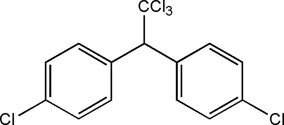
Unfortunately, amid the numerous success stories were some adverse outcomes that chemists had not foreseen. It was not realized that highly chlorinated insecticides such as DDT [1,1-bis(4-chloropheny1)-2,2,2-trichloroethane] (Scheme 1.1), also known as dichlorodiphenyl-trichloroethane (made by the reaction of chloral with chlorobenzene), would bioaccumulate in birds. This caused eggshell thinning and nesting failures, resulting in dramatic population declines in species such as peregrine falcon, bald eagle, osprey, and brown pelican. Rachel Carson3 was one of the first to call attention to this problem. Now that these insecticides have been banned in the United States, the species are recovering. Some are still made and used in other countries, but may return to the United States by long-range aerial transport (e.g., from Mexico). (Compounds applied to plants, building surfaces, and such may evaporate and enter the atmosphere where they may remain until returned to the ground at distant points by rain or by cooling of the air.4) DDT is still made in Mexico, China, India, and Russia. A global treaty to ban these persistent pollutants is being sought.5
SCHEME1.1 Chemical structure of pesticide 4,4’-dichlorodiphenyl- trichloroethane (DDT).
It was also not appreciated that these compounds and other persistent highly chlorinated compounds, such as polychlorinated biphenyls (PCBs), can act as estrogen mimics.6,7 Surfactants such as those made from alkylphenols and ethylene oxide are also thought to do this, although perhaps to a lesser extent. The effects are now showing up in populations of native animals, raising questions about possible effects in humans. A program is being set up to screen 86,000 commercial pesticides and chemicals for this property.8
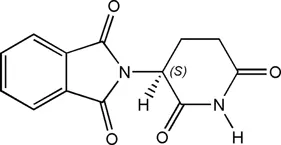
Thalidomide (Scheme 1.2) was used to treat nausea in pregnant women from the late 1950s to 1962. It was withdrawn from the market after 8000 children in 46 countries were born with birth defects.9
SCHEME1.2 Chemical structure of teratogenic (S)-thalidomide.
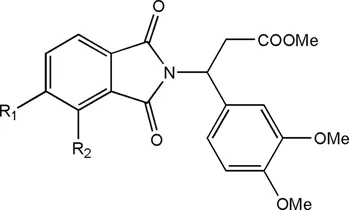
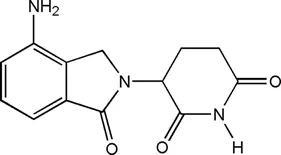
The compound has other uses as a drug as long as it is not given to pregnant women. In Brazil, it is used to treat leprosy. Unfortunately, some doctors there have not taken the warning seriously enough and several dozen deformed births have occurred.10 The U.S. Food and Drug Administration (FDA) has approved its use for treating painful inflammation ofleprosy.11 It also inhibits human immunodeficiency virus (HIV) and can prevent the weight loss that often accompanies the acquired immunodeficiency syndrome (AIDS). Celgene is using it as a lead compound for an anti-inflammatory drug and is looking for analogues with reduced side effects.12 The analog below (Scheme 1.3) is 400–500 times as active as thalidomide. Revlimid (Scheme 1.4) is approved for treating multiple myeloma.13
SCHEME1.3 Chemical structure of a thalidomide analog.
SCHEME1.4 Chemical structure of revlimid.
Chlorofluorocarbons were developed as safer alternatives to sulfur dioxide and ammonia as refrigerants. Their role in the destruction of the ozone layer was not anticipated. Tetraethyl lead was used as an antiknock agent in gasoline until it was learned that it was causing lead poisoning and lowering the intelligence quotient (IQ) in children. We have still not decided what to do with the waste from nuclear power plants, which will remain radioactive for longer than the United States has been in existence. Critics still question the advisability of using the Yucca Mountain, Nevada, site.14 They say that the finding of 36Cl from atomic bomb tests in the 1940s at the depth of the repository indicates that surface water can get into this site.15
Doctors did not anticipate the development of drug-resistant malaria and tuberculosis. The emergence of Legionnaire’s disease, Lyme disease, AIDS, Hantavirus, and Ebola virus was not anticipated. Most drug companies are still unwilling to tackle tropical diseases because they fear that poor people afflicted with diseases will not be able to pay for the drugs.16
Today, there is often public suspicion toward scientists.17 Some people picture a mad chemist with his stinks and smells. There is a notion among some people “that science is boring, conservative, close-minded, devoid of mystery, and a negative force in society.”18 Chemophobia has increased. Many people think that chemicals are bad and “all natural” is better, even though a number of them do not know what a chemical is. There is a feeling that scientists should be more responsible for the influence of their work on society. Liability suits have proliferated in the United States. This has caused at least three companies to declare bankruptcy: Johns Manville for asbestos in 1982, A. H. Robins for its “Dalkon Shield” contraceptive device in 1985, and Dow Corning for silicone breast implants in 1995.19 Doctors used to be respected pillars of their communities. Today they are subjects of malpractice suits, some of which only serve to increase the cost of health care. Medical implant research is threatened by the unwillingness of companies such as DuPont and Dow Corning to sell plastics for the devices to implant companies.20 The chemical companies fear liability suits. Not long ago drug companies became so concerned about lawsuits on childhood vaccines that many were no longer willing to make them. Now that the U.S. Congress has passed legislation limiting the liability, vaccine research is again moving forward. The lawsuits had not stimulated research into vaccines with fewer side effects, but instead had caused companies to leave the market.
1.2 Toxicity of Chemicals in the Environment
The public’s perception of toxicity and risk often differs from that found by scientific testing.21 The idea that “natural”22 is better tha...
Table of contents
Cover
Half Title Page
Title Page
Copyright Page
Dedication
Table of Contents
Preface to the Third Edition
Preface to the Second Edition
Preface to the First Edition
Author
1 Introduction
2 Doing without Phosgene, Hydrogen Cyanide, and Formaldehyde
3 The Chlorine Controversy
4 Toxic Heavy Metal Ions
5 Solid Catalysts and Reagents for Ease of Workup
6 Solid Acids and Bases
7 Chemical Separations
8 Working without Organic Solvents
9 Biocatalysis and Biodiversity
10 Stereochemistry
11 Agrochemicals
12 Materials for a Sustainable Economy
13 Chemistry of Long Wear
14 Chemistry of Recycling
15 Energy and the Environment
16 Population and the Environment
17 Environmental Economics
18 Greening
19 Metrics
Appendix
Index
Trusted by 375,005 students
Access to over 1.5 million titles for a fair monthly price.
Study more efficiently using our study tools.
Frequently asked questions
Yes, you can cancel anytime from the Subscription tab in your account settings on the Perlego website. Your subscription will stay active until the end of your current billing period. Learn how to cancel your subscription
No, books cannot be downloaded as external files, such as PDFs, for use outside of Perlego. However, you can download books within the Perlego app for offline reading on mobile or tablet. Learn how to download books offline
Perlego offers two plans: Essential and Complete
Essential is ideal for learners and professionals who enjoy exploring a wide range of subjects. Access the Essential Library with 800,000+ trusted titles and best-sellers across business, personal growth, and the humanities. Includes unlimited reading time and Standard Read Aloud voice.
Complete: Perfect for advanced learners and researchers needing full, unrestricted access. Unlock 1.5M+ books across hundreds of subjects, including academic and specialized titles. The Complete Plan also includes advanced features like Premium Read Aloud and Research Assistant.
Both plans are available with monthly, semester, or annual billing cycles.
We are an online textbook subscription service, where you can get access to an entire online library for less than the price of a single book per month. With over 1.5 million books across 990+ topics, we’ve got you covered! Learn about our mission
Look out for the read-aloud symbol on your next book to see if you can listen to it. The read-aloud tool reads text aloud for you, highlighting the text as it is being read. You can pause it, speed it up and slow it down. Learn more about Read Aloud
Yes! You can use the Perlego app on both iOS and Android devices to read anytime, anywhere — even offline. Perfect for commutes or when you’re on the go. Please note we cannot support devices running on iOS 13 and Android 7 or earlier. Learn more about using the app
Yes, you can access Introduction to Green Chemistry by John Andraos,Albert S. Matlack in PDF and/or ePUB format, as well as other popular books in Sciences physiques & Science environnementale. We have over 1.5 million books available in our catalogue for you to explore.