
- 208 pages
- English
- ePUB (mobile friendly)
- Available on iOS & Android
eBook - ePub
Fashion Design Research Second Edition
About this book
Every fashion collection begins with research. But how do you start? How do you use that research? Fashion Design Research answers these questions and demystifies the process. The book begins with the basics of primary and secondary research sources and shows students how and where to gather information. Chapters on colour, fabric and market research are followed by the final chapter on concept development, which shows how to gather all the information together, featuring one research project from beginning to end. This revised edition includes updated images and new case studies, plus more on ethics, sustainability and research methods.
Information
Topic
DesignSubtopic
Design della moda
What is Research?
As a fashion designer, research is part of your everyday life. Inspiration can come from anywhere, at any time. There are methods that you can use to spark ideas, which all designers use – primary and secondary research. But how much research should you do? How do you keep your search on the right track? This chapter will show you how to ensure your research has depth and relevance, which will, in turn, generate collections that are creative, innovative and unique.

What is Research?
Research is fundamental to fashion design and provides the starting point for any collection. Without it there would be no design – or certainly no good design. Research can be conducted at any time and involves observing the world around you, and collecting and recording objects, images and ideas that inspire you. Primary research is new research, created by you; secondary research involves collecting material created by others, which you might find in books or on the internet, for example.
Your research can be part of an ongoing process, collecting day to day, or you can choose to research for a particular project or brief. It should be perceived not as an arduous task, but rather an opportunity to discover a treasure trove of potentially useful ideas.
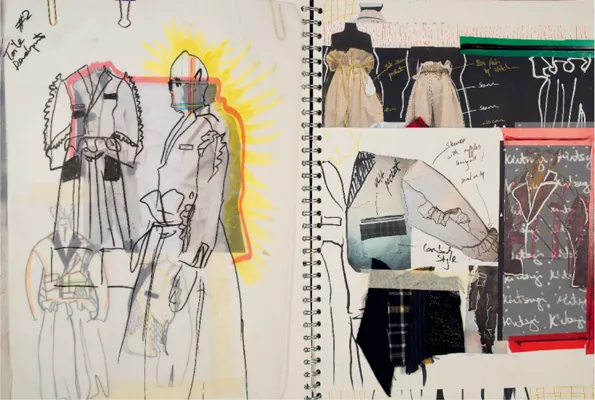
A double-page spread in a sketchbook informed by primary and secondary research. These pages show initial designs ideas, stand work with annotations and some fabric research.
Research is integral. A wise man once said to me, ‘Fashion does not come from fashion’, and it’s so true.
Carolyn Massey
Carolyn Massey
For me it is very important to absorb the world’s cultures. These construct your particular way of communicating, and provide a way to go beyond your own ‘mental home’.
Romeo Gigli
Romeo Gigli
Research can take the form of mood boards, nights out or a trip away somewhere. It’s a complete creative process where nothing is left out of the equation.
PPQ
PPQ
The Value of Research
Fashion research is a creative investigation that can yield ideas, which then inspire and contribute to the design process. The deeper the investigation, the more design opportunities it will provide – thorough research allows more links between the layers of research material to be made, simply because there is more material to work with. Superficial research, as the name suggests, just skims the surface; fewer links can be made, so it usually results in design ideas that have undergone insufficient development. Research should define the concept and the creative direction through a process of assimilation and editing. By researching you are searching, or searching again.
The fashion industry by its very nature is ephemeral – it is fast-paced and subject to change over very short periods of time. Nothing in fashion is totally new; it is a cycle with reinvention at its core. The ability to innovate – to create the ‘new’ – is developed through strong research application, which is, therefore, an essential skill for a designer. Designers cannot create within a vacuum; they are like sponges, constantly absorbing the environment around them to find the inspiration needed to create a point of difference – ‘newness’. Whether engaging with technological advances in fabric or reacting to a current political mood, designers are at the forefront of creative endeavours.
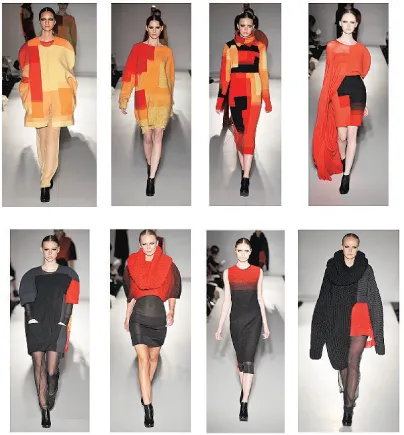
A cohesive collection results from strong research application where silhouette, proportion, line, fabric and colour are explored. In this collection, opaque felted fabric is paired with ultra-sheer chiffon, the blocks of colour divide the body in an interesting way, and the emphasis on the shoulders creates a top-heavy silhouette.
Primary Research
Primary research is a first-hand investigation. It consists of material that is created by you and which did not previously exist. A wide range of methods are used to gather and collate this, including experimenting with fabrics, taking your own photographs, making collages, and sketching indoors, outdoors, at galleries, museums and other places of interest.
When sketching at a gallery, you (the important ingredient) interpret an exhibit through drawing. Your focus should be on recording the elements of the exhibit that inspire you and can be of use. These can include anything from colour to form, texture and silhouette.
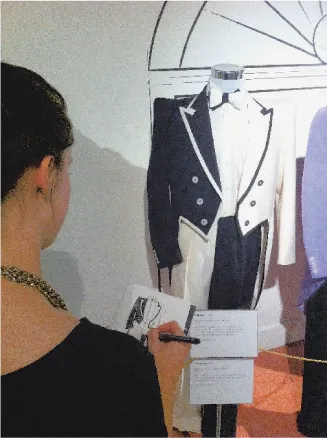
Drawing at the ‘Tommy Nutter: Rebel on the Row’ exhibition, at the Fashion and Textile Museum, London.
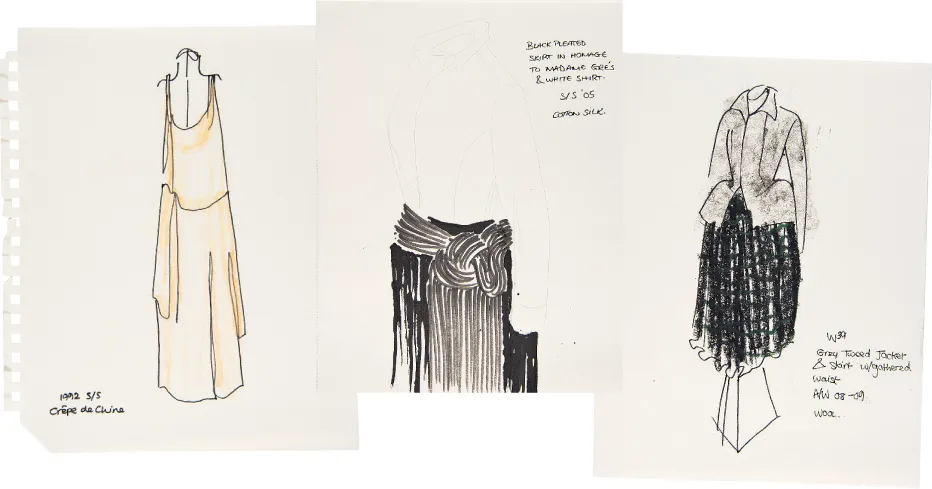
Drawings made at the ‘Yohji Yamamoto’ exhibition at the Victoria and Albert Museum, London.
Creating fabric samples, experimenting with design details and manipulating fabric are very hands-on approaches to fashion research – for many designers these provide the starting point of a collection. Issey Miyake, for example, is renowned for his use of pleated fabric (see here), and fabric manipulation is central to his work. Working on a tailor’s dummy also allows you to explore and research silhouette, proportion and form, enabling you to realize or interrogate your two-dimensional sketches and designs in three dimensions.
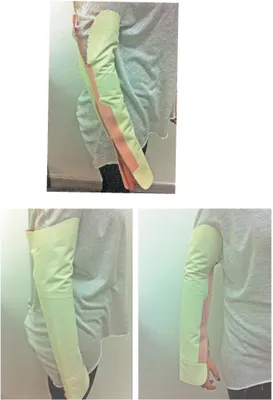
Shirt sleeve samples made by bonding fabrics. This piece was inspired by a concept-led approach, exploring the utility wear of nurses in hospitals.
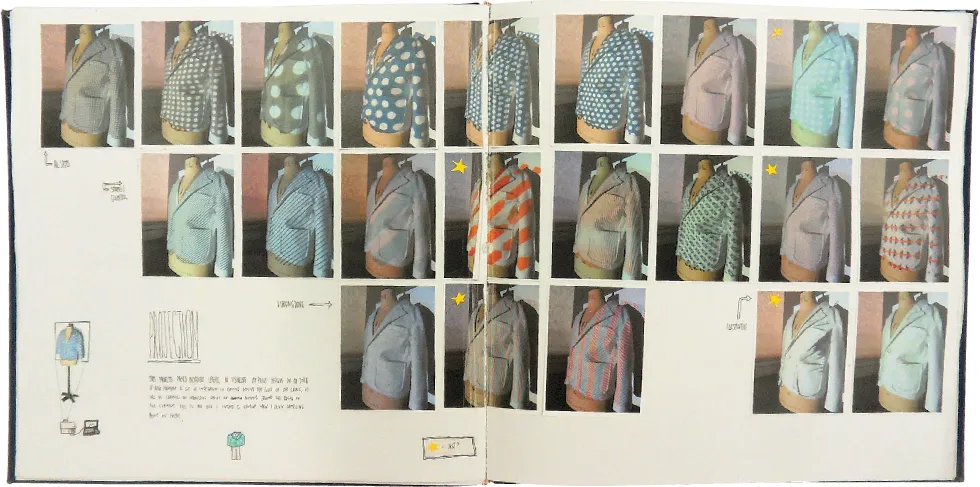
Experimenting with projection to decide on the print of a jacket for a collection.
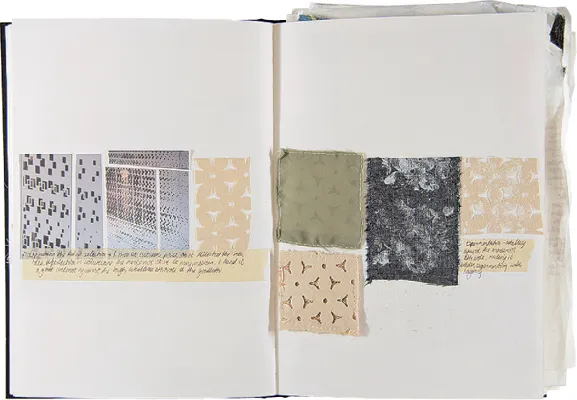
The fabric samples on the right-hand side have been inspired by the artwork images on the left-hand side of the sketchbook.
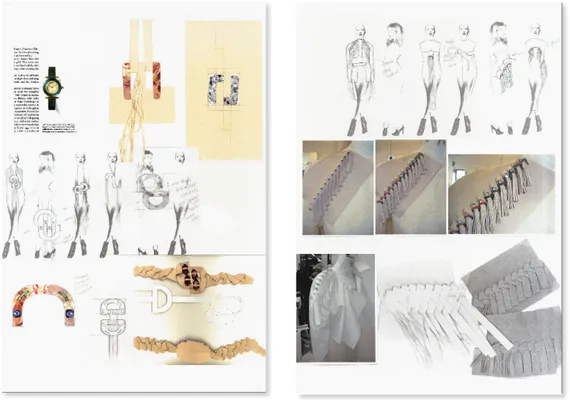
Experimenting with fabrics to further explore your concept can inform both how you design and what you design.
Photography also fits under the heading of primary research. This is frequently the quickest method of recording research material. You can use a camera to document inspirational objects and places. You can also photograph your experiments ...
Table of contents
- Cover
- Title
- Copyright
- Contents
- Introduction
- 1. What is Research?
- 2. How to Start Researching
- 3. Informational Research
- 4. Creative Research
- 5. Colour Research
- 6. Fabric Research
- 7. Market Research
- 8. Concept Development
- Glossary
- Further Reading
- Resources
- Index
- Picture Credits
- Acknowledgements
Trusted by 375,005 students
Access to over 1.5 million titles for a fair monthly price.
Study more efficiently using our study tools.
Frequently asked questions
Yes, you can cancel anytime from the Subscription tab in your account settings on the Perlego website. Your subscription will stay active until the end of your current billing period. Learn how to cancel your subscription
No, books cannot be downloaded as external files, such as PDFs, for use outside of Perlego. However, you can download books within the Perlego app for offline reading on mobile or tablet. Learn how to download books offline
Perlego offers two plans: Essential and Complete
- Essential is ideal for learners and professionals who enjoy exploring a wide range of subjects. Access the Essential Library with 800,000+ trusted titles and best-sellers across business, personal growth, and the humanities. Includes unlimited reading time and Standard Read Aloud voice.
- Complete: Perfect for advanced learners and researchers needing full, unrestricted access. Unlock 1.5M+ books across hundreds of subjects, including academic and specialized titles. The Complete Plan also includes advanced features like Premium Read Aloud and Research Assistant.
We are an online textbook subscription service, where you can get access to an entire online library for less than the price of a single book per month. With over 1.5 million books across 990+ topics, we’ve got you covered! Learn about our mission
Look out for the read-aloud symbol on your next book to see if you can listen to it. The read-aloud tool reads text aloud for you, highlighting the text as it is being read. You can pause it, speed it up and slow it down. Learn more about Read Aloud
Yes! You can use the Perlego app on both iOS and Android devices to read anytime, anywhere — even offline. Perfect for commutes or when you’re on the go.
Please note we cannot support devices running on iOS 13 and Android 7 or earlier. Learn more about using the app
Please note we cannot support devices running on iOS 13 and Android 7 or earlier. Learn more about using the app
Yes, you can access Fashion Design Research Second Edition by Ezinma Mbeledogu in PDF and/or ePUB format, as well as other popular books in Design & Design della moda. We have over 1.5 million books available in our catalogue for you to explore.