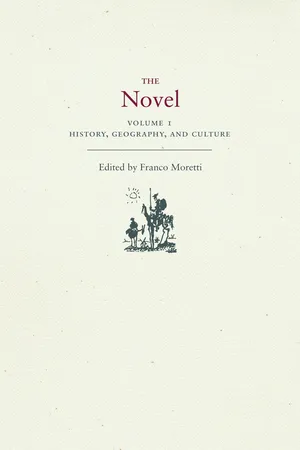
Nearly as global in its ambition and sweep as its subject, Franco Moretti's The Novel is a watershed event in the understanding of the first truly planetary literary form. A translated selection from the epic five-volume Italian Il Romanzo (2001-2003), The Novel's two volumes are a unified multiauthored reference work, containing more than one hundred specially commissioned essays by leading contemporary critics from around the world. Providing the first international comparative reassessment of the novel, these essential volumes reveal the form in unprecedented depth and breadth--as a great cultural, social, and human phenomenon that stretches from the ancient Greeks to today, where modernity itself is unimaginable without the genre.
By viewing the novel as much more than an aesthetic form, this landmark collection demonstrates how the genre has transformed human emotions and behavior, and the very perception of reality. Historical, statistical, and formal analyses show the novel as a complex literary system, in which new forms proliferate in every period and place.
Volume 1: History, Geography, and Culture, looks at the novel mostly from the outside, treating the transition from oral to written storytelling and the rise of narrative and fictionality, and covering the ancient Greek novel, the novel in premodern China, the early Spanish novel, and much else, including readings of novels from around the world.
These books will be essential reading for all students and scholars of literature.
- 928 pages
- English
- ePUB (mobile friendly)
- Available on iOS & Android
eBook - ePub
About this book
Information
Publisher
Princeton University PressYear
2022Print ISBN
9780691127187
9780691049472
eBook ISBN
9780691243757
Topic
LiteraturaSubtopic
Crítica literariaPART 1 . 1
A Struggle for Space
From Oral to Written: An Anthropological Breakthrough in Storytelling
The telling of tales is often thought to be characteristic of all human discourse, and it is fashionable to speak of narrative as a universal form of expression, one that is applied both to the life experiences of individuals and to the dramas of social interaction. Storytelling in oral cultures in turn is seen as the foundation on which the novel is built in literate ones, and the activity is regarded as the focus of much creativity. Blind Homer was the model, putting all his nonliterate imagination into the epic. In discussing storytelling we are clearly leading into the topics of fiction and the novel. But not all storytelling is fictional; it can also involve personal narratives. However, although typically it is associated with oral cultures, with “the singer [or teller] of tales,”1 in his article on the subject, Walter Benjamin sees the storyteller disappearing with the arrival of the novel, whose dissemination he associates with the advent of printing, and no longer directly linked with experience in the same way as before.2
The timing of the appearance of the novel is subject to discussion. Mikhail Baktin uses the term novel (or “novelness”) in a much more extended sense. But in dealing with origins more concretely, he traces three types: the novel of “adventure time” back to the Greek romances of the second century C.E., the novel of everyday time in the story of The Golden Ass of Apuleius, and the “chronotope” centered on biographical time, although this does not produce any novels at this period. All three forms are harbingers of the modern novel.3 That is basically a product of the arrival of printing in the late fifteenth century, but as we see from these early examples, the nature of story-telling had already radically changed with the coming of writing. Indeed, I want to argue that, contrary to much received opinion, narrative (already in 1566, according to the Oxford English Dictionary, used for “an account, narration, a tale, recital”) is not so much a universal feature of the human situation as one that is promoted by literacy and subsequently by printing.
Today the word narrative has come to have an iconic, indeed a cant, significance in Western literary and social science circles. I suggest a rather different approach, using the term in a much tighter way, implying a plot with a firm sequential structure, marked by a beginning, a middle, and an end in the Aristotelian manner. Otherwise, one becomes involved in a kind of extension similar to that which Derrida has tried to give to writing, in which term he includes all “traces,” including memory traces. That usage makes it impossible to make the at times essential distinction between written archives and memory banks. The same is true for the use of the word literature for oral genres, what I call standard oral forms, since this usage obscures important analytical differences. Likewise, narrative is sometimes held to include any vaguely sequential discourse. “What is the narrative?” is the often heard cry. When I employ the term, I do so in an altogether tighter sense, as a standard form that has a definite plot that proceeds by structured stages.
Let me take a recent, authoritative example of the wider usage. In his book, The Political Unconscious (1981), which is subtitled Narrative as a Socially Symbolic Act, Fredric Jameson sees his task as attempting to “restructure the problematics of ideology, of the unconscious and of desire, of representation, of history, and of cultural production, around the all-informing process of narrative, which I take to be . . . the central function or instance of the human mind.”4 There is little one can say about such a terrifyingly inclusive aim centered on such an all-embracing concept of the process of narrative. He is not alone in this usage. Some psychologists view storytelling as a prime mode of cognition; at a recent conference on competences, philosophers proposed the creation of narrative as one of the key competencies of humankind.
In attempting to query this and similar assumptions, I want also to tackle another. In an article on “the narrative structure of reality,” reflecting another all-inclusive use of this term, Stuart Hall remarks, “we make an absolutely too simple and false distinction between narratives about the real and the narratives of fiction, that is, between news and adventure stories.”5 Is that really too simple and false? In my experience the distinction exists, if not universally, at least transculturally. Indeed, I would suggest it is an intrinsic feature of linguistic discourse. How do we know someone is not deceiving us, telling us a fiction, a story, if we make no distinction?
As Orwell observes about Catalonia in his “Looking Back on the Spanish Civil War,” “This kind of thing is frightening to me, because it often gives me the feeling that the very concept of objective truth is fading out of the world. After all, the chances are that those lies or at any rate similar lies will pass into history.”6 Whether what we are being told is a fiction or a deliberate lie (implying intentionality), both are departures from the literal truth. It does not matter to me in this context whether there is philosophical justification for objective truth, a correspondence theory of truth. I need only an acknowledgment of the fact that the actors need to distinguish between truth and untruth.
It is true that psychology, psychoanalysis, and perhaps sociology too, have qualified our view of the lie from the standpoint of the individual, in an attempt to elicit the reasons why people do not tell the truth. But in dyadic interaction, in social communication between two or more persons, the question of the truth or untruth of a statement remains critical. Did he or did he not post the letter I gave him as he claimed? Untruth may not be a lie. It may also involve fantasy or fiction, fantasy being the latter’s nonrealistic equivalent. Fantasy does not invite a literal comparison with a truthful account of events at the surface level. But fiction may do just that, may make a claim to truth value. That was the difference between romances and novels in England at the beginning of the eighteenth century. The realistic novels of Defoe and others deliberately invite an assessment of the truth or otherwise of the tale. The writers often claim truth for fiction—not the underlying experiential truth but literal, factual truth.
The distinction runs parallel to that commonly made between history and myth, marked respectively by linear and circular time; the former in effect requires the availability of documents and hence of writing, but its absence does not exclude a sense of the past in oral cultures, of which myth is only one variety of “history,” in the formal meaning of a study based on the examination of documents. We might wish to qualify this distinction for our own purposes, but there can be little doubt that it emerged within the actor’s frame of reference; the Homeric mythos was set apart from historia and even logos, both of which implied some assessment of truth.7
In the absence of writing, communication in oral cultures has to rely largely on speech. Yet experience in Africa suggests that such discourse rather rarely consisted in the telling of tales, if by that we mean personal and fictional stories created for adults. The LoDagaa of northern Ghana certainly make a distinction of this kind between what I translate as “proper speech” (yil miong) and lies (ziiri), between truth and falsehood. Proper speech would include what I have translated as “The Myth of the Bagre,” but that recitation itself raises the question of whether what it offers is a lie or whether it is God’s way, God’s truth. Folktales are not referred to as lies, since they make no claim to the truth, but neither are they truth (for example, animals speak and behave like humans); as I shall claim, such tales are largely addressed to children, and they do verge upon the lie in the Platonic sense, as we see from the account of a LoDagaa writer.
For the problem with fictional narrative emerges from another angle in a rather imaginative autobiography by a member of this same LoDagaa group, Malidoma Somé, who claims his people make no distinction between the natural and supernatural or between reality and the imagined (which I doubt). Somé is described in his book, Of Water and the Spirit, as “a medicine man and diviner” as well as holding a Ph.D. from Brandeis and giving lectures at a spiritual center in America. He decides to test the absence of these distinctions by showing the elders of his African village a videotape of Star Trek. They interpret the film as portraying “the current affairs in the day-to-day lives of some other people living in the world. . . . I could not make them understand,” he writes, “that all this was not real. Even though stories abound in my culture, we have no word for fiction. The only way I could get across to them the Western concept of fiction was to associate fiction with telling lies.”8 That assertion corresponds with my own experience, at least as far as adults are concerned.
Truthful narratives among the LoDagaa, in my own experience, would be those relating to one’s own personal life, perhaps accounts of labor migration to the gold mines in the south of the country or those of local feuds or wars that happened before the coming of the colonial conquerors early last century. Stories of this kind are occasionally told, but their place is rather marginal; narrative and storytelling, even nonfictional, are hardly as central as is visualized by those seeking to reconstruct the forms of discourse in early literate culture and supposedly inherited from yet earlier purely oral ones.
The discussions of Derrida, Hall, and Jameson seem to me to represent the elimination or neglect of historically and analytically useful distinctions in a misguided, postmodern-influenced drive against “binarism” and toward holism. In fact the distinctions we have adopted do not threaten the overall unity of the esprit humain, the human mind, nor do they necessarily embody a we/they view of the world.
Turning more specifically to the question of narrative in oral cultures, there are five aspects I want to look at: legends, epics, myths, folktales, and finally, personal narratives. The epic is a distinctly narrative form, partly fictional, though often having a basis in heroic deeds on the field of battle. It is defined as a kind of narrative poetry that celebrates the achievements of some heroic personage of history or tradition (that is, which may have a quota of fact). The great scholar of early literature, Hector Chadwick, saw the epic as the typical product of what he called the Heroic Age, peopled by chiefs, warriors, and tribesmen (1932–40). Since this genre is usually regarded as emerging in preliterate societies, much academic research has been directed at trying to show that, for example, the Homeric poems, as epics, were composed in preliterate rather than literate cultures. During the 1930s, the Harvard classical scholars, Milman Parry (1971) and Albert Lord (1960), made a series of recordings of songs in Yugoslav cafés and aimed to show that their style, especially in the use of form...
Table of contents
- Cover Page
- Title Page
- Copyright Page
- Contents
- On The Novel
- Part 1.1: A Struggle for Space
- Part 1.2: Polygenesis
- Part 1.3: The European Acceleration
- Part 1.4: The Circle Widens
- Part 1.5: Toward World Literature
- Contributors
- Author Index
- Works Cited Index
Trusted by 375,005 students
Access to over 1.5 million titles for a fair monthly price.
Study more efficiently using our study tools.
Frequently asked questions
Yes, you can cancel anytime from the Subscription tab in your account settings on the Perlego website. Your subscription will stay active until the end of your current billing period. Learn how to cancel your subscription
No, books cannot be downloaded as external files, such as PDFs, for use outside of Perlego. However, you can download books within the Perlego app for offline reading on mobile or tablet. Learn how to download books offline
Perlego offers two plans: Essential and Complete
- Essential is ideal for learners and professionals who enjoy exploring a wide range of subjects. Access the Essential Library with 800,000+ trusted titles and best-sellers across business, personal growth, and the humanities. Includes unlimited reading time and Standard Read Aloud voice.
- Complete: Perfect for advanced learners and researchers needing full, unrestricted access. Unlock 1.5M+ books across hundreds of subjects, including academic and specialized titles. The Complete Plan also includes advanced features like Premium Read Aloud and Research Assistant.
We are an online textbook subscription service, where you can get access to an entire online library for less than the price of a single book per month. With over 1.5 million books across 990+ topics, we’ve got you covered! Learn about our mission
Look out for the read-aloud symbol on your next book to see if you can listen to it. The read-aloud tool reads text aloud for you, highlighting the text as it is being read. You can pause it, speed it up and slow it down. Learn more about Read Aloud
Yes! You can use the Perlego app on both iOS and Android devices to read anytime, anywhere — even offline. Perfect for commutes or when you’re on the go.
Please note we cannot support devices running on iOS 13 and Android 7 or earlier. Learn more about using the app
Please note we cannot support devices running on iOS 13 and Android 7 or earlier. Learn more about using the app
Yes, you can access The Novel, Volume 1 by Franco Moretti in PDF and/or ePUB format, as well as other popular books in Literatura & Crítica literaria. We have over 1.5 million books available in our catalogue for you to explore.