"The greatest American dramatist of our age." (Evening Standard)
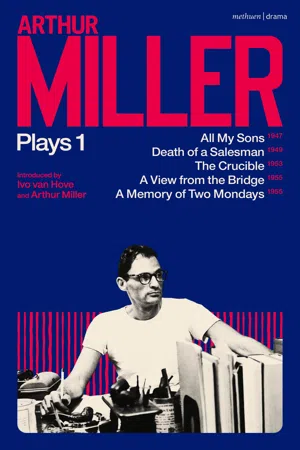
In this collected works, five of Arthur Miller's most-produced and popular plays are brought together in a new edition, alongside an exclusive introduction by Ivo van Hove, the celebrated contemporary director of Miller's works.
All five plays were written by Miller within a ten-year period which began with his first Broadway hit, All My Sons, in 1947 which led Brooks Atkinson of the New York Times to state that 'theatre has acquired a genuine new talent.' This was followed in 1949 by his exploration of the American Dream in Death of a Salesman, which went on to win the Tony Award for Best Play and the Pulitzer Prize for Drama.
The Crucible followed in 1953, produced during the McCarthy era and becoming a parable of the witch-hunting practices of a government determined to root-out Communists. A View from the Bridge, originally performed in 1955, concerns the lives of longshoremen in the Brooklyn waterfront and has remained one of Miller's most produced plays. Originally presented as a one-act companion piece to A Memory of Two Mondays, both plays explore the dreams and working lives of ordinary Americans in the early decades of the 20th century.
Freshly edited and featuring a bold new design, this updated edition of Arthur Miller Plays 1 is a must-have for theatre fans and students alike.
eBook - ePub
Arthur Miller Plays 1
All My Sons; Death of a Salesman; The Crucible; A Memory of Two Mondays; A View from the Bridge
- 472 pages
- English
- ePUB (mobile friendly)
- Available on iOS & Android
eBook - ePub
Arthur Miller Plays 1
All My Sons; Death of a Salesman; The Crucible; A Memory of Two Mondays; A View from the Bridge
About this book
Information
Death of a Salesman
Certain Private Conversations in Two Acts and a Requiem
The Characters
| Willy Loman | Charley |
| Linda | Uncle Ben |
| Biff | Howard Wagner |
| Happy | Jenny |
| Bernard | Stanley |
| The Woman | Miss Forsythe |
| Letta |
The action takes place in Willy Loman’s house and yard and in various places he visits in the New York and Boston of today.
Act One
A melody is heard, played upon a flute. It is small and fine, telling of grass and trees and the horizon. The curtain rises.
Before us is the Salesman’s house. We are aware of towering, angular shapes behind it, surrounding it on all sides. Only the blue light of the sky falls upon the house and forestage; the surrounding area shows an angry glow of orange. As more light appears, we see a solid vault of apartment houses around the small, fragile-seeming home. An air of the dream clings to the place, a dream rising out of reality. The kitchen at center seems actual enough, for there is a kitchen table with three chairs, and a refrigerator. But no other fixtures are seen. At the back of the kitchen there is a draped entrance, which leads to the living-room. To the right of the kitchen, on a level raised two feet, is a bedroom furnished only with a brass bedstead and a straight chair. On a shelf over the bed a silver athletic trophy stands. A window opens onto the apartment house at the side.
Behind the kitchen, on a level raised six and a half feet, is the boys’ bedroom, at present barely visible. Two beds are dimly seen, and at the back of the room a dormer window. (This bedroom is above the unseen living-room.) At the left a stairway curves up to it from the kitchen.
The entire setting is wholly or, in some places, partially transparent. The roof-line of the house is one-dimensional; under and over it we see the apartment buildings. Before the house lies an apron, curving beyond the forestage into the orchestra. This forward area serves as the back yard as well as the locale of all Willy’s imaginings and of his city scenes. Whenever the action is in the present the actors observe the imaginary wall-lines, entering the house only through its door at the left. But in the scenes of the past these boundaries are broken, and characters enter or leave a room by stepping “through” a wall onto the forestage.
From the right, Willy Loman, the Salesman, enters, carrying two large sample cases. The flute plays on. He hears but is not aware of it. He is past sixty years of age, dressed quietly. Even as he crosses the stage to the doorway of the house, his exhaustion is apparent. He unlocks the door, comes into the kitchen, and thankfully lets his burden down, feeling the soreness of his palms. A word-sigh escapes his lips—it might be “Oh, boy, oh, boy.” He closes the door, then carries his cases out into the living-room, through the draped kitchen doorway.
Linda, his wife, has stirred in her bed at the right. She gets out and puts on a robe, listening. Most often jovial, she has developed an iron repression of her exceptions to Willy’s behavior—she more than loves him, she admires him, as though his mercurial nature, his temper, his massive dreams and little cruelties, served her only as sharp reminders of the turbulent longings within him, longings which she shares but lacks the temperament to utter and follow to their end.
Linda (hearing Willy outside the bedroom, calls with some trepidation) Willy!
Willy It’s all right. I came back.
Linda Why? What happened? (Slight pause.) Did something happen, Willy?
Willy No, nothing happened.
Linda You didn’t smash the car, did you?
Willy (with casual irritation) I said nothing happened. Didn’t you hear me?
Linda Don’t you feel well?
Willy I’m tired to the death. (The flute has faded away. He sits on the bed beside her, a little numb.) I couldn’t make it. I just couldn’t make it, Linda.
Linda (very carefully, delicately) Where were you all day? You look terrible.
Willy I got as far as a little above Yonkers. I stopped for a cup of coffee. Maybe it was the coffee.
Linda What?
Willy (after a pause) I suddenly couldn’t drive any more. The car kept going off onto the shoulder, y’know?
Linda (helpfully) Oh. Maybe it was the steering again. I don’t think Angelo knows the Studebaker.
Willy No, it’s me, it’s me. Suddenly I realize I’m goin’ sixty miles an hour and I don’t remember the last five minutes. I’m—I can’t seem to—keep my mind to it.
Linda Maybe it’s your glasses. You never went for your new glasses.
Willy No, I see everything. I came back ten miles an hour. It took me nearly four hours from Yonkers.
Linda (resigned) Well, you’ll just have to take a rest, Willy, you can’t continue this way.
Willy I just got back from Florida.
Linda But you didn’t rest your mind. Your mind is overactive, and the mind is what counts, dear.
Willy I’ll start out in the morning. Maybe I’ll feel better in the morning. (She is taking off his shoes.) These goddam arch supports are killing me.
Linda Take an aspirin. Should I get you an aspirin? It’ll soothe you.
Willy (with wonder) I was drivin...
Table of contents
- Cover
- Half-Title Page
- Title Page
- Contents
- Arthur Miller: Chronology of Professionally Produced Plays
- Introduction by Ivo van Hove
- Introduction by Arthur Miller
- All My Sons
- Death of Salesman
- The Crucible
- A Memory of Two Mondays
- A View from the Bridge
- Copyright
Trusted by 375,005 students
Access to over 1.5 million titles for a fair monthly price.
Study more efficiently using our study tools.
Frequently asked questions
Yes, you can cancel anytime from the Subscription tab in your account settings on the Perlego website. Your subscription will stay active until the end of your current billing period. Learn how to cancel your subscription
No, books cannot be downloaded as external files, such as PDFs, for use outside of Perlego. However, you can download books within the Perlego app for offline reading on mobile or tablet. Learn how to download books offline
Perlego offers two plans: Essential and Complete
- Essential is ideal for learners and professionals who enjoy exploring a wide range of subjects. Access the Essential Library with 800,000+ trusted titles and best-sellers across business, personal growth, and the humanities. Includes unlimited reading time and Standard Read Aloud voice.
- Complete: Perfect for advanced learners and researchers needing full, unrestricted access. Unlock 1.5M+ books across hundreds of subjects, including academic and specialized titles. The Complete Plan also includes advanced features like Premium Read Aloud and Research Assistant.
We are an online textbook subscription service, where you can get access to an entire online library for less than the price of a single book per month. With over 1.5 million books across 990+ topics, we’ve got you covered! Learn about our mission
Look out for the read-aloud symbol on your next book to see if you can listen to it. The read-aloud tool reads text aloud for you, highlighting the text as it is being read. You can pause it, speed it up and slow it down. Learn more about Read Aloud
Yes! You can use the Perlego app on both iOS and Android devices to read anytime, anywhere — even offline. Perfect for commutes or when you’re on the go.
Please note we cannot support devices running on iOS 13 and Android 7 or earlier. Learn more about using the app
Please note we cannot support devices running on iOS 13 and Android 7 or earlier. Learn more about using the app
Yes, you can access Arthur Miller Plays 1 by Arthur Miller in PDF and/or ePUB format, as well as other popular books in Media & Performing Arts & Theatre. We have over 1.5 million books available in our catalogue for you to explore.