eBook - ePub
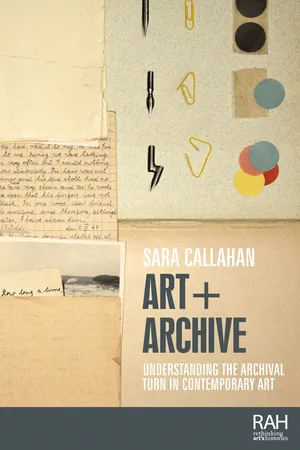
Art + Archive
Understanding the archival turn in contemporary art
- 334 pages
- English
- ePUB (mobile friendly)
- Available on iOS & Android
eBook - ePub
Art + Archive
Understanding the archival turn in contemporary art
About this book
Art + Archive provides an in-depth analysis of the connection between art and the archive at the turn of the twenty-first century. The book examines how the archive emerged in art writing in the mid-1990s and how its subsequent ubiquity can be understood in light of wider social, technological, philosophical and art-historical conditions and concerns. Deftly combining writing on archives from different disciplines with artistic practices, the book clarifies the function and meaning of one of the most persistent artworld buzzwords of recent years, shedding light on the conceptual and historical implications of the so-called archival turn in contemporary art.
Information
Publisher
Manchester University PressYear
2022Print ISBN
9781526160287
9781526156853
eBook ISBN
9781526156846
Topic
ArtSubtopic
Art Theory & CriticismPart I
The notion of the archive in art writing and theory
1
Archive art discourse
A keyword search on the term archive and archival on the online sites of two prominent art magazines (Artforum and Art Journal) reveals relatively few references to these terms in the 1960s, 1970s and 1980s, growing slightly in the 1990s, only to rise sharply from around 2005 onwards with hundreds of hits each year. The increased frequency of references to the archive in these publications is an indication of a wider use of archival terminology in the art field in the early years of the twenty-first century – not only in art magazines but in exhibitions, artists’ texts, academic symposia, special issues of journals and periodicals, as well as numerous articles and books.
Already in 1986 Allan Sekula discussed the nineteenth-century archive as part of an epistemological structure deeply connected to photography's ability to establish and delimit the deviance and social pathology of the other in his essay ‘The Body and the Archive’.1 Although not overtly about art at all, it was written by an artist and photography theorist, and has been frequently referenced in subsequent texts on archive art. John Tagg, another photography theorist, suggested in 2012 that he himself, Sekula and other writers with an interest in the archive as a political apparatus were part of a different ‘archival mode’ than those who took on the topic in the 1990s and 2000s.2 The terminology was similar, but, as noted, Tagg claimed that by the later date the archive had become little more than a ‘must-have accessory of the moment’.3 What the surge of references to the archive consists of, should include, and whether it is welcome and significant or too ubiquitous to be useful is the subject of some debate. What is clear is that critics, art historians and curators use archival terminology to describe a perceived trend in artworks and practices in the decades following the mid-1990s. To be precise, two separate archive-related tendencies emerge in the art context at the turn of the twenty-first century: the term archive – and variations thereof – is more frequently used, but it also comes to have a more diverse set of meanings and associations than in previous decades.
Although archival terminology is in frequent use at this time, it is not possible to fully grasp the phenomenon of archive art by keyword searches alone. Artworks and artistic practices included in the category are not considered archival merely because they overtly use the terminology of archives, but because they are somehow seen to evoke archival concepts or themes.
The aim of this book is not to add to the growing list of publications that propose their own definition of archive art. In fact, this book operates with the assumption that the category ‘archive art’ does not exist separately from the texts, artworks, exhibitions and practices that identify it as such.4 It is far from clear whether it should be considered a category of art at all, or whether it is more accurately described as a shared set of interests. The focus of this first chapter is therefore to examine how such a ‘turn’ or grouping was formed, and to lay the groundwork for a careful examination of how the notion of the archive functions in a contemporary art context. This chapter is divided into two distinct parts: first an outline of the corpus of texts and some related exhibitions that contribute to the identification, definition and cementation of a set of artworks and practices that can be termed archive art. By zooming in on a number of texts written over the course of approximately two decades (mid-1990s to mid-2010s), the first part can be likened to a set of index cards where pertinent quotes and brief summaries of the texts are laid out, like a literature review of archive art discourse. Or, to use a more archival image, the first part functions a bit like the archive's finding aid, a tool to help the reader navigate the material and get a bird's-eye view of a sprawling set of documents. Following the first part is an outline of ten broad themes identified in the text corpus. I introduce these thematic clusters here, but they will reappear in Part II of the book where they will be further unpacked and analysed. The reader can therefore approach this chapter in two ways: since it is intended as a foundation for what is to come it can be read thoroughly before moving on to subsequent chapters, but it can also be productively referenced while reading the book's later parts, if and when needed.
The text corpus of archive art
It is difficult to pinpoint the exact beginning of the archive art phenomenon; however, it is fair to say that one of the very first to identify an archival trend was curator and writer Ingrid Schaffner, whose essay ‘Deep Storage: On the Art of Archiving’ was published in the summer issue of the British art magazine Frieze in 1995.5 The themes of storage and archiving identified in the article were later developed into an exhibition co-curated by Schaffner.6 On the occasion of the exhibition's move to the US a large catalogue was produced that contained a slightly reworked version of Schaffner's essay, as well as a one-page meta-reflection on the project.7 The catalogue also included texts by prominent writers in the field of photography theory, art history, critique and media theory such as Geoffrey Batchen, Benjamin Buchloh, Sheryl Conkelton, Geert Lovink, Stefan Iglhaut and Susan Buck-Morss. In Schaffner's essay, storage was the main focus, and the archive was directly tied to the physical space of the museum.8 She argued that ‘[a]nxiety and dust provoke the archiving impulse. In the museum – the mausoleum most artists still aim to enter through their work – the recesses of the storeroom simultaneously beckon and bar access to history.’ 9 In addition to this focus on concrete and physical archives, the archive...
Table of contents
- Cover
- Half-title page
- Series page
- Title page
- Copyright page
- Contents
- Plates
- Figures
- Acknowledgements
- The archive: a must-have accessory of the moment?
- Part I: The notion of the archive in art writing and theory
- Part II: Five themes in contemporary archive art
- Postscript
- Bibliography
- Index
- Color Plates
Trusted by 375,005 students
Access to over 1.5 million titles for a fair monthly price.
Study more efficiently using our study tools.
Frequently asked questions
Yes, you can cancel anytime from the Subscription tab in your account settings on the Perlego website. Your subscription will stay active until the end of your current billing period. Learn how to cancel your subscription
No, books cannot be downloaded as external files, such as PDFs, for use outside of Perlego. However, you can download books within the Perlego app for offline reading on mobile or tablet. Learn how to download books offline
Perlego offers two plans: Essential and Complete
- Essential is ideal for learners and professionals who enjoy exploring a wide range of subjects. Access the Essential Library with 800,000+ trusted titles and best-sellers across business, personal growth, and the humanities. Includes unlimited reading time and Standard Read Aloud voice.
- Complete: Perfect for advanced learners and researchers needing full, unrestricted access. Unlock 1.5M+ books across hundreds of subjects, including academic and specialized titles. The Complete Plan also includes advanced features like Premium Read Aloud and Research Assistant.
We are an online textbook subscription service, where you can get access to an entire online library for less than the price of a single book per month. With over 1.5 million books across 990+ topics, we’ve got you covered! Learn about our mission
Look out for the read-aloud symbol on your next book to see if you can listen to it. The read-aloud tool reads text aloud for you, highlighting the text as it is being read. You can pause it, speed it up and slow it down. Learn more about Read Aloud
Yes! You can use the Perlego app on both iOS and Android devices to read anytime, anywhere — even offline. Perfect for commutes or when you’re on the go.
Please note we cannot support devices running on iOS 13 and Android 7 or earlier. Learn more about using the app
Please note we cannot support devices running on iOS 13 and Android 7 or earlier. Learn more about using the app
Yes, you can access Art + Archive by Sara Callahan, Marsha Meskimmon, Amelia Jones, Marsha Meskimmon,Amelia Jones in PDF and/or ePUB format, as well as other popular books in Art & Art Theory & Criticism. We have over 1.5 million books available in our catalogue for you to explore.