Alvar Aalto and The Art of Landscape captures the essence of the Finnish architect's landscape concept, emphasising culture and tradition, which characterised his approach to and understanding of architecture as part of the wider environment. From the forests of his youth to sights from his travels, Alvar Aalto (1898–1976) was influenced by outdoor landscapes. Throughout his career, he felt the need to shape the terrain and this became a signature of his architecture. Divided into five chapters, this book traces Aalto's relationship with landscape, starting with an analysis of his definitions and descriptions of landscape language, which ranged from natural references and biological terms, to synonyms and comparisons. It includes beautifully illustrated case study projects from the 1950s and 1960s, discussing Aalto's transformation of different landscapes through topography, terracing and tiers, ruins and natural elements, horizon outlines, landmarks, and the repetition of form. Featuring archival sketches, garden drawings, and plans, the book also contains Aalto's text 'Architecture in the Landscape of Central Finland' from 1925 in the appendix. This book provides fascinating, untold insights into Aalto's relationship with landscape and how this developed during his lifetime, for scholars, researchers, and students interested in architecture and landscape history, landscape art, and cultural studies.
- 216 pages
- English
- ePUB (mobile friendly)
- Available on iOS & Android
eBook - ePub
Alvar Aalto and The Art of Landscape
About this book
Information
1 Writings of Alvar Aalto
DOI: 10.4324/9781003220961-2
Landscape
The first time Aalto wrote about landscape was in 1921, right after completing his education. He wrote about the harmony in landscape and compared two different ways of planting buildings into the landscape in a small, old rural centre, Keuruu nearby Jyväskylä:
Something does catch the eye, however – there are two churches here. One of them is on ground level, in a birch grove. It is humble and old. The other stands among pine trees on a hill. It is large, not at all humble, and it is new…The old church is built of wood. Its colour is black, a strikingly beautiful shade of black. The homely tar has darkened over the years into wonderful patina. The tower has a noble design, the whole church is well-proportioned. It reflects stylistic form from faraway, civilized countries, but seen through the child’s eye of a Northener… The new church is made of brick, it has a high tower, and the whole building bursts out of the frame of the landscape. This church does not speak, it shouts, like a person who doesn’t want to hear other voices. We see no trace of a devoted master’s love of his work here, we do not see the consideration of a sensitive eye for the nature around.1
At that time, Aalto had not yet been to Italy, where his eye caught the elegance of old hilltop towns. In the 1920s, Aalto worked on the designs of renovations for seven old churches and proposals or competition entries for eight new churches. In doing so, he was actively thinking and writing about ways to capture the atmosphere of the building:
When entering our old churches, gazing at a Gustavian (Rococco) country manor or examining a century old work of rural handicraft, we are seized by emotion. No doubt this is partly due to the trace of human handwork on the surface, the artistic purity of building materials or the simple lines adapted to our landscape; on the other hand, it also has to do with the signs of wear and centuries of patina in the building material.2
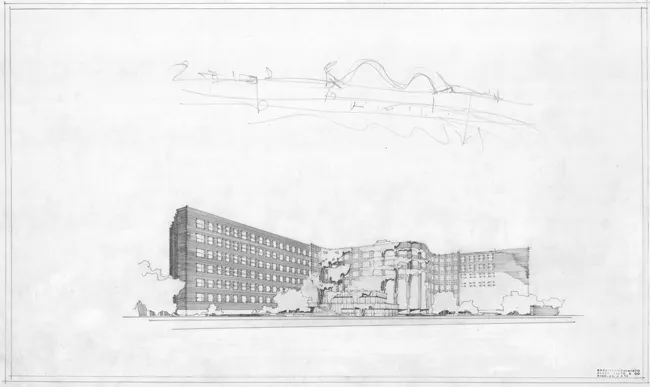
It is noteworthy that, by then, he was already combining the idea of contour of the landscape to the patina of material. These same concepts that are reflected in his work in the early 1950s were already coming together for the first time in the MIT dormitory (1946–49), where the organic shape of the building follows the nearby river, with the specially ordered handmade bricks to execute his idea to have trellises covered with climbers like in hanging gardens (Figure 1.1).3
In his article, ‘Architecture in the Landscape of Central Finland’ (the whole text in page 160), written shortly after Midsummer Night in 1925, Aalto wrote ‘The landscape (I use this word, since it is the best adapted to characterize nature)…’.4 Here, Aalto encapsulates landscape as a view from a distance or a point, and that is how it appears when surveying his sketches. His early sketches for his first commission to design a church in 1926 for Muurame parish, a small community to the south of Jyväskylä by Lake Päijänne, were drawn from a distance, showing not only the building but also the landscape. By that time, he had already visited Italy twice and become familiar with the hilly landscape and how to make the most of the hilltops. ‘The variety of contour’, mentioned in the same article, appears as silhouettes or outlines of the landscape as a source of inspiration in several of his designs. Examples of these can be seen in Aalto’s early sketches for the League of Nations Building in Geneva (1926) all the way to the very late proposal for Shiraz Art Museum (1969–70) in Iran. Neither of these was realised. Many sketches of Muurame church were made in the same way. In November 1925, he wrote in a Sunday annex of the local newspaper together with the sketches of the Muurame church:
Muurame village, the site of the forthcoming church, is an exceptionally beautiful valley formation encircled by high hills, and as such is a highly advantageous, yet demanding setting for a church building. Nowhere in Central Finland have I encountered a landscape whose lines curved so boldly and where the different elements of the landscape were each in turn so harmoniously and well represented. The integration of the water in narrow strips into the shoreside landscape, the old arable agriculture in the valley bottom, the little river with its old stone bridge, the factory building in the village’s nethermost jungle, the topographically beautiful mark on the landscape made by the road, and so on, all of these features together form a quite especially rare and powerfully culture-imprinted panorama, which currently only lacks one feature, an architecturally focal monument…5
The text, which comprises only a few sentences, is a detailed analysis combining the natural and cultural landscapes. By using the words ‘panorama’ and ‘topography’, loanwords in the Finnish language, he wanted to underline his professional attitude to his task in an otherwise quite poetic description.
Landscape as an ‘observational instrument’ leads one to take a closer view of some of Aalto’s ‘landscape images’ that he created by cropping the landscape or by creating the landscape for us to look at in his buildings. This might be owing to some influence of the Pavillon Le Corbusier, Pavillon de L’Esprit Nouveau, and Villa ‘Le Lac’.6 Particularly good examples of this are the landscape framed by the south-facing opening in the brick wall of the courtyard at the Muuratsalo Experimental House (1952–53), or the internal courtyards that allow natural light to fill the corridors of Helsinki University of Technology at the Otaniemi campus (1953–60); the latter of these are spaces that can be seen but are seldom used. The framed view from the living room in Villa Mairea (1938–39) opens up a totally other kind of image. That image is oriented towards history and tradition; there is a sauna building made of logs with turf on the roof-like old times, standing on the shoreline of the imaginary lake, that is, the pool surrounded by wildflowers. In the old photographs, they were white daisies. The image can also be seen as a gesture of gratitude towards the older generation, as the wealth of the Ahlström family – the owners of the house – lied on the timber industry.
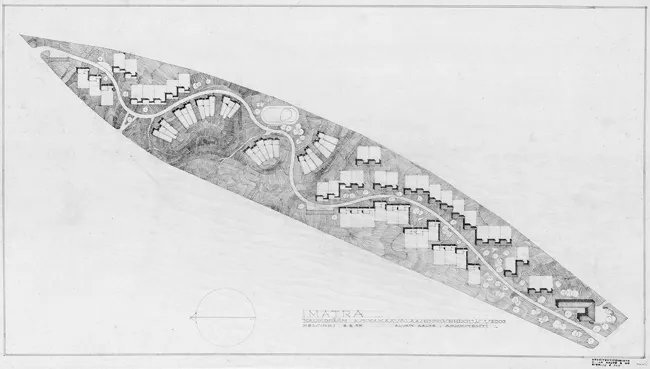
In 1924, Aalto wrote, ‘It was Mantegna’s painting that made me analyse the topography of Finnish towns. We also have hills which are sometimes reminiscent of the holy land of Tuscany. In some places, where railways and the engineer’s mania for levelling have not yet made everything ungainly, the houses mount the slopes in terraces and the twists and turns of the road follow a higher law…’.7 The text shows that Aalto’s thoughts of landscape were oriented to urban design from very early in his life. His experiences as a teenager working with his surveyor father made him recognise the levelling in the most ordinary surroundings such as traffic lanes. Göran Schildt mentioned in his preface to Aalto’s 1924 article that Aalto had by that time a plan to write a book about urban architecture! Unfortunately, there exists no evidence regarding that. The use of terrain contours as a main instrument for placing buildings on site can be seen already in his plans for the Sunila housing area (1936–38). There, the residential buildings are freely placed in the forest in a fan-shaped configuration on a slope towards the bottom of the valley along with sports grounds. The Kaukopää housing area in Imatra (1957) is also placed on a slightly sloped coniferous forest in a fan-shaped plan. Similar settings in different variations form a basic style in Aalto’s urban plans, and there is a reason for that pattern. A fan-shaped plan settles better in a hilly landscape than a grid-shaped plan, and it is more merciful for natural elements such as stones to be left on site (Figure 1.2).
Aalto used the word landscape also as contradictory to rational or standard. In 1942, he wrote a text in a booklet titled ‘Architecture and Standards’, published by the Finnish Association of Architects. There, he spoke of the problem of definitions and envied the authors who had dictionaries with words precisely defined like ‘standards’:
Even with the limited vocabulary of every day speech, the author can describe a great variety of things, present his ideas, and give expression to shifting emotions, depending on his skill in using the language. The architect’s plight is different…8
In the original Finnish text, Aalto used the word maisema, landscape to mean ‘shifting emotions of landscape’. He must have meant that landscapes arouse the kind of feelings that are difficult to express with the language of architecture. Although his use of the word ‘landscape’ in his speech at the Academy of Finland in 1955 was cryptic, it is a famous speech where he explored the possibility of using standardisation in a more human way, taking a car as an example:
It stands on four wheels, always in a similar setting – a highway or a street – whereas human dwellings exist in millions of different places with constantly varying characteristics; the sun is now here, now there – in other words, the orientation varies, the landscape varies, requirements vary traffic arteries are placed in various ways on different sides of the home or housing area, dwellings are built at different latitudes from Spitsbergen to the tropics.9
Here again the important words for ‘landscape’ in the Finnish language are missing. Aalto wrote that the enjoyment of varied landscapes is a basic human need. In both these examples, Aalto was referring to the emotions aroused by landscapes, and that is what he was doing when creating the various layers of images both with his plans and projects.
In an interview on Finnish TV in 1972, the interviewer, Göran Schildt, asked Aalto about his relation to his father’s profession. His response was
…As for the Finnish landscape, it was there all around me, all the time. That experience of a working balance also gave me an idea of how man should treat his surroundings. You have written in your books that man’s activities in nature are like cancer in a living body. But it doesn’t have to be like that. We can instead seek a balance with our environ...
Table of contents
- Cover
- Half Title
- Series Page
- Title Page
- Copyright Page
- Table of Contents
- Preface
- Acknowledgement
- Introduction
- 1 Writings of Alvar Aalto
- 2 The origin of Aalto's landscape concept
- 3 Alvar Aalto – the influences of the visual arts
- 4 Case studies
- 5 Architecture in the Landscape of Central Finland
- 6 Chronology
- Conclusions
- Index
Trusted by 375,005 students
Access to over 1.5 million titles for a fair monthly price.
Study more efficiently using our study tools.
Frequently asked questions
Yes, you can cancel anytime from the Subscription tab in your account settings on the Perlego website. Your subscription will stay active until the end of your current billing period. Learn how to cancel your subscription
No, books cannot be downloaded as external files, such as PDFs, for use outside of Perlego. However, you can download books within the Perlego app for offline reading on mobile or tablet. Learn how to download books offline
Perlego offers two plans: Essential and Complete
- Essential is ideal for learners and professionals who enjoy exploring a wide range of subjects. Access the Essential Library with 800,000+ trusted titles and best-sellers across business, personal growth, and the humanities. Includes unlimited reading time and Standard Read Aloud voice.
- Complete: Perfect for advanced learners and researchers needing full, unrestricted access. Unlock 1.5M+ books across hundreds of subjects, including academic and specialized titles. The Complete Plan also includes advanced features like Premium Read Aloud and Research Assistant.
We are an online textbook subscription service, where you can get access to an entire online library for less than the price of a single book per month. With over 1.5 million books across 990+ topics, we’ve got you covered! Learn about our mission
Look out for the read-aloud symbol on your next book to see if you can listen to it. The read-aloud tool reads text aloud for you, highlighting the text as it is being read. You can pause it, speed it up and slow it down. Learn more about Read Aloud
Yes! You can use the Perlego app on both iOS and Android devices to read anytime, anywhere — even offline. Perfect for commutes or when you’re on the go.
Please note we cannot support devices running on iOS 13 and Android 7 or earlier. Learn more about using the app
Please note we cannot support devices running on iOS 13 and Android 7 or earlier. Learn more about using the app
Yes, you can access Alvar Aalto and The Art of Landscape by Teija Isohauta in PDF and/or ePUB format, as well as other popular books in Architecture & Urban Planning & Landscaping. We have over 1.5 million books available in our catalogue for you to explore.