Referenced by Winston Churchill as one of...the greatest books ever written in the English language..., Seven Pillars of Wisdom follows British Army Colonel T. E. Lawrence through his time during the First World War. Completed in 1922, the book was not published until 1926. An autobiographical account told in fantastical prose, this telling of historical events shows the Arab Revolt through Lawrence's eyes in vivid detail.
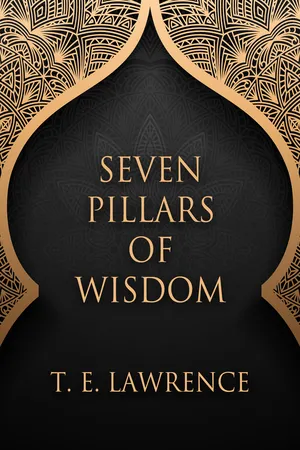
- 1,035 pages
- English
- ePUB (mobile friendly)
- Available on iOS & Android
eBook - ePub
Seven Pillars of Wisdom
About this book
Information
BOOK FOUR. Extending to Akaba
CHAPTERS XXXIX TO LIV
The port of Akaba was naturally so strong that it could be taken only by surprise from inland: but the opportune adherence to Feisal of Auda Abu Tayi made us hope to enrol enough tribesmen in the eastern desert for such a descent upon the coast.
Nasir, Auda, and I set off together on the long ride. Hitherto Feisal had been the public leader: but his remaining in Wejh threw the ungrateful load of this northern expedition upon myself. I accepted it and its dishonest implication as our only means of victory. We tricked the Turks and entered Akaba with good fortune.
Nasir, Auda, and I set off together on the long ride. Hitherto Feisal had been the public leader: but his remaining in Wejh threw the ungrateful load of this northern expedition upon myself. I accepted it and its dishonest implication as our only means of victory. We tricked the Turks and entered Akaba with good fortune.
CHAPTER XXXIX
By May the ninth all things were ready, and in the glare of mid-afternoon we left Feisal's tent, his good wishes sounding after us from the hill-top as we marched away. Sherif Nasir led us: his lucent goodness, which provoked answering devotion even from the depraved, made him the only leader (and a benediction) for forlorn hopes. When we broke our wishes to him he had sighed a little, for he was body-weary after months of vanguard-service, and mind-weary too, with the passing of youth's careless years. He feared his maturity as it grew upon him, with its ripe thought, its skill, its finished art; yet which lacked the poetry of boyhood to make living a full end of life. Physically, he was young yet: but his changeful and mortal soul was ageing quicker than his body-going to die before it, like most of ours.
Our short stage was to the fort of Sebeil, inland Wejh, where the Egyptian pilgrims used to water. We camped by their great brick tank, in shade of the fort's curtain-wall, or of the palms, and put to rights the deficiencies which this first march had shown. Auda and his kinsmen were with us; also Nesib el Bekri, the politic Damascene, to represent Feisal to the villagers of Syria. Nesib had brains and position, and the character of a previous, successful, desert-journey: his cheerful endurance of adventure, rare among Syrians, marked him out as our fellow, as much as his political mind, his ability, his persuasive good-humoured eloquence, and the patriotism which often overcame his native passion for the indirect. Nesib chose Zeki, a Syrian officer, as his companion. For escort we had thirty-five Ageyl, under ibn Dgheithir, a man walled into his own temperament: remote, abstracted, self-sufficient. Feisal made up a purse of twenty thousand pounds in gold—all he could afford and more than we asked for—to pay the wages of the new men we hoped to enrol, and to make such advances as should stimulate the Howeitat to swiftness.
This inconvenient load of four hundredweight of gold we shared out between us, against the chance of accident upon the road. Sheikh Yusuf, now back in charge of supply, gave us each a half-bag of flour, whose forty-five pounds were reckoned a man's pinched ration for six weeks. This went slung on the riding-saddle, and Nasir took enough on baggage camels to distribute a further fourteen pounds per man when we had marched the first fortnight, and had eaten room for it in our bags.
We had a little spare ammunition and some spare rifles as presents; and loaded six camels with light packs of blasting gelatine for rails or trains or bridges in the north. Nasir, a great Emir in his own place, also carried a good tent in which to receive visitors, and a camel load of rice for their entertainment: but the last we ate between us with huge comfort, as the unrelieved dietary of water—bread and water, week after week, grew uninspiring. Being beginners in this style of travelling, we did not know that dry flour, the lightest food, was therefore the best for a long journey. Six months later neither Nasir nor myself wasted transport and trouble on the rice-luxury.
My Ageyl—Mukheymer, Merjan, Ali—had been supplemented by Mohammed, a blowsy obedient peasant boy from some village in Hauran, and by Gasim, of Maan, a fanged and yellow-faced outlaw, who fled into the desert to the Howeitat, after killing a Turkish official in a dispute over cattle tax. Crimes against tax-gatherers had a sympathetic aspect for all of us, and this gave Gasim a specious rumour of geniality, which actually was far from truth.
We seemed a small party to win a new province, and so apparently others thought; for presently Lamotte, Bremond's representative with Feisal, rode up to take a farewell photograph of us. A little later Yusuf arrived, with the good doctor, and Shefik, and Nesib's brothers, to wish us success on our march. We joined in a spacious evening meal, whose materials the prudent Yusuf had brought with him. His not-slender heart perhaps misgave him at the notion of a bread supper: or was it the beautiful desire to give us a last feast before we were lost in the wilderness of pain and evil refreshment?
After they had gone we loaded up, and started before midnight on another stage of our journey to the oasis of Kurr. Nasir, our guide, had grown to know this country nearly as well as he did his own.
While we rode through the moonlit and starry night, his memory was dwelling very intimately about his home. He told me of their stone-paved house whose sunk halls had vaulted roofs against the summer heat, and of the gardens planted with every kind of fruit tree, in shady paths about which they could walk at ease, mindless of the sun. He told me of the wheel over the well, with its machinery of leathern trip-buckets, raised by oxen upon an inclined path of hard-trodden earth; and of how the water from its reservoir slid in concrete channels by the borders of the paths; or worked fountains in the court beside the great vine-trellised swimming tank, lined with shining cement, within whose green depth he and his brother's household used to plunge at midday.
Nasir, though usually merry, had a quick vein of suffering in him, and to-night he was wondering why he, an Emir of Medina, rich and powerful and at rest in that garden-palace, had thrown up all to become the weak leader of desperate adventures in the desert. For two years he had been outcast, always fighting beyond the front line of Feisal's armies, chosen for every particular hazard, the pioneer in each advance; and, meanwhile, the Turks were in his house, wasting his fruit trees and chopping down his palms. Even, he said, the great well, which had sounded with the creak of the bullock wheels for six hundred years, had fallen silent; the garden, cracked with heat, was becoming waste as the bund hills over which we rode.
After four hours' march we slept for two, and rose with the sun. The baggage camels, weak with the cursed mange of Wejh, moved slowly, grazing all day as they went. We riders, light-mounted, might have passed them easily; but Auda, who was regulating our marches, forbade, because of the difficulties in front, for which our animals would need all the fitness we could conserve in them. So we plodded soberly on for six hours in great heat. The summer sun in this country of white sand behind Wejh could dazzle the eyes cruelly, and the bare rocks each side our path threw off waves of heat which made our heads ache and swim. Consequently, by eleven of the forenoon we were mutinous against Auda's wish still to hold on. So we halted and lay under trees till half-past two, each of us trying to make a solid, though shifting shadow for himself by means of a doubled blanket caught across the thorns of overhanging boughs.
We rode again, after this break, for three gentle hours over level bottoms, approaching the walls of a great valley; and found the green garden of El Kurr lying just in front of us. White tents peeped from among the palms. While we dismounted, Rasim and Abdulla, Mahmud, the doctor, and even old Maulud, the cavalryman, came out to welcome us. They told us that Sherif Sharraf, whom we wished to meet at Abu Raga, our next stopping place, was away raiding for a few days. This meant that there was no hurry, so we made holiday at El Kurr for two nights.
It contented me: for the trouble of boils and fever which had shackled me in Wadi Ais had come afresh, more strongly, making each journey a pain, and each rest a blessed relaxation of my will strong to go on—a chance to add patience to a scant reserve. So I lay still, and received into my mind the sense of peace, the greenness and the presence of water which made this garden in the desert beautiful and haunting, as though pre-visited. Or was it merely that long ago we had seen fresh grass growing in the spring?
The inhabitant of Kurr, the only sedentary Belluwi, hoary Dhaif-Allah, laboured day and night with his daughters in the little terraced plot which he had received from his ancestors. It was built out of the south edge of the valley in a bay defended against flood by a massive wall of unhewn stone. In its midst opened the well of clear cold water, above which stood a balance-cantilever of mud and rude poles. By this Dhaif-Allah, morning and evening when the sun was low, drew up great bowls of water and spilled them into clay runnels contrived through his garden among the tree roots. He grew low palms, for their spreading leaves shaded his plants from the sun which otherwise might in that stark valley wither them, and raised young tobacco (his most profitable crop); with smaller plots of beans and melons, cucumbers and egg-plants, in due season.
The old man lived with his women in a brushwood hut beside the well, and was scornful of our politics, demanding what more to eat or drink these sore efforts and bloody sacrifices would bring. We gently teased him with notions of liberty; with freedom of the Arab countries for the Arabs. 'This Garden, Dhaif-Allah, should it not be your very own?' However, he would not understand, but stood up to strike himself proudly on the chest, crying, 'I—I am Kurr'.
He was free and wanted nothing for others; and only his garden for himself. Nor did he see why others should not become rich in a like frugality. His felt skull-cap, greased with sweat to the colour and consistence of lead, he boasted had been his grandfather's, bought when Ibrahim Pasha was in Wejh a century before: his other necessary garment was a shirt, and annually, with his tobacco, he would buy the shirt of the new year for himself; one for each of his daughters, and one for the old woman—his wife.
Still we were grateful to him, for, besides that he showed an example of contentment to us slaves of unnecessary appetite, he sold vegetables and on them, and on the tinned bounty of Rasim and Abdulla and Mahmud, we lived richly. Each evening round the fires they had music, not the monotonous open-throated roaring of the tribes, nor the exciting harmony of the Ageyl, but the falsetto quarter tones and trills of urban Syria. Maulud had musicians in his unit; and bashful soldiers were brought up each evening to play guitars and sing cafe songs of Damascus or the love verses of their villages. In Abdulla's tent, where I was lodged, distance, the ripple of the fragrant out-pouring water, and the tree-leaves softened the music, so that it became dully pleasant to the ear.
Often, too, Nesib el Bekri would take out his manuscript of the songs of Selim el Jezairi, that fierce unscrupulous revolutionary who, in his leisure moments between campaigns, the Staff College, and the bloody missions he fulfilled for the Young Turks, his masters, had made up verses in the common speech of the people about the freedom which was coming to his race. Nesib and his friends had a swaying rhythm in which they would chant these songs, putting all hope and passion into the words, their pale Damascus faces moon-large in the firelight, sweating. The soldier camp would grow dead silent till the stanza ended, and then from every man would come a sighing, longing echo of the last note. Only old Dhaif-Allah went on splashing out his water, sure that after we had finished with our silliness someone would yet need and buy his greenstuff.
CHAPTER XL
To townsmen this garden was a memory of the world before we went mad with war and drove ourselves into the desert: to Auda there was an indecency of exhibition in the plant-richness, and he longed for an empty view. So we cut short our second night in paradise, and at two in the morning went on up the valley. It was pitch dark, the very stars in the sky being unable to cast light into the depths where we were wandering. To-night Auda was guide, and to make us sure of him he lifted up his voice in an interminable Tio, ho, ho' song of the Howeitat; an epic chanted on three bass notes, up and down, back and forward, in so round a voice that the words were indistinguishable. After a little we thanked him for the singing, since the path went away to the left, and our long line followed his turn by the echoes of his voice rolling about the torn black cliffs in the moonlight.
On this long journey Sherif Nasir and Auda's sour-smiling cousin, Mohammed el Dheilan, took pains with my Arabic, giving me by turn lessons in the classical Medina tongue, and in the vivid desert language. At the beginning my Arabic had been a halting command of the tribal dialects of the Middle Euphrates (a not impure form), but now it became a fluent mingling of Hejaz slang and north-tribal poetry with household words and phrases from the limpid Nejdi, and book forms from Syria. The fluency had a lack of grammar, which made my talk a perpetual adventure for my hearers. Newcomers imagined I must be the native of some unknown illiterate district; a shot-rubbish ground of disjected Arabic parts of speech.
However, as yet I understood not three words of Auda's, and after half an hour his chant tired me, while the old moon climbed slowly up the sky, sailed over the topmost hills and threw a deceitful light, less sure than darkness, into our valley. We marched until the early sun, very trying to those who had ridden all night, opposed us.
Breakfast was off our own flour, thus lightening at last, after days of hospitality, our poor camels' food-load. Sharraf being not yet in Abu Raga, we made no more of haste than water-difficulties compelled; and, after food, again put up our blanket roofs and lay till afternoon, fretfully dodging after their unstable shadow, getting moist with heat and the constant pricking of flies.
At last Nasir gave the marching signal, and we went on up the defile, with slightly pompous hills each side, for four hours; when we agreed to camp again in the valley bed. There was abundant brushwood for fuel; and up the cliff on our right were rock-pools of fresh water, which gave us a delicious drink. Nasir was wrought up; he commanded rice for supper, and the friends to feed with us.
Our rule of march was odd and elaborate. Nasir, Auda, and Nesib were so many separate, punctilious houses, admitting the supremacy of Nasir only because I lived with him as a guest and furnished them with the example of respect. Each required to be consulted on the details of our going, and where and when we should halt. This was inevitable with Auda, a child of battle who had never known a master, since, as a tiny boy, he had first ridden his own camel. It was advisable with Nesib, a Syrian of the queasy Syrian race; jealous; hostile to merit, or to its acknowledgement.
Such people demanded a war-cry and banner from outside to combine them, and a stranger to lead them, one whose supremacy should be based on an idea: illogical, undeniable, discriminant: which instinct might accept and reason find no rational basis to reject or approve. For this army of Feisal's the conceit was that an Emir of Mecca, a descendant of the prophet, a Sherif, was an otherworldly dignitary whom sons of Adam might reverence without shame. This was the binding assumption of the Arab movement; it was this which gave it an effective, if imbecile unanimity.
In the morning we rode at five. Our valley pinched together, and we went round a sharp spur, ascending steeply. The track became a bad goat-path, zigzagging up a hill-side too precipitous to climb except on all fours. We dropped off our camels and led them by the head-stalls. Soon we had to help each other, a man urging the camels from behind, another pulling them from the front, encouraging them over the worst places, adjusting their loads to ease them.
Parts of the track were dangerous, where rocks bulged out and narrowed it, so that the near half of the load grazed and forced the animal to the cliff-edge. We had to re-pack the food and explosives; and, in spite of all our care, lost two of our feeble camels in the pass. The Howeitat killed them where they lay broken, stabbing a keen dagger into the throat-artery near the chest, while the neck was strained tight by pulling the head round to the saddle. They were at once cut up and shared out as meat.
The head of the pass we were glad to find not a range but a spacious plateau which sloped slowly before us to the east. The first yards were rough and rocky, overgrown with low mats of thorns like ling; but afterwards we came to a valley of white shingle, in whose bed a Beduin woman was filling her water-skin with a copper cup, ladling milky water, quite pure and sweet, from a little hole a foot wide, scraped elbow deep in the pebbles. This was Abu Saad, and for its name's sake and for its water, and the joints of red meat bumping on our saddles, we settled we would stay here one night, filling up yet more of the time which must be filled before Sharraf came back from his expedition against the railway.
So we rode on four more miles, to camp under spreading trees, in close-grown thickets of thorn-scrub, hollow underneath like booths. By day these made tent-ribs for our blankets stretched against the masterful sun. At night they were bowers for our sleeping-places. We had learned to sleep with nothing overhead but moon and stars, and nothing either side to keep distant the winds and noises of the night; and by contrast it was strange, but quieting, to rest within walls, with a roof above; even though walls and roof were only interlacing twigs making a darker mesh against the star-scattered sky.
For myself, I was ill again; a fever increasing upon me, and my body very sore with boils and the rubbing of my sweaty saddle. When Nasir, without my prompting, had halted at the half-stage, I turned and thanked him warmly, to his astonishment. We were now on the limestone of the Shefa crest. Before us lay a great dark lava-field, and short of it a range of red and black banded sandstone cliffs with conical tops. The air on the high tableland was not so warm; and morning and evening there blew across us a free current which was refreshing after the suspended stillness of the valleys.
We breakfasted on our camel meat, and started more gaily the next morning down a gently-falling plateau of red sandstone. Then we came to the first break of surface, a sharp passage to the bottom of a shrub-grown, sandy valley, on each side of which sandstone precipices and pinnacles, gradually growing in height as we went down, detached themselves sharply against the morning sky. It was shadowed in the bottom, and the air tasted wet and decayed, as though sap was drying out into it. The edges of the cliffs about us were clipped strangely, like fantastic parapets. We wound on, ever deeper into the earth until, half an hour later, by a sharp corner we entered Wadi Jizil, the main gutter of these sandstone regions, whose end we had seen near Hedia.
Jizil was a deep gorge some two hundred yards in width, full of tamarisk sprouting from the bed of drifted sand, as well as from the soft twenty-foot banks, heaped up wherever an eddy in flood or wind had laid the heavier dust under the returns of cliffs. The walls each side were of regular bands of sandstone, streaked red in many shades. The union of dark cliffs, pink floors, and pale green shrubbery was beautiful to eyes sated with months of sunlight and sooty shadow. When evening came, the declining sun crimsoned one side of the valley with its glow, leaving the other in purple gloom.
Our camp was on some swelling dunes of weedy sand in an elbow of the valley, where a narrow cleft had set up a back-wash and scooped out a basin in which a brackish remnant of last winter's flood was caught. We sent a man for news up the valley to an oleander thicket where we saw the white peaks of Sharraf's tents. They expected him next day; so we passed two nights in this strange-coloured, echoing place. The brackish pool was fit for our camels, and in it we bathed at noon. Then we ate and slept generously, and wandered in the nearer valleys to see the horizontal stripes of pink and brown and cream and red which made up the general redness of the cliffs, delighting in the varied patterns of thin pencillings of lighter or darker tint which were drawn over the plain body of rock. One afternoon I spent behind some shepherd's fold of sandstone blocks in warm soft air and sunlight, with a low burden of the wind plucking at the rough wall-top above my head. The valley was instinct with peace, and the wind's continuing noise made even it seem patient.
My eyes were shut and I was dreaming, when a youthful voice made me see an anxious Ageyli, a stranger, Daud, squatting by me. He appealed for my compassion. His friend Farraj had burned their tent in a frolic, and Saad, captain of Sharraf's Ageyl ...
Table of contents
- Cover
- Copyright
- Table of Contents
- INTRODUCTORY CHAPTER
- INTRODUCTION. Foundations of Revolt
- BOOK ONE. The Discovery of Feisal
- BOOK TWO. Opening the Arab Offensive
- BOOK THREE. A Railway Diversion
- BOOK FOUR. Extending to Akaba
- BOOK FIVE. Marking Time
- BOOK SIX. The Raid upon the Bridges
- BOOK SEVEN. The Dead Sea Campaign
- BOOK EIGHT. The Ruin of High Hope
- BOOK NINE. Balancing for a Last Effort
- BOOK TEN. The House is Perfected
- EPILOGUE
Trusted by 375,005 students
Access to over 1.5 million titles for a fair monthly price.
Study more efficiently using our study tools.
Frequently asked questions
Yes, you can cancel anytime from the Subscription tab in your account settings on the Perlego website. Your subscription will stay active until the end of your current billing period. Learn how to cancel your subscription
No, books cannot be downloaded as external files, such as PDFs, for use outside of Perlego. However, you can download books within the Perlego app for offline reading on mobile or tablet. Learn how to download books offline
Perlego offers two plans: Essential and Complete
- Essential is ideal for learners and professionals who enjoy exploring a wide range of subjects. Access the Essential Library with 800,000+ trusted titles and best-sellers across business, personal growth, and the humanities. Includes unlimited reading time and Standard Read Aloud voice.
- Complete: Perfect for advanced learners and researchers needing full, unrestricted access. Unlock 1.5M+ books across hundreds of subjects, including academic and specialized titles. The Complete Plan also includes advanced features like Premium Read Aloud and Research Assistant.
We are an online textbook subscription service, where you can get access to an entire online library for less than the price of a single book per month. With over 1.5 million books across 990+ topics, we’ve got you covered! Learn about our mission
Look out for the read-aloud symbol on your next book to see if you can listen to it. The read-aloud tool reads text aloud for you, highlighting the text as it is being read. You can pause it, speed it up and slow it down. Learn more about Read Aloud
Yes! You can use the Perlego app on both iOS and Android devices to read anytime, anywhere — even offline. Perfect for commutes or when you’re on the go.
Please note we cannot support devices running on iOS 13 and Android 7 or earlier. Learn more about using the app
Please note we cannot support devices running on iOS 13 and Android 7 or earlier. Learn more about using the app
Yes, you can access Seven Pillars of Wisdom by T. E. Lawrence in PDF and/or ePUB format, as well as other popular books in Social Sciences & Historical Biographies. We have over 1.5 million books available in our catalogue for you to explore.