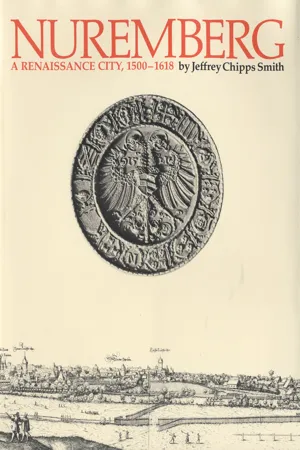
This illustrated study of Renaissance Nuremberg explores the city's social and artistic history through the sixteenth century and beyond.
The German city of Nuremberg reached the height of its artistic brilliance during the Renaissance, becoming one of the foremost cultural centers in all of Europe by 1500. Nuremberg was the home of painter Albrecht Dürer, whose creative genius inspired generations of German artists. However, Dürer was only one of a host of extraordinary painters, printmakers, sculptors, and goldsmiths working in the city.
Following a map of the city's principal landmarks, Guy Fitch Lytle provides a compact historical background for Jeffrey Chipps Smith's detailed discussions of the city's social and artistic significance. Smith examines the religious function of art before and during the Reformation; the early manifestations of humanism in Nuremberg and its influence on the art of Dürer and his contemporaries; and the central role of Dürer's pedagogical ideas and his workshop in the dissemination of Renaissance artistic concepts. Finally, Smith surveys the principal artists and stylistic trends in Nuremberg from 1500 to the outbreak of the Thirty Years War.
Nuremberg: A Renaissance City, 1500-1618 contains biographical sketches of forty-five major artists of the period, plus more than three hundred illustrations depicting the city and its most magnificent artistic treasures.
- 337 pages
- English
- ePUB (mobile friendly)
- Available on iOS & Android
eBook - ePub
Nuremberg, a Renaissance City, 1500–1618
About this book
Information
Topic
ArtSubtopic
European Art1. Introduction and Description
In 1500 Nuremberg cartographer Erhard Etzlaub published a road map of central Europe (cat. nr. 1) to guide pilgrims traveling to Rome for the Jubilee Year. At the center of his map, Etzlaub proudly placed his hometown. Etzlaub’s local chauvinism aside, Nuremberg, then a city of about forty thousand inhabitants, was strategically located in the heart of the German Empire along the major trade routes of the day. Etzlaub’s map can also be interpreted as an accurate description of Nuremberg’s cultural position within the empire, for by 1500 Nuremberg had blossomed into Germany’s pre-eminent artistic center.
From the outset of Albrecht Dürer’s career in 1490 to the completion of the new wing of the city hall at the beginning of the Thirty Years War (1618), Nuremberg produced a remarkable number of talented masters who guided German art from the late Gothic through the Renaissance and Mannerism to the early Baroque. Dürer is the most famous native son. Somewhat less well known are his followers Hans von Kulmbach, Hans Schäufelein, Georg Pencz, and the Beham brothers. Sculptors Veit Stoss, Adam Kraft, and the Vischer family had few peers during the opening decades of the sixteenth century. In all fields such artists as Peter Flötner, Melchior Baier, Jost Amman, and Hans Petzoldt influenced the development of art within and beyond the German borders. Goldsmith Wenzel Jamnitzer was rivaled only by Florentine Benvenuto Cellini in his inventiveness and technical virtuosity.
While it might seem naïve to laud Nuremberg to the exclusion of the many other towns that contributed to the rich, varied cultural environment of sixteenth-century Germany, this emphasis is supported by two observations: no other German city produced as many major artists in as many fields and no other city enjoyed the same long-term influence as did Nuremberg. The outstanding patronage of Cardinal Albrecht von Brandenburg, Archbishop of Mainz; of Ottheinrich, Count Palatine, at Neuburg and Heidelberg; of the Electors of Saxony at Wittenberg, Weimar, and their principal residences; of the Wittelsbachs in Munich; or even of Emperor Rudolf II at Prague, resulted in brief periods of brilliance that spurred important artistic advances in these cities.1 These centers, however, waned following the death of a specific ecclesiastical patron or prince. Leipzig, Strassburg, and other university towns likewise had occasional bursts of creativity. Nuremberg can best be compared with the major mercantile towns of Basel, Frankfurt, and Augsburg. At the outset of the sixteenth century, Basel was the home of Hans Holbein the Younger and many of Europe’s finest printers; artistically, though, it never really recovered from Ulrich Zwingli’s Reformation. Frankfurt was perhaps the most active publishing center in Germany during the middle of the century, yet the city never developed a vibrant local school of painters and sculptors. Only Augsburg, due largely to the Fugger family, was a true rival, especially in the art of the goldsmith.2 Augsburg possessed many first-rate artists, including Hans Holbein the Elder, Hans Burgkmair, Christoph Amberger, the Lenckers, and Christoph Weiditz. Augsburg did surpass Nuremberg during the last years of the sixteenth century and the opening years of the seventeenth when its sculptors, painters, and architects created their own original interpretations of late Italian Mannerism.
To state that Nuremberg was Germany’s most important artistic center is simple. To define the particulars and the underlying reasons for its status as well as to chart the stylistic transformations during the sixteenth century require a longer exposition. The city’s progress cannot be characterized as smooth and constant. The prominence of specific artistic media varied from period to period.
Nuremberg’s artistic history can be divided rather neatly by the dates 1500, 1525, 1550, and 1618. In 1500 Albrecht Dürer completed his Self-Portrait (Munich, Alte Pinakothek), the first German painting constructed according to specific geometric ratios to ensure correct figural proportions and positioning. With this picture, Dürer had become an “artistic painter” (kunstreicher moler), his term for an artist trained not only in the traditional techniques of painting but also in the scientific foundation common to all the liberal arts. This painting marks the culmination of the first decade of Dürer’s career. The experimentation of his youth had passed and his mature theoretical and stylistic ideas, expressed in the Self-Portrait, had been definitively formulated. He was now prepared to accept his first group of pupils whose adoption of his ideas quickly transformed Nuremberg’s art.
Nuremberg’s ascent from regional to international status occurred during the opening years of the sixteenth century as the influence of Dürer and his followers spread. Dürer introduced Renaissance ideas into Nuremberg and, through his prints, into other European cities. One reason for his success was his ability to combine Italian concepts of human form, spatial construction, and iconography with the underlying naturalism of German late Gothic art. Dürer translated the lessons of Italian art into a pictorial language that northern masters could comprehend, yet he never totally shed his late Gothic heritage. Indeed the tensions and awkward experiments of this transition from the late Gothic to the Renaissance will be significant characteristics of the art of the 1510s and 1520s.
In 1525 Nuremberg revolted against the Roman Catholic church and became the first free imperial city to adopt Lutheranism. This is a critical date in the history of Nuremberg and its art, for the Protestant Reformation brought new attitudes about the function and even the morality of religious art. Such traditional forms of religious art as altarpieces and devotional statues were openly challenged as idolatrous. Nuremberg’s patricians had richly decorated local churches with paintings, sculptures, and liturgical objects during the first quarter of the century. Suddenly this source of artistic patronage ceased, and Nuremberg’s artists were forced quickly to develop new secular themes and stylistic ideas. Dürer’s teachings had prepared emerging artistic leaders Georg Pencz and Peter Flötner to appreciate the current innovations in northern Italian and Roman art. If Dürer introduced the Renaissance into Nuremberg, this next generation of masters naturalized it. Georg Pencz brought the latest innovations of Michelangelo and Giulio Romano into the pictorial programs of local patrician houses. Although the art of the second quarter of the century in some respects did not match the brilliance of the earlier period, it did not die with Dürer in 1528 as some critics have suggested. Instead it responded boldly to the dual challenges of the Reformation and the High Renaissance.
A third artistic period began approximately twenty-five years later. Pencz died in 1550; Flötner had died four years earlier. Their High Renaissance styles soon gave way to the inventive Mannerism of Wenzel Jamnitzer, Nuremberg’s and Germany’s greatest goldsmith, whose style and personality dominated the city for the next three and a half decades. Jamnitzer’s deliberate distortion of Italian Renaissance and classical elements is first evident in the Merkel Table Decoration of 1549 (figs. 47 and 48). His technical innovations, notably his perfection of the art of casting after live models, and original compositional designs were widely emulated.
The complexities of Jamnitzer’s Mannerism struck a sympathetic chord with his German colleagues. One reason for this is the inherent stylistic association between Mannerism and the intricate geometric patterns that characterize German late Gothic art. In Nuremberg, especially in its architecture, and elsewhere, Gothic forms persisted into the seventeenth century. In the designs of several of his tall standing cups, Jamnitzer intentionally revived certain Gothic features. This survival and revival of the late Gothic in all the arts were significant traits throughout the late sixteenth and early seventeenth centuries.
The year 1618 provides a fitting terminus for this study. In this year Christoph Jamnitzer, grandson of Wenzel and Nuremberg’s last truly inventive artist, died. The flurry of artistic activity in the city during the 1590s and the opening two decades of the seventeenth century peaked around 1618 with the erection of Jakob Wolff the Younger’s new ...
Table of contents
- Cover
- Title
- Copyright
- Contents
- Foreword
- Preface
- Lenders to the Exhibition
- List of Abbreviations
- 1. Introduction and Description
- 2. The Renaissance, the Reformation, and the City of Nuremberg
- 3. Religious Art and the Reformation
- 4. Art and the Rise of Humanism
- 5. Dürer as Teacher
- 6. Artistic Developments of the First Half of the Sixteenth Century
- 7. Art Prior to the Thirty Years War
- Catalogue of Artists
- Appendix: Biographies of Important Nuremberg Artists Mentioned in the Catalogue but Not Included in the Exhibition
- Bibliography
- Index
- Photographic Credits
Trusted by 375,005 students
Access to over 1.5 million titles for a fair monthly price.
Study more efficiently using our study tools.
Frequently asked questions
Yes, you can cancel anytime from the Subscription tab in your account settings on the Perlego website. Your subscription will stay active until the end of your current billing period. Learn how to cancel your subscription
No, books cannot be downloaded as external files, such as PDFs, for use outside of Perlego. However, you can download books within the Perlego app for offline reading on mobile or tablet. Learn how to download books offline
Perlego offers two plans: Essential and Complete
- Essential is ideal for learners and professionals who enjoy exploring a wide range of subjects. Access the Essential Library with 800,000+ trusted titles and best-sellers across business, personal growth, and the humanities. Includes unlimited reading time and Standard Read Aloud voice.
- Complete: Perfect for advanced learners and researchers needing full, unrestricted access. Unlock 1.5M+ books across hundreds of subjects, including academic and specialized titles. The Complete Plan also includes advanced features like Premium Read Aloud and Research Assistant.
We are an online textbook subscription service, where you can get access to an entire online library for less than the price of a single book per month. With over 1.5 million books across 990+ topics, we’ve got you covered! Learn about our mission
Look out for the read-aloud symbol on your next book to see if you can listen to it. The read-aloud tool reads text aloud for you, highlighting the text as it is being read. You can pause it, speed it up and slow it down. Learn more about Read Aloud
Yes! You can use the Perlego app on both iOS and Android devices to read anytime, anywhere — even offline. Perfect for commutes or when you’re on the go.
Please note we cannot support devices running on iOS 13 and Android 7 or earlier. Learn more about using the app
Please note we cannot support devices running on iOS 13 and Android 7 or earlier. Learn more about using the app
Yes, you can access Nuremberg, a Renaissance City, 1500–1618 by Jeffrey Chipps Smith in PDF and/or ePUB format, as well as other popular books in Art & European Art. We have over 1.5 million books available in our catalogue for you to explore.