The past twenty-five years have brought a dramatic expansion of scholarship in maritime history, including new research on piracy, long-distance trade, and seafaring cultures. Yet maritime history still inhabits an isolated corner of world history, according to editors Lauren Benton and Nathan Perl-Rosenthal. Benton and Perl-Rosenthal urge historians to place the relationship between maritime and terrestrial processes at the center of the field and to analyze the links between global maritime practices and major transformations in world history.
A World at Sea consists of nine original essays that sharpen and expand our understanding of practices and processes across the land-sea divide and the way they influenced global change. The first section highlights the regulatory order of the seas as shaped by strategies of land-based polities and their agents and by conflicts at sea. The second section studies documentary practices that aggregated and conveyed information about sea voyages and encounters, and it traces the wide-ranging impact of the explosion of new information about the maritime world. Probing the political symbolism of the land-sea divide as a threshold of power, the last section features essays that examine the relationship between littoral geographies and sociolegal practices spanning land and sea. Maritime history, the contributors show, matters because the oceans were key sites of experimentation, innovation, and disruption that reflected and sparked wide-ranging global change.
Contributors: Lauren Benton, Adam Clulow, Xing Hang, David Igler, Jeppe Mulich, Lisa Norling, Nathan Perl-Rosenthal, Carla Rahn Phillips, Catherine Phipps, Matthew Raffety, Margaret Schotte.
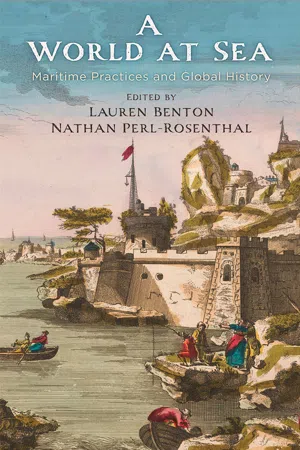
eBook - ePub
A World at Sea
Maritime Practices and Global History
- 280 pages
- English
- ePUB (mobile friendly)
- Available on iOS & Android
eBook - ePub
A World at Sea
Maritime Practices and Global History
About this book
Information
Publisher
University of Pennsylvania PressYear
2020Print ISBN
9780812252415
9780812252415
eBook ISBN
9780812297348
Part I
Currents
Chapter 1
Why Did Anyone Go to Sea? Structures of Maritime Enlistment from Family Traditions to Violent Coercion
Anacharsis, the Scythian philosopher, said, “There are three kinds of people: the living, the dead and those who sail the sea in ships.” That was in the Heroic Age and, at a later date, Dr Johnson said, with equal authority and force, that it passed his comprehension why anybody with the wit to steal enough money to get himself decently hanged should ever go to sea.
—Richard Armstrong, The Early Mariners
Anacharsis in the early sixth century BCE and Samuel Johnson in the late eighteenth century CE were in complete agreement about the unnaturalness of seafaring for a land-based species such as ours. Nonetheless, countless generations have gone to sea, and some individuals have made a career of seafaring, which begs the question, “Why?” This essay will address that question, focusing primarily on the ways and means that European shipowners and governments in the early modern period found crews and officers, although it will include some evidence from other times and places. The focus will be on individuals engaged in seaborne occupations, rather than members of seafaring communities on land or the broad range of humanity that traveled by sea at one time or another through choice or necessity. For that reason, women will be absent from the story, although they were important participants in families and communities earning their living from the sea and as heads of state setting policies for the enlistment of mariners and the regulation of seaborne commerce.
The ways and means of maritime enlistment ranged widely from enthusiastic free choice to the most violent forms of coercion. Geographical location, personal inclination, family traditions, and economic incentives influenced many individual decisions to go to sea, at the positive end of the spectrum. Kidnapping someone for sea duty with no legal justification anchored the negative end of the spectrum. Between the two extremes lay a wide variety of personal, economic, legal, and other considerations that induced men and boys to go to sea for the first time. Other incentives, both positive and negative, influenced the decision to continue with a maritime life.
Historians frequently distinguish between civilian and military seafaring, especially after the late eighteenth century, as the merchant marine came to be largely separate from official navies. For the early modern period, that makes little sense. Both civilian and military voyages drew from the same pool of vessels and potential crewmen, and the same individuals and ships could serve at different times in fishing, trade, piracy, or warfare. As a Spanish merchant marine captain noted as late as the nineteenth century, “the merchant marine and the navy have identical interests to promote, and instead of divorcing themselves they complement one another. They are like two bodies with a single soul.”1 Less romantic and more pertinent to this essay, sailors in the merchant marine were the primary source of additional labor for navies. Perhaps the most important difference between civilian and military recruitment was that the former relied primarily on economic incentives, whereas the latter relied primarily on legal incentives, especially during wartime.
I have been studying Spanish shipbuilding and seafarers in the early modern period for some years now, focusing on the sixteenth and seventeenth centuries. Oddly enough, Spain is not usually considered among Europe’s seafaring powers, though the global Spanish empire depended on seaborne trade, communication, and defense for more than three centuries. My current research deals with Spanish galley service in the Mediterranean, based on newly restored registers in the archive of the Naval Museum in Madrid.2 The officers, sailors, soldiers, and oarsmen arrived on the galleys for a variety of reasons. Examples from their experiences and those of sailors on oceangoing vessels form a major part of this essay. The argument also draws on fifteen studies about European seafarers in various parts of the world from 1570 to 1870,3 and another recent collection devoted to seafarers’ lives, though not all of the authors deal with enlistment.4
To establish a framework to consider the many modes of maritime enlistment, one helpful approach is a lengthy philosophical article by Scott Anderson that discusses the concept of coercion from St. Thomas Aquinas to the present. Among other issues, Anderson considers the extent to which coercion or attempted coercion can influence a decision to act, and how that decision relates to free will.5 In other words, if an individual decides to act based on some degree of positive or negative coercion, to what extent can that act be considered voluntary? Such questions have engaged philosophers and ethicists much more than historians, but it is useful to be aware of them in studying maritime enlistment, in part because the degree of free will in the decision to enlist could easily affect an individual’s subsequent experiences and behavior at sea.
To keep in mind the full range of reasons that men and boys went to sea, this essay will consider the various influences on maritime enlistment along the same spectrum, beginning with the positive and ending with the negative. The discussion will fall under several general headings, although some overlap is unavoidable: Proximity to the Sea; Family Traditions; Economic Incentives; Legal Requirements; and Beyond the Law. A brief conclusion will gather the various threads of the argument together. The examples will focus primarily on Europe, in the hope that European patterns over several centuries can suggest questions and issues of relevance to governments as well as individuals trying to crew vessels in other times and places.
Proximity to the Sea
The most obvious positive incentive for going to sea was geographical location. It is reasonable to assume that a population living on or near a coastline would develop a seafaring tradition. Portugal faced the Atlantic Ocean, with numerous ports large and small, and drew on virtually every region for its seafaring population.6 In northeastern North America along the Atlantic coast, seafaring was an essential part of local economies in early colonial times. Daniel Vickers noted that all of the sailors from the region grew up no more than five miles from the sea.7 Nonetheless, geography was not destiny. Norway, for example, has an extensive coastline and depended on the sea for trade and communication in the early modern period, but after the Middle Ages foreign shippers and crews dominated Norwegian trade and fishing.8 Finland has an extensive coastline on the Gulf of Bothnia, but a very small number of ports. Farther south, although the Southern Netherlands included the major port of Antwerp, the local population was not known for seafaring in the early modern period.9 Even Iceland, surrounded by the sea and with a population heavily dependent on fish for food, relied on outsiders to supply the fish and provide seaborne transport. Only the northwest coast of Iceland had a seafaring tradition before 1800.10 In short, geographical proximity did not necessarily induce a population to develop a seafaring tradition.11
One reason is that agricultural productivity was so low in the early modern centuries that the vast majority of Europeans had to work the land to provide enough food to survive. Even in coastal areas with a strong seafaring tradition, the percentage of the population earning a living from the land was nearly always much larger than the seafaring population. That was also true in colonial New England, where many seafarers began and ended their working lives as farmers.12 In another example, Spain has extensive coastlines on the Bay of Biscay, the Mediterranean Sea, and the Atlantic Ocean. Nonetheless, the men listed in an official registry of mariners in 1740 comprised less than 1 percent of the population of the coastal provinces, most of them in the port towns, and an even smaller percentage of the total Spanish population.13
On the other hand, limited coastlines did not prevent some areas from developing a robust seafaring tradition. The Holy Roman Empire was largely landlocked, but the active ports in the German states on the Baltic and the North Sea linked the empire as a whole to seaborne trade and fisheries and attracted sailors from surrounding regions as well.14 Some sailors from inland areas of the empire may have been attracted to seafaring because they lacked sufficient access to farmland; others may have viewed life at sea as a more exciting prospect than farming or as a surer way to make a living. In short, the incentives—both positive and negative—of geographical location cannot fully explain why men went to sea, though they undoubtedly played a role in many individual decisions.
Family Traditions
Another obvious example of a positive incentive for going to sea was family tradition. For residents of coastal areas, a career at sea would have been a logical choice for men and boys, generation after generation. Presumably, many could not have imagined another way to make a living and gladly followed their fathers, uncles, and brothers to sea. We should realize, however, that not every male in every generation would have been suited or attracted to a life at sea. Would unwilling boys have nonetheless been persuaded to go to sea by their families? The degree to which family expectations and pressures can be considered coercive is open to argument. Reluctant maritime recruits may have followed family tradition without considering that they were being coerced to do so. Scott Anderson’s discussion of philosophical debates about coercion rules out “by stipulation, such things as mere disapproval, emotional manipulation, or wheedling.”15 Those very attitudes and behaviors, however, are favored weapons in the emotional arsenal of family relations. Anderson himself acknowledges that coercion “seems also to be an indispensable technique in the rearing of children.”16 Historians looking at family traditions of seafaring should consider that emotional coercion—both positive and negative—may have influenced some individual decisions to go to sea, and we cannot assume that all such decisions were made with a full heart.
One of my recent projects dealt with a Spanish armada dispatched in 1581–84 to fortify the Strait of Magellan and drive pirates and interlopers from Brazil.17 King Philip II formed the armada after Francis Drake’s peacetime raids in the Americas and his own successful claim to the vacant throne of Portugal. The armada was designed to prevent other opportunists from following Drake’s example and to demonstrate the king’s resolve to defend Portuguese Brazil as well as Spanish territories in the Americas. The commander of the Armada of the Strait, Diego Flores de Valdés, was a nobleman from Asturias on Spain’s northwest coast and a member of a distinguished seafaring clan. The head of the clan, Pedro Menéndez de Avilés, had ousted the French from La Florida in 1565 as the capstone event in a career at sea. Flores had served with distinction in that encounter, and an array of nephews, brothers, sons, and in-laws of the Menéndez clan enlisted to serve in Flores’s armada in 1581. There is no question that family tradition was a positive factor in their enlistment, perhaps the most important factor. The disproportionate number of Asturians in the armada, and their family relations, are not apparent from their names alone, but the career trajectories of individual men, as well as their marriages and other documented interactions, emphasize the importance of familial connections. Pedro Sarmiento de Gamboa, who accompanied the armada as the governor-designate of the colony he hoped to plant at the Strait of Magellan, wrote lengthy complaints to the king about the horde of Asturians who were loyal to Flores and wanted to destroy plans for the colony. It is easy to dismiss his complaints, because Sarmiento accused nearly everyone of turning against him at one point or another. Nonetheless, the horde of Asturians was real, and they undoubtedly had both geographical and familial incentives to enlist.
Virtually all of the 722 mariners recruited for the expedition came from a seafaring tradition, but those not connected to the Menéndez clan were difficult to recruit. Although the destination of the armada was not made public, everyone in southwestern Spain seemed to know that it was going to the Strait of Magellan. The terrors of sailing in the South Atlantic were well known to the maritime community, and there were other disadvantages as well. An ordinary voyage to New Spain (Mexico) or Tierra Firme (South America) would have provided the men with an opportunity to engage in minor trade on their own account, but the Armada of the Strait had a purely military and diplomatic function, with few opportunities for profit. Moreover, given Drake’s raids and rumors of other fleets being sent from England and France, the armada would almost certainly encounter enemies. Some may have viewed the possibility of encountering enemies in a positive light; if they distinguished themselves in battle, they could earn royal favor and advance in rank and pay. Overall, however, the officers of that particular armada had to work hard to recruit sufficient sailors and soldiers, despite seafaring traditions.
Like Spain, many other states benefited from geographical location and family traditions in recruiting sailors and other maritime workers. In Portugal, the crown relied on family networks to provide shipbuilders and seafarers generation after generation. During the period of Habsburg rule (1580–1640), the crown rewarded the families of pilots, masters, and officers with social benefits, which tended to reinforce family traditions of seafaring.18 Similarly, in the Netherlands’ provinces of Holland, Zeeland, Friesland, Groningen, and the Wadden Islands, an internal labor market for sailors focused on maritim...
Table of contents
- Cover
- Title Page
- Copyright
- Contents
- Introduction: Making Maritime History Global
- Part I. Currents
- Part II. Dispatches
- Part III. Thresholds
- Afterword: Land-Sea Regimes in World History
- Notes
- List of Contributors
- Index
- Acknowledgments
Trusted by 375,005 students
Access to over 1.5 million titles for a fair monthly price.
Study more efficiently using our study tools.
Frequently asked questions
Yes, you can cancel anytime from the Subscription tab in your account settings on the Perlego website. Your subscription will stay active until the end of your current billing period. Learn how to cancel your subscription
No, books cannot be downloaded as external files, such as PDFs, for use outside of Perlego. However, you can download books within the Perlego app for offline reading on mobile or tablet. Learn how to download books offline
Perlego offers two plans: Essential and Complete
- Essential is ideal for learners and professionals who enjoy exploring a wide range of subjects. Access the Essential Library with 800,000+ trusted titles and best-sellers across business, personal growth, and the humanities. Includes unlimited reading time and Standard Read Aloud voice.
- Complete: Perfect for advanced learners and researchers needing full, unrestricted access. Unlock 1.5M+ books across hundreds of subjects, including academic and specialized titles. The Complete Plan also includes advanced features like Premium Read Aloud and Research Assistant.
We are an online textbook subscription service, where you can get access to an entire online library for less than the price of a single book per month. With over 1.5 million books across 990+ topics, we’ve got you covered! Learn about our mission
Look out for the read-aloud symbol on your next book to see if you can listen to it. The read-aloud tool reads text aloud for you, highlighting the text as it is being read. You can pause it, speed it up and slow it down. Learn more about Read Aloud
Yes! You can use the Perlego app on both iOS and Android devices to read anytime, anywhere — even offline. Perfect for commutes or when you’re on the go.
Please note we cannot support devices running on iOS 13 and Android 7 or earlier. Learn more about using the app
Please note we cannot support devices running on iOS 13 and Android 7 or earlier. Learn more about using the app
Yes, you can access A World at Sea by Lauren Benton, Nathan Perl-Rosenthal, Lauren Benton,Nathan Perl-Rosenthal in PDF and/or ePUB format, as well as other popular books in History & Military & Maritime History. We have over 1.5 million books available in our catalogue for you to explore.