Contrary to warnings about the dangers of populism, Donald F. Critchlow argues that grassroots activism is essential to party renewal within a democratic system.
Grassroots activism, presenting a cacophony of voices calling for reform of various sorts without programmatic coherence, is often derided as populist and distrusted by both political parties and voters. But according to Donald T. Critchlow, grassroots movements are actually responsible for political party transformation, both Democratic and Republic, into instruments of reform that reflect the interests, concerns, and anxieties of the electorate.
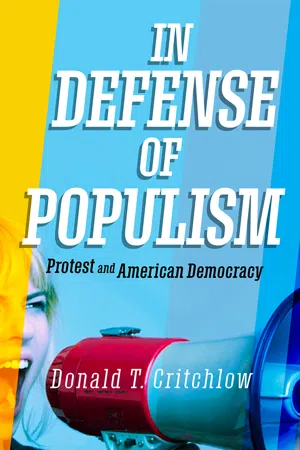
Contrary to popular discourse warning about the dangers of populism, Critchlow argues that grassroots activism is essential to party renewal within a democratic system. In Defense of Populism examines movements that influenced Republican, Democratic, and third-party politics—from the Progressives and their influence on Teddy Roosevelt, to New Dealers and FDR, to the civil rights, feminist, and environmental movements and their impact on the Democratic Party, to the Reagan Revolution and the Tea Party. In each case, Critchlow narrates representative biographies of activists, party leaders, and presidents to show how movements become viable calls for reform that get translated into policy positions.
Social tensions and political polarization continue to be prevalent today. Increased social disorder and populist outcry are expected whenever political elites and distant bureaucratic government are challenged. In Defense of Populism shows how, as a result of grassroots activism and political-party reform, policy advances are made, a sense of national confidence is restored, and the belief that American democracy works in the midst of crisis is affirmed.
- 224 pages
- English
- ePUB (mobile friendly)
- Available on iOS & Android
eBook - ePub
About this book
Information
Publisher
University of Pennsylvania PressYear
2020Print ISBN
9780812252767
9780812252767
eBook ISBN
9780812297737
| 1 | Populism Prelude to “Big Government” |
Populism emerged in the last decade of the nineteenth century like a tornado sweeping up through Texas into the South and spilling over into the Midwest, across the Mountain and Pacific Coast states. Gaining force from long agitation, complaint, and calls for reform by farmers and industrial workers throughout the late nineteenth century, the Populist movement gave rise to a new third party, the People’s Party (commonly referred to as the Populist Party, although that was not its official name). This party, dissipated by its own internal frictions and contradictory alliances, was ultimately broken asunder by a huge electoral wall erected by Republicans in the presidential election of 1896.
Populism in the 1890s marked the culmination of storms of protest after 1865 over income inequality, railroad monopoly, unfair and oppressive labor practices, and political corruption on the local, state, and national levels. These protest movements were reflected in grassroots agitation expressed in currency reform (Greenbackism and Free Silver), anti-monopoly third parties, the Single Tax movement (Henry George), utopian socialism (Edward Bellamy), and labor protests and strikes. The formation of the People’s Party brought these reform movements together, attempting to ally farmers with urban industrial workers. Already by the presidential election of 1892 and clearly by the midterm elections of 1894, the People’s Party demonstrated its unviability as a third party challenging the two established parties. The obvious political solution for People’s Party leaders was to fuse with the Democratic Party under the leadership of William Jennings Bryan, who successfully pushed forward his crusade for free silver in winning the Democratic Party presidential nomination in 1896. Bryan was a populist in sentiment, but he was a confirmed Democrat. His “Cross of Gold” speech at the Democratic Party national convention fired up the delegates and he won the party’s nomination. When Bryan lost the presidential election to Republican William McKinley in 1896, the People’s Party was all but dead. Bryan, though, remained a force in the Democratic Party for years to come. The Populist agenda lived on to find expression and implementation in the Progressive Era, from 1900 to 1917.
The political consequences of the Populist movement forced both major parties to undertake reform to varying degrees. Already by 1896, both the Democratic and Republican Party platforms incorporated calls for railroad regulation and the end of federal injunctions against organized labor. The most direct effect of Populism among Democrats was found in the Bryan wing of the party, which continued to play a major role well into the 1930s, as expressed in anti-imperialist and isolationist foreign policy positions and anti-monopoly and anti-corporate sentiment. The southern wing of the Democratic Party, largely agrarian, remained the bulwark of the party. Tragically, the Populist reform agenda was subverted in the Democratic South by the complete transformation of the party into a militant defender of white supremacy, often led by former Populists turned Democrats. In North Carolina, former Populist Furnifold M. Simmons joined Populist newspaper editor Josephus Daniels in making the state Democratic Party into a “white man’s” party. In 1900, Democrats recaptured the North Carolina governorship and secured the enactment of a state constitutional amendment that effectively disenfranchised most black voters, who had been able to elect a few black candidates to minor offices in the eastern part of the state through a Populist-Republican alliance.1 The Tarheel Democratic redemption was nearly as ruthless as white “redemption” during the post–Civil War Reconstruction era and occurred throughout the Democratic South.
Republicans on both the national and state levels stood most firmly against Populism, although in a few southern states, such as North Carolina and Tennessee, the GOP fused with Populist-oriented Republicans to oppose the Democratic Party control. Agrarian radicalism expressed itself among a few Midwest governors and U.S. senators, such as Robert La Follette in Wisconsin, George Norris in Nebraska, and William Borah in Idaho.
The 1893 economic depression and the formation of the People’s Party forced the major parties to seek reform. Populist-Progressive reforms did not fully resolve many of the problems that still confronted labor, farmers, African Americans, the cities, and the economic order. It took a major economic depression in 1929 and the New Deal to enact further reform, encouraged again by grassroots activism in the 1920s, but the poignancy of progressive reform in the early twentieth century can only be fully understood within the context of grassroots activism in the post–Civil War years. Scholarly debate over the continuity between Populism and Progressivism, and between grassroots agitation in the late nineteenth century and in the first decades of the twentieth century, can be misleading. Direct organizational continuity is often absent. For example, the Greenback movement in the 1870s was not continuous with municipal reform at the turn of the century. However, some continuity among leaders of Henry George’s Single Tax movement is found in administrative appointments made during the Woodrow Wilson presidency. Similarly, in the post–Civil War period, women continued the struggle for voting rights, which eventually culminated in the Nineteenth Amendment in 1920. post–Civil War grassroots agitation took many forms in the late nineteenth century. Leaders and activists came and went in these movements, as did organizations and third-party formations. What is important, though, is that calls for reform, grassroots mobilization, and challenges to established political and social leadership built over time, with increasing crescendo, setting the stage for party renewal when forced by the depression of the 1890s and popular demand for change.
The Gilded Age
In the late nineteenth century, the United States became the most powerful and prosperous nation in the world. American economic growth was unprecedented. Driven by a combination of productivity growth and a rapid increase in population, including mass immigration, the American economy was a wonder to behold. At the end of the Civil War, the United States trailed the United Kingdom, France, and Germany in manufacturing. By 1894, the nation’s value of manufacturing nearly equaled the value of manufacturing of these three countries combined. Huge fortunes were made in manufacturing and finance by taking advantage of new technological developments, improved transportation and communications systems, and organizational enterprise. Andrew Carnegie in steel, J. D. Rockefeller in oil, and J. P. Morgan in finance symbolized the robber barons of the age. The growing concentration of industry and finance—an inevitable result of corporate capitalism and the force of economies of scale—displaced the old mercantile economy centered on local and regional markets. Economic concentration and often unscrupulous business practices drove out merchants and owners of smaller enterprises in this new corporate order.
The new economy brought prosperity to many. A new middle class of white-collar employees was created. Homeownership increased. The corporation created new occupations for middle managers, accountants, service employees, and office workers. In 1870, less than 2 percent of the workforce was employed in clerical positions; by 1900, more than 35 percent was white collar. At the same time, however, social tensions intensified between labor and capital as workers sought unionization, shorter working hours, the end of child labor, and safer working conditions. Unemployment plagued industrial workers throughout the late nineteenth century, affecting nearly every family. Though real wages increased for skilled workers (74 percent) and unskilled workers (31 percent), in this economic transformation many semiskilled workers were displaced. As the agricultural economy expanded to the Midwest and Plains regions, farmers confronted a cycle of rising and falling farm prices and increased international competition. Faced with debt and often foreclosure, farmers called for inflationary measures to help alleviate their problems.
While industrial workers and farmers faced problems, older eastern cities and newer midwestern cities were transformed, simply overwhelmed by overflowing populations both foreign and native. In the decades between 1888 and 1920, more than 23 million immigrants came to America, 80 percent from eastern and southern Europe. By 1890, adult immigrants outnumbered native adults in eighteen of the twenty largest cities. This rapid urbanization created insurmountable problems in transportation, housing, sanitation, crime, and poverty.
In this environment, social tensions proved inevitable, as capital clashed with labor, and farmers with railroads, moneylenders, and agricultural corporations. Social tensions expressed themselves in protest against the wealthy, concentrated capital, and politicians who served their interests. “Down with Monopoly!” became a rallying cry for grassroots agitation throughout the late nineteenth century. Railroads were potent symbols of the monopoly problem, and many Americans disapproved of this concentration of wealth and power. By 1896, railroads accounted for more of the gross national product than did federal, state, and local government combined.2 As the century drew to a close, more than 150,000 miles of railroad line had been laid. Fortunes were made in railroad construction and ownership. The result was mass overbuilding, laying more track than needed, and inevitable bankruptcy.
A similar pattern of consolidation emerged in the telegraph, steel, oil, and other industries. Financial pools and cartels gave rise to trusts aimed at squelching competition, regulating prices, excluding new competition, controlling labor, and exerting political influence of local, state, and national legislators, regulators, and political parties. Railroads exerted control over many state legislatures and were seen as another example of political corruption. Actual income or wealth disparity was difficult to measure then or later by historians studying inequality in the nineteenth century because of poor data.3 Whether farmers were being exploited by moneylenders proves equally difficult to measure. Historians looking closely at mortgage rates and loans concluded that rates for farmers were not higher for midwestern agriculture than for eastern merchants.4 Nonetheless, given that the period from the 1870s to the 1890s was one of price deflation punctuated by major and minor panics, it appeared to many that life was not getting better for the majority of Americans. Whatever the hard facts, a common perception among many Americans in this time was that the new wealth of the nation was not being shared fairly. “The rich are getting richer, and the poor poorer” was a constant refrain throughout the late nineteenth century by farmers, workers, and opponents of monopoly.
In 1885, in the midst of a decline in prices that had begun three years earlier, a financial panic hit Wall Street. The effects of the panic were severe. An estimated 5 percent of businesses failed, another 5 percent were forced to close at some point during the year, and an estimated one million workers were unemployed. Labor launched a campaign for an eight-hour workday. On May 1, 1886, a general strike involving 350,000 workers across the country created a national work stoppage. In Chicago, the movement turned violent three days later when a bomb went off in the ranks of 180 policemen who had gathered to disperse a labor rally held at Haymarket Square in the center of the city. The late-night rally had been called by radical anarchists to protest the recent shooting of a striker at the McCormick Reaper works. After the bomb went off, gunfire erupted on both sides, leaving at least eight people dead. In the aftermath of the riot, anti-radical hysteria swept the city. Dozens of radicals were rounded up by the police, and eight anarchists were arrested and placed on trial. At the trial, the prosecution was unable to tie any defendant directly to the throwing of the bomb. The prosecution brought forward witnesses and presented considerable circumstantial evidence that the anarchists had been involved in bomb making and were planning terrorist attacks. The defendants were not well served by a politicized defense counsel inexperienced in criminal law. All were found guilty, with seven defendants sentenced to death and the eighth given a prison sentence.5
Henry Demarest Lloyd, a lawyer and a radical journalist for the Chicago Tribune, denounced the trial as a travesty of justice. He was joined by prominent reformers and labor leaders who launched a national campaign to have the governor of Illinois, Richard J. Oglesby, grant clemency to the defendants. Lloyd met personally with the governor. In the end, Oglesby, faced with an Illinois Supreme Court and U.S. Supreme Court decision upholding the verdict, commuted the sentences of two of the defendants to life. Four of the defendants originally sentenced to death were executed on November 11, 1887; two others had their sentences commuted; and the final defendant committed suicide in jail. Lloyd concluded, “The American Republic has already ceased to exist. It is rotten before it is ripe.”6
The Haymarket riot proved to be just the beginning of class violence. Full-scale class warfare erupted with the 1893 depression, which occurred just a month after reform Democrat Grover Cleveland came into the White House. The Depression of 1893, probably the most devastating economic downturn in American history to that time, unleashed labor protest and heightened farmer agitation.7 By the end of 1893, 600 banks and 15,000 businesses had failed, and one-fourth of the railway capital of the country was placed in receivership. Business liabilities increased almost tenfold. Developers who had overextended their markets in the Mississippi Valley by building railroads into freightless territory and expanding farm acreage went belly-up. An estimated one to three million workers were laid off, with the unemployment rate reaching an estimated 40 percent. In this environment, decades of anti-monopoly agitation and farmer discontent erupted with full force.
When the small, struggling industrial union of American Railway Workers, under the leadership of Eugene Debs, went out on strike in support of the Pullman Car Workers in 1893, class war reached a fever pitch. Railroad owners, organized into the Managers Association, refused mediation and instead imported strikebreakers from Canada. They then convinced President Grover Cleveland’s U.S. attorney general Richard Olney to bring 3,400 sworn deputies to Chicago to break the strike. Strikers responded with a full-scale riot, ripping up train tracks in Chicago. President Cleveland ordered four companies of federal troops to Chicago to restore order. The Chicago Tribune declared, “Strike Is Not War.” Debs was arrested on the charge of conspiracy to obstruct federal mails. He was released only to be rearrested for contempt of court and sentenced to six months in prison. The strike was crushed, and so was Debs’s union.
Social movements require leaders with ideas. Ideas provide the foundation for a successful social movement. Leaders can offer grand visions for social transformation, or they can promote ideas little more than blurred reflections of the past mirrored in the present. In the late nineteenth century, Henry George and Edward Bellamy stood out as inspiring proponents of social change. Both men set the intellectual stage for the populist revolt that erupted in the 1890s.
Henry George, by trade a printer, presented in his book Poverty and Progress (1880) a panacea for eliminating capitalism’s ills through a “single tax” on undeveloped land. Edward Bellamy, an eccentric New Englander, offered in his best-selling novel Looking Backward (1887) a utopia built around a military-like society. Both men inspired social movements. At first, George welcomed the emergence of the People’s Party, but then quickly repudiated it when the party refused to endorse his “single tax” scheme. Nonetheless, Single Taxers, as his followers were called, played important roles in the Populist movement. Following the success of Looking Backward, Bellamy found himself the unlikely leader of a movement to form Nationalist Clubs across the country to fulfill the utopia outlined in his novel. When the People’s Party emerged a few years later, Bellamy quickly aligned himself with the Populist cause. The once shy, hermit-like Bellamy threw himself enthusiastically, indeed fanatically, into work on behalf of the People’s Party. The importance of these two men lay not in their individual activities but in the social movements their ideas inspired. Their individual ideas and movements presente...
Table of contents
- Cover
- Title Page
- Copyright
- Dedication
- Contents
- Introduction: Social Protest and Democracy
- 1. Populism: Prelude to “Big Government”
- 2. The New Deal, Social Protest, and the Administrative State
- 3. How Grassroots Mobilization Changed Postwar Civil Rights
- 4. Second-Wave Feminism, Social Protest, and the Rights Revolution
- 5. The Populist Right: Anti-Statism and Anti-Elitism
- 6. Protest in a Polarized Age
- Notes
- Index
- Acknowledgments
Trusted by 375,005 students
Access to over 1.5 million titles for a fair monthly price.
Study more efficiently using our study tools.
Frequently asked questions
Yes, you can cancel anytime from the Subscription tab in your account settings on the Perlego website. Your subscription will stay active until the end of your current billing period. Learn how to cancel your subscription
No, books cannot be downloaded as external files, such as PDFs, for use outside of Perlego. However, you can download books within the Perlego app for offline reading on mobile or tablet. Learn how to download books offline
Perlego offers two plans: Essential and Complete
- Essential is ideal for learners and professionals who enjoy exploring a wide range of subjects. Access the Essential Library with 800,000+ trusted titles and best-sellers across business, personal growth, and the humanities. Includes unlimited reading time and Standard Read Aloud voice.
- Complete: Perfect for advanced learners and researchers needing full, unrestricted access. Unlock 1.5M+ books across hundreds of subjects, including academic and specialized titles. The Complete Plan also includes advanced features like Premium Read Aloud and Research Assistant.
We are an online textbook subscription service, where you can get access to an entire online library for less than the price of a single book per month. With over 1.5 million books across 990+ topics, we’ve got you covered! Learn about our mission
Look out for the read-aloud symbol on your next book to see if you can listen to it. The read-aloud tool reads text aloud for you, highlighting the text as it is being read. You can pause it, speed it up and slow it down. Learn more about Read Aloud
Yes! You can use the Perlego app on both iOS and Android devices to read anytime, anywhere — even offline. Perfect for commutes or when you’re on the go.
Please note we cannot support devices running on iOS 13 and Android 7 or earlier. Learn more about using the app
Please note we cannot support devices running on iOS 13 and Android 7 or earlier. Learn more about using the app
Yes, you can access In Defense of Populism by Donald T. Critchlow in PDF and/or ePUB format, as well as other popular books in Politics & International Relations & American Government. We have over 1.5 million books available in our catalogue for you to explore.