"Politics makes for strange bedfellows," the old saying goes. Americans, however, often forget the obvious lesson underlying this adage: politics is about winning elections and governing once in office. Voters of all stripes seem put off by the rough-and-tumble horse-trading and deal-making of politics, viewing its practitioners as self-serving and without principle or conviction.
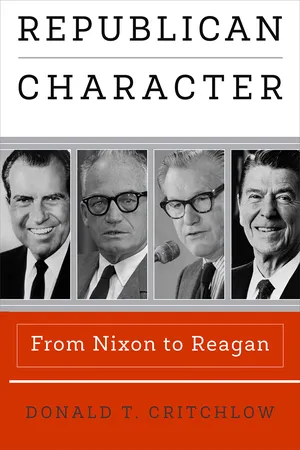
Because of these perspectives, the scholarly and popular narrative of American politics has come to focus on ideology over all else. But as Donald T. Critchlow demonstrates in his riveting new book, this obsession obscures the important role of temperament, character, and leadership ability in political success. Critchlow looks at four leading Republican presidential contenders—Richard Nixon, Nelson Rockefeller, Barry Goldwater, and Ronald Reagan—to show that, behind the scenes, ideology mattered less than principled pragmatism and the ability to build coalitions toward electoral and legislative victory.
Drawing on new archival material, Critchlow lifts the curtain on the lives of these political rivals and what went on behind the scenes of their campaigns. He reveals unusual relationships between these men: Nixon making deals with Rockefeller, while Rockefeller courted Goldwater and Reagan, who themselves became political rivals despite their shared conservatism. The result is a book sure to fascinate anyone wondering what it takes to win the presidency of the United States—and to govern effectively.
- 192 pages
- English
- ePUB (mobile friendly)
- Available on iOS & Android
eBook - ePub
About this book
Information
Publisher
University of Pennsylvania PressYear
2018Print ISBN
9780812224719
9780812249774
eBook ISBN
9780812294637
1 | Richard Nixon The Disillusioned Idealist |
Nixon’s political rise proved as meteoric as Andrew Jackson’s 150 years earlier, but Nixon’s fall and disgrace were unequaled in American political history. He was a congressman at the age of thirty-three, senator at thirty-seven, two-term vice president at forty-three, and president at fifty-six; he experienced ignominy at sixty-one. He entered politics with the optimism of many who came of age during World War II, believing that the world could be made better. He represented the idealism of a young generation that had survived the trauma of the Depression and a global war that ended with the use of nuclear weapons, the most devastating technology ever developed by humankind. The Nixon who left the White House twenty-five years later revealed little idealism and much cynicism.
Nixon had changed from an idealistic and optimistic young man into a secretive, brooding politician by the time he entered the White House in 1969. The idealism of his youth and the optimism of an up-and-coming attorney and politician in Southern California gave way to a sense of distrust and betrayal. Nixon’s idealism was tested—and later found wanting—in the blood-sport world of American domestic politics and Machiavellian international politics. His first election victories, running for Congress in 1946 and the U.S. Senate in 1950, made him into a lifelong enemy of the left. The rough-and-tumble of politics increasingly jaded Nixon’s idealism. His memoir, RN, one of the most candid presidential memoirs next to Ulysses S. Grant’s autobiography, reveals his profound sense of disappointment in his political friends not rallying to his defense when he was nearly pushed off the Republican ticket in 1952 under charges of having a “secret fund.” Nixon survived with the famous “Checkers” speech. Further disappointment came when his boss, Dwight Eisenhower, suggested that he take a cabinet position instead of joining the GOP presidential ticket in 1956. Continued press attacks on him, especially Washington Star political cartoonist Pat Oliphant’s scathing caricatures of the “diabolical Nixon” rankled him. The ostracizing of his children at school by classmates and their parents hurt both him and his wife, Pat. He thought seriously about leaving politics.
Much has been made by scholars and biographers who have traced Nixon’s secretiveness, hypersensitivity to critics, and later imperial presidency to his boyhood. Nixon’s flawed personality, we have been told, can be found in a dominating mother, a distant father, and status anxiety induced by growing up in a lower-middle-class family. This kind of psychologizing presumes that a person at fifty can be explained fully by looking at a boy of twelve. Childhood plays a role in shaping character and leadership abilities, but later life experiences arguably play a greater one.
Left out of this portrait, though, is the young Nixon who grew up in a tight-knit family in the Quaker-settled small town of Whittier, California. The young Nixon was bookish, highly intelligent, and well liked by his classmates through grammar school, high school, and college. What he lacked in close friends, Nixon made up for by his intelligence, energy, and spirit. He gained admission to Duke University Law School, one of the most innovative law schools in the country. He failed to get an offer from a Wall Street law firm, but he returned to Whittier a local hero and developed a successful law practice there. He married a local beauty, and in the first years of their marriage, they were wildly in love. During his time as a naval officer in the South Pacific, his men liked and respected him.
As a transport officer in the South Pacific, Nixon saw the horrors of war, coming under enemy bombardment and witnessing navy pilots who had been in crashes, one so burned he was only recognized by the wedding ring on his charred fingers. Nixon left the navy committed to creating a stable international order that could prevent the destructive global wars that had characterized the early twentieth century.
Although he had rejected the pacifism of Quakerism, Nixon drew from his war experience the need for international order to ensure peace. American leadership and international involvement were necessary to this new global world order. Nixon remained, above all else and whatever his contradictions, an internationalist. He entered politics an idealist about the future of America, its place in the world, and the role his party, the Republican Party, could play in shaping this new world.
Essential to understanding Richard Nixon was his religious background as a Quaker and evangelical Christian. He grew up in a Quaker family in a town dominated by members of this small Christian sect. His faith imbued in young Nixon a sense of public service and the notion the world could be made a better place. His mother conversed in what was called “plain speak” in which “thee” and “thou” were used. The death of his older brother brought Richard Nixon and his father to evangelical Christianity, which they combined with their Quaker faith. Although in college, Nixon rejected the literal interpretation of the Bible, he continued to attend Quaker services, a practice he maintained at Duke. As a Quaker at Duke, Nixon spoke out against racial segregation and shared with his fellow classmates stories of family dinners where they were often joined by African Americans. It is difficult to see in this young Richard Nixon the cynical, “Tricky Dick” persona ascribed to him by later political opponents, Democrats and Republicans alike. The rough-and-tumble of American politics changed Richard Nixon, revealing a character flaw that deepened over time. A more tough-minded, thick-skinned, and less sensitive man—a John F. Kennedy or Lyndon Baines Johnson—might have dismissed personal attacks and the disloyalty of political allies. Nixon did not, and in the end, history judged him lacking the character and temperament for a successful presidency.
A Boyhood in a Quaker Town
Central to Nixon’s childhood was his family’s devotion to the Quaker faith.1 Nixon told his later sympathetic biographers, Earl Mazo and Jonathan Aiken, that many had overlooked the importance that the Quaker religion had played in his childhood. The Quaker branch the Nixons belonged to was especially puritanical and evangelical. The faith of the Nixon family, therefore, was not that of the quiet Quaker of lore but closer to the evangelical Protestantism of modern America.2 Altar calls for sinners to confess and repent their sins replaced the quietism of the traditional Quakerism of its English founder George Fox and his greatest convert, William Penn, the founder of Pennsylvania.
Whittier, California, where the Nixon family moved in 1920 when Richard was nine years old, was settled by Quakers. Most of the residents and all the city leaders were Quaker, and Quakerism was the culture of the town.3 Located a short distance southeast of Los Angeles, Whittier began as a Spanish land grant before it was sold to a group of Quaker investors with the intent of making it a religious settlement. Named after Quaker poet John Greenleaf Whittier, the small town was more a religious village than a city.
Nixon’s mother, Hannah, was a student at the local Whittier College when she met Frank Nixon, a poorly educated trolley worker. He had moved to California from Ohio where he had organized fellow city trolley motormen and conductors. In Los Angeles, he became a motorman on the Pacific Electric streetcar line that ran between Los Angeles and Whittier. When Hannah and Frank announced their engagement, Hannah’s family expressed reservations. Frank was loud, uneducated, and not a Quaker. He converted to Quakerism, but this did not change his argumentative personality. Hannah abhorred personal confrontation and kept out of what Nixon described in his memoirs as “tempestuous arguments with my brothers Harold and Don” in which “their shouting could be heard all through the neighborhood.”4 Whatever tumult existed in the family, the Nixons were a close-knit clan, and nobody doubted Frank Nixon’s devotion to his wife or his sons.
Most of the people in Whittier were Republicans, but Frank and Hannah Nixon voted in 1916 for Democrat Woodrow Wilson because of his promise to keep America out of war. Frank was at first a hardline Republican who supported Warren G. Harding, but the Teapot Dome scandal led him to support Robert “Fighting Bob” LaFollette’s Progressive Party in 1924 and later the Townsend Plan, which called for a guaranteed monthly income of two hundred dollars to anyone over the age of sixty. Although Nixon claimed that his mother exerted the greater influence on him, he learned from his father the seething anger of a working man and a small business owner—the kind of person that became the “Silent Majority” in the 1960s.
The young Richard gained from his mother a deep appreciation of history, which he continued to read throughout his life, and a love of music. Frank Nixon presented a sharp contrast to his wife. Both were deeply religious, but Hannah, who had majored in Greek and Latin in college, continued to read history and literature. She named her five sons, with only one exception, after the early kings of England: Harold, born in 1909; Richard, born in 1913; Francis Donald, born in 1914; Arthur, born in 1918; and Edward, born in 1930. She was an extremely private person. Nixon recalls in his memoirs that she took “literally the injunction from St. Matthew that praying should be done behind closed doors and went into a closet to say her prayers before going to bed at night.”5 She was soft-spoken and held in almost reverence by her family and those who knew her.6
The Nixon family’s life revolved around church and work. Church devotionals took up Wednesday evenings, with choir on Thursday and church several times on Sunday.7 The Nixons attended extensive religious programs of the Friends in Whittier and in the nearby town of Yorba Linda. Grandmother Almira Milhous wore a white ribbon of the Women’s Christian Temperance Union and tried to instill a fundamentalist faith and a literal interpretation of the Bible into her family.8 Even these activities did not satisfy Frank Nixon, who weekly drove the entire family to hear Los Angeles evangelist Aimee Semple McPherson at her five-thousand-seat Angelus Temple and her competitor, radio preacher Robert “Fighting Bob” Shuler at the Trinity Methodist Church. Hannah limited her involvement in these revivals because of her deep instinct for religious privacy.
Richard Nixon studied the Bible, memorized verses, and led prayers and gave witness at the East Whittier Friends Church. His faith was tested by the early deaths from tuberculosis of his brothers Arthur and Harold, especially Arthur’s sudden death in 1925 at the age of seven. Young Richard hid his emotions from his parents, but in his memoirs, he admitted that for weeks afterward he cried in private. Frank, tormented by the death of his son, took it as a sign of God’s displeasure in him. Afterward, he kept his country store closed on Sundays. Whatever doubts Richard had about his faith disappeared when he joined his father in a revival held by Paul Rader, head of the World Wide Gospel movement, the same year as Arthur’s death. When Rader called for his listeners to “Come Forward for Christ,” Richard stepped forward and rededicated his life to God.9 The born-again Richard only rejected the literal interpretation of the Bible after he was in college.
Nixon’s childhood did not instill class resentment or social anxiety. The Nixon family took pride in owning their store. Social hierarchy existed in Whittier, with a few large citrus-grove owners, land developers, lawyers, and community leaders. Whittier itself was a modest town with a Myers Department Store, a grocery store, and a few small businesses located on unpaved downtown streets. Hierarchy in a small town such as Whittier was far different from the social resentment that might have developed in a large city with its very rich and very poor, or the class resentment that might have occurred in a large corporation with highly paid bosses and relatively poorly paid employees. Whittier was a town of 7,997 people in 1920 where everyone knew everyone else.10
The young Nixon revealed unusual ambition for his age. In a grammar school autobiography, he wrote that he planned on attending college, doing postgraduate work at Columbia University, and traveling the world.11 An avid reader of newspapers and magazines even at a young age, Nixon concluded that lawyers seemed to be critical players in nearly everything. After reading about the Teapot Dome scandal in Harding’s administration, the young Nixon, lying on the floor with newspapers spread out in front of him, announced, “When I grow up, I’m going to be an honest lawyer so things like that can’t happen.”12 The death of his younger brother when Richard was twelve deeply affected him, but the death of his tall, blue-eyed brother Harold when Nixon was in high school strengthened his desire to excel more than ever. Harold’s death, after a long illness, imparted a new tenacity to Nixon’s drive to be the best, as if to compensate for his parents’ loss of two of their children. Nixon’s ambition was not unusual for an intelligent young man. He was a bit of a dreamer, and his family saw in him something special.
Nixon attended Fullerton High School and finished at Whitter High in the late 1920s. He was well liked at both schools. The top of the hierarchy of both schools rested on athletes, student-body leaders, theater groupies, and class “brains.” Richard tried to be all of these things. Thin and awkward, he made the football team, where, as a classmate at Fullerton later recalled, he took a “terrific beating. . . . He was persistent and he tried with every ounce of strength he had, but he just didn’t seem to have a feel for it.”13 He won the leading role in a high-school play only to hear catcalls from the student audience. He excelled, though, at public speaking and debate. He finished third in his high-school graduating class. By the time he graduated, the character traits for later success were already in place: hard work combined with intelligence; an inner fortitude that allowed him to place himself on a public stage, even if it meant catcalls; and a young man of ambition only limited by circumstances that he sought to overcome.
His success at Whittier College came from his intelligence, hard work, and personal skills. He was not affable, but he could be gregarious, at least for him, in smaller groups. He won the respect of his classmates and became a campus leader. As Nixon noted in his memoirs, he studied hard and received high grades, but “academic pursuits were by no means the only—or the most important—part of my four years there.”14
If academics were not high on his list of priorities, social priorities were. The first week of school, Nixon, the seventeen-year-old first-year student, joined Dean Triggs, a transfer student from Colorado College, in organizing a new social club, the Orthogonian Society (square shooters) as a counter to the one social club on campus, the Franklin Society, whose members, as Nixon described in his memoirs, had “high social status.” The Franklin Society dominated social life and controlled the student-body offices on the campus of a hundred students. The mobilization against the Franklin Society targeted exclusion and elitism on campus, although Whittier College was hardly a rich man’s college. Students prided themselves on having to work to pay their tuition. The Orthogonians recruited mostly athletes and men working their way through school. The club revealed the kind of sense of humor that comes from being an outsider on campus. It was devoted to what they called the Four Bs—“Beans, Brawn, Brain, and Bowels”—which translated from the college vernacular of the day to mean, “Sassiness, Muscles, Intelligence, and Guts.”
Nixon fit in well with his fellow students. He won the freshman class presidency on a campaign of allowing dancing on campus. Nixon’s campaign to force the administration to allow official dances might be seen as an early sign of political opportunism, especially given that he was a poor dancer himself and did not enjoy the activity. Within the political context of Whittier College and the long-standing Quaker tradition of opposing dancing, Nixon’s pro-dance position took some political courage. Dancing went against Quaker culture.15 It conjured up sexual libidinousness, physical abandonment, and youthful rebellion. Nixon in standing with his fellow students challenged established authority. He clearly was not presenting himself as a “goody two shoes” to the powers that be. As one professor who taught at the time later...
Table of contents
- Cover
- Half title
- Title
- Copyright
- Dedication
- Contents
- Introduction. Presidential Character, Politics, and Power
- 1. Richard Nixon: The Disillusioned Idealist
- 2. Nelson Rockefeller: Ambition and Appetite
- 3. Idealism Betrayed, Opportunity Denied: Nixon and Rockefeller Compared
- 4. Barry Goldwater: Undisciplined Individualist
- 5. Ronald Reagan: Principled Pragmatist
- 6. Uneasy Allies: Goldwater and Reagan Compared
- Epilogue. Voters and Leaders in Disarray
- Notes
- Index
- Acknowledgments
Trusted by 375,005 students
Access to over 1.5 million titles for a fair monthly price.
Study more efficiently using our study tools.
Frequently asked questions
Yes, you can cancel anytime from the Subscription tab in your account settings on the Perlego website. Your subscription will stay active until the end of your current billing period. Learn how to cancel your subscription
No, books cannot be downloaded as external files, such as PDFs, for use outside of Perlego. However, you can download books within the Perlego app for offline reading on mobile or tablet. Learn how to download books offline
Perlego offers two plans: Essential and Complete
- Essential is ideal for learners and professionals who enjoy exploring a wide range of subjects. Access the Essential Library with 800,000+ trusted titles and best-sellers across business, personal growth, and the humanities. Includes unlimited reading time and Standard Read Aloud voice.
- Complete: Perfect for advanced learners and researchers needing full, unrestricted access. Unlock 1.5M+ books across hundreds of subjects, including academic and specialized titles. The Complete Plan also includes advanced features like Premium Read Aloud and Research Assistant.
We are an online textbook subscription service, where you can get access to an entire online library for less than the price of a single book per month. With over 1.5 million books across 990+ topics, we’ve got you covered! Learn about our mission
Look out for the read-aloud symbol on your next book to see if you can listen to it. The read-aloud tool reads text aloud for you, highlighting the text as it is being read. You can pause it, speed it up and slow it down. Learn more about Read Aloud
Yes! You can use the Perlego app on both iOS and Android devices to read anytime, anywhere — even offline. Perfect for commutes or when you’re on the go.
Please note we cannot support devices running on iOS 13 and Android 7 or earlier. Learn more about using the app
Please note we cannot support devices running on iOS 13 and Android 7 or earlier. Learn more about using the app
Yes, you can access Republican Character by Donald T. Critchlow in PDF and/or ePUB format, as well as other popular books in History & North American History. We have over 1.5 million books available in our catalogue for you to explore.