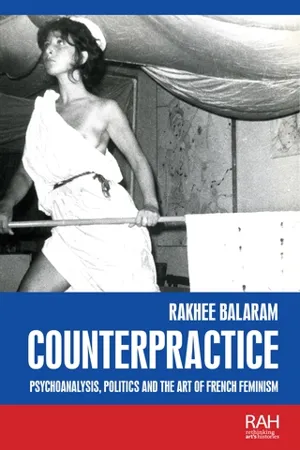
eBook - ePub
Counterpractice
Psychoanalysis, politics and the art of French feminism
- 440 pages
- English
- ePUB (mobile friendly)
- Available on iOS & Android
eBook - ePub
Counterpractice
Psychoanalysis, politics and the art of French feminism
About this book
Counterpractice highlights a generation of women who used art to define a culture of experimental thought and practice during the period of the French women's movement or Mouvement de Libération des Femmes (1970–81). It considers women's art in relation to some of the most exciting thinkers to have emerged from the French literature and philosophy of the 1970s – Hélène Cixous, Luce Irigaray and Julia Kristeva – forcing a timely reconsideration of the full spectrum of revolutionary practices by women in the years following the events of May '68. Lavishly illustrated with over 200 images, the book also features an illuminating foreword by art historian Griselda Pollock.
Information
Topic
ArteSubtopic
Historia del arte contemporáneo1
On the streets: from May ’68 to the MLF
Revolutionaries do not make revolutions! The revolutionaries are those who know when power is lying in the street and when they can pick it up.Hannah Arendt, 19721
In 1970, Partisans: L’année zéro became a manifesto of the women's liberation movement in terms of history, activities, goals, international relations with other movements, and testimonies. Anne Zelensky and Jacqueline Feldman (‘Anne and Jacqueline’) (who a few months earlier had created FMA, or Féminin Masculin Avenir, as a socialist group to discuss the ‘women question’ 2) wrote a history of May ’68, citing their participation in a conference on ‘la femme et la révolution’ at the Sorbonne, fifteen days after other debates had taken place, where it was thought that women (via a discussion on the pill) should be included.3 The journal included the ‘anonymous’ J.K., writing of political militantism:
Je dois dire que, au début du moins, je me foutais pas mal de la politique, mais j’étais quasiment obligée de faire semblant de m’y intéresser pour ne pas être considérée comme une cloche par ce type … Ça n’avait vraiment aucun rapport avec ma vie, mon expérience … Ça n’est pas resté toujours à ce point pour moi, mais je pense que la dépendance des femmes à l’égard des hommes est telle, tant sur le plan affectif que sur le plan des idées, qu’il est fréquent de voir une militante changer d’idées politiques parce qu’elle change de mec, ou ne militer que pour vivre avec un tel, et arrêter de militer si elle se sépare de lui … A partir de mai je n’ai plus pu supporter de vivre en contradiction avec mes idées, qui étaient cette fois-ci vraiment devenues les miennes.4
I must say that, at the beginning at least, I did not care much about politics, but I was almost obliged to pretend to be interested in it in order to not be considered an idiot by this guy … It really had nothing to do with my life, my experience … It did not always stay like this for me, but I think that a woman's dependence on a man exists as much on an emotional level as an intellectual one. So it becomes common to see a female militant change her political ideas because she changes her guy, or to campaign only to be able to live with him, and to stop campaigning if she breaks up with him … After May I could no longer bear to live in contradiction with my ideas, which at this time really became my own.
This representation of woman as symbol (either passive or ‘faking it’) can be seen as leading to the inception of the MLF, fueled by the passion for subjectivity, or personal voice, as upheld by the women's movement. Duchen finds that J.K.'s case symbolizes what many women experienced: ‘Accounts of the events tended to represent women activists as the silent wives or girlfriends of the male militants.’ 5 At the same time, however, information was processed and absorbed by the ‘silent’ partner for later action (as seen in J.K.'s comments), and by many women in the MLF who had been involved in the events of May ’68 but had felt excluded by their lack of real mobility, influence and power. This ‘acting as if’ for women also resonated with Caroline de Bendern's views as ‘the’ symbol of May ’68. The iconic photograph, by Jean-Pierre Rey, of ‘Marianne’ (Figure 1.1) on the shoulders of artist Jean-Jacques Lebel (cropped from one picture, appearing in another) became one of the most celebrated images of the ‘revolution’ and of liberation. However, the image itself masks the reality of the woman: Caroline de Bendern was immediately disinherited from her English aristocratic family, and, after years of ambivalence toward the photo, she finally sought compensation for use of the image without her permission.6 The image captured a moment that, significantly, she invented:
On est en route vers la Bastille, je viens de grimper sur les épaules d’un copain. On demandait quelqu’un pour porter le drapeau et moi, j’avais si mal aux pieds à force de piétiner que j’ai saisi l’aubaine. Je n’aurais voulu ni du drapeau rouge – à cause des communistes qui ont saboté le mouvement – ni du drapeau noir, car je ne connais rien aux anarchistes. Mais le drapeau vietnamien me convient comme symbole d’une guerre que toute la jeunesse dénonce. … Instinctivement, je me redresse, mon visage se fait plus grave, mon geste plus solennel, je voudrais à tout prix être belle et donner du mouvement une représentation à la hauteur de ce moment. Au fond, je prends la pose. Et suis piégée par cette pose. … Je deviens exactement ce que j’essaie de paraître.7
We are on our way to the Bastille, I just got onto a friend's shoulders. Someone was asked to carry the flag, and my feet hurt so badly from walking that I seized the chance. I would not have wanted the red flag – because of the communists who sabotaged the movement – nor the black flag, since I knew nothing about the anarchists. But the Vietnamese flag suits me as a symbol of a war that all young people condemn … Instinctively, I straighten up, my face becomes serious, my movements more solemn, I would like to be beautiful above all and to give the movement a representation which would live up to this moment. Basically, I posed. And am trapped by this pose … I became exactly what I was trying to appear to be.
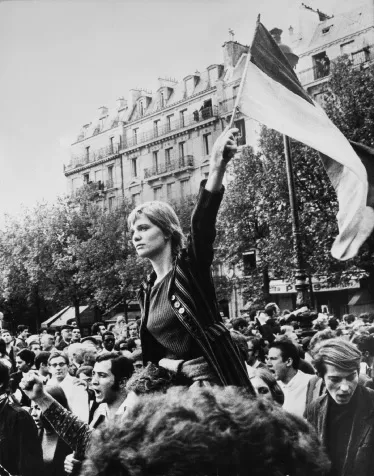
1.1 Jean-Pierre Rey, ‘La Marianne de Mai 68’, May 1968.
Although Caroline as ‘Marianne’ was revered as a symbol, it is important to note that women were not always in control of their representation. Women were still being portrayed as objects of deliberate provocation and erotic sexuality in Situationist posters and in their comic strips, which superimposed inflammatory political slogans on the bodies of naked women or used women to challenge ...
Table of contents
- Cover
- Half-title page
- Series page
- Title page
- Copyright page
- Contents
- Illustrations
- Acknowledgments
- Foreword
- Preface: the glissade
- Introduction
- 1: On the streets: from May ’68 to the MLF
- 2: The MLF 1970s
- 3: Libération-création: MLF, women artists and the militant body
- 4: Instase: Psychanalyse et Politique and the spaces of women's art
- 5: Women's groups and collective art practices
- 6: Hard politics, soft art: subversive practices from écriture féminine to soft art
- Conclusion: La révolution accomplie? Some legacies of women's art in 1970s France
- Index
- Plates
Trusted by 375,005 students
Access to over 1.5 million titles for a fair monthly price.
Study more efficiently using our study tools.
Frequently asked questions
Yes, you can cancel anytime from the Subscription tab in your account settings on the Perlego website. Your subscription will stay active until the end of your current billing period. Learn how to cancel your subscription
No, books cannot be downloaded as external files, such as PDFs, for use outside of Perlego. However, you can download books within the Perlego app for offline reading on mobile or tablet. Learn how to download books offline
Perlego offers two plans: Essential and Complete
- Essential is ideal for learners and professionals who enjoy exploring a wide range of subjects. Access the Essential Library with 800,000+ trusted titles and best-sellers across business, personal growth, and the humanities. Includes unlimited reading time and Standard Read Aloud voice.
- Complete: Perfect for advanced learners and researchers needing full, unrestricted access. Unlock 1.5M+ books across hundreds of subjects, including academic and specialized titles. The Complete Plan also includes advanced features like Premium Read Aloud and Research Assistant.
We are an online textbook subscription service, where you can get access to an entire online library for less than the price of a single book per month. With over 1.5 million books across 990+ topics, we’ve got you covered! Learn about our mission
Look out for the read-aloud symbol on your next book to see if you can listen to it. The read-aloud tool reads text aloud for you, highlighting the text as it is being read. You can pause it, speed it up and slow it down. Learn more about Read Aloud
Yes! You can use the Perlego app on both iOS and Android devices to read anytime, anywhere — even offline. Perfect for commutes or when you’re on the go.
Please note we cannot support devices running on iOS 13 and Android 7 or earlier. Learn more about using the app
Please note we cannot support devices running on iOS 13 and Android 7 or earlier. Learn more about using the app
Yes, you can access Counterpractice by Rakhee Balaram, Marsha Meskimmon in PDF and/or ePUB format, as well as other popular books in Arte & Historia del arte contemporáneo. We have over 1.5 million books available in our catalogue for you to explore.