Snack Foods
eBook - ePub

Snack Foods

Processing, Innovation, and Nutritional Aspects

  1. 604 pages
  2. English
  3. ePUB (mobile friendly)
  4. Available on iOS & Android
eBook - ePub

Snack Foods

Processing, Innovation, and Nutritional Aspects

About this book

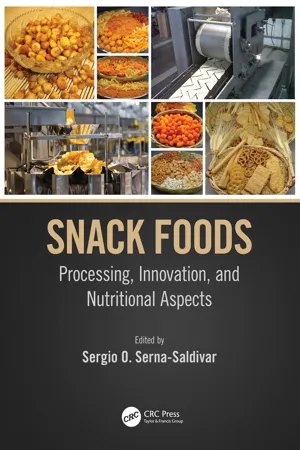
The diverse segments of the snack industries that generate close to $520 billion of annual sales are adapting to new consumer´s expectations, especially in terms of convinience, flavor, shelf life, and nutritional and health claims. Snack Foods: Processing, Innovation, and Nutritional Aspects was conceptualized to thoroughly cover practical and scientific aspects related to the chemistry, technology, processing, functionality, quality control, analysis, and nutrition and health implications of the wide array of snacks derived from grains, fruits/vegetables, milk and meat/poultry/seafood.

This book focuses on novel topics influencing food product development like innovation, new emerging technologies and the manufacturing of nutritious and health-promoting snacks with a high processing efficiency. The up-to-date chapters provide technical reviews emphasising flavored salty snacks commonly used as finger foods, including popcorn, wheat-based products (crispbreads, pretzels, crackers), lime-cooked maize snacks (tortilla chips and corn chips), extruded items (expanded and half products or pellets), potato chips, peanuts, almonds, tree nuts, and products derived from fruits/vegetables, milk, animal and marine sources.

Key Features:

  • Describes traditional and novel processes and unit operatios used for the industrial production of plant and animal-based snacks.
  • Depicts major processes employed for the industrial production of raw materials, oils, flavorings and packaging materials used in snack food operations.
  • Contains relevant and updated information about quality control and nutritional attributes and health implications of snack foods.
  • Includes simple to understand flowcharts, relevant information in tables and recent innovations and trends.

Divided into four sections, Snack Foods aims to understand the role of the major unit operations used to process snacks like thermal processes including deep-fat frying, seasoning, packaging and the emerging 3-D printing technology. Moreover, the book covers the processing and characteristics of the most relevant raw materials used in snack operations like cereal-based refined grits, starches and flours, followed by chapters for oils, seasoning formulations and packaging materials. The third and most extensive part of the book is comprised of several chapters which describe the manufacturing and quality control of snacks mentioned above. The fourth section is comprised of two chapters related to the nutritional and nutraceutical and health-promoting properties of all classes of snacks discussed herein.

Information

Publisher
CRC Press
Year
2022
Print ISBN
9780367646875
eBook ISBN
9781000543360

1 Overview and State-of-the-Art of the Snack Food Industry

Sergio O. Serna-Saldivar
DOI: 10.1201/9781003129066-1
Contents
1.1 Introduction
1.2 Classification of Snack Foods
1.2.1 Current Commercial Products
1.2.2 Emerging Products and Technologies
1.3 Historical Preview and General Properties of Snacks
1.3.1 Popcorn
1.3.2 Wheat-Based Snacks
1.3.2.1 Crackers or Hard or Salt Biscuits
1.3.2.2 Pretzels
1.3.2.3 Granolas
1.3.3 Snack Bars
1.3.4 Alkaline-Cooked Corn Products (Corn and Tortilla Chips)
1.3.5 Extruded Snacks
1.3.6 Snacks from Legumes and Pseudocereals
1.3.6.1 Peanuts
1.3.7 Potato Chips
1.3.8 Almonds and Tree Nuts
1.3.9 Fruits and Vegetables
1.3.10 Milk-Based Snacks
1.3.11 Meat- and Marine-Based Snacks
1.4 Statistics of Snack Food Production, Sales, and Consumption
1.5 Nutritional Value of Snacks
1.6 Major Constraints of Snacks
1.6.1 Major Nutritional and Health Concerns
1.6.2 Potential Toxicological Compounds
1.6.2.1 Pathogenic Bacteria
1.6.2.2 Mycotoxins
1.6.2.3 Toxic Compounds from Degraded Oil
1.7 Future Outlook
References

1.1 Introduction

Snacks are defined as foods served or taken informally in small amounts between meals and are further described as light, casual, or hurried meals. Most snacks are ready-to-eat (RTE) items high in oil and generally flavored with salt or salt-based flavorings although many sweet fruit/vegetable-based snacks are growing in relevance throughout the globe. It is hard to establish the borderline between snacks, collations, and confectionary products, so in this book we will primarily stress the production and features of shelf-stable savory snacks containing low moisture. The major distinction of snacks is that they are shelf-stable products at room temperature because most are subjected to dehydration by frying, toasting, baking, or salting. The packaging of these products is aimed to preserve freshness and avoid moisture uptake and oil rancidity. From the microbial viewpoint, most snacks do not pose health risks because pathogenic bacteria and molds require higher water activities (Aw) to prevail and grow. Most snack processors focus their technologies to enhance the shelf-life of their products from the rancidity or fat oxidation and texture standpoints. These critical parameters are mainly controlled by the selection of the proper frying oils, the frying process, the use of artificial or natural additives, and especially the packaging technology, which in most instances employ materials that exclude moisture, oxygen, and UV light to protect product crispiness and rancidity.
Today, consumers are seeking snacks that are aligned with their individual diet preferences, whether it’s vegan, vegetarian, keto, or gluten free. The clean-label movement has created an array of products manufactured with clean ingredients and additives, and therefore more snack mixes or blends based on dry or intermediate moisture fruits, grains, legumes, and tree nuts are being developed. The other positive trend of the industry is the snacking of high protein and low-carb products mainly produced from dry and intermediate moisture meats and marine species.
Overall, the current trend of the snack industry is the development of nutritious snacks with lower amounts of fat and sodium, higher amounts of proteins and dietary fiber, with GRAS additives (green or clean label), and a better profile of fatty acids especially in terms of the ratio of unsaturated:saturated fatty acids.
The objective of this chapter is to introduce the reader to the scope of the snack industry including the historical preview of major snacks, statistics of volume and sales, and the importance, advancements, innovations, future trends, and constraints of the industry.

1.2 Classification of Snack Foods

Snacks have always been an important part of life, and these foods represent a relevant segment of the food industry globally especially in developed countries. The snack food market is continually evolving and adapting to the new consumers’ trends. During this century, the industry has gradually adapted to fulfill the demands of millennials and recently to forced patterns due to the COVID-19 pandemic. Snacking is increasing from factors such as increases in one-person households, a higher proportion of working parents and more school-age children obtaining their own meals, a highly mobile population, and the availability of RTE snacks in convenience stores and vending machines (Riaz 2004). From the processing viewpoint, the industry is continuously innovating and evolving to generate new foods packaged in attractive and functional materials to preserve their freshness for longer periods of time.

1.2.1 Current Commercial Products

Snacks are broadly classified according to their food source and to their manufacturing process (Tables 1.1 and 1.2). Practically all food groups have important examples of snacks. Undoubtedly, the most relevant and sold worldwide are those derived from grains, mainly cereals, followed by tubers. These products are fabricated taking advantage of the functionality of the gelatinized starch. Many other types of snacks are sourced from tree nuts, fruit/vegetables, milk, different meats, and marine products. Independently of the food source, practically all snacks are shelf stable at room temperature because of their low moisture content and water activity (Aw). The only exception is snacks derived from milk such as yogurt, cheeses, mousse, and flans, which commonly require refrigeration. Table 1.1 summarizes the major snack types according to the food source, characteristics, and general nutritional attributes. From the processing standpoint, most commercial snacks fit into the categories of first, second, or third generations (Table 1.2). First-generation snacks are the easiest to manufacture and consist of natural products such as roasted whole grains, peanuts, nuts, dried fruits and vegetables, popcorn, and regular potato chips. Most snacks consumed today belong to the category of second generation. These include simple formed products mainly obtained after direct extrusion (i.e., corn chips, expanded puffs, balls, and curls) or by sheeting/forming and baking/frying such as fabricated potato chips, tortilla chips, granola bars, pita chips, crisps/toasted breads, and hard pretzels. The most elaborated category in terms of ingredients and processing is the third-generation snacks commonly manufactured after two sequential extrusion steps known as cooking and forming that yield first pregelatinized dense pellets or half products which are further processed with deep-fat frying, baking, or microwave cooking to reach the consumer.
TABLE 1.1 Classification of Snack Foods According to Their Food Source and Main Characteristics
Snack Food Source Main Types of Snacks Main Characteristics Major Nutritional Attributes and Constraints
Grain Base
Cereals
Corn: popcorn, parched corn, corn chips, tortilla chips, extruded puffs.
Wheat, oats, and/or rye: toasted bread or crisps, crackers, pita bread chips, hard pretzels.
Shelf-stable products that contain low moisture and high-fat content commonly produced by conventional, lime, or extrusion cooking processes followed by baking, frying, and seasoning with salt-based flavorings.
Since most products are produced from refined milled fractions and flavored with fat they are considered high caloric and fat products. These snacks are rich in starch and oil and contain relatively low protein, dietary fiber, and micronutrients. The protein is medium to low quality because it lacks lysine and other essential amino acids. Wheat, rye, barley, and even oat products need to be declared on the food label as potential allergens for celiac or gluten intolerant people.
Legumes/oilseeds
Roasted peanuts,...

Table of contents

  1. Cover
  2. Half-Title
  3. Title
  4. Copyright
  5. Contents
  6. Preface
  7. About the Editor
  8. List of Contributors
  9. Chapter 1 Overview and State-of-the-Art of the Snack Food Industry
  10. Chapter 2 Application of Traditional and Emerging Processes
  11. Chapter 3 Industrial Frying and Seasoning Operations
  12. Chapter 4 Packaging of Snack Foods
  13. Chapter 5 3D-Printed Snacks
  14. Chapter 6 Production of Cereal-Based Raw Materials for the Snack Industry
  15. Chapter 7 Production and Properties of Fats and Oils
  16. Chapter 8 Seasonings for Snack Foods
  17. Chapter 9 Popcorn and Other Puffed Grains
  18. Chapter 10 Production of Wheat-Based Snacks
  19. Chapter 11 Alkaline-Cooked Snack Foods
  20. Chapter 12 Production of Snacks by Extrusion Cooking
  21. Chapter 13 Snacks Based in Legumes, Pseudocereals, and Other Seeds
  22. Chapter 14 Snacks from Potatoes
  23. Chapter 15 Almonds and Tree Nuts
  24. Chapter 16 Snacks from Fruits and Vegetables
  25. Chapter 17 Dairy-Based Snacks
  26. Chapter 18 Snacks from Animal, Poultry, and Sea Foods
  27. Chapter 19 Quality Control and Assurance in the Snack Food Industry
  28. Chapter 20 Nutritional Composition and Toxic Compounds of Snack Foods
  29. Chapter 21 Nutraceutical and Health Implications of Snack Foods
  30. Index

Trusted by 375,005 students

Access to over 1.5 million titles for a fair monthly price.

Study more efficiently using our study tools.

Frequently asked questions

Yes, you can cancel anytime from the Subscription tab in your account settings on the Perlego website. Your subscription will stay active until the end of your current billing period. Learn how to cancel your subscription
No, books cannot be downloaded as external files, such as PDFs, for use outside of Perlego. However, you can download books within the Perlego app for offline reading on mobile or tablet. Learn how to download books offline
Perlego offers two plans: Essential and Complete
  • Essential is ideal for learners and professionals who enjoy exploring a wide range of subjects. Access the Essential Library with 800,000+ trusted titles and best-sellers across business, personal growth, and the humanities. Includes unlimited reading time and Standard Read Aloud voice.
  • Complete: Perfect for advanced learners and researchers needing full, unrestricted access. Unlock 1.5M+ books across hundreds of subjects, including academic and specialized titles. The Complete Plan also includes advanced features like Premium Read Aloud and Research Assistant.
Both plans are available with monthly, semester, or annual billing cycles.
We are an online textbook subscription service, where you can get access to an entire online library for less than the price of a single book per month. With over 1.5 million books across 990+ topics, we’ve got you covered! Learn about our mission
Look out for the read-aloud symbol on your next book to see if you can listen to it. The read-aloud tool reads text aloud for you, highlighting the text as it is being read. You can pause it, speed it up and slow it down. Learn more about Read Aloud
Yes! You can use the Perlego app on both iOS and Android devices to read anytime, anywhere — even offline. Perfect for commutes or when you’re on the go.
Please note we cannot support devices running on iOS 13 and Android 7 or earlier. Learn more about using the app
Yes, you can access Snack Foods by Sergio O. Serna-Saldivar in PDF and/or ePUB format, as well as other popular books in Technology & Engineering & Food Science. We have over 1.5 million books available in our catalogue for you to explore.