The story of America's "War on Drugs" usually begins with Richard Nixon or Ronald Reagan. In Containing Addiction, Matthew R. Pembleton argues that its origins instead lie in the years following World War II, when the Federal Bureau of Narcotics—the country's first drug control agency, established in 1930—began to depict drug control as a paramilitary conflict and
sent agents abroad to disrupt the flow of drugs to American shores.
U.S. policymakers had long viewed addiction and organized crime as profound domestic and trans-national threats. Yet World War II presented new opportunities to implement drug control on a global scale. Skeptical of public health efforts to address demand, the Federal Bureau of Narcotics believed that reducing the global supply of drugs was the only way to contain the spread of addiction. In effect, America applied a foreign policy solution to a domestic social crisis, demonstrating how consistently policymakers have assumed that security at home can only be achieved through hegemony abroad. The result is a drug war that persists into the present day.
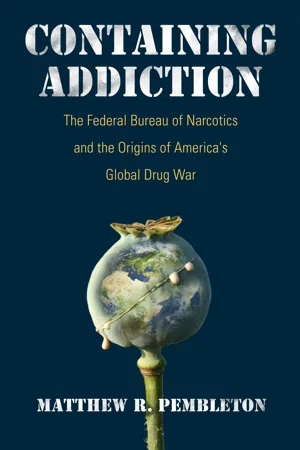
eBook - ePub
Containing Addiction
The Federal Bureau of Narcotics and the Origins of America's Global Drug War
- English
- ePUB (mobile friendly)
- Available on iOS & Android
eBook - ePub
Containing Addiction
The Federal Bureau of Narcotics and the Origins of America's Global Drug War
About this book
Information
Chapter 1
The Discourse of the Dope Menace
The opium poppy holds as much potential disaster as an atom bomb.
—Harry J. Anslinger (1946)
Americans can take heart in the good news that we are defeating the cruelest enemy we’ve ever faced: The murderous traffic in dope.
—Harry J. Anslinger (1961)
When Commissioner of Narcotics Harry J. Anslinger testified on the merits of the 1937 Marihuana Tax Act, he described rising drug use as a “national menace” and brought a stack of gory crime-scene photos to illustrate the point. Marijuana, he claimed, was like a rattlesnake or a wildfire and directly responsible for an alarming number of gruesome crimes, images of which he displayed for the amazed legislators. The drug made people crazy and it was everywhere, he said, growing in ditches and vacant lots, so ubiquitous that schoolchildren could afford it even in the depths of the Depression. Not content with his oral testimony, Anslinger submitted several additional written statements into the record, including a report from a New Orleans district attorney (DA) that he called “one of the finest” he’d seen on the link between drugs and crime. The report described a marijuana-fueled crime wave that was as nefarious as it was violent, concluding, “The underworld has been quick to realize the value of this drug in subjugating the will of human derelicts to that of the master mind.”1
Twenty years later, the Commissioner spun a similar tale, but now the stakes were even higher. The ability of drugs—be it marijuana or heroin—to erode human willpower and moral judgment remained intact; what had changed was the scope. According to the Federal Bureau of Narcotics, the dope trade began as a loosely directed criminal enterprise but had become increasingly organized and, in the case of communist China, a state-sponsored clandestine attack.
Like imperial Japan before them, Anslinger warned, the commies were using heroin as the vanguard of invasion, spreading addiction to soften their targets and fill their coffers. It wasn’t just China’s neighbors at risk; American troops in South Korea were exposed. “The communists have planned well,” he told a UN audience in 1953, “and know a well-trained soldier becomes a liability and security risk from the moment he first takes a shot of heroin.” Four years later, as American GIs patrolled the demilitarized zone, he repeated the charge to an audience of U.S. senators and reported that South Korean forces had intercepted thousands of communist agents entering the country “with heroin in one hand and gold in the other” on a mission “to corrupt our people there.” The recent arrest of a gang of merchant seamen running drugs between Hong Kong and San Francisco, Anslinger argued, was proof that Red China was reaching across the Pacific. Closer to home, he warned that Fidel Castro had joined “the hammer and sickle—and the narcotic needle” by turning Cuba into a “privileged sanctuary” and “launching site” for communist drug traffickers to continue their assault on the free world.2
In other words, America’s enemies—communists and criminals alike—were already waging a drug war against the red, white, and blue. This was a different kind of war, one without front lines or uniforms. In the closing pages of his 1961 book, The Murderers, the Commissioner urged Americans to “be on guard against the use of drugs as a political weapon” and speculated that communists might recruit fellow travelers or groups like the Mafia to “make narcotics a new ‘sixth’ column to weaken and destroy selected targets in the drive for world domination.” Talk of “fifth” or “sixth” columns was a colorful way of linking drugs to the specter of foreign subversion or internal betrayal, and it positioned the dope menace as a transnational threat to freedom itself. “The greatest threat to America lies within her boundaries,” Anslinger claimed; longtime FBN official Malachi Harney assured Americans, “Most of our danger is from without.”3 The danger, both would be quick to correct themselves, was everywhere, and it required a police force capable of meeting a truly global threat.
Creating Consensus
Anslinger could boast many accomplishments as commissioner, but his greatest legacy may have been framing the threat posed by drugs. During his thirty-two years in office, Anslinger wrote countless magazine and newspaper articles and discussed his work with an array of audiences. He even found time to indulge his literary aspirations and cowrote three full-length books: The Traffic in Narcotics (1953), The Murderers (1961), and The Protectors (1964)—all of which dramatized the FBN’s fight against the dope menace. As the nation’s top official on drugs, Anslinger’s voice carried, and he never failed to press his message: drugs are a subversive foreign menace, the addicts who use them weaken the moral foundation of American society, and those who traffic in drugs are evil. The lurid appeal of this message with the press, the public, and U.S. policymakers helped prepare a cultural climate supportive of increasingly vigorous control measures.4
A pithy phrase with surprising depth, the “dope menace” or “narcotics evil,” as officials typically abbreviated the complexities of the drug problem, had four central components: the actual drugs, the nature of addiction, drug users, and drug traffickers. Bureau officials weren’t inventing this stuff out of thin air, but they saw the world through a particular lens—one shaped by the social, political, and cultural issues of their day—and then portrayed the dope menace in a manner sympathetic to their own institutional agenda. At times, the Bureau’s depiction was cartoonishly overblown. At other times, it was almost subtle, as FBN officials linked drugs and addiction to festering cultural anxieties and long-standing problems in American life. The dope menace was, in short, a discourse and one packed with layers of meaning, each of which can be peeled away to reveal how deep-seated cultural beliefs shaped American policy.
This chapter sketches the dope menace’s evolution from the first decades of the twentieth century into the 1960s and the rise and fall of the first drug war consensus. The dope menace represented the threat posed by drugs; the drug war consensus signaled broad support for a punitive, police-centered, and transnational response. To put it another way, the dope menace was the horse, and the drug war consensus was the cart. That’s a mild oversimplification, as causal relationships could flow both ways, but what’s important to appreciate is that the drug war was a response to a threat many thought was real and not merely a pretext for foreign intelligence operations or reinforcing racial segregation. Those are undoubtedly products of the drug war, but they are not its cause.
The dope menace took shape in the first decades of the twentieth century, before the FBN arrived on the scene. Bureau officials solidified the core concepts during the 1930s and elaborated minor variations into the 1950s. The drug war consensus was the response; its seeds were sown in the 1930s, germinated during World War II, and then cross-pollinated with the Cold War and bore fruit in the 1950s. Together, the dope menace and drug war consensus gave rise to the FBN’s drug war and its subsequent escalation under Nixon and Reagan. And this is how it all began . . .
A Greater Evil than Human Slavery
Federal drug control began at the dawn of the twentieth century, an era of tumultuous change in American life. In the span of a single generation, from around 1890 to 1920, the country was radically transformed by the twin processes of industrialization and urbanization, turned from a rural agrarian nation into an urban industrial one. The ratio of people living in urban and rural settings drew even in 1920, and nearly all population growth took place in cities thereafter. The settlement of the western frontier closed an important chapter of U.S. history and raised questions about the future of America’s “manifest destiny.” It was a wrenching time for the nation’s collective psyche and self-image. America’s new industrial might turned the country into an economic powerhouse but seemed to change the national character and to create as many problems as it solved. Poverty, crime, and disease became issues on a scale as never before. Economic growth was explosive but unstable and its rewards uneven. A recurring cycle of boom and bust left many Americans looking to the future these changes had wrought with a typical but contradictory mixture of brio and unease. American elites responded in a number of ways. Some empowered the state to restore a sense of order; others turned their gaze to the horizon and exhorted the country to embrace a global role that might stabilize conditions at home.5
In 1926 Texas Democrat Tom Connally, still early in a long and distinguished political career, offered a folksy analogy that perfectly illustrated how American leaders made sense of their changing world. It was impossible, he argued, to untangle the political, economic, and moral relationships that geography had once kept separate. While explaining the need to engage with the League of Nations to a New York Times reporter—for reasons, we should note, that included drug control—Connally described the situation facing an anonymous farmer who rents a distant property to a fellow named Bill Jones. Prior to the farmer’s financial stake, Connally explained, physical distance allowed a certain independence. “Bill Jones can get drunk, curse and swear and do anything he wants. . . . But when the farmer gets a mortgage on Bill Jones’s property he becomes interested. If Bill Jones then gets drunk, curses, swears and shoots up the town the farmer will get mightily interested and will do something about it. So it is with nations.” Connally concluded, “Now that we have large interests in Europe we are beginning to show a high moral interest in their affairs.”6 Fraught with symbolic meaning, drugs were an issue that crystallized such dilemmas and united the impulses toward reform, order, and global engagement.
At the turn of the century, however, the foreign and domestic aspects of the drug problem were largely separate matters. Opium was readily attainable by the early nineteenth century, and solutions like laudanum were a household item. An import, opium always had a foreign connotation that was most pronounced in the concern over Chinese-run opium dens, but these were more nuisance than threat. The real problem was that narcotic addiction was a frequent consequence of medical treatment, particularly after the trauma of the Civil War and introduction of the hypodermic needle. Medicine made rapid advances in the late nineteenth century, but it was primitive by modern standards and physicians relied on opiates like morphine—a potent but habit-forming alkaloid isolated from opium—to alleviate an assortment of ailments. Tuberculosis, for example, was a leading cause of death and essentially untreatable until the development of antibiotics, so the best doctors could do was administer various opiates—usually heroin after 1898—as a palliative to ease their patients’ suffering. Opium’s anti-diarrheal qualities were also valuable; germ theory was just taking hold, and many sources of drinking water were polluted. This array of ameliorating powers ensured opium’s inclusion in a variety of patent medicines and mail-order cures at a time when roughly equal numbers of Americans preferred to self-medicate than face the expense and horror of the sawbones. By the end of the century, the single largest cohort of American opiate addicts was actually middle- and upper-class women, because they enjoyed the best access to medical care and the variety of snake-oil cures that usually packed a potent dose of opiates.7
The first federal drug laws addressed these two aspects of the domestic problem. The 1909 Opium Exclusion Act barred the import of smoking opium, but the real game changers were the Pure Food and Drug Act of 1906, which required proper labeling, and the 1914 Harrison Narcotic Act, which introduced federal oversight by requiring physicians and druggists to register with the government and pay a nominal tax. This power of taxation—rather than criminalization per se—formed the basis of U.S. drug enforcement for the next fifty-six years.
A new drug, however, challenged professional and legislative controls. Diacetylmorphine was developed under the brand name “Heroin” by the German company Bayer and brought to market in 1898. The name came from the Greek and German words heros and heroisch; both mean heroic or strong. Heroin is roughly twice as potent as morphine and works twice as fast. At a time when chemists were daily pushing the frontiers of their craft—Bayer introduced aspirin the following year—heroin was greeted as a miracle of modern science: praised for its ability to alleviate the suffering of tubercular patients and celebrated as less addictive than morphine. But troubling signs soon emerged. Doctors administering heroin reported crippling physiological dependence in their patients. Recreational users also developed a taste for the powerful narcotic, which could be sniffed rather than smoked or injected. With the hazards of addiction increasingly apparent, the American medical community abandoned the drug even before its import and manufacture were outlawed by the Heroin Act of 1924. Illicit use, however, continued. Odorless, low bulk, and incredibly strong, heroin was easy to smuggle and conceal as authorities clamped down on more notorious drugs like opium and cocaine, both of which all but vanished. The number of heroin users to emerge from the first decades of the twentieth century was small—and dwarfed by the much larger population of morphine users—but the psychoactive genie was out of the bottle, and it had dire consequences for the discourse of the dope menace.8
At roughly the same time, drug control became a major component of U.S. foreign policy due to events over the western horizon, where American reformers and missionaries were dismayed to find widespread opium addiction in China and the Philippines—one a coveted foreign market and the other a newly acquired colony. With the support of Presidents Roosevelt and Taft, Charles Henry Brent, an Episcopal bishop proselytizing in the Philippines, and Dr. Hamilton Wright, a tropical disease specialist, convened two diplomatic enclaves to address the world opium situation. The 1909 Shanghai Opium Commission accomplished little beyond a nonbinding statement expressing concern. The 1912 Hague Opium Convention, the world’s first drug control treaty, was similarly constrained by imperial reluctance to abandon a lucrative colonial cash crop. It did, however, require each of its signatories to establish some kind of domestic control regime, a provision later incorporated into the Treaty of Versailles.
These were small steps, but they established lasting precedents on the American side. Leading the U.S. delegation, Hamilton Wright pressed the European powers to withdraw from the colonial opium economy and advocated strict agricultural caps as the best way to limit global supply. The Europeans thwarted this supply-side approach, but source control remained the foundation of U.S. counternarcotic strategy. America’s special concern for Chinese addiction, meanwhile, revealed a curious blend of impulses: a kind of messianic humanitarianism reinforced the notion that a grateful, drug-free China would become an effective trade partner. This blend of American exceptionalism, economic interest, and geopolitics remained a defining feature of U.S. drug control—as did the period’s rhetoric, with papers like the Chicago Tribune immediately proclaiming a “war on opium.”9
The negotiations, however, also revealed the conflicted role played by the United States itself, which has historically been the primary impetus behind global control and a voracious consumer of both licit and illicit drugs—a revelation that horrified Hamilton Wright. After failing to broker a binding agreement at Shanghai, Wright launched an intensive study of global consumption in preparation for the Hague summit. In an interview titled “Uncle Sam Is the Worst Drug Fiend in the World,” he explained that America had both the largest and the fastest-growing rate of per capita narcotic consumption in the world. Anticipating criticism, Wright argued that only tough domestic controls would restore U.S. credibility—which helped lead to the 1914 Harrison Act. In the meantime, Wright recognized that drug control exposed a glaring contradiction in the American worldview. “The history of the opium fight forms a queer illustration of our National blindness to our own faults,” he lamented, “and emphasizes our National tendency to see, with amazing clarity, the sins of others, while remaining blind to our own viciousness.”10
World War I—like the Civil War before it and World War II after it—was a watershed...
Table of contents
- Cover
- Title Page
- Copyright Page
- Dedication
- Contents
- Preface
- Introduction. Toiling in the Vineyards
- 1. The Discourse of the Dope Menace
- 2. The World’s Greatest Living Authority on Dope
- 3. On the Street and behind Enemy Lines
- 4. A Red-Blooded American Boy and True-Crime Action Hero
- 5. Constructing a Kingpin
- 6. The Drug War Goes Abroad
- 7. The Global Drug War
- 8. The Wheel Turns
- Conclusion. Waging Drug Wars
- Notes
- Archival Sources
- Index
Trusted by 375,005 students
Access to over 1.5 million titles for a fair monthly price.
Study more efficiently using our study tools.
Frequently asked questions
Yes, you can cancel anytime from the Subscription tab in your account settings on the Perlego website. Your subscription will stay active until the end of your current billing period. Learn how to cancel your subscription
No, books cannot be downloaded as external files, such as PDFs, for use outside of Perlego. However, you can download books within the Perlego app for offline reading on mobile or tablet. Learn how to download books offline
Perlego offers two plans: Essential and Complete
- Essential is ideal for learners and professionals who enjoy exploring a wide range of subjects. Access the Essential Library with 800,000+ trusted titles and best-sellers across business, personal growth, and the humanities. Includes unlimited reading time and Standard Read Aloud voice.
- Complete: Perfect for advanced learners and researchers needing full, unrestricted access. Unlock 1.5M+ books across hundreds of subjects, including academic and specialized titles. The Complete Plan also includes advanced features like Premium Read Aloud and Research Assistant.
We are an online textbook subscription service, where you can get access to an entire online library for less than the price of a single book per month. With over 1.5 million books across 990+ topics, we’ve got you covered! Learn about our mission
Look out for the read-aloud symbol on your next book to see if you can listen to it. The read-aloud tool reads text aloud for you, highlighting the text as it is being read. You can pause it, speed it up and slow it down. Learn more about Read Aloud
Yes! You can use the Perlego app on both iOS and Android devices to read anytime, anywhere — even offline. Perfect for commutes or when you’re on the go.
Please note we cannot support devices running on iOS 13 and Android 7 or earlier. Learn more about using the app
Please note we cannot support devices running on iOS 13 and Android 7 or earlier. Learn more about using the app
Yes, you can access Containing Addiction by Matthew R. Pembleton in PDF and/or ePUB format, as well as other popular books in History & North American History. We have over 1.5 million books available in our catalogue for you to explore.