'It is your democratic right to eat properly braaied (barbequed) food. The Democratic Republic of Braai is wherever you gather around fires with friends and family for a celebration of the nation. Where conversations are had and stories are shared. It is a place where you never have to suffer from badly braaied food.' This is the promise of Jan Braai's Democratic Republic of Braai. Jan's first South African bestseller Fireworks brought us the basics of braai (barbeque), his second book Red Hot showed us that braai could be so much more. Now The Democratic Republic of Braai brings you the greatest braai recipes that Jan knows – because it's your right to braai the best. Find exceptional braai recipes for steak, chicken, lamb and more – there's no need to eat or serve badly braaied food ever again. Everything is clear and the steps are logical. The recipes use normal ingredients with understandable names that you can pronounce and find at your local supermarket. This is a manifesto on how to braai your way to complete independence from the kitchen.

- 200 pages
- English
- ePUB (mobile friendly)
- Available on iOS & Android
eBook - ePub
The Democratic Republic of Braai
About this book
Information
Useful tips for new citizens of the Republic
BUY A MEAT THERMOMETER
This is also known as a ‘food thermometer’, a ‘digital food thermometer’ or an ‘instant-read digital food thermometer’. Don’t buy those old-school ones with dials. Buy a digital one that instantly gives you a completely accurate readout of the internal temperature of the meat. You don’t need the fork-shaped ones from the braai equipment areas of supermarkets and outdoor stores. A normal cheap one from a kitchen store will do, and it will transform forever the way you braai and how good you are. Beef is ready at 57 °C, lamb is ready at 63 °C, pork is ready at 71 °C and chicken is ready at 80 °C. Anything you braai beyond that just dries out the meat and that will have a negative impact on its juiciness, tenderness and flavour.
AS A RULE OF THUMB, DO NOT MARINATE
You will notice some recipes in this book do require a form of marinating – in these cases, always use a non-reactive marinating bowl. Generally speaking, I am not a big fan of marinating meat. It takes time that you frequently don’t have. I prefer a recipe that can be prepped entirely during the time that it takes for the fire to burn out and form coals. In my experience, marinades are also not very effective in adding flavour to meat. I absolutely hate to braai steak that was in marinade. Rather braai the steak as is, which creates a nice crust on the meat, and add a proper, well-prepared sauce afterwards. Chicken burns easily at the best of times and when you put it in some sweet and sticky marinade it really worsens the problem, as it’s a given fact that the sugars in the marinade will burn black before the inside of the chicken is properly braaied to 80 °C. As such I like to braai chicken first and then add the spice and sauce at the end. Examples of how you should braai chicken are comprehensively covered in the recipes for Revolution chicken (page 152) and Klein Karoo chicken (page 52). The logic holds true every time. First braai the meat and then add the spices or sauce that would just turn black and burn on the fire. The same goes for pork spare ribs – first braai then baste. Check out the pork rib recipe on page 54 for an example of that. Lamb is irrelevant to this discussion; there is no need to marinate it as it already has enough flavour as is. Whatever the type of meat, my view right now is that if you’re desperate for marinade rather buy a flavour injector. It’s a new toy I’ve started to play with which allows you to put flavoured liquid inside the meat. The type of inside where no marinade will ever go. See Olive-oiled steaks (page 162) for how to use your flavour injector.
BUY A NO. 10 FLAT-BOTTOMED ‘BAKE’ POTJIE
These guys are the way of the future. Their size and shape make them perfect for domestic use. I have four of them at home and use them all the time for many of the recipes in this book: potjies, meals in potjies, cakes, desserts and the Breakfast of champions (page 48). A no. 10 flat-bottomed potjie manoeuvres and handles easily, is perfect when you’re cooking for 4–6 people and, as it’s flat-bottomed, you can pop it onto the gas stove in the kitchen when there is a hurricane outside. They fit easily into a normal domestic kitchen sink to wash, and when you’re living alone, they also fit into the dishwasher (although I know other people sometimes frown upon this). As the no. 10 is flat-bottomed and has no legs, it is also by far the easiest of all potjies to transport in your car. This happens when you go on holiday (it’s empty), or when you are travelling to a friend’s house with a half-cooked pulled pork potjie before a rugby game. In the latter case, wrap it up in an old blanket or towel before putting it in the boot.
HOW TO SEASON YOUR NEW POTJIE
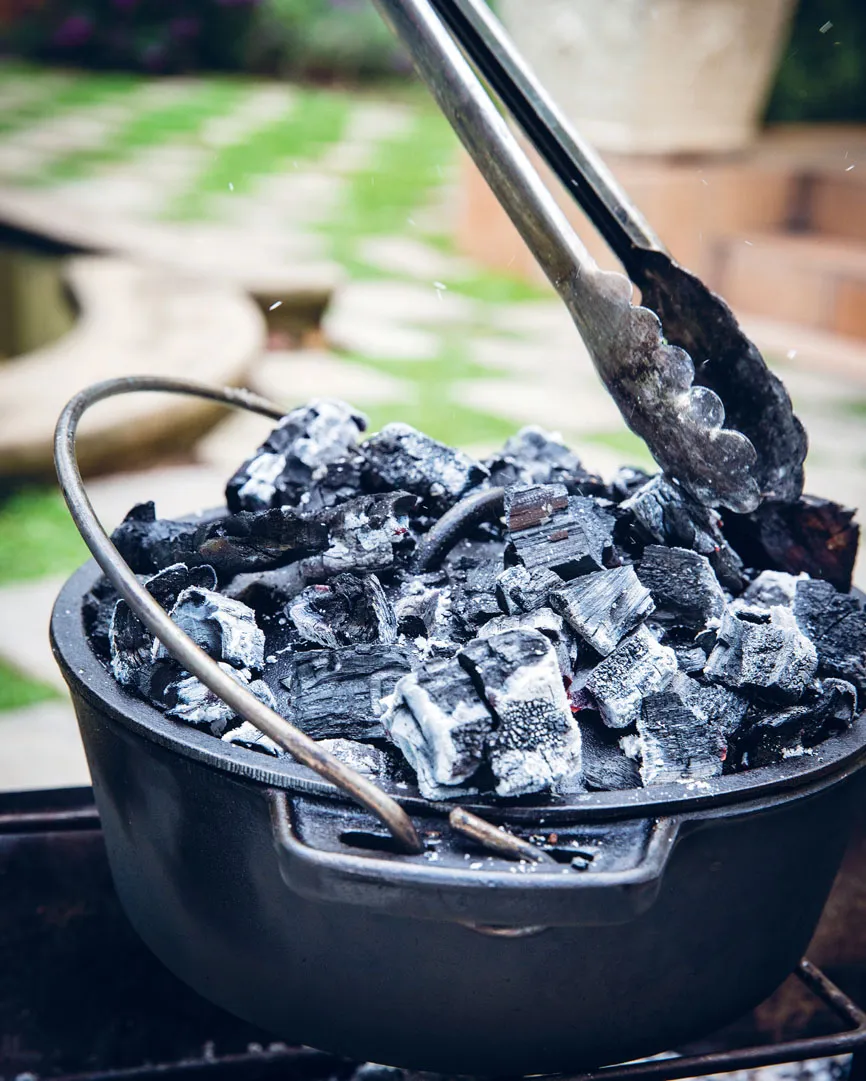
A potjie is made from cast iron. As such, there are some unsavoury elements inside your new pot when you buy it. Cooking food in a brand-new potjie is a very bad idea as the food will not only look funny (it will have an unnatural dark grey colour even though you haven’t burnt it) but it will also taste like iron. Preparing your new potjie is a very important yet simple procedure. The first step is to wash and scrub it properly using warm water, dishwashing liquid and steel wool. Dry it and then completely coat the inside with cooking oil (sunflower oil will do the trick). Heat the pot until the oil begins to smoke and then wipe it clean with a paper towel. Repeat this oil, heat and wiping drill until the paper towel comes out clean. Now wash the pot and test whether it’s ready by cooking mieliepap in it (page 56). If the porridge comes out white and tastes fine, your pot is ready for general use. Potjies improve with age; the more you use it, the better seasoned it will be.
EAT MORE CURRY
For the past few years I’ve been going through a serious curry-eating phase. When I say ‘few years’ I mean about a decade. Journalists often ask me in interviews what it is that I most often eat at home. And here is the answer: the one thing I most often do on the braai at home is curry potjies. The result of all this curry-making at home is that there are four really great curry potjie recipes in this book and I would like to urge you to cook all of them as soon as possible. The korma, massaman and vindaloo are cult classics of the curry-eating world. I’ve also crafted a beautiful pork neck curry recipe, which is not only a very easy one to make but also extremely pleasant to eat. My belief is that a curry should have as much flavour as possible, but should not necessarily burn the taste buds off your tongue. There is a big difference between spicy (what we’re going for here) and hot. These four curry recipes are complemented with a page dedicated to the making of roti (page 144) and the making of side dishes and rice for curry (page 140).
WILD ANIMALS AT THE BRAAI
Various types of birds have caused me various types of headaches at braai fires over the years. However, the animals that have really ruined my braais are the ones with four legs. Always be wary of wild animals and never take any chances. Monkeys attack from the front, and can usually be heard and seen before they pounce. As they jump through the trees, you can often hear them approaching by the crack of branches and the rustle of leaves so you can be ready ahead of time to guard your food. Baboons attack from all directions. In my experience the type of baboons that walk up to a braai usually don’t neg...
Table of contents
- Cover
- Dedication
- Title Page
- Contents
- Hello there, and thank you!
- In the Democratic Republic of Braai, you need common sense
- Measurements used in the Republic
- Useful tips for new citizens of the Republic
- And finally…
- Copyright
Trusted by 375,005 students
Access to over 1.5 million titles for a fair monthly price.
Study more efficiently using our study tools.
Frequently asked questions
Yes, you can cancel anytime from the Subscription tab in your account settings on the Perlego website. Your subscription will stay active until the end of your current billing period. Learn how to cancel your subscription
No, books cannot be downloaded as external files, such as PDFs, for use outside of Perlego. However, you can download books within the Perlego app for offline reading on mobile or tablet. Learn how to download books offline
Perlego offers two plans: Essential and Complete
- Essential is ideal for learners and professionals who enjoy exploring a wide range of subjects. Access the Essential Library with 800,000+ trusted titles and best-sellers across business, personal growth, and the humanities. Includes unlimited reading time and Standard Read Aloud voice.
- Complete: Perfect for advanced learners and researchers needing full, unrestricted access. Unlock 1.5M+ books across hundreds of subjects, including academic and specialized titles. The Complete Plan also includes advanced features like Premium Read Aloud and Research Assistant.
We are an online textbook subscription service, where you can get access to an entire online library for less than the price of a single book per month. With over 1.5 million books across 990+ topics, we’ve got you covered! Learn about our mission
Look out for the read-aloud symbol on your next book to see if you can listen to it. The read-aloud tool reads text aloud for you, highlighting the text as it is being read. You can pause it, speed it up and slow it down. Learn more about Read Aloud
Yes! You can use the Perlego app on both iOS and Android devices to read anytime, anywhere — even offline. Perfect for commutes or when you’re on the go.
Please note we cannot support devices running on iOS 13 and Android 7 or earlier. Learn more about using the app
Please note we cannot support devices running on iOS 13 and Android 7 or earlier. Learn more about using the app
Yes, you can access The Democratic Republic of Braai by Jan Braai in PDF and/or ePUB format, as well as other popular books in Art & Culinary Arts. We have over 1.5 million books available in our catalogue for you to explore.