- 44 pages
- English
- ePUB (mobile friendly)
- Available on iOS & Android
Nursing TEAS Guide
About this book
Essential academic skill requirements covered for the TEAS test for entry into Nursing School, all in 6 laminated pages. Many people have underestimated this test their first time around and had to take it again, do not be one of them. These 6 laminated pages are a guide to success. Nurses are some of the biggest fans of QuickStudy guides, so start your collection and get started on a new career. Suggested uses:
• Students –study companion that can be reviewed any where and any time, to ensure you are keeping your goals in sight
• Teachers/Professors – a roadmap for your students training to take the TEAS to start a Nursing career
• Nursing Schools – a great opportunity to provide this tool for incoming students to help them pass the test and enter your program

Frequently asked questions
- Essential is ideal for learners and professionals who enjoy exploring a wide range of subjects. Access the Essential Library with 800,000+ trusted titles and best-sellers across business, personal growth, and the humanities. Includes unlimited reading time and Standard Read Aloud voice.
- Complete: Perfect for advanced learners and researchers needing full, unrestricted access. Unlock 1.4M+ books across hundreds of subjects, including academic and specialized titles. The Complete Plan also includes advanced features like Premium Read Aloud and Research Assistant.
Please note we cannot support devices running on iOS 13 and Android 7 or earlier. Learn more about using the app.
Information

- Calculations inside parentheses should be performed first.
- Next, do multiplication and division, moving from left to right.
- Then, do addition and subtraction, moving from left to right. 5 + (6 × 4 – 3) – 13= 5 + (24 – 3) – 13= 5 + 21 – 13= 13
- The sum of two positive numbers is a positive number. 3 + 4 = 7
- The sum of two negative numbers is a negative number. –3 + (–4) = –7
- The sum of one positive number and one negative number can be either a positive or a negative number, depending on which number is greater. –3 + 4 = 1 –4 + 3 = –1
- When adding large numbers, line them up so the right sides are aligned vertically.
344 +299 643
- Subtraction is taking away one number from another. 8 – 4 = 43–8 = 3 + (–8) = –3
- When subtracting large numbers, line them up so the right sides are aligned vertically.
344 –299 45
- The product of two positive numbers is a positive number. 3 × 8 = 24
- The product of two negative numbers is a positive number. (–3) × (–8) = 24
- The product of a positive number and a negative number is a negative number. 8 × (–3) = –24
- When multiplying large numbers, line them up so that the right sides are aligned vertically.
159 ×25 3975
- The quotient of two positive numbers is a positive number. 9 ÷ 3 = 3
- The quotient of two negative numbers is a positive number. (–9) ÷ (–3) = 3
- The quotient of a positive number and a negative number is a negative number. (–9) ÷ 3 = –3
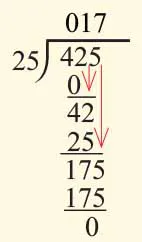
- Long division is used to divide larger numbers. 425 ÷ 25Answer:17

- The LCD is the smallest number into which two or more denominators will divide evenly; this number is used for adding and subtracting fractions. EX: What is the LCD of
and1 5
?3 4 The smallest number that is divisible by both 5 and 4 is 20, so the LCD is 20.
- If the fractions have the same denominator, add the numerators; the denominator stays the same.EX:
+1 9
=5 9
; since both the numerator and the denominator are both divisible by 3, you will want to write the answer in its reduced form, which is6 9
.2 3 - If the fractions have a different denominator, you will first need to find the LCD. EX: The LCD is 12, so rewrite equivalent fractions with a denominator of 12:
+2 3 3 4
×2 3
=4 4
;8 12
×3 4
=3 3
; then add the equivalent fractions:9 12
+8 12
=9 12
. Since the numerator is greater than the denominator, this can be reduced to a mixed number,17 12
.1 5 12
- If the fractions have the same denominator, subtract the numerators; the denominator stays the same.
−5 9
=1 9 4 9 Since the ...
Table of contents
- READING
- MATH
- SCIENCE
- ENGLISH LANGUAGE & USAGE