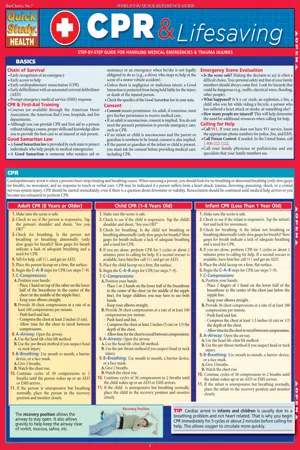
Making the decision to help in an emergency situation is often a difficult choice. Be prepared for emergencies with the help of our CPR & Lifesaving QuickStudy® guide. Packed with quickly accessible information on different aspects of lifesaving, this go-to reference will help you respond effectively in an emergency until professional help arrives. Learn how to evaluate a scene, the steps in CPR and AED use, standard precautions, and other essential elements in the chain of survival. This durable, laminated guide also includes illustrations for easy understanding. Keep a copy in your home, with your camping gear, at your office, in your car, etc., so that you will always be prepared.
- 44 pages
- English
- ePUB (mobile friendly)
- Available on iOS & Android
eBook - ePub
About this book
Trusted by 375,005 students
Access to over 1 million titles for a fair monthly price.
Study more efficiently using our study tools.
Information
Topic
Medicine
Medical Emergencies
Shock
Shock occurs when there is a disturbance in circulation, resulting in a lack of oxygen being delivered to the tissues in the body. Causes may include heart attack, breathing problems, severe bleeding, or dehydration. Signs and symptoms can include dizziness, weakness, fainting, pale or clammy skin, rapid or weak pulse, loss of consciousness, rapid or irregular breathing, and nausea and vomiting.
- Call 911.
- If the cause is known, treat appropriately.
- Have the person lie down on his/her back. Elevate the legs to encourage circulation to the brain.
- Reassure the person that you have called for help.
- Keep the person calm.
- Use a blanket to keep the person warm.
- If vomiting occurs, lay the person on his/her side in the recovery position to prevent choking and aspiration.
Chest Pain
Chest discomfort can be described as sharp, dull, burning, aching, stabbing, squeezing, tightness, or crushing. Such discomfort can signify a heart attack, but there are many other possible causes, such as respiratory disorders (e.g., asthma, pneumonia, pleurisy, or pulmonary embolism) and gastrointestinal disorders (e.g., heartburn, gallbladder disease, or ulcer). It is best to be proactive and seek medical attention immediately if someone is experiencing chest pain.
- Call 911.
- Keep the person calm.
- If possible, gather a brief health history and list of medications from the person. This is an opportunity to obtain information that is valuable to emergency responders. If the situation worsens, the person may not be able to provide the information to the responders.
- If the person has been prescribed nitroglycerine for chest pain, you may assist the person in taking the medication under the tongue.
- If the person is not allergic to aspirin, give 4 chewable aspirin tablets (81 mg each) or 1 regular aspirin tablet (325 mg).
- Keep the person calm until medical personnel arrive.
Heart Attack
A heart attack results from a lack of oxygen to the heart. This can be caused by a blocked or restricted artery in the heart. Common signs and symptoms include chest discomfort, such as sharp, dull, burning, aching, stabbing, squeezing, tightness, or crushing pain. Pain may radiate to the jaw, neck, back, or arm. Symptoms can vary in women and people who have diabetes; symptoms in these cases may be fatigue, nausea, and lightheadedness.
- Call 911.
- If the person is not allergic to aspirin, give 4 chewable aspirin tablets (81 mg each) or 1 regular aspirin tablet (325 mg).
- Keep the person calm until medical personnel arrive.
- If the person loses consciousness and stops breathing, begin CPR.
Stroke
A stroke occurs when the blood flow to the brain is interrupted. Signs and symptoms include weakness, numbness, paralysis, balance issues, dizziness, sudden headache, and slurred speech.
- Call 911.
- Remember FAST to check for signs and symptoms of stroke:
- Face: Ask the person to smile, and note any facial droop or lack of movement.
- Arms: Ask the person to close his/her eyes and hold his/her arms out in front. Note any weakness or drifting of the arms.
- Speech: Ask the person to say a full sentence, and note any slurring of speech.
- Time: Call 911 immediately. Note the time of onset of the symptoms if possible.
- Monitor the person’s breathing and level of consciousness.
- If the person is alert, allow him/her to sit or lie down in the most comfortable position, preferably with the head elevated. Reassure the person that help is on the way, and stay with the person until help arrives.
- If the person is unconscious, lay him/her on either side in the recovery position to protect the airway.
- If breathing stops, administer CPR.
- If possible, gather a brief health history and list of medications from the person. Emergency responders will need that information. Together with the time of onset, this information will determine eligibility for certain medication that can help treat a stroke.
Breathing Difficulty
Breathing difficulty can result from injury or medical illness, such as asthma, congestive heart failure (CHF), chronic obstructive pulmonary disease (COPD), or emphysema. Signs and symptoms include abnormally fast or slow breathing, abnormally deep or shallow breathing, noisy breathing, and the inability to speak in full sentences. A persistent cough may also be present.
- Call 911.
- Reassure the person that you have called for help.
- If possible, gather a brief health history and list of medications from the person. This is an opportunity to obtain information that is valuable to emergency responders. If the situation worsens, the person may not be able to provide the information to the responders.
- If the person has a prescribed inhaler or nebulizer device, assist him/her in using the device to administer the medication. Note the time that it was administered.
- Keep the person in a comfortable position. Most often, this will be sitting upright.
- Keep the person warm. Cold air may worsen respiratory symptoms.
- If breathing stops, administer CPR.
Allergic Reactions
Allergic reactions occur when the body tries to protect itself from an invader called an antigen, a foreign substance that triggers the body’s immune system. The immune system generally protects the body against toxins and bacteria. Sometimes it will overreact to a harmless substance (allergen) and an allergic reaction takes place. The allergic reaction can be minor or severe.
Minor Allergic Reactions Minor or local allergic reactions are generally from direct skin contact with poisonous plants (poison ivy, poison sumac), bee and wasp stings, fire ant bites, pollen, dust, etc. Signs and symptoms involve redness, hives, swelling, and itching of the skin. Problems with the person’s airway are generally not observed. - Treat conservatively with the application of a cool cloth or ice to reduce the swelling.
- Oral antihistamines can help reduce symptoms.
- Check with your health care provider for further instructions or if symptoms do not r...
Table of contents
- Basics
- CPR
- C–A–B Sequence For CPR
- CPR: Putting It All Together
- Automated External Defibrillator (AED)
- Choking
- Health History Forms
- Standard Precautions
- Medical Emergencies
- Heat Emergencies
- Cold Emergencies
- Trauma Injuries
- Rescuing & Moving Victims
- Injury Prevention
- First-Aid Kit Supply Checklist
Frequently asked questions
Yes, you can cancel anytime from the Subscription tab in your account settings on the Perlego website. Your subscription will stay active until the end of your current billing period. Learn how to cancel your subscription
No, books cannot be downloaded as external files, such as PDFs, for use outside of Perlego. However, you can download books within the Perlego app for offline reading on mobile or tablet. Learn how to download books offline
Perlego offers two plans: Essential and Complete
- Essential is ideal for learners and professionals who enjoy exploring a wide range of subjects. Access the Essential Library with 800,000+ trusted titles and best-sellers across business, personal growth, and the humanities. Includes unlimited reading time and Standard Read Aloud voice.
- Complete: Perfect for advanced learners and researchers needing full, unrestricted access. Unlock 1.4M+ books across hundreds of subjects, including academic and specialized titles. The Complete Plan also includes advanced features like Premium Read Aloud and Research Assistant.
We are an online textbook subscription service, where you can get access to an entire online library for less than the price of a single book per month. With over 1 million books across 990+ topics, we’ve got you covered! Learn about our mission
Look out for the read-aloud symbol on your next book to see if you can listen to it. The read-aloud tool reads text aloud for you, highlighting the text as it is being read. You can pause it, speed it up and slow it down. Learn more about Read Aloud
Yes! You can use the Perlego app on both iOS and Android devices to read anytime, anywhere — even offline. Perfect for commutes or when you’re on the go.
Please note we cannot support devices running on iOS 13 and Android 7 or earlier. Learn more about using the app
Please note we cannot support devices running on iOS 13 and Android 7 or earlier. Learn more about using the app
Yes, you can access CPR & Lifesaving by Shirley A Jones in PDF and/or ePUB format, as well as other popular books in Medicine & Emergency Medicine & Critical Care. We have over one million books available in our catalogue for you to explore.