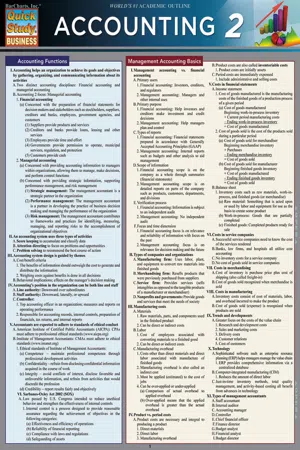
Accounting 2
eBook - ePub

Accounting 2

QuickStudy Laminated Reference Guide

,
  1. 44 pages
  2. English
  3. ePUB (mobile friendly)
  4. Available on iOS & Android
eBook - ePub

Accounting 2

QuickStudy Laminated Reference Guide

,

About this book

Our best-selling Accounting 2 guide has now gotten even better, thanks to the latest up-to-date information added to the original text. The new material within this 3-panel (6 page)guide goes further into the various accounting practices that businesses use to keep financially afloat; mathematical equations, charts, and tables are also included in an easy-to-use format.

Frequently asked questions

Yes, you can cancel anytime from the Subscription tab in your account settings on the Perlego website. Your subscription will stay active until the end of your current billing period. Learn how to cancel your subscription.
No, books cannot be downloaded as external files, such as PDFs, for use outside of Perlego. However, you can download books within the Perlego app for offline reading on mobile or tablet. Learn more here.
Perlego offers two plans: Essential and Complete
  • Essential is ideal for learners and professionals who enjoy exploring a wide range of subjects. Access the Essential Library with 800,000+ trusted titles and best-sellers across business, personal growth, and the humanities. Includes unlimited reading time and Standard Read Aloud voice.
  • Complete: Perfect for advanced learners and researchers needing full, unrestricted access. Unlock 1.4M+ books across hundreds of subjects, including academic and specialized titles. The Complete Plan also includes advanced features like Premium Read Aloud and Research Assistant.
Both plans are available with monthly, semester, or annual billing cycles.
We are an online textbook subscription service, where you can get access to an entire online library for less than the price of a single book per month. With over 1 million books across 1000+ topics, we’ve got you covered! Learn more here.
Look out for the read-aloud symbol on your next book to see if you can listen to it. The read-aloud tool reads text aloud for you, highlighting the text as it is being read. You can pause it, speed it up and slow it down. Learn more here.
Yes! You can use the Perlego app on both iOS or Android devices to read anytime, anywhere — even offline. Perfect for commutes or when you’re on the go.
Please note we cannot support devices running on iOS 13 and Android 7 or earlier. Learn more about using the app.
Yes, you can access Accounting 2 by in PDF and/or ePUB format, as well as other popular books in Business & Business General. We have over one million books available in our catalogue for you to explore.

Information

FINANCIAL ANALYSIS
  1. Horizontal analysis
    1. Evaluation of financial statement data over period of time
    2. Increases or decreases of financial items are determined
    3. Changes are shown in dollars and by percentage
      1. Find the difference between the most current period balance and the previous period balance for each item on the balance sheet
      2. Calculate the percentage change as follows: Dollar change ÷ balance from previous period × 100
    4. Example of a horizontal analysis of a balance sheet:
Balance Sheet
Change
2010 2009 Amount Percent
Assets
Current assets $1,000,000 $970,000 $30,000 3.1%
Plant assets (net) 825,000 675,000 150,000 22.2%
Intangible assets 16,000 18,500 (2,500) -13.5%
Totals assets $1,841,000 $1,663,500 $177,500 11.8%
Liabilities
Current liabilities $350,000 $305,100 $44,900 14.7%
Long-term liabilities 547,000 567,000 ($20,000) -3.5%
Total liabilities $897,000 $872,100 $24,900 11%
Stockholders’ Equity
Common stock 290,000 280,000 10,000 3.6%
Retained earnings 654,000 511,400 142,600 27.9%
Total stockholders’ equity 944,000 791,400 152,600 31.5%
Total liabilities & stockholders’ equity $1,841,000 $1,663,500 $177,500 11%
Income Statement
Change
2010 2009 Amount Percent
Sales $2,200,000 $1,970,000 $230,000 11.7%
Sales returns & allowances 100,000 125,000 (25,000) -20.0%
Net sales $2,100,000 $1,845,000 255,000 13.8%
Cost of good sold 1,381,000 1,150,000 231,000 20.1%
Gross profit $719,000 $695,000 24,000 3.5%
Selling expenses 254,000 212,500 41,500 19.5%
Administrative expenses 106,000 109,000 (3,000) -2.8%
Total operating expenses 360,000 321,500 38,500 12.0%
Income from operations 359,000 373,500 (14,500) -3.9%
Other revenues & gains Interest & dividends 10,000 11,500 (1,500) -13.0%
Other expenses & losses Interest expense 35,000 41,200 (6,200) -15.0%
Income before income taxes 314,000 320,800 (6,800) -2.1%
Income tax expense 142,500 168,000 (25,500) -15.2%
Net income $171,500 $152,800 $18,700 12.2%
  1. Vertical analysis
    1. Evaluation of financial statement data that expresses each item as a percent of a base amount
      1. Each item on the income statement is divided by net sales
      2. Each item on the balance sheet is divided by total assets
    2. Example of a vertical analysis of an income statement:
Income Statement
2010
Amount Percent 2009 Percent
Sales $2,200,000 104.8% $1,970,000 106.8%
Sales returns & allowances 100,000 4.8% 125,000 6.8%
Net sales $2,100,000 100.0% $1,845,000 100.0%
Cost of good sold 1,381,000 65.8% 1,150,000 62.3%
Gross profit $719,000 34.2% $695,000 37.7%
Selling expenses 254,000 12.1% 212,500 11.5%
Administrative expenses 106,000 5.0% 109,000 5.9%
Total operating expenses 360,000 17.1% 321,500 17.4%
Income from operations 359,000 17.1% 373,500 20.2%
Other revenues & gains Interest & dividends 10,000 0.5% 11,500 0.6%
Other expenses & losses Interest expense 35,000 1.7% 41,200 2.2%
Income before income taxes 314,000 15.0% 320,800 17.4%
Income tax expense 142,500 6.8% 168,000 9.1%
Net income $171,500 8.2% $152,800 8.3%
...
Balance Sheet
2010 2009
Amount Percent Amount Percent
Assets
Current assets $1,000,000 54.3% $970,000 58.3%
Plant assets (net) 825,000 44.8% 675,000 40.6%
Intangible assets 16,000 0.9% 18,500 1.1%
Totals assets $1,841,000

Table of contents

  1. Accounting Functions
  2. Management Accounting Basics
  3. Cost Behavior
  4. Budgeting
  5. Management Control Systems
  6. Decentralized Organizations
  7. Capital Budgeting
  8. Cost Allocation
  9. Financial Analysis
