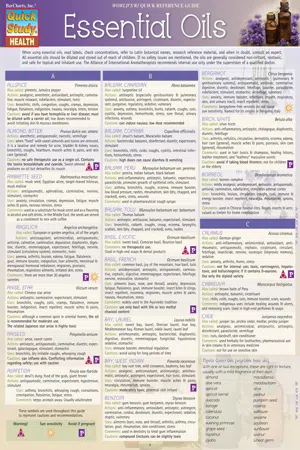
With over 130 essential oils in this handy 6-page, oil-proof guide, beginners or experts can quickly find an oil's therapeutic aspects plus cautions regarding certain oils. Latin botanical and alternate names make finding the right oil easy and comments listed for some oils will give more background – historical or traditional uses, or more on specific cautions. Suggested uses: o Experts – as a handy go-to tool for your workspace, oil-proof by way of lamination o Beginner – learning tool for quick reference and starting point for more research o Personal – shopping guide - know where to start if looking for non-medical therapeutic options for you or a loved one's health benefits
Cautions:toxic if ingested. White camphor is safe for use in small doses but is classified as a marine pollutant. Yellow and brown camphor are highly toxic
Comments: one of the oldest known medicines in China & India. Hippocrates prescribed it for sciatica, coughs, abdominal pains, spasms, nervous disorders, and poisonous bites
Daucus carota
Carrot seed
Also called: wild carrot, Queen Anne’s lace, bird’s nest
Access to over 1.5 million titles for a fair monthly price.
Study more efficiently using our study tools.
Frequently asked questions
Yes, you can cancel anytime from the Subscription tab in your account settings on the Perlego website. Your subscription will stay active until the end of your current billing period. Learn how to cancel your subscription
No, books cannot be downloaded as external files, such as PDFs, for use outside of Perlego. However, you can download books within the Perlego app for offline reading on mobile or tablet. Learn how to download books offline
Perlego offers two plans: Essential and Complete
Essential is ideal for learners and professionals who enjoy exploring a wide range of subjects. Access the Essential Library with 800,000+ trusted titles and best-sellers across business, personal growth, and the humanities. Includes unlimited reading time and Standard Read Aloud voice.
Complete: Perfect for advanced learners and researchers needing full, unrestricted access. Unlock 1.5M+ books across hundreds of subjects, including academic and specialized titles. The Complete Plan also includes advanced features like Premium Read Aloud and Research Assistant.
Both plans are available with monthly, semester, or annual billing cycles.
We are an online textbook subscription service, where you can get access to an entire online library for less than the price of a single book per month. With over 1.5 million books across 990+ topics, we’ve got you covered! Learn about our mission
Look out for the read-aloud symbol on your next book to see if you can listen to it. The read-aloud tool reads text aloud for you, highlighting the text as it is being read. You can pause it, speed it up and slow it down. Learn more about Read Aloud
Yes! You can use the Perlego app on both iOS and Android devices to read anytime, anywhere — even offline. Perfect for commutes or when you’re on the go. Please note we cannot support devices running on iOS 13 and Android 7 or earlier. Learn more about using the app
Yes, you can access Essential Oils by Penelope Pool in PDF and/or ePUB format, as well as other popular books in Medicine & Alternative & Complementary Medicine. We have over 1.5 million books available in our catalogue for you to explore.