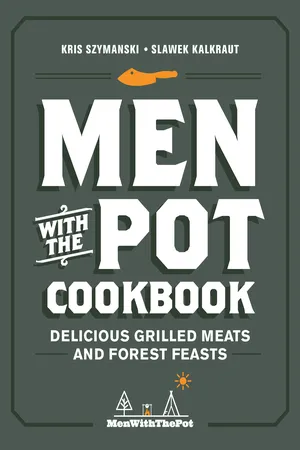
Men with the Pot Cookbook
eBook - ePub

Men with the Pot Cookbook

Delicious Grilled Meats and Forest Feasts

  1. 208 pages
  2. English
  3. ePUB (mobile friendly)
  4. Available on iOS & Android
eBook - ePub

Men with the Pot Cookbook

Delicious Grilled Meats and Forest Feasts

About this book

Bask in the beauty of the forest (or your backyard) with the Men with the Pot as you create memorable, mouthwatering meats, rustic bakes, and more over your campfire or on your grill.

People often ask the Men with the Pot “what’s behind the name?” The answer is simple: when they started out, they were just two men with one pot who wanted to do something big! Their aim was to light a fire and inspire others to follow the same path—cooking whatever brings them joy.
 
Kris and Slawek’s eye-catching videos have done just that, propelling that humble idea into a concept reaching tens of millions of fans every month.
 
Men with the Pot Cookbook brings that same spirit to the page, with their first collection of recipes in print. Chapters and recipes include:
 
  • Forest Cooking Around the World: Chicken Alfredo, Gnocchi Two Ways, Polish Rolady, Paella, Forest Takeaway, Tagliatelle Ragu, Campfire Ravioli
  • Forest Baking: Sausage Rolls, Skillet Pizza, Forest Pretzels, Baked Camembert in Forest-Made Bread, Focaccia Bread, Campfire Donuts
  • Chicken, Turkey, and Duck: Forest-Fried Chicken, Honey Mustard Chicken Quarters, Duck Breasts with Smashed Potatoes, Chicken From Hell
  • Meat Madness: Tomahawk Steak, Perfect T-Bone Steak, Tropical Pork Ribs, Pineapple Pork, Lamb Chops with Pomegranate Sauce, Campfire Irish Stew
  • From the Sea and Into the Forest: Pastry-Wrapped Salmon, Fish Curry, Cod Fillets Wrapped in Bacon, Drunk Salmon, Prawn Pasta, Fish and Chips, Herb-crusted Cod
  • Sandwiches, Tacos, Quesadillas, and More: Chicken Fajitas, Smoked Pork Belly Sandwich, Dirty Cheeseburger, Steak Sandwich, Best Meatball Sandwich, Chicken Quesadillas with Forest-made Tortillas, Cheese Tacos

Throughout the book, you’ll also learn some bushcraft, from lighting a fire to making a campfire spit or cooling rack from found wood. And of course, there are plenty of photos from their forest kitchen, which means even a simple weeknight meal is sure to take you away from the ordinary.

Frequently asked questions

Yes, you can cancel anytime from the Subscription tab in your account settings on the Perlego website. Your subscription will stay active until the end of your current billing period. Learn how to cancel your subscription.
No, books cannot be downloaded as external files, such as PDFs, for use outside of Perlego. However, you can download books within the Perlego app for offline reading on mobile or tablet. Learn more here.
Perlego offers two plans: Essential and Complete
  • Essential is ideal for learners and professionals who enjoy exploring a wide range of subjects. Access the Essential Library with 800,000+ trusted titles and best-sellers across business, personal growth, and the humanities. Includes unlimited reading time and Standard Read Aloud voice.
  • Complete: Perfect for advanced learners and researchers needing full, unrestricted access. Unlock 1.4M+ books across hundreds of subjects, including academic and specialized titles. The Complete Plan also includes advanced features like Premium Read Aloud and Research Assistant.
Both plans are available with monthly, semester, or annual billing cycles.
We are an online textbook subscription service, where you can get access to an entire online library for less than the price of a single book per month. With over 1 million books across 1000+ topics, we’ve got you covered! Learn more here.
Look out for the read-aloud symbol on your next book to see if you can listen to it. The read-aloud tool reads text aloud for you, highlighting the text as it is being read. You can pause it, speed it up and slow it down. Learn more here.
Yes! You can use the Perlego app on both iOS or Android devices to read anytime, anywhere — even offline. Perfect for commutes or when you’re on the go.
Please note we cannot support devices running on iOS 13 and Android 7 or earlier. Learn more about using the app.
Yes, you can access Men with the Pot Cookbook by Kris Szymanski,Slawek Kalkraut in PDF and/or ePUB format, as well as other popular books in Art & Culinary Arts. We have over one million books available in our catalogue for you to explore.

Information

eBook ISBN
9780760374191
Topic
Art

1

A FIELD GUIDE FOR USING THIS BOOK

image
If it isn’t already obvious, we would much rather spend our days out in the forest than shopping for ingredients. And we want that for you, too. We frequently use whatever we happen to have on hand, and the recipes still turn out great! Food should be fun, after all, so don’t stress the small stuff. We do, however, have some tips and suggestions that will help make your time in the woods more successful.

TOOLS

If you’ve seen just a couple of our videos, you know we enjoy making many of our tools. But we can’t make everything! Here are some things we use frequently:
BOWLS: Two large bowls (same size) for mixing, serving, and covering and a small or medium bowl for mixing.
CAST-IRON POT (5-QUART, OR 4.5-LITER): If you’ll be cooking over the fire the way we do, you’ll want one with a hanging handle, rather than something like a Dutch oven.
CAST-IRON SKILLETS (2 [12-INCH, OR 30 CM]), WELL-SEASONED: Cast iron is unbeatable for cooking, especially with fire. Don’t use anything coated with enamel (unless you don’t mind ruining the enamel).
ENAMEL OR STEEL CAMP CUPS (2 large [12- or 16-ounce, or 360 or 480 ml]) with a handle (or small saucepan with a flameproof handle).
FLINT: It’s how we start our fires (see How to Light Your Fire).
GRILL PANS (2, SAME SIZE): Ours are 11 inches (27 cm) with handles on either side but use whatever you have (so long as the handles are flameproof).
HANDSAW: Helpful in bushcrafting.
HATCHET: Useful for chopping firewood; we also use the blunt head as a mallet.
HEAVY-DUTY OVEN MITT: Something leather, like a barbecue or welder’s glove, not what you use in the kitchen, so you’re not burned by the high heat.
KNIVES: Large chef’s knife. One rainy day, when we were unable to cook outdoors, we decided to make a knife. We went into a shed and came out a few hours later with what would become our most-asked-about tool: our signature 7½-inch (19 cm) cleaver. For us, it’s a universal instrument that chops, slices, stirs, flips . . . whatever we need. Plus, a smaller (6-inch, or 15 cm) camp knife: We often use this for whittling.
image
LARGE CUTTING BOARD: Our wooden one is 11 × 18 inches (28 × 45 cm), and we frequently roll dough to “the size of our board.” We actually have two boards, one dedicated for cutting proteins on.
MEASURING SPOONS (see Forest Hack, at right): Yep, for measuring.
MORTAR AND PESTLE: It sounds strange, but everything tastes better when made with a mortar and pestle; we don’t know why, it just does—but feel free to use a food processor for chopping, crushing, or mixing ingredients.
PARCHMENT PAPER: To help prevent foods from sticking to the cooking vessel and to make cleanup easier.
PASTRY BRUSH: For brushing on sauces, melted butter, glazes, etc.
ROLLING PIN: for rolling doughs.
SKEWERS: We whittle our own (see Make Your Own Skewers and Holder), but you can use wooden or metal ones if you prefer.
SPIDER OR SLOTTED SPOON: We just use branches to fish things out of hot water or oil, but we want you to be safe!
WOODEN SPOON: For both mixing and cooking—you don’t want to damage your cast iron, so always use wood, which won’t scratch it.
image
FOREST HACK
When we’re in the forest, we frequently use a combination spoon/fork/knife camp utensil for our measurements, so we tend to think in terms of “1 spoon of oregano” or “2 spoons of mustard.” Because our viewers always ask about our ingredients, we’ve given more precise measurements here. For things like bread and pasta, stick with the measures we provide. For other things, like sauces and general seasonings, go ahead and use your spork—start small and taste as you go, adding more of what tastes good to you.
image

INGREDIENTS

We can’t say it often enough: Food is an adventure! Look at these recipes like a map. You can follow them precisely, or you can veer off on your own and discover something entirely new. If you think you can add something to make a dish better, please do it! Similarly, if we call for a yellow onion, but all you have is red, use it. If there’s an ingredient you don’t like, use something you do like. Because meals take longer to prepare in the woods than they do in the kitchen, you’ll find that everything just tastes better, regardless of whether you use the same ingredients we do (though, we do prefer salted butter because we didn’t have it as children in Poland, and it’s really quite amazing).

HEAT VS. FLAME

Even when you’re cooking over your own grill at home, it’s not always easy to control the heat—fire is unpredictable! But building a proper campfire with plenty of glowing embers takes time, at least 45 minutes. When you’re out in the forest, among the elements, it proves even more difficult (just ask us about making bread in a light Irish rain). What starts out as a pleasant day could turn into a windy or drizzly evening come dinnertime. For us, the wind is the worst, but even your elevation can be a factor in how your food cooks. Where we live, we can experience the four seasons every 15 minutes, but this is...

Table of contents

  1. Cover
  2. Title Page
  3. Contents
  4. Introduction: Welcome to the Forest
  5. Chapter 1 A Field Guide for Using This Book
  6. Chapter 2 Forest Cooking Around the World
  7. Chapter 3 Meat Madness
  8. Chapter 4 Chicken, Turkey, and Duck
  9. Chapter 5 Forest Baking
  10. Chapter 6 From The Sea and Into the Forest
  11. Chapter 7 Burgers, Sandwiches, Tacos, and Quesadillas
  12. Resources
  13. Acknowledgments
  14. About the Authors
  15. Index
  16. Copyright