Over the past quarter century, American liberals and conservatives alike have invoked memories of the 1960s to define their respective ideological positions and to influence voters. Liberals recall the positive associations of what might be called the "good Sixties"—the "Camelot" years of JFK, the early civil rights movement, and the dreams of the Great Society—while conservatives conjure images of the "bad Sixties"—a time of urban riots, antiwar protests, and countercultural revolt.
In Framing the Sixties, Bernard von Bothmer examines this battle over the collective memory of the decade primarily through the lens of presidential politics. He shows how four presidents—Ronald Reagan, George H. W. Bush, Bill Clinton, and George W. Bush—each sought to advance his political agenda by consciously shaping public understanding of the meaning of "the Sixties." He compares not only the way that each depicted the decade as a whole, but also their commentary on a set of specific topics: the presidency of John F. Kennedy, Lyndon Johnson's "Great Society" initiatives, the civil rights movement, and the Vietnam War.
In addition to analyzing the pronouncements of the presidents themselves, von Bothmer draws on interviews he conducted with more than one hundred and twenty cabinet members, speechwriters, advisers, strategists, historians, journalists, and activists from across the political spectrum—from Julian Bond, Daniel Ellsberg, Todd Gitlin, and Arthur Schlesinger to James Baker, Robert Bork, Phyllis Schlafly, and Paul Weyrich.
It is no secret that the upheavals of the 1960s opened fissures within American society that have continued to affect the nation's politics and to intensify its so-called culture wars. What this book documents is the extent to which political leaders, left and right, consciously exploited those divisions by "framing" the memory of that turbulent decade to serve their own partisan interests.
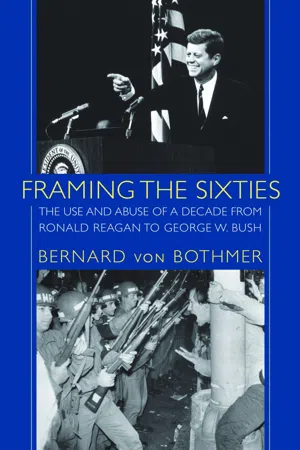
eBook - ePub
Framing the Sixties
The Use and Abuse of a Decade from Ronald Reagan to George W. Bush
- English
- ePUB (mobile friendly)
- Available on iOS & Android
eBook - ePub
Framing the Sixties
The Use and Abuse of a Decade from Ronald Reagan to George W. Bush
About this book
Information
Publisher
University of Massachusetts PressYear
2013Print ISBN
9781558497320
9781558497313
eBook ISBN
9781613762301
1

“The Sixties”
DEFINING AN ERA
Despite a forty-year remove, the tumult of the sixties and the subsequent backlash continues to drive our political discourse.
Barack Obama (2006)
AMERICAN POLITICIANS frequently speak of two 1960s—an earlier part, which they view favorably, and a later part, which they do not. Also, when they say “the sixties,” they tend to mean 1964-1974, not 1960-1969: “the sixties” thus exclude President Kennedy but include President Nixon. Eager as they are to demonize what they dislike about “the sixties,” conservatives owe much to that era. “The sixties” were a gift to the Right, as the decade—along with the Watergate scandal and the loss of the war in Vietnam in the early 1970s—spawned a counterrevolution that subsequently blamed the era for a host of problems. “The sixties” revived the moribund conservative movement and, by 1980, installed it firmly in power.
“The Good” versus “the Bad” Sixties
“There were two sixties for the liberals. You can call them the ‘good sixties’ and the ‘bad sixties,’” noted Democratic speechwriter David Kusnet. “And it remains that way in American memory.” Kusnet pointed to a string of people and events to differentiate the two concepts. “The ‘good sixties’ were John F. Kennedy, Robert Kennedy, the Peace Corps, Martin Luther King, the integrationists, the civil rights movement, the March on Washington in 1963, the Civil Rights Act, the Voting Rights Act, the figures like Congressman John Lewis,” he said. “Most Americans to this day think well of that portion of the 1960s.” The defining events of the other 1960s began later in that fateful decade. “The ‘bad sixties’ start with the escalation of the Vietnam War and the escalation of protest at home. The ‘bad sixties’ are violent protests in the streets, burning the American flag—Americans not just opposing the Vietnam War but rooting for the Viet Cong.”1
Contemporary American politics, according to Kusnet, has become a game of claiming the “good sixties” for one’s own side and pinning the “bad sixties” on the opposition. “What conservatives try to do is identify liberals with the ‘bad sixties.’ And what liberals try to do is identify themselves with the ‘good sixties.’ To be identified with John F. Kennedy is a good thing. To be identified with Martin Luther King is a good thing. To be identified with the later SDS [Students for a Democratic Society] is a bad thing.”2 In 1992 the Clinton campaign epitomized this technique by repeatedly showing the famous photograph of the candidate shaking hands with John Kennedy twenty-nine years earlier.
When speaking of the 1960s, explained former Democratic National Committee chair Paul Kirk, one needs to differentiate between the two parts of the era. The decade was marked by government dishonesty, an ill-considered war abroad, civil unrest, and political assassinations. But the early 1960s were an inspirational time that “people are still trying to emulate, if not to bring back, in some way.”3
The Right described a strikingly similar calendar. According to Edwin Feulner, president of the Heritage Foundation: “For at least half of the sixties, the whole thing hadn’t erupted yet. It was the latter sixties and early seventies that were bad.”4 Phyllis Schlafly agreed that the worst of the 1960s came in the latter half of the decade. “The biggest thing was the Vietnam War,” she recalled. “Although it got started in the mid-sixties … it got really messy and bad for our country later on.”5
When Were “the Sixties”?
“Decades don’t begin on time,” observed Peter Collier, a former sixties leftist radical who is now a conservative. For him, “‘63 is the obvious moment to start the sixties. It’s all fifties up till then, fifties aftermath.” To Collier the 1960s “is a swatch of history that has a beginning, middle, and end. It begins in the paranoia and culture shock of JFK’s assassination. And that Euripidean sixties has its high point in ‘68, which is the pivotal moment, when revolution was as much a possibility in this country as it ever has been.”6 Reagan speechwriter C. Landon Parvin agreed. “The ‘sixties’ most people talk about is mid-sixties and beyond. The early parts of the sixties are the orphan years of the fifties.”7
Republican speechwriter Peter Robinson defined the period even more precisely: “The 1960s run from the assassination of John Kennedy in ‘63 to the fall of Saigon in ‘75. Most of it takes place in the sixties, but it’s a very loose and rough shorthand for a time of troubles, political unrest, the sexual revolution, protest against Vietnam.”8 In political journalist David Broder’s view: “The Kennedy era is surrounded by all of the myths of Camelot and the romanticism of a bright, attractive young person cut down in the prime of life…. The sixties, in terms of the liberal phenomenon, are the Great Society, Lyndon Johnson, Vietnam, and the urban riots.”9 To Robert Bork, “the sixties were the last part of the 1960s and the first part of the seventies.”10 For liberal activist Daniel Ellsberg, “the sixties extended into the seventies.”11
The Left and Right agree that the Kennedy administration is not what people mean when they refer to “the sixties,” in that JFK is not associated with the “bad sixties.” And it is the “bad sixties” that have come to define the decade as a whole.
For most Americans the 1960 election did not represent a dramatic break with the past, despite the many differences between Dwight D. Eisenhower and Kennedy: party, age, background, region, religion, experience, and, most glaringly, their belief in the role the federal government should play in the life of the citizenry. To Thomas C. Reed, a special assistant to President Reagan, Kennedy’s election represented “a blossoming” of the 1950s. “The Kennedy years were not ‘the sixties.’ … ‘The sixties’ are a short form for Lyndon Johnson and Robert McNamara bringing to a crashing end all the hopes and dreams that were based on the Eisenhower years and then blossomed with the Kennedy election.”12 The Washington Post’s Benjamin C. Bradlee summed it up this way: “Ike for eight years, Kennedy for three years—eleven years of vaguely the same direction.”13
“The Kennedy era was the ushering in of a new era, but not quite ‘the sixties’ in the way we often think of it today,” agreed journalist David Maraniss. “Kennedy himself was a fairly economically conservative president, and the classic liberal was Hubert Humphrey.”14 Many prominent historians argue as well that Kennedy was a “pre-1960s” figure, and that the later 1960s—for Godfrey Hodgson “an age of turmoil … almost national hysteria”—marked a dramatic break from the Kennedy years.15
Such definitions of decades are after all quite subjective: much of this type of memory of the 1960s is constructed in such a way as to speak badly of the era. The construction of Kennedy as emblematic of the 1950s reinforces conservatives’ negative interpretation of “the sixties.” But the Right’s successful definition of “the sixties” as a terrible period that does not begin until after Kennedy’s death requires an aggressive reinterpretation of Kennedy’s actual presidency, for the Kennedy years were themselves filled with conflict and tension. At the time, they were the “bad sixties.”
“The sixties were scary,” declared Rick Perlstein, author of books on Barry Goldwater and Richard Nixon. “Bad things happened in the sixties. But the early sixties were scary, too, and that’s something that’s been repressed. People don’t say: ‘Oh, that great Kennedy era. We almost had a nuclear war over Berlin. Oh, that great Kennedy era, when an armed mob took over the University of Mississippi.’” Much of the nostalgia for the early 1960s, Perlstein noted, “has to do with the Camelot industry,” which “travestied history” by romanticizing the early 1960s as the calm before the storm. But “the late sixties are a hard time for Democrats to claim because it was traumatic,” Perlstein emphasized. “The late 1960s were great if you were young and were having a lot of fun, but for the majority it was the scariest time ever. America seemed to be falling apart.”16 Liberal author and journalist Thomas Frank agreed. “People remember the early 1960s as happy times,” whereas “the late sixties were a horrible time. Nobody thinks of 1968 and 1969 as being fun.”17
In looking nostalgically to the Kennedy presidency, the public endorses the distinction between the years 1960-1963 and the chaos of the latter 1960s. JFK “has never been connected with the ‘bad sixties,’ as the Right uses [the term],” said historian Alan Brinkley. “Kennedy is still this iconic figure of a better time in the history of liberalism…. Identifying with Kennedy … is a way of skipping over all the bad stuff and going back to the happy time. So that part of the sixties is still very much something that people would like to identify themselves with. It’s the late sixties that people want to stay away from.”18 To both the Left and the Right, this desire to disassociate oneself from the “bad sixties” has long defined American politics.
If Kennedy has not been tarred with the brush of the “bad sixties,” it is because of his ambiguous political ideology. “I would not categorize Kennedy as a conservative, but maybe the label is a ‘realistic liberal,’” said former Republican presidential candidate Pierre S. du Pont IV. “He thought that liberalism was important, but so was growing opportunity and a sound economy.”19 Other Republicans concurred. Kennedy “was a very moderate president, of course,” said Curt Smith. “He had to be pushed and kicked, screaming, into doing anything regarding civil rights.”20
As David Broder noted, Kennedy “was opposed for the nomination by most of the liberals in the Democratic Party…. He ran to the right of Nixon in 1960 on national security issues. He put Republicans in to run the Treasury and Defense departments.”21 In 1960, recalled David Kusnet, those on the Left “were either for Hubert Humphrey or Adlai Stevenson, and were not that fond of [JFK] when he was president.”22 Alan Brinkley stressed that while Kennedy “was not particularly liberal, [he] … certainly wanted to be perceived as liberal because everyone in the Democratic Party, at least, thought it was of critical importance.” In 1963 “the term ‘liberal’ was still, except on the Right, a widely admired idea…. In most parts of the country, being the liberal candidate was a real asset.” Kennedy tried to present himself as a liberal, and in fact “became increasingly liberal in every sense of the term at the time during his presidency.”23
Much of the debate about the meaning of the 1960s in American politics revolves—for both the Right and the Left—around defining the Kennedy years. This debate over whether Kennedy was or was not representative of liberalism in the 1960s would color the rhetoric of Presidents Reagan, George H. W. Bush, Clinton, and George W. Bush.
But just as “the sixties” do not begin until the end of the Kennedy era in 1963, they extend into the 1970s because many across the political spectrum saw the Nixon administration not as a truly conservative one but as an extension of 1960s liberalism. To be sure, many Republicans admired Richard Nixon personally. “Culturally, without question,” Nixon was a true conservative, stated Curt Smith, who wrote the speech George H. W. Bush gave at Nixon’s funeral and who knew Nixon well. “He hated the national media[,] … [coined] the term ‘silent majority[,]’ … opposed busing,” Smith recollected. “Nixon was never afraid to attack on behalf of Middle America. He showed great courage.”24
Yet at the same time Nixon engendered great animosity from the Right. “Nixon was espousing policies that were anathema to conservatives,” said Edwin Feulner, who viewed Nixon as a carryover from 1960s liberalism. “Nixon was funding the Great Society to try to buy off the Left.”25 According to conservative activist Morton Blackwell, “Nixon was never beloved by movement conservatives.”26 Asked about an assertion often repeated by conservatives, that “Johnson enacted the Great Society but Nixon funded it,” Lisa Schiffren answered: “I would agree 100 percent. Nixon was personally conservative [in] his dress and his manner. But he’s the one who said, ‘We’re all Keynesians now.’” Schiffren went so far as to claim, without elaborating further, “He and his secretaries certainly stated their beliefs that history was on the side of the Soviet Union.” Nixon “funded the welfare state. He set affirmative action in motion. He was in favor of D.C. statehood.” Nixon “was coming at the tail end of a very liberal moment in American politics.” His policies “wouldn’t fly now,” she noted in 2005.27
“He wasn’t [a true conservative] in many ways,” agreed Robert Bork. “He did do some strange things like impose price controls, and his policy of détente with the Soviets was probably a mistake.” Nevertheless, “a lot of conservatives did strange things,” said Bork. “[Senator Daniel Patrick] Moynihan entranced Nixon by talking about liberal policies enacted and pursued by conservative men. The parallel he was suggesting was Disraeli. That phrasing seemed to entrance Nixon.”28
According to Reagan adviser Stuart K. Spencer, “a counter-conservative revolution” began immediately after the 1960 election. Those on the Right “didn’t think Nixon met the criteria of what they called a ‘conservative.’” The biggest single point of agreement between Nixon and Reagan, “and the one that carried [Reagan], was anticommunism.”29 Nixon was hardly soft on communism duri...
Table of contents
- Cover
- Title Page
- Copyright
- Dedication
- Contents
- Acknowledgments
- Introduction: Framing the Frame
- 1. “The Sixties”: Defining an Era
- 2. Blaming “the Sixties”: The Rise of Ronald Reagan
- 3. A Tale of Two Sixties: Reagan’s Use of JFK and LBJ
- 4. Reagan and the Memory of the Vietnam War
- 5. Remembering Vietnam and the Civil Rights Movement: George H. W. Bush’s 1960s
- 6. George H. W. Bush and the Great Society
- 7. Bill Clinton and the Heroes of the 1960s: Using Liberal Icons for Conservative Ends
- 8. Vietnam and “the Sixties” in the Clinton Presidency
- 9. The “Un-Sixties” Candidate: George W. Bush
- 10. Framing John Kerry: The 2004 Presidential Campaign and “the Sixties”
- Conclusion: The Persistent Power of the 1960s
- Appendix: Alphabetical List and Identifications of Individuals Interviewed
- Notes
- Index
- About the Author
- Back Cover
Trusted by 375,005 students
Access to over 1.5 million titles for a fair monthly price.
Study more efficiently using our study tools.
Frequently asked questions
Yes, you can cancel anytime from the Subscription tab in your account settings on the Perlego website. Your subscription will stay active until the end of your current billing period. Learn how to cancel your subscription
No, books cannot be downloaded as external files, such as PDFs, for use outside of Perlego. However, you can download books within the Perlego app for offline reading on mobile or tablet. Learn how to download books offline
We are an online textbook subscription service, where you can get access to an entire online library for less than the price of a single book per month. With over 1.5 million books across 990+ topics, we’ve got you covered! Learn about our mission
Look out for the read-aloud symbol on your next book to see if you can listen to it. The read-aloud tool reads text aloud for you, highlighting the text as it is being read. You can pause it, speed it up and slow it down. Learn more about Read Aloud
Yes! You can use the Perlego app on both iOS and Android devices to read anytime, anywhere — even offline. Perfect for commutes or when you’re on the go.
Please note we cannot support devices running on iOS 13 and Android 7 or earlier. Learn more about using the app
Please note we cannot support devices running on iOS 13 and Android 7 or earlier. Learn more about using the app
Yes, you can access Framing the Sixties by Bernard von Bothmer in PDF and/or ePUB format, as well as other popular books in History & North American History. We have over 1.5 million books available in our catalogue for you to explore.