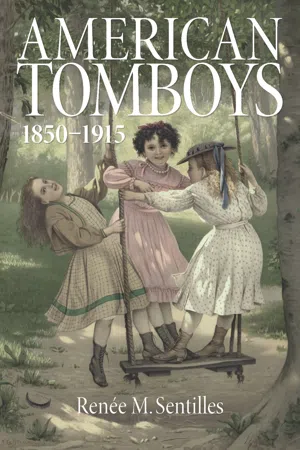
A lot of women remember having had tomboy girlhoods. Some recall it as a time of gender-bending freedom and rowdy pleasures. Others feel the word is used to limit girls by suggesting such behavior is atypical. In American Tomboys, Renée M. Sentilles explores how the concept of the tomboy developed in the turbulent years after the Civil War, and she argues that the tomboy grew into an accepted and even vital transitional figure. In this period, cultural critics, writers, and educators came to imagine that white middle-class tomboys could transform themselves into the vigorous mothers of America's burgeoning empire. In addition to the familiar heroines of literature, Sentilles delves into a wealth of newly uncovered primary sources that manifest tomboys' lived experience, and she asks critical questions about gender, family, race, and nation. Beautifully written and exhaustively researched, American Tomboys explores the cultural history of girls who, for a time, whistled, got into scrapes, and struggled against convention.
- English
- ePUB (mobile friendly)
- Available on iOS & Android
eBook - ePub
American Tomboys, 1850-1915
About this book
Information
Publisher
University of Massachusetts PressYear
2018Print ISBN
9781625343208
9781625343192
eBook ISBN
9781613765562
Topic
Sciences socialesSubtopic
Études relatives au genre1
Tomboys and the New Girlhood
On May 25, 1858, readers of the Nashville Patriot came upon an article titled “Our Daughters—Tom-boys”:
The “Tom-Boy” is an eager, earnest, impulsive, bright-eyed, glad-hearted, kind-souled specimen of the genus feminae. If her laugh is a little too frequent and her tone a trifle too emphatic, we are willing to overlook these for the sake of the true life and exulting vitality to which they are the “escape valves;” and, indeed, we rather like the high pressure nature which must close off its superfluous “steam” in such ebullitions.1
This snippet of prose appeared in papers nationwide for months, and frequently resurfaced in later decades. It was not an important piece even in 1858, but rather filler for newspapers far more focused on civil wars raging in Venezuela, Spain, and Mexico. Yet its popular reprinting across the country spoke to the American zeitgeist. Building on widely reinforced fears of enfeebled American youth, the writer scolds: “When our young men want so sadly what is tersely termed ‘backbone,’ when our young women want stamina . . . , there is a ‘reform’ upon this subject very much needed. . . . I would have [mothers] encourage their little girls to exercise effort, industry and energy, so as to give the them the health, vigor, activity, and power to expand into glorious womanhood.” If we do not want our girls to be weak, they must be “encouraged to become real, bona fide, flesh-and-blood ‘tomboys.’”2 Acknowledging that “tom-boy” is usually used to rein in exuberant girls, the author suggests that for the sake of nation and (white) race, it is time for parents and girls to aspire to the term.
Positive portrayals of tomboys emerged with the notion that girlhood itself was a separate stage of existence with its own values, interests, and symbols.3 This was not accidental, but rather reflected two contradictory forces at work in the creation of girlhood: in the popular culture, girls were defined to be the opposite of boys, and yet girls were now living more like boys than ever, in large part because of expanding primary and secondary education. As Americans began to define their national character as intrinsically independent, candid, and self-reliant, they searched for a girl type who could embody such traits. The rough and simple tomboy now became a viable approach to raising healthy girls.
By the second half of the century, didactic as well as prescriptive literature articulated fears that the Victorian emphasis on gentility and fashion was turning American girls into something that went against treasured values of American culture.4 American as well as British audiences responded heartily to the widely disseminated 1868 essay “The Girl of the Period,” by British gadfly Eliza Linton. Although she deplored the brazen forays of British girls into the public world—a theme Linton would expound on for the next thirty years with antifeminist zealotry—she directed the bulk of her criticism in the first essay at young women’s participation in consumer culture. “The Girl of the Period,” she charges, “is a creature who dyes her hair and paints her face, as the first articles of her personal religion—a creature whose sole idea of life is fun; whose sole aim is unbounded luxury; and whose dress is the chief object of such thought and intellect as she possesses.”5 Thus, by Linton’s summary, the most visible new girls of the Anglo-speaking world embodied fashion and commerce. For Americans, such a girl clearly personified urban or European values; she was a corrupt extension of an overly cultivated girl. All the promise of American’s economic development and social growth had led to this, writers suggested: a girl who expresses no moral value and is of no value to society. Tomboys—unaware of their attractions, beyond uninterested in fashion, and still so rooted into the earth as to appear unselfconsciously smudged and tangled—were a clear repudiation of the fashionable girls who began to populate imaginative culture.
This chapter examines how a growing belief in (white) childhood innocence, the expansion of female and coeducation, and popular narratives came together to forge a new girl archetype using an already familiar name. Allowed to be funny and engage in innocent but careless behavior, the figure of the tomboy helped girls and their parents navigate the gender tensions of a society in the midst of economic transformation from an agricultural to urban industrial economy. It was also no accident that the embracing of boy-girls gained new popularity in the wake of the Civil War. The upheaval of war contributed to the viability of a tomboy ideal by throwing categories of race and gender into disarray, making it possible for an innocent white girl to “act like a boy” without imperiling her adult respectability.6 And yet that same disarray also sparked a counter-need to reinforce white, female bodies as innately feminine. The tomboy ideal signaled changes in growing up female in America. But by licensing her free spirit only up until marriage, the tomboy also underlined the deep conflict between self and society faced by girls.
New Childhood and Gender
A growing need among the middle class to reinforce gender difference between children as well as adults led to an increasing preoccupation with how girls and boys should behave as opposites. Writings to entertain children were rare before the nineteenth century, and they did not focus on the gendering of boys and girls.7 Boy-girls and girl-boys occasionally showed up in antebellum didactic fiction as the gendering of children increased, stressing the need for children to adopt the prevailing gender norms. The children in these stories are not presented negatively per se so much as needing to be redirected.
Eliza Leslie, a popular author whose work appeared in Boston’s Juvenile Miscellany, wrote two such tales illustrating the problems of girls and boys crossing the gender line: “Lucy Nelson, or The Boy-Girl” (1831) quickly followed by “Billy Bedlow, or The Girl-Boy” (1832). Leslie participated in the new emphasis on the gendering of children at roughly the beginning of the rise of the middle class in urban industrial America. Although by the turn of the century scientists would argue that binary gender was a sign of higher civilization, in this earlier period writers like Leslie posited that gender was divinely or naturally binary and that respectable families kept that divide firm.8
Yet even if fictional depictions of rowdy girls were not celebratory in this period, heroine Lucy Nelson’s lack of calculation is innocently appealing. Leslie begins the tale by implying that most girls naturally gravitate to more feminine company: “It was very strange that Lucy Nelson always preferred playing with boys, and seemed to take no pleasure in any girlish amusements.” Lucy wants to play with her brothers. Like the tomboys who follow in her stead a few decades later, she discovers her talents among the boys: “She could fly a kite, spin a top, toss a ball, drive a hoop, and walk on stilts; and was delighted to race about the fields, and wade through the creek with boys.” She most enjoys getting in snow fights, skating, and sledding. Too full of energy to move demurely, she jumps stairs “three steps at a time, and she did not hesitate to be on a horse without saddle or bridle, and gallop all over the fields.” Moreover, Lucy foments mischief—leading her brothers into rambunctious and even dangerous play, essentially teaching them how to be boys.9
In the process of illustrating how girls should not behave, the story also emphasizes that girls should by nature be silent, tidy, graceful, and still. Real girls, such as Lucy’s sisters, like to “dress dolls, and make feasts, and read story-books.” Lucy’s careless appearance is an important marker of her internal disorder: “Her clothes were torn to pieces in climbing fences and trees, her shoes were always covered with dirt.” Cleanliness of the girl is important beyond hygiene, signifying the spiritual purity of the girl herself.10 Perhaps most damning of all, “her skin was so sunburnt, that she might almost have been mistaken for an Indian child.” Leslie concludes: “Every one called her a boy-girl.”11
As punishment, Lucy’s parents decide that she must spend a month dressed as a boy. Lucy is elated; she had, of course, been begging to wear trousers. But alas, this tale is designed to scare little girls away from gender-transgressive behavior, so her hard-won trousers lead to humiliation. When a family friend mistakes her for a boy, Lucy reaches the end of her tolerance: “I am not a boy!” She bursts into tears and flees. Her declaration dispels anxieties over ambiguities, and signifies that she will accept her female identity if it means she will not be shamed. But the transition pains her. At first Lucy’s efforts to rein in her spirits give her headaches, but “at length she became a modest well-behaved little girl, and took pleasure in all the occupations and amusements that are suited to her sex.”12
“Billy Bedlow,” Leslie’s bookend story about a sissy boy, highlights different attitudes toward boys crossing the increasingly polarized gender line. Gender scholar Ken Corbett stresses that “‘sissy’ carries the implication of weakness, unbecoming delicacy, and enervation, devoid of the possibilities born of resistance, agency, and action.”13 While Lucy is publically shamed for something she otherwise claims happily, Billy Bedlow is forced to recognize that feminine dress is irrational and unseemly for a boy. Billy’s vanity marks him. Enthralled with his own reflection in the mirror, he sleeps with curling papers around his long golden locks, and with his hands in gloves to keep them soft. According to Leslie, he is happy “to sit with his sister and make pin-cushions, reticules, and purses, and to play and dress their dolls.” A born ninny, he “screamed if a spider or a wasp came near him.” In fact, Leslie states candidly, “he often wished in his heart to be a girl.” He wishes this not because of an internal sense of gender identity, but out of shallow transvestite desires: he wants to “wear a large bonnet and carry a parasol.” Billy’s preoccupations impede his ability to take initiative and engage in the homosocial rituals so critical to boyhood. Naturally, Billy’s mother’s catering to his desires has only made the problem more acute.14
Things come to a head when Billy accompanies a group of children on a field trip, wearing a corset under his fussy frockcoat to look as “thin, small and feminine as possible.” The corset hampers his movement, and when the laces slip into view, an older boy teases Billy in front of the others. Billy is so “vexed and ashamed” that he cries and hides. Luckily for him, the teasing boy is not a bully but the best example of budding manhood, who kindly convinces Billy to discard the fussy clothing, cut off his curls, and lay off the cologne.15
In the language of later tomboy fiction, Billy is a “sissy boy,” a character who often served as the tomboy’s sidekick. In contemporary parlance, he is made to suffer for being queer. Yet Leslie does not require Billy to change his desires, only his self-performance. Billy does not now bravely squash spiders or leave his sisters to their sewing patterns. For all we know, Billy still longs to wear a bonnet. Leslie’s concern is that he now appears appropriate, unlike Lucy, who must feel as well as look conventional.
Another somewhat chilling story about punishing gender-bending children in this period can be found in a lighthearted children’s picture book, Little Miss Consequence. “The Tom-Boy Who Was Changed into a Real Boy” appears as one in a compilation of playful, cautionary verses. The tomboy of in this story was “so rude and fond of noise” that
She would mount a tree or wall
To seek bird’s nests, and would jump over ditches,
ditches, ditches;
But at works of skill and grace
She held the lowest place,
And was very far from clever at her stitches, stitches,
stitches
At last she grew so coarse,
E’en her voice was rough and hoarse,
And her attitudes became so like a boy’s, boy’s boy’s,
That they thought it only right,
On a certain Summer’s night,
To change her sex completely, without noise, noise, noise.
So a sailor she was made,
And a ship’s captain was paid
Quite quietly to take her off to sea, sea, sea;
Where for anything I know
This said Tomboy may be now;
And a caution may it prove to you and me, me, me.16
The tomboy cannot remain in the middle, so the mysterious and ominous “they” proceed “to change her sex without noise, noise, noise.” And while there’s something undeniably horrific about the idea of “them” doing this in the night, and sending the tomboy off to adventures far from everyone she knows, there is also something vaguely ambiguous about her punishment. Here the tomboy is rewarded with freedom, rather than shamed into headache-inducing conformity like Lucy. It is impossible to imagine this particular girl preferring “stiches, stiches, stiches” to embarking on worldly adventures.
But these were didactic tales, written to shape the behavior of girls and boys, not reflect it. Leslie’s need to condemn boys and girls crossing the gender line implies that such desire was not uncommon. And even if the naughty tomboy was happy in the end to set sail as a boy, her fate nonetheless tells child readers that crossing convention too far may result in one never coming back. The need to clarify what it meant to be a good boy or girl suggests alarm over gender shifting in society as a whole.
For the most part, until the 1870s images of girls were used to define boyhood rather than girlhood, principally because new concepts of boyhood emerged slightly earlier than those of girls, a result of boys’ earlier participation in wage labor. Free nations of boys, as E. Anthony Rotundo puts it, arose in the streets, alleyways, and fields of towns and cities when boys lost the adult supervision they had experienced through apprenticeships in earlier times. Now boys fraternized exclusively with each other in the time and spaces between home and work, bonded through the nexus of gender and age. “In this space of their own,” Rotundo observes, “boys were able to play outside the rules of the home and the marketplace. It was a heady and even liberating experience.” In their minds, the outdoors belonged to them. Indoors now became an alien space of femininity. Emphasizing the demure aspects of girlhood served to strengthen boyhood as girlhood’s opposite. After outgrowing their home-bound early childhood, boys looked back ...
Table of contents
- Cover
- Title Page
- Copyright Page
- Dedication
- Contents
- Preface
- Acknowledgments
- Introduction
- 1. Tomboys and the New Girlhood
- 2. Tomboy Heroines in the Home
- 3. Tomboy Heroines on the Manly Frontier
- 4. The Tomboy and the New Woman
- 5. Boyhood for Girls
- 6. The American Girl
- 7. Tomboys as Retrospective
- Coda
- Notes
- Selected Bibliography
- Index
Trusted by 375,005 students
Access to over 1.5 million titles for a fair monthly price.
Study more efficiently using our study tools.
Frequently asked questions
Yes, you can cancel anytime from the Subscription tab in your account settings on the Perlego website. Your subscription will stay active until the end of your current billing period. Learn how to cancel your subscription
No, books cannot be downloaded as external files, such as PDFs, for use outside of Perlego. However, you can download books within the Perlego app for offline reading on mobile or tablet. Learn how to download books offline
Perlego offers two plans: Essential and Complete
- Essential is ideal for learners and professionals who enjoy exploring a wide range of subjects. Access the Essential Library with 800,000+ trusted titles and best-sellers across business, personal growth, and the humanities. Includes unlimited reading time and Standard Read Aloud voice.
- Complete: Perfect for advanced learners and researchers needing full, unrestricted access. Unlock 1.5M+ books across hundreds of subjects, including academic and specialized titles. The Complete Plan also includes advanced features like Premium Read Aloud and Research Assistant.
We are an online textbook subscription service, where you can get access to an entire online library for less than the price of a single book per month. With over 1.5 million books across 990+ topics, we’ve got you covered! Learn about our mission
Look out for the read-aloud symbol on your next book to see if you can listen to it. The read-aloud tool reads text aloud for you, highlighting the text as it is being read. You can pause it, speed it up and slow it down. Learn more about Read Aloud
Yes! You can use the Perlego app on both iOS and Android devices to read anytime, anywhere — even offline. Perfect for commutes or when you’re on the go.
Please note we cannot support devices running on iOS 13 and Android 7 or earlier. Learn more about using the app
Please note we cannot support devices running on iOS 13 and Android 7 or earlier. Learn more about using the app
Yes, you can access American Tomboys, 1850-1915 by Renée M. Sentilles in PDF and/or ePUB format, as well as other popular books in Sciences sociales & Études relatives au genre. We have over 1.5 million books available in our catalogue for you to explore.