Winner of the Louis Gottschalk Prize
Winner of the Thomas J. Wilson Memorial Prize
"Witty and full of fascinating details."
—Los Angeles Times
Why are there restaurants? Why would anybody consider eating alongside perfect strangers in a loud and crowded room to be an enjoyable pastime? To find the answer, Rebecca Spang takes us back to France in the eighteenth century, when a restaurant was not a place to eat but a quasi-medicinal bouillon not unlike the bone broths of today.
This is a book about the French revolution in taste—about how Parisians invented the modern culture of food, changing the social life of the world in the process. We see how over the course of the Revolution, restaurants that had begun as purveyors of health food became symbols of aristocratic greed. In the early nineteenth century, the new genre of gastronomic literature worked within the strictures of the Napoleonic state to transform restaurants yet again, this time conferring star status upon oysters and champagne.
"An ambitious, thought-changing book…Rich in weird data, unsung heroes, and bizarre true stories."
—Adam Gopnik, New Yorker
"[A] pleasingly spiced history of the restaurant."
—New York Times
"A lively, engrossing, authoritative account of how the restaurant as we know it developed…Spang is…as generous in her helpings of historical detail as any glutton could wish."
—The Times
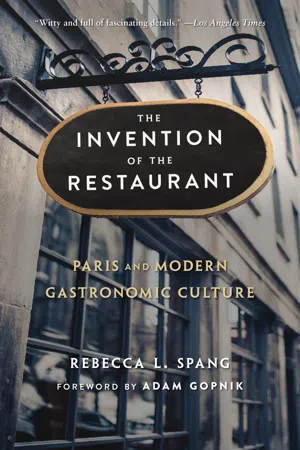
eBook - ePub
The Invention of the Restaurant
Paris and Modern Gastronomic Culture, With a New Preface
- 325 pages
- English
- ePUB (mobile friendly)
- Available on iOS & Android
eBook - ePub
The Invention of the Restaurant
Paris and Modern Gastronomic Culture, With a New Preface
About this book
Information
1
The Friend of All the World
The following material would require more extensive treatment, but the nature of this work does not allow it. I would like to float on a peaceful river but I am dragged along in a torrent.
Commerce cures destructive prejudices, and it is nearly a general rule that everywhere manners are gentle, there is commerce and everywhere there is commerce, there are gentle manners.
MONTESQUIEU, ESPRIT DES LOIS (1748)
If Mathurin Roze de Chantoiseau’s scheme to reduce the French national debt had been as successful as his bouillon-selling establishments, he might have prevented the French Revolution. Instead, he invented the restaurant. Certainly, his life story suggests that he had little doubt as to which was the greater accomplishment, which invention the most likely to endear him to future generations.
On a cloudy afternoon in late April of 1789, Roze de Chantoiseau, known to at least a few of his contemporaries as “the creator of the restaurant,” journeyed from Paris to Versailles.1 There, however, he presented the king and gathered deputies with neither a caterer’s bill nor a proposed menu. Instead, now in his late fifties, the first restaurateur was (or so it seemed) finally about to be recognized for his numerous ingenious efforts on behalf of the French people.2 “The Friend of All the World,” as he signed himself, had already struggled valiantly for twenty years to bring his grand plan to fruition. Now to King Louis XVI and the few delegates already assembled for the first meeting of the Estates-General in 175 years, he offered his wondrous invention: a fiscal reform scheme, aimed at reducing the monstrous French national debt by replacing the “fruitless and imaginary idea of credit” with “Letters of Credit” of real value.3
Twenty years earlier, Roze de Chantoiseau had had copies of a similar proposal printed. Lovingly describing his system in a letter to Intendant Général des Finances de Boullongne (an important agent of the Crown), he had concluded with the admission that some would think his plan mere fantasy: “but they said the same about Christopher Columbus.”4 During the autumn of 1769, as the pamphlet outlining his system began to circulate in Paris, Roze de Chantoiseau had no doubt expected to receive the financier’s grateful acknowledgment for his discovery of a means to increase the money supply without causing runaway inflation or levying new taxes. Roze’s plan did, in fact, generate considerable interest: Président à Mortier of the Paris Parlement, Jean Omer Joly de Fleury, wrote to the Lieutenant General of Police that it had occasioned “much discussion.” Yet these conversations overheard by the high-ranking magistrate did not exactly fuel a rush of public acclaim toward the “Christopher Columbus” of the French debt problem, and Chantoiseau soon found himself not thanked but arrested, and held for months in Fort l’Evêque prison on charges of printing and disseminating an incendiary text.5
In the atmosphere of reform-minded optimism characteristic of the spring of 1789, and with other major, Crown-backed business successes now to his name, Roze may have felt the time was propitious for the revival of his marvelous plan. All the evidence suggests, however, that the Estates-General received his proposal politely, and then hastily discarded it. Undaunted, Roze de Chantoiseau offered a similar scheme to the Paris city government in summer 1790, and later dedicated other versions to the “republican citizens” of the National Convention and the Thermidorean Committee of Public Safety.6 Revolutionary governments, alas, seemed no more inclined than the monarchy had been to recognize the value of his scheme. So in spring 1799, Roze de Chantoiseau and a business partner abandoned the public sphere and proposed to implement their new credit system, which Chantoiseau had patented, by founding a private bank.7 The “United Departmental Bank of Commerce and the Arts,” as he called it, was hardly the smashing success Roze de Chantoiseau had foretold, and he died nearly penniless in March 1806.8
As the preceding brief outline suggests, the restaurant’s “Author” (as he often called himself) pursued a wide range of business ventures: the restaurant did not develop in isolation, nor was it immediately a gastronomic haven, emerging fully formed from the cooking steam and heated imaginations of some bustling kitchen. Nor did it evolve from the inns and wineshops that had long served travelers and others in need of sustenance, for those institutions continued to exist and nobody ever claimed to be their author. For Roze de Chantoiseau, however, selling restorative bouillons to individuals was less like running a tavern than it was like peddling credit schemes to the monarchy—both of his life’s tasks seemed equally viable, compelling, and innovative activities. The “invention” of the restaurant, the creation of a new market sphere of hospitality and taste, was but one component in Roze’s plan to fix the economy, repair commerce, and restore health to the body politic.
Mathurin Roze de Chantoiseau was neither the most famous nor the most successful of eighteenth-century restaurateurs; in fact, his stint in the restaurant business was quite brief and largely anonymous. Nor was his a particularly powerful name with which to reckon in the retail food trades of eighteenth-century Paris: families such as the Gaugés and the Trianons, who had been cook-caterers, pastrycooks, and roast-meat-sellers for generations, were far better known and far more influential in the guild-regulated food trades. He was not even the era’s most ingenious gustatorial entrepreneur: the mustard manufacturer Maille established a dynasty whose name endures to this day, and the boulevard entertainer Comus (named for the Greek god of cookery) made a fortune with his display of electrical entertainments.9 Nevertheless, Roze’s role in the invention of the restaurant is especially significant, for he epitomizes (if only by the variety of his projects) the restaurant’s place in intricate networks of market expansion and commercial growth. Like others of his era, the first restaurateur saw the long-stigmatized mechanisms of trade (the circulation of goods and the stimulation of desires) as potential conduits of social benefit and national improvement.
Roze de Chantoiseau, who invented the restaurant while running an information office, attempting to abolish the national debt, and editing a commercial directory, was hardly unique in the range of his interests. In 1766, when this first restaurateur opened his door, culinary issues were often integrated into a wide range of discussions. Conservatives and radicals alike included diet and cookery in their numerous descriptions of what ailed France, and in their innumerable suggestions for cures. The Gazetin de comestible, a sort of mail-order catalogue of fine foods, appropriated the medieval idea of civic religious abstinence to suggest that if each of its readers would simply fast one day a month and donate the money saved on that day’s food to the state, the national debt would be quickly under control.10 The academician Etienne Laureault de Foncemagne wrote both scholarly prefaces to cookbooks, in which he praised the eighteenth-century’s controversial nouvelle cuisine, and equally learned polemics in which he disputed with Voltaire over the authorship of Le Testament politique du Cardinal Richelieu; the abbé Claude Fleury commented on the varied cuisines of ancient peoples and authored a series of wildly successful catechisms.11 While the chevalier de Jaucourt, who wrote many of the articles on food, dining, and physiology for the Encyclopédie, explored diet and cuisine in his moralizing critique of “modern” luxury, other writers addressed the same topics as part of their optimistic celebration of nature’s sensibility.12 Thémiseul de Saint-Hyacinthe, the widely read editor of the Hague’s Journal littéraire, made the comparison of ancient and modern cookeries one of the high points in his satire of the famous Homer scholar, Madame Dacier (who herself had gone to considerable lengths to prepare a properly Homeric meal); the aesthetician DuBos scattered references to food and cuisine throughout his Réflexions critiques sur la poésie et la peinture (Critical Reflections on Poetry and Painting), thereby providing his readers with a series of pleasantly quotidian comparisons; Voltaire went so far as to claim that in “every known language,” the word “taste” was used both literally, for the physical, gustatory sensation, and metaphorically, for the awareness of beauty.13 If certain authors, such as the academician Foncemagne, used their expertise in philosophy or aesthetics in order to discuss cookery as an art, others dismissed as crude sensualists any who described culinary endeavors in such a lofty fashion. In literal heteroglossia, some tongues spoke while others savored.
In all of the above cases, interest in food was not a distinctive or peculiar preoccupation, but simply a part of being involved in general social, cultural, and political life. In cookbooks and artistic treatises, personal letters and medical books, eaters, doctors, cooks, and philosophers used often identical vocabularies in order to discuss a variety of questions, ranging from what cookery could tell them about the proper positioning of the arts in society to the moral and medical implications of a fondness for ornamentation. While much of this discussion was in a bantering or jesting tone, science seemed perpetually poised on the brink of proving even the most extraordinary claims: if blood circulated through the body, and electrical currents moved through the atmosphere, who was to say that spices had not caused the fall of Rome, or that a change in national diet might not do much to revive French poetry? Diet and cookery, as subjects of wide relevance, fascinated many of the era’s most prominent thinkers, and were located, if not always at the center, then at least on the margins (like mesmerism, clandestine literature, and much else that mobilized public opinion) of the major intellectual and artistic debates of the day.14
Like any number of these enterprising authors and would-be reformers, Roze de Chantoiseau frequented the aristocratic and administrative circles of Paris. Like Cerutti, Mirabeau, and a horde of fellow Physiocrats, he wrote tracts about the money supply; like the patent medicine vendor Ray, he accumulated royal endorsements and advertised his accomplishments widely; like the journalist Pahin de La Blancherie or the playwright Beaumarchais, he proved incredibly resilient, reappearing time and again in the least expected contexts.15 Roze de Chantoiseau’s genius lay in his realization that the expanding discourse of cuisine that surrounded him—the curious product of mechanistic physiology, physiocratic emphasis on agriculture, and mondaine belief in the beneficial effects of luxury—called for and could support a new institution. With the restaurant, he transposed the era’s widespread interest in dietary change—indicated by everything from the popularity of the so-called nouvelle cuisine and the huge boom in cookbook production, to the growing tendency to build houses in which one room was specifically for dining—from affluent households and the realm of print into the market.16 Roze de Chantoiseau’s life, in all likelihood, was full of people like the salonnière Marie-Thérèse Geoffrin, who attributed her good health (and, by extension, her place in the capital’s intellectual life) to a careful and parsimonious diet.17 Connected, by dint of ingenuity, tenacity, and reasonably comfortable family background, to this world of fussy eaters; related by business dealings to the many commercial innovators who swarmed through Paris in the final decades of the Old Regime; and linked by marriage to the Henneveu family whose cabaret-turned-restaurant, the Cadran Bleu, would remain a fixture in descriptions of the Paris restaurant world until the mid-nineteenth century, Roze de Chantoiseau was ideally positioned to be the restaurant’s first theorist.18 (We might call him “over-determined”: if he did not exist, the historian of the restaurant would have to invent him.) Though a more rigorous or puritanical mind might have felt uneasy with the combination of worldly comfort, agricultural encouragement, and homely retail acumen on which the creation of the restaurant depended, Mathurin Roze de Chantoiseau happily borrowed bits and pieces from a variety of competing viewpoints, in the optimistic, or perhaps merely naive, belief that the most positive components of each could be combined to create the best of all possible worlds. Like the editors of the Gazetin de comestible, who argued that the importation into Paris of Italian pastas and provincial pâtés would stimulate agriculture and bolster commerce, the inventor of the restaurant heralded a world in which public utility and private pleasure could be simultaneously and mutually satisfied.19
Mathurin Roze de Chantoiseau, that “fertile genius,”20 was one of three sons of Armand Roze, a landowner and merchant in the tiny hamlet of Chantoiseau, located roughly four kilometers southeast of Fontainebleau Palace.21 At his death in 1774, Armand Roze owned three houses in or near Chantoiseau, and his sons were well-positioned and prosperous. Two sons had remained in Chantoiseau as important figures in the community: Antoine Armand held the prestigious office of “Inspector of the King’s buildings,” while Louis Emery earned a comfortable living as a wholesale grocer and china merchant (fayencier).22 Mathurin, the third son, grandly added the aristocratic-sounding “de Chantoiseau” to his name and moved...
Table of contents
- Cover
- Title
- Copyright
- Contents
- Illustrations
- Introduction: To Make a Restaurant
- 1 The Friend of all the World
- 2 The Nouvelle Cuisine of Rousseauian Sensibility
- 3 Private Appetites in a Public Space
- 4 Morality, Equality, Hospitality!
- 5 Fixed Prices: Gluttony and the French Revolution
- 6 From Gastromania to Gastronomy
- 7 Putting Paris on the Menu
- 8 Hiding in Restaurants
- Epilogue: Restaurants and Reverie
- Notes
- Acknowledgments
- Index
Trusted by 375,005 students
Access to over 1.5 million titles for a fair monthly price.
Study more efficiently using our study tools.
Frequently asked questions
Yes, you can cancel anytime from the Subscription tab in your account settings on the Perlego website. Your subscription will stay active until the end of your current billing period. Learn how to cancel your subscription
No, books cannot be downloaded as external files, such as PDFs, for use outside of Perlego. However, you can download books within the Perlego app for offline reading on mobile or tablet. Learn how to download books offline
Perlego offers two plans: Essential and Complete
- Essential is ideal for learners and professionals who enjoy exploring a wide range of subjects. Access the Essential Library with 800,000+ trusted titles and best-sellers across business, personal growth, and the humanities. Includes unlimited reading time and Standard Read Aloud voice.
- Complete: Perfect for advanced learners and researchers needing full, unrestricted access. Unlock 1.5M+ books across hundreds of subjects, including academic and specialized titles. The Complete Plan also includes advanced features like Premium Read Aloud and Research Assistant.
We are an online textbook subscription service, where you can get access to an entire online library for less than the price of a single book per month. With over 1.5 million books across 990+ topics, we’ve got you covered! Learn about our mission
Look out for the read-aloud symbol on your next book to see if you can listen to it. The read-aloud tool reads text aloud for you, highlighting the text as it is being read. You can pause it, speed it up and slow it down. Learn more about Read Aloud
Yes! You can use the Perlego app on both iOS and Android devices to read anytime, anywhere — even offline. Perfect for commutes or when you’re on the go.
Please note we cannot support devices running on iOS 13 and Android 7 or earlier. Learn more about using the app
Please note we cannot support devices running on iOS 13 and Android 7 or earlier. Learn more about using the app
Yes, you can access The Invention of the Restaurant by Rebecca L. Spang in PDF and/or ePUB format, as well as other popular books in History & French History. We have over 1.5 million books available in our catalogue for you to explore.