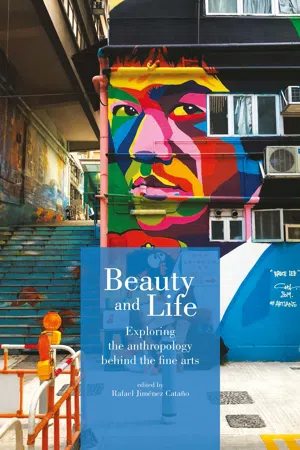
- 229 pages
- English
- ePUB (mobile friendly)
- Available on iOS & Android
eBook - ePub
About this book
In architecture, height and mass have a wonderful effect because they suggest immediately a relation to the sphere on which the structure stands, and so to the gravitating system. The tower which with such painful solidity soars like an arrow to heaven apprizes me in an unusual manner of that law of gravitation, by its truth to which it can rear aloft into the atmosphere those dangerous masses of granite, and keep them there for ages as easily as if it were a feather or a scrap of down (Ralph Waldo Emerson, Life and Literature, lecture 2: Art).
"Become a great artist. That is the only way to justify what you are doing to everyone's life." […] I did not understand what he meant. I did not feel I had to justify anything... I did not want to paint in order to justify anything, I wanted to paint because I wanted to paint. I wanted to paint the same way my father wanted to travel and work for the Rebbe. My father worked for Torah. I worked for— what? How could I explain it? For beauty? No. Many of the pictures I painted were not beautiful. For what, then? For a truth I did not know how to put into words. For truth I could only bring to life by means of color and line and texture and form (Chaim Potok, My Name is Asher Lev).
The pantheon of art is not a timeless presence which offers itself to pure aesthetic consciousness but the assembled achievements of the human mind as it has realised itself historically. Aesthetic experience also is a mode of self-understanding. But all self-understanding takes place in relation to something else that is understood and includes the unity and sameness of this other. Inasmuch as we encounter the work of art in the world and a world in the individual work of art, this does not remain a strange universe into which we are magically transported for a time. Rather, we learn to understand ourselves in it, and that means that we preserve the discontinuity of the experience in the continuity of our existence. Therefore it is necessary to adopt an attitude to the beautiful and to art that does not lay claim to immediacy, but corresponds to the historical reality of man (Hans-Georg Gadamer, Truth and Method).
Texts by Federica Bergamino, Michela Cortini, Juan José García-Noblejas, Rafael Jiménez Cataño, Giuseppe Madonna, Juan Carlos Mansur, Silvana Noschese, Jaana Parviainen, Giampiero Pizzol, Fulvia Strano.
Information
Topic
ArtSubtopic
Art Theory & CriticismThree Approaches to the Mystery of the Human Person through Schnittke’s Music
Rafael Jiménez Cataño
My first academic reflection on Schnittke’s music was in an attempt to glean a sort of “narrative of redemption” from different art forms and genres.1 It was the first edition of the seminar Poetics & Christianity, 2003. In that study I focused on themes such as fallenness, grace, mystery, need for redemption, afterlife, liberation, etc., divided into six sections: poetry, novels, short stories, films, and music (in two sections, both devoted to Schnittke).2 This paper was read by Prof. Alexander Ivashkin (1948-2014), who was a cellist and biographer of Schnittke as well as his personal friend, who invited me to participate in Schnittke Day, a short conference inaugurating the Schnittke Archive in Goldsmiths College at the University of London, which was held on February 25, 2006. On that occasion, in front of musicians and musicologists, many of them friends or close acquaintances of the composer, I presented what essentially constitutes the text that is now published here. The proceedings were not published. Shortly after, in March of 2007, Prof. Ivashkin participated in the third edition of Poetics & Christianity, which was organized by the faculties of philosophy and communication at Santa Croce, with the keynote address “Symbols, Metaphors and Irrationalities in Twentieth-Century Music.”
1. What does mystery mean?
The two musical sections of my 2003 dissertation were entitled “Seizing the unseizable” and “The ever-open biography.” These titles directly point to the mystery of the human person. Indeed, every person is always more than what we know about him or her. This is mystery. Every person is always more than what he or she is at the present: growth is an essential feature of the human person. This is mystery. The growth of the person introduces the question of sameness and otherness, the question of an “ever-open biography.” This question is very present in Ibsen’s Peer Gynt, throughout the entire drama, and with a significant formulation when the distinction between humans and trolls is explained—the former say to each other, as a maxim for life, “Man, to thyself be true!,” the latter say “Troll, to thyself be—enough!” (“It is enough to be yourself!”)3
A dynamic interpretation of “Be yourself!” is the Pindaric imperative, from the second Pythian Ode: “Become who you are!”4 But a static interpretation, which is also possible, would be just another formulation of the troll’s maxim. This ambiguity pervades the life of Peer Gynt. We have to recognize that the question about what it means to be faithful to oneself pervades the life of all of us. In 1986, John Paul II defined sanctity with similar words. Who are the saints? Those who “have lived with totality their own calling to be fully themselves, in accord with the wonderful originality the Creator had put in them.”5 He said “be,” but there is a call and a response, and therefore a process of becoming. In this connection between being oneself and having to become another, love is essential, as Ibsen’s Peer Gynt also eloquently shows in the figure of Solvejg. After John Paul II we can quote his successor, who writes: “This proces...
Table of contents
- Notes on Contributors
- Introduction
- Anthropology and Literature ‘Relational Reciprocity’ in the Narrative Reading Experience
- Dwelling in the City
- Three Approaches to the Mystery of the Human Person through Schnittke’s Music
- On Practical Reason and Poetic Fiction: A Reading of Michael Mann’s The Insider
- The Disruption of Science and the Triumph of Wonder. The “Freudiana” Case
- Museum Cultural Mediation as an Anthropological Approach to Art History. Visitors’ Experiences at Museo di Roma
- Bodily Knowledge: Revised Epistemological Reflections on Kinaesthesia, Movement, and Dance
- The Human Being: A Musical Instrument in Construction through All Phases of Life. A Journey between the Maieutic Method and Psychophonie
- The Beauty of Truth in the Theater of the World
Trusted by 375,005 students
Access to over 1.5 million titles for a fair monthly price.
Study more efficiently using our study tools.
Frequently asked questions
Yes, you can cancel anytime from the Subscription tab in your account settings on the Perlego website. Your subscription will stay active until the end of your current billing period. Learn how to cancel your subscription
No, books cannot be downloaded as external files, such as PDFs, for use outside of Perlego. However, you can download books within the Perlego app for offline reading on mobile or tablet. Learn how to download books offline
Perlego offers two plans: Essential and Complete
- Essential is ideal for learners and professionals who enjoy exploring a wide range of subjects. Access the Essential Library with 800,000+ trusted titles and best-sellers across business, personal growth, and the humanities. Includes unlimited reading time and Standard Read Aloud voice.
- Complete: Perfect for advanced learners and researchers needing full, unrestricted access. Unlock 1.5M+ books across hundreds of subjects, including academic and specialized titles. The Complete Plan also includes advanced features like Premium Read Aloud and Research Assistant.
We are an online textbook subscription service, where you can get access to an entire online library for less than the price of a single book per month. With over 1.5 million books across 990+ topics, we’ve got you covered! Learn about our mission
Look out for the read-aloud symbol on your next book to see if you can listen to it. The read-aloud tool reads text aloud for you, highlighting the text as it is being read. You can pause it, speed it up and slow it down. Learn more about Read Aloud
Yes! You can use the Perlego app on both iOS and Android devices to read anytime, anywhere — even offline. Perfect for commutes or when you’re on the go.
Please note we cannot support devices running on iOS 13 and Android 7 or earlier. Learn more about using the app
Please note we cannot support devices running on iOS 13 and Android 7 or earlier. Learn more about using the app
Yes, you can access Beauty and Life by Rafael Jiménez Cataño in PDF and/or ePUB format, as well as other popular books in Art & Art Theory & Criticism. We have over 1.5 million books available in our catalogue for you to explore.