![]()
Chapter 1
Conceptual Understanding
. . . . . . . . . . . . . . . . . . . .
Strolling about the gardens of the Academus and the Lyceum of Athens in the sunny days of 350 BCE, dining together and arguing the propositions of their masters, Plato and Aristotle, wondering students sought to resolve the great debates over the "theory of knowledge": Is truth discoverable by man? How is the concept of truth that is not empirical (as in mathematics) possible? Can the faculty of reason in every man be trained to find that truth? If so, how? The debates have been resonating in the great academies ever since.
In more recent times, the debates over "theory of knowledge" (now referred to as epistemology) have heated up. Philosophers such as Immanuel Kant (1724-1804) and G. W. F. Hegel (1770-1831) established the centrality of the mind as a principle of knowledge and defined knowledge as a stage of affirmation of reality; John Dewey (1859-1952) explained that the function of human intelligence is indeed to ensure adaptation. These claims set up the stage for new arguments over the finality of the concept of truth itself: Is this concept objective or subjective? The idealistic and the realistic schools of philosophy postulated that truth is objective; but others, like Karl Marx (1818-1883) and Jean Paul Sartre (1905-1980), argued that truth is only a product of our interpretations that are determined in social and historical contexts.
Philosophers are still debating the distinction between human consciousness and its object, and between scientific truth and common sense, drawing into the debate psychologists and educators who are entrusted with the applied perspectives of these arguments (see Suchting, 1986).
Mathematics educators, for example, are concerned with such cases as that of Debora. Debora, a 5th grade student, had mastered the procedure of adding fractions. Her teacher asked her to explain the process in front of the class:
Teacher: Who can come to the board and show us how to solve the following problem? [Write on the board.]
Debora: I want …
Teacher: Please come and show us. But also explain as you proceed.
Debora: First I see that 6 is the least common denominator, so I write 6.
Now, it does not change the numerator for the first fraction, it changes the second by 2 and the third by 3.
Now, I add the numerators and the answer is 6.
Now, 6/6 is exactly 1.
… = 1
Teacher: Very good. Now, look at this drawing and explain what you see. [Draws.]
Debora: It's a pie with three pieces.
Teacher: Tell us about the pieces.
Debora: Three thirds.
Teachers: What is the difference among the pieces?
Debora: This is the largest third, and here is the smallest …
Sound familiar? Have you ever wondered why students often understand mathematics in a very rudimentary and prototypical way, why even rich and exciting hands-on types of active learning do not always result in "real" learning of new concepts? From the psycho-educational perspective, these are the critical questions. In other words, epistemology is valuable to the extent that it helps us find ways to enable students who come with preconceived and misconceived ideas to understand a framework of scientific and mathematical concepts.
Constructivism: A New Perspective
At the dawn of behaviorism, constructivism became the most dominant epistemology in education. The purest forms of this philosophy profess that knowledge is not passively received either through the senses or by way of communication, just as meaning is not explicitly out there for grabs. Rather, constructivists generally agree that knowledge is actively built up by a "cognizing" human who needs to adapt to what is fit and viable (von Glasersfeld, 1995). Thus, there is no dispute among constructivists over the premise that one's knowledge is in a constant state of flux because humans are subject to an ever-changing reality (Jaworski, 1994, p. 16).
Although constructivists generally regard understanding as the outcome of an active process, constructivists still argue over the nature of the process of knowing. Is knowing simply a matter of recall? Does learning new concepts reflect additive or structural cognitive changes? Is the process of knowing concepts built from the "bottom up," or can it be a "top-down" process? How does new conceptual knowledge depend on experience? How does conceptual knowledge relate to procedural knowledge? And, can teachers mediate conceptual development?
Is Learning New Concepts Simply a Mechanism of Memorization and Recall?
Science and mathematics educators have become increasingly aware that our understanding of conceptual change is at least as important as the analysis of the concepts themselves. In fact, a plethora of research has established that concepts are mental structures of intellectual relationships, not simply a subject matter. The research indicates that the mental structures of intellectual relationships that make up mental concepts organize human experiences and human memory (Bartsch, 1998). Therefore, conceptual changes represent structural cognitive changes, not simply additive changes. Based on the research in cognitive psychology, the attention of research in education has been shifting from the content (e.g., mathematical concepts) to the mental predicates, language, and preconcepts. Despite the research, many teachers continue to approach new concepts as if they were simply addons to their students' existing knowledge—a subject of memorization and recall. This practice may well be one of the causes of misconceptions in mathematics.
Structural Cognitive Change
The notion of structural cognitive change, or schematic change, was first introduced in the field of psychology (by Bartlett, who studied memory in the 1930s). It became one of the basic tenets of constructivism. Researchers in mathematics education picked up on this term and have been leaning heavily on it since the 1960s, following Skemp (1962), Minsky (1975), and Davis (1984). The generally accepted idea among researchers in the field, as stated by Skemp (1986, p. 43), is that in mathematics, "to understand something is to assimilate it into an appropriate schema." A structural cognitive change is not merely an appendage. It involves the whole network of interrelated operational and conceptual schemata. Structural changes are pervasive, central, and permanent.
The first characteristic of structural change refers to its pervasive nature. That is, new experiences do not have a limited effect, but cause the entire cognitive structure to rearrange itself. Vygotsky (1986, p. 167) argued,
It was shown and proved experimentally that mental development does not coincide with the development of separate psychological functions, but rather depends on changing relations between them. The development of each function, in turn, depends upon the progress in the development of the interfunctional system.
Neuroscientists describe the pervasiveness of change by referring to the neuroplasticity of the brain. A new experience causes new connections to form among the dendrites and axons attached to the brain's cells and changes the structure of the brain. When a cognitive change is structural, the structure as a whole is affected. Mathematical thinking is viewed as a structure of a connected collection of hierarchical relations. A change in part of this structure affects its relations with the other parts and thus changes the whole (Davis & Tall, 2002, pp. 131-150).
The second characteristic of structural cognitive change is centrality, or the autonomous, self-regulating propensity of the change. The centrality characteristic, which undergirds the theory of evolution, is represented in Vygotsky's work on cultural and social development, Piaget's work on cognitive development, and Luria's work on the neurophysiological relationship between brain and behavior (Kozulin, Mangieri, & Block, 1994). Simply stated, when one learns something and that learning results in structural change, one is prepared to learn something more advanced in the same category. For example, when adding numbers, children use the initial "count all" strategy until they recognize that certain parts of the process are redundant. They then figure out they can omit the first part and just "count on." That strategy later gives way to recalling addition facts. As this example shows, new structures act to secure themselves as they accommodate new experiences.
The third characteristic of structural change, permanence, asserts that structural changes are not reversible and cannot be "forgotten" because they result from the need to accommodate novel experiences. This characteristic of structural cognitive change best explains the open-ended and continuous development of a person's cognition.
Does Knowledge Develop "Bottom Up" or "Top Down"?
If knowledge develops from the "bottom up," than educators have to replace the "top-down" curriculum with a learner-centered bottom-up pedagogy and condemn any reference to mathematics as an objective body of knowledge (see Rowlands, Graham, & Berry, 2001). Is that the case? Mathematicians are the first to counter this argument by stressing that much of mathematics is based on deductive proof, not on exploration and experimentation. Most of us would assert that our own mathematics knowledge has indeed been acquired not through our own private research, but under the (at times forceful) guidance of mathematically educated people around us. The fact that the majority of people develop a mathematical knowledge that represents almost the entire history of this discipline proves that the question is moot. Rather than approaching the problem as an input-output dichotomy of choices, it is important to examine how more constructive the solution becomes when it is focused on the process of learning.
The Difference Between Conceptual Knowledge and Procedural Knowledge
In mathematics, conceptual knowledge (otherwise referred to in the literature as declarative knowledge) involves understanding concepts and recognizing their applications in various situations. Conversely, procedural knowledge involves the ability to solve problems through the manipulation of mathematical skills with the help of pencil and paper, calculator, computer, and so forth (see Figure 1.1). Obviously, mathematicians invented procedures based on mathematical concepts. The National Council of Teachers of Mathematics standards require that students know the procedures and understand their conceptual base. Yet, there are two contrasting theories regarding the acquisition of these two types of knowledge. One is referred to as the conceptualchange view and the other as the empiricist view.
Figure 1.1. Declarative Knowledge Versus Procedural Knowledge
Declarative (Conceptual) Knowledge
- Knowledge rich in relationships and understanding.
- It is a connected web of knowledge, a network in which the linking relationships are as prominent as the discrete bits of information.
- Examples of concepts: square, square root, function, area, division, linear equation, derivative, polyhedron.
- By definition, conceptual knowledge cannot be learned by rote. It must be learned by thoughtful, reflective mental activity.
- Is it possible to have conceptual knowledge/understanding about something without procedural knowledge?
Procedural Knowledge
- Knowledge of formal language or symbolic representations.
- Knowledge of rules, algorithms, and procedures.
- Can procedures be learned by rote?
- Is it possible to have procedural knowledge without conceptual knowledge?
Without neglecting the importance of experience, the conceptual-change view defines learning as the modification of current concepts and emphasizes the role of concepts in the sense people make of their experience. This theory sheds light on what it would make sense to refer to as misconceptions, how those misconceptions develop, and what should be done to correct them. In contrast, the empiricist theory of learning emphasizes the predominant role of experience in the construction of concepts.
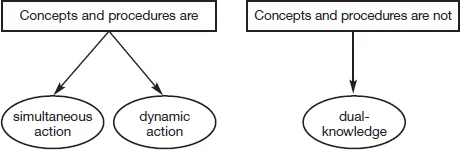
These theories yield three different instructional practices. Two of these practices focus on what is common between concepts and procedure, and the third underscores the difference between these types of knowledge (see Figure 1.2).
Figure 1.2. Relationship Between Conceptual Knowledge and Procedural Knowledge: From Theory to Instructional Practice
One practice considers conceptual knowledge as meta-knowledge that grows out of procedural proficiency. It is referred to as the practice of "simultaneous action" (e.g., Hiebert & Carpenter, 1992; Morris, 1999; Skemp, 1976). Instruction that follows this practice typically starts with a brief introduction of new concepts and focuses on the modeling of procedures and practice. For example, a teacher will explain why students cannot simply add the numerators of fractions with different denominators. To ad...