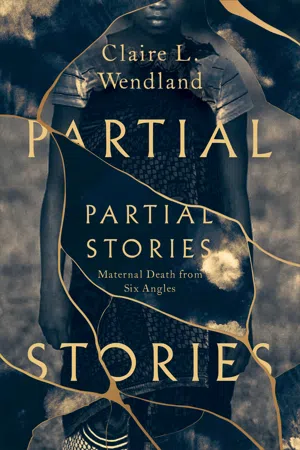
A close look at stories of maternal death in Malawi that considers their implications in the broader arena of medical knowledge.
By the early twenty-first century, about one woman in twelve could expect to die of a pregnancy or childbirth complication in Malawi. Specific deaths became object lessons. Explanatory stories circulated through hospitals and villages, proliferating among a range of practitioners: nurse-midwives, traditional birth attendants, doctors, epidemiologists, herbalists. Was biology to blame? Economic underdevelopment? Immoral behavior? Tradition? Were the dead themselves at fault?
In Partial Stories, Claire L. Wendland considers these explanations for maternal death, showing how they reflect competing visions of the past and shared concerns about social change. Drawing on extended fieldwork, Wendland reveals how efforts to legitimate a single story as the authoritative version can render care more dangerous than it might otherwise be. Historical, biological, technological, ethical, statistical, and political perspectives on death usually circulate in different expert communities and different bodies of literature. Here, Wendland considers them together, illuminating dilemmas of maternity care in contexts of acute change, chronic scarcity, and endemic inequity within Malawi and beyond.
- English
- ePUB (mobile friendly)
- Available on iOS & Android
eBook - ePub
About this book
Information
Publisher
University of Chicago PressYear
2022Print ISBN
9780226816883
9780226816869
eBook ISBN
9780226816876
1
Dangerous Modernities
Why Did She Die?
The woman from Tsoka lived for only a few moments at the referral hospital. A relative, a health center midwife, and an on-call doctor provided fragments of her story.
Not long before the rains, a twenty-eight-year-old woman late in her seventh pregnancy worked preparing her maize field outside the town of Tsoka, a few kilometers beyond the western edge of one of Malawi’s largest cities. In a few years, the little town will probably be engulfed. For now, though, only the first tendrils of city life—occasional brightly painted mini-shops, bars, and battery-charge businesses—have unfurled into the dry rural landscape of brown fields and scarred baobabs, and the greener clefts where clumps of banana trees grow.
The woman looked uncomfortable as she chopped at the hard dirt with her hoe. A sister asked if her labor was beginning; she said no. But soon the relatives working this field together realized she had slipped away. Worried, they began a search.
She was not at home. She was not on the dirt road that led to Tsoka Health Center. She was not at the nearest mzamba’s shelter. They found her at about half past five, just as the short equatorial dusk was turning to night, lying alongside her crying newborn on a narrow path. Blood soaked the dirt, and she was still bleeding heavily. Perhaps an umbilical cord indicated that the afterbirth was still inside, perhaps someone recognized that no placenta lay nearby—no one told me that part of the story. Clearly, however, she needed help urgently. Several family members picked her up and set off quickly to the nearest health center. It takes time to carry a heavy burden on an uneven path. Later, over the radio, the midwife reported that her patient had arrived at seven p.m.
The government health center where the woman’s relatives sought help was one of several dotted around the city’s edges. Tsoka Health Center had no blood bank or surgical equipment, but it had a maternity ward. The nurse-midwife on duty tried to remove the stuck placenta.
It is usually possible to remove a placenta with your hands. You reach into the woman’s vagina and curve your gloved hand into its narrowest diameter to slide through the cervix. You are nearly up to your elbow; if your patient is conscious she feels excruciating pain. You find where the soft bulk of the placenta joins the tough wall of the uterus, and push your fingers gently into that plane to separate them. It is not unlike taking a nsima cake from the serving bowl with one’s hand, sliding and lifting while trying to keep one’s own serving and the remaining nsima intact. (In another country, I was taught to imagine my fingers as a spatula, sliding under a pancake and lifting it free of the griddle.) If you succeed in maneuvering your fingers in just the right plane and if the placenta is not abnormally implanted into the muscle, the whole thing comes free and you can pull it out. Usually, that’s what happens. And usually, the hemorrhage stops as the uterine muscle contracts hard, clamping shut the many torn spiral-shaped arteries.1
That is what the midwife at Tsoka would have hoped for. But midwives, clinical officers, and doctors know to fear other possibilities. A failed attempt can make the hemorrhage worse. Sometimes the muscle won’t contract. And sometimes—more often when a woman has had many pregnancies or has had prior uterine surgery like a cesarean section—there is so much scarring on the muscle itself that the placenta sticks firmly to it, and either won’t come out at all or comes out only partly. Then your hands alone will not suffice. Your patient needs a surgeon and an operating room and surgical instruments, fast.
This was one of those times. The midwife could not get the placenta out. Her patient was too medically unstable for a transfer by minibus, and anyway the informal public transit system did not run from Tsoka after dark. The midwife radioed for the single working ambulance that served the city and its surrounds at night. It was out at Mitengo Health Center, as far east of the city as Tsoka was west. Even though the driver came directly to Tsoka and then brought both the sick patient from Mitengo and the bleeding woman from Tsoka to the referral hospital, the emergency transport took several hours. The woman arrived at the hospital six hours after giving birth. Dr. Tembo, who’d been on call, reported later that the patient was unresponsive, gasping, her pulse rapid. She had no intravenous line. Perhaps the health center had run out of IV sets (not uncommon) or perhaps no one had considered administering fluids. She died even as a medical student tried to start an IV and Dr. Tembo drew blood to crossmatch for transfusion.
Family members added an unsettling postscript. The dead woman’s last three births had also happened outside, unattended, the mother hidden away. Those newborns had died. One of the nurses mused aloud: did she want these pregnancies? No one said it, but it seems likely that I was not the only one to wonder whether the woman from Tsoka had hoped this baby would die too.
Almost any nurse or doctor would have shared Dr. Tembo’s conclusion: the primary cause of death was hypovolemic shock; the underlying cause of death was obstetric hemorrhage. True, no quantitative evidence supported this diagnosis. No one had measured the blood. Much of it had soaked into the dirt path. More was left on the dead woman’s chitenje, the nurse-midwife’s uniform, the ambulance’s bench, and the doctor’s white coat. No one had taken a hematocrit, a simple test clinicians can use to estimate blood loss. Even if Tsoka Health Center had been able to run a hematocrit at night, doing so would not have been a priority; no test would have changed how the midwife managed the hemorrhage. At the referral hospital, the woman died before her blood reached the lab. One can estimate the severity of a person’s anemia qualitatively, by pulling down her lower eyelid to examine her conjunctiva, or by looking at her tongue. Both were “paper white,” said Dr. Tembo. Even without corroborating numbers produced by machines, it seemed reasonable to conclude that hemorrhage killed the woman from Tsoka by depriving her cardiac muscles of red blood cells, and therefore oxygen, and in that way stopping her heart.
Many women hemorrhage. Few die. What other processes were at work in this case? Lack of emergency transport was a glaring problem. To assess other potentially contributing factors, however, was to raise questions difficult to answer.
What about insufficient supplies? Intravenous fluids delay death from shock due to hemorrhage: the heart has something to pump, and the remaining red blood cells get out to tissues starving for oxygen. Might an IV at the health center have prevented her death? Or transfusion? Even at hospitals designated for comprehensive care, blood was often unavailable. When available, it was frequently inadequate: scarcity forced a brutal triage, pitting pregnant women against trauma victims or children suffering from acute leukemia. In a referral hospital, I’d been refused more than a single pint of blood for a hemorrhaging patient, told “the labor ward uses too much.” Blood was never available at health centers at all.
The medical care the woman received, at the health center and in the hospital, was prompt, careful, and attentive. But was it adequate? A national survey of hospitals and health centers revealed that many had no staff capable of removing retained placentas. So was the placenta really stuck, or was the midwife unskilled in its removal?2
What role, if any, did unwanted fertility play? If the woman from Tsoka had not wanted those last three pregnancies, did she have access to reliable contraceptives? If she had access, did she have authority to decide to use them?
How did her own strange behavior fit in? Was it a tragic consequence of mental illness, as Dr. Tembo speculated? Or did it indicate bewitchment, as the dead woman’s sister suspected? Might blood, counseling by the elders, treatment by a sing’anga, a ready ambulance, or better roads have saved her life?
Stories at Work
Stories like the tale of the woman from Tsoka circulated in Malawi. They were woven into speeches made by chiefs mobilizing support for safe-motherhood projects. They were narrated by nurses denouncing government ministers’ priorities, or village elders lamenting the unruliness of youth. Abbreviated versions appeared in the newspapers, in front-page journalistic exposés on Malawi’s hospitals and “In Memoriam” sections at the back.
Circulating stories made sense of the senseless. Why did the woman from Tsoka hide away from everyone while giving birth? No one who attended her understood, but everyone offered explanations. Many maternal deaths, including hers, contained puzzling elements or important unknowns. To make sense of deaths, one had to ignore such elements, either filling in the gaps with assertions about what must have been true (like explaining this death as a product of mental illness or witchcraft), or using a narrative framework in which gaps and puzzles didn’t matter (like explaining this death as an obstetric hemorrhage).
Medical stories were used to guide action that could prevent future deaths. The plot in which a pregnant woman came in with swollen hands and a bad headache was one the experienced nurse-midwife recognized as preeclampsia. It was a plot that moved toward seizures, brain swelling, and death.3 The midwife taught her students to intervene quickly and appropriately, changing the story’s ending. To recognize which tale one was in and to act accordingly was essential to good clinical care. But the really sharp clinician had to act while also keeping her mind open to other possible stories: swelling and headache could result from a malarial crisis instead.
Witchcraft stories also guided actions to avert danger.4 Perhaps the expected time of delivery had come and gone and a woman was still pregnant. It had been ten months, or eleven. This plot was familiar too. A healer identified the witch afflicting the woman, and turned the witchcraft back upon its sender. That action—on its own or alongside administration of a powerful medicinal tea—could move the plot toward a healthy delivery. If no healer intervened, the plot could lead instead to the pregnancy’s disappearance. In the worst cases, uncountered witchcraft might lead to a woman’s death.
Hints of familiar plot outlines appear in the explanations people offered for the death of the woman from Tsoka. If she was bewitched, then her peculiar actions were the consequences of someone’s malevolent interventions and a skilled sing’anga might have remedied them. If she was mentally ill, the same actions resulted from a chemical imbalance that a skilled clinician might have treated with pharmaceuticals.
Stories also allocated responsibility. Clinicians often blamed inadequate tools, medications, or staff (a charge addressed in chapters 3 and 4). But experts who diagnosed the problem of maternal death also frequently made moral judgments, often—as in Bonnex Kaunda’s case—explicitly gendered ones. The solutions they prescribed rendered particular groups of people responsible. Stories of dead mothers were woven by elders into the moral education of juniors—whether in the flickering firelight under the stars at a coming-of-age ritual, beneath a corrugated iron roof at a district hospital’s mortality review, or in the reflected glow of a PowerPoint presentation at an international conference. Moralizing language cut across categories of experts. Bonnex Kaunda and several other asing’anga blamed maternal death on promiscuity; so did some nurse-midwives. Both an urban doctor and a rural chief laid responsibility at the feet of multiparty democracy and the destructive “freedoms” it brought.
Narratives of responsibility refracted maternal death through different moral lenses—feminist or patriarchal, ...
Table of contents
- Cover
- Title Page
- Copyright Page
- Dedication
- Contents
- Introduction
- bonnex kaunda: “There are too many goings-on these days.”
- 1 Dangerous Modernities
- agnesi kunjirima: “You can make your pregnancy safe.”
- 2 Knowing Bodies
- lillian siska: “I help them right here at home.”
- 3 Ambivalent Technologies
- chimwemwe bruce: “Changes, yes, but no development.”
- 4 Abundant Scarcity
- rhoda nantongwe: “By the time she comes to the hospital, it is too late.”
- 5 Countless Accountings
- dyna ng’ong’ola and kettie pensulo: “Women in this community are very much concerned.”
- 6 Fragile Authority
- Conclusion
- Glossary of Chichewa Terms
- Key People and Places
- Abbreviations
- Acknowledgments
- Notes
- References
- Index
Trusted by 375,005 students
Access to over 1.5 million titles for a fair monthly price.
Study more efficiently using our study tools.
Frequently asked questions
Yes, you can cancel anytime from the Subscription tab in your account settings on the Perlego website. Your subscription will stay active until the end of your current billing period. Learn how to cancel your subscription
No, books cannot be downloaded as external files, such as PDFs, for use outside of Perlego. However, you can download books within the Perlego app for offline reading on mobile or tablet. Learn how to download books offline
Perlego offers two plans: Essential and Complete
- Essential is ideal for learners and professionals who enjoy exploring a wide range of subjects. Access the Essential Library with 800,000+ trusted titles and best-sellers across business, personal growth, and the humanities. Includes unlimited reading time and Standard Read Aloud voice.
- Complete: Perfect for advanced learners and researchers needing full, unrestricted access. Unlock 1.5M+ books across hundreds of subjects, including academic and specialized titles. The Complete Plan also includes advanced features like Premium Read Aloud and Research Assistant.
We are an online textbook subscription service, where you can get access to an entire online library for less than the price of a single book per month. With over 1.5 million books across 990+ topics, we’ve got you covered! Learn about our mission
Look out for the read-aloud symbol on your next book to see if you can listen to it. The read-aloud tool reads text aloud for you, highlighting the text as it is being read. You can pause it, speed it up and slow it down. Learn more about Read Aloud
Yes! You can use the Perlego app on both iOS and Android devices to read anytime, anywhere — even offline. Perfect for commutes or when you’re on the go.
Please note we cannot support devices running on iOS 13 and Android 7 or earlier. Learn more about using the app
Please note we cannot support devices running on iOS 13 and Android 7 or earlier. Learn more about using the app
Yes, you can access Partial Stories by Claire L. Wendland in PDF and/or ePUB format, as well as other popular books in Social Sciences & African History. We have over 1.5 million books available in our catalogue for you to explore.