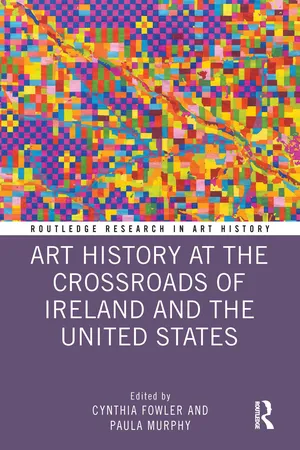
Taking the visual arts as its focus, this anthology explores aspects of cultural exchange between Ireland and the United States.
Art historians from both sides of the Atlantic examine the work of artists, art critics and art promoters. Through a close study of selected paintings and sculptures, photography and exhibitions from the nineteenth century to the present, the depth of the relationship between the two countries, as well as its complexity, is revealed.
The book is intended for all who are interested in Irish/American interconnectedness and will be of particular interest to scholars and students of art history, visual culture, history, Irish studies and American studies.
Time alone can determine whether a work of art is actually great but there is a simple reason to believe that this picture has the elements of greatness. It occupies a unique place in art. Battle scenes, good and bad, have been painted over and over, and Indians have been portrayed on canvas with a treachery to art equal to aboriginal degradation. But here is an Indian battle, and the only one of its kind that ever occurred – a conflict in which there was not a single white survivor. The painting tells the story with a strength of character, realism in detail, and vividness of scene which can scarcely fail to attract the attention of the world.
(Chicago Tribune, August 20, 1882)
Speculating in the mid-twentieth century on the most popular American artwork – “viewed, commented on and discussed by more people in this country” than any other – historian Robert Taft suggested that two paintings of the Battle of the Little Bighorn earn the distinction. One of them, Custer’s Last Rally (CLR) (1881) (Figure 1.1) by the Irish-born artist John Mulvany (c. 1839–1906), was “displayed, known, and admired throughout the country” as it went on a nationwide tour and was extensively circulated in chromolithographic form.1 Patriotic, thrilling, and inspiring, Mulvany’s painting engraved Custer’s mythic last stand on the white American imagination.2 It caught the eye of the eminent poet and critic Walt Whitman, whose praise knew no bounds. Whitman declared the work “one of the very few attempts at deliberate artistic expression for our land and people”.3 He looked at the painting through American eyes, never acknowledging Mulvany’s Irish background. This essay focuses on the visual representation of the defeat at the Battle of the Bighorn as represented in Mulvany’s Custer’s Last Rally.
Considering Mulvany was a celebrated artist in his time, the question arises, how can a painter of such an important painting as Custer’s Last Rally be obliterated from the canon? And why are so many of Mulvany’s paintings, once admired, now missing? When he died, there was no keeper of the flame.4 Notwithstanding his extensive connections in the higher echelons of American and Irish-American civic and public life, his charm and bonhomie, and his critically positive reviews, Mulvany died in tragic circumstances – alcoholic and frail in mind and body. Notwithstanding his undoubted skill, he had clung to an aesthetic that saw him increasingly out of step with developments in art at the turn of the century. His subject matter – his representations of the West and the Civil War – was initially hailed as radical but soon perceived as outmoded. His Irish subject matter, of huge interest to Irish-Americans, was of marginal interest in the New World. And there was more than a whiff of cordite around Mulvany. His work with the Irish-American dynamiting campaign in London had deadly consequences, and he became embroiled in the split in the Irish republican movement in the United States in the 1880s. Add to that a number of scandalous liaisons. Not surprisingly, the art world moved him to a distance, where he has languished. But the canon is a construct worth reconsidering from time to time.
Figure 1.1 John Mulvany, Custer’s Last Rally (CLR), 1881 (print).
Source: Courtesy of The Buffalo Bill Center of the West, Cody, Wyoming; Whitney Western Art Museum; 149.69.
As an immigrant, Mulvany was steeped in both Irish history and contemporary Irish-American politics. Aged twelve, towards the end of the Famine, he left Ireland as a stowaway. Thomas Tuite, his erstwhile biographer, wrote in some detail about Mulvany’s relationship with his erudite and zealously nationalist teacher, Master Rogers.5 In America, Mulvany sublimated this sensibility into art (in time incorporating American nationalism into his work). He became a messenger and model in the National Academy of Design in New York, and in 1859 enrolled there as a student. In 1861 he was working in Chicago as a photographic colorist. At the outbreak of the Civil War he went to the front as an illustrator for Irish newspapers, following which he painted monumental works, such as McPherson and Revenge (1888) and Sheridan’s Ride from Winchester (1896), in which he drew on his European training, in contrast to the work of American artists such as Winslow Homer, who also illustrated the Civil War in an emerging American style.
With promises of support from influential Irishmen in Chicago, Mulvany dedicated himself to executing a series of paintings of Ireland’s historic past that would mobilize support for a resurgent nationalist movement.6 To attain the necessary skills, he went to the Akademie der Bildenden Künste in Munich in 1869, where he was awarded the medal of honor. He also studied in Antwerp, Paris, and Amsterdam. On his return, the entire contents of his studio were consumed in the Great Chicago Fire of 1871. Left with no more than the clothes on his back, he went west. From 1872 he painted Western American subjects, winning critical acclaim at the National Academy of Design in 1876 for Preliminary Trial of a Horse Thief – Scene in a Western Justice’s Court (Figure 1.2). Other western-American subjects include Lynch Law (1877), Trappers of the Yellowstone (1877), and Back to the Wigwam (1881). He also had a prestigious portrait practice, painting, among others, General Thomas Francis Meagher and Robert Emmet, Brigham Young, and Red Cloud. But it was his Custer’s Last Rally that had the greatest impact on his contemporaries.
Figure 1.2 John Mulvany, Preliminary Trial of a Horse Thief – Scene in a Western Justice’s Court, 1876 (oil on canvas).
Source: Courtesy of Joseph Szymanski, Szymanski Gallery, Rock Hall, Maryland, USA.
From the rear in the painting, the warriors emerge from a burning Indian village, and through the dense smoke of carbine charge at what remains of Custer’s 7th Cavalry. The surrounded dismounted soldiers use their dead horses as breastworks from which they stand or stoop to fire at foe also attacking from the front. The force of the charge contrasts with the arrested motion of the men, doomed to die, as if before our eyes. Although all in the painting is conjecture, soldiers confirmed the fighting as “real”, “in its vigor and desperation, [and] in fidelity to the facts of modern and contemporary American fighting”.7 Contemporary accounts of the picture relished the overwhelming chaos, kinaesthetically sweeping the spectator into the narrative. The contrasting perspectives of the opposing warriors are reinforced stylistically – high realism in the treatment of the “gallant”, and an impressionistic swirl in the treatment of the “savages”. The chaos is heightened to the pitch of the still-living horses writhing in terrified agony. The right foreground is occupied by war-painted, breech-clouted, and bonneted dead and dying Indians, reinforcing the repoussoir thrust towards Custer, the centripetal force of the painting. Custer, taking aim with his huge cavalry pistol (glittering saber by his side), is surrounded to his right, left, and front by twenty or so of his remaining men, including Captains Yates and Cook. All are characteristically identifiable: the dead Yates, “the highest type of an American, handsome, lovable, manly, strong and courageous”, according to Mulvany, and Cook, wounded, as we see from the bloodied handkerchief around his head, but fighting to the last.8 On the right, just beyond Cook, is “the typical Irish-American soldier” described as “one of the strongest figures upon the canvas”.9 However, it was not “the heroism of a race” [my italics] that was depicted here, but the “the combined heroism of races, and the grandeur of man, for the artist shows the archetypes of Celt and Teuton, Saxon and Gaul, all fused and inwrought with the life that has made them above all American Warriors of the Plains.”10
Perspectives on the Battle
It is important to consider Custer’s Last Rally in relation to the battle itself. As the United States celebrated its hundredth anniversary, news of the defeat at the Battle of the Little Bighorn rocked the country. On June 25, 1876, the 7th Cavalry commanded by Lieutenant Colonel George Armstrong Custer attacked a large village on the Little Bighorn River in Montana and was defeated by an insurmountable force of Native Americans, Lakota Sioux and their allies the Northern Cheyenne and Arapaho tribes. Providing an important Native perspective on the battle, novelist and poet James Welch (Blackfeet and A’aninin) described Custer as “an overweaning [sic] fool . . . [transformed into] a martyr at a time when this country . . . desperately needed a martyr”.11 However, notwithstanding his defeat and the deaths of 262 soldiers, Custer was all but deified. The Battle of the Little Bighorn was the defining event of the American Indian Wars, for though a victory in battle for Indigenous peoples, ironically it expedited their ultimate defeat.12
In anticipation of Custer’s arrival, some three thousand had gathered above the valley of the Little Bighorn River. Custer’s orders were to wait for reinforcements, but he decided to go it alone (so as to attain full glory in the event of success). He first divided his command. One company was assigned to protect the pack train. Three companies under the command of Captain Frederick Benteen were sent to scout for the enemy to the rear of the column. And Major Marcus Reno’s detachment was to approach from the southeast, a counterattack that led to the loss of a third of his force; Custer then ordered his remaining men to retreat to a nearby ridge, where they remained under siege for two days. Meanwhile, Custer moved by the Indians’ flank. Many of his troopers were raw recruits equipped with single-shot rifles. Lacking cover and vastly outnumbered by Indians carrying repeating rifles and carbines, Custer and the men under his immediate command were dead within an hour. The bodies were stripped and horribly mutilated, though not those of Custer and his Irish officer Captain Myles Keogh (who wore a papal medal, later seen around the neck of Sitting Bull), presumably in a gesture of warrior respect.
The battle was mythopoeic. Walt Whitman penned a poem, and artists and journalists rushed to the scene. The magnificent landscape, dominated by the Black Hills – with their lure of gold – formed the backdrop, but accounts of the bloodiest catastrophe of the A...
Table of contents
Cover
Half Title
Series
Title
Copyright
Table of Contents
List of Contributors
List of Images
Preface
Introduction
1. Desperate and Glorious: John Mulvany’s Custer’s Last Rally
2. ‘An American and Not an Irish Statue’: Commemorating Naval Hero Commodore John Barry
3. Some Thoughts on Arthur Kingsley Porter and Françoise Henry as Transcultural Pioneers of Early Irish Medieval Art
4. Irish Art at the Armory Show, 1913
5. Seeing New York: Jack Butler Yeats and the American City
6. ‘This New Life of Painting’: Morris Graves in Ireland, 1954-1964
7. Ireland’s ‘Strayed Angel’: George W. Russell (AE) - From Dublin to New York, 1904-1934
8. Dorothea Lange in Ireland: Anthropology and Image
9. Sean Scully: Painting a Global Immigrant’s Vision
10. Transnational Solidarity: African American and Irish Intersections in Public Art Commemorating Frederick Douglass
11. Kathy Prendergast: Transcultural Cartography
12. Uncommon Kinships: The Generous Reciprocity of the Choctaw Nation and Ireland
Index
Trusted by 375,005 students
Access to over 1.5 million titles for a fair monthly price.
Study more efficiently using our study tools.
Frequently asked questions
Yes, you can cancel anytime from the Subscription tab in your account settings on the Perlego website. Your subscription will stay active until the end of your current billing period. Learn how to cancel your subscription
No, books cannot be downloaded as external files, such as PDFs, for use outside of Perlego. However, you can download books within the Perlego app for offline reading on mobile or tablet. Learn how to download books offline
Perlego offers two plans: Essential and Complete
Essential is ideal for learners and professionals who enjoy exploring a wide range of subjects. Access the Essential Library with 800,000+ trusted titles and best-sellers across business, personal growth, and the humanities. Includes unlimited reading time and Standard Read Aloud voice.
Complete: Perfect for advanced learners and researchers needing full, unrestricted access. Unlock 1.5M+ books across hundreds of subjects, including academic and specialized titles. The Complete Plan also includes advanced features like Premium Read Aloud and Research Assistant.
Both plans are available with monthly, semester, or annual billing cycles.
We are an online textbook subscription service, where you can get access to an entire online library for less than the price of a single book per month. With over 1.5 million books across 990+ topics, we’ve got you covered! Learn about our mission
Look out for the read-aloud symbol on your next book to see if you can listen to it. The read-aloud tool reads text aloud for you, highlighting the text as it is being read. You can pause it, speed it up and slow it down. Learn more about Read Aloud
Yes! You can use the Perlego app on both iOS and Android devices to read anytime, anywhere — even offline. Perfect for commutes or when you’re on the go. Please note we cannot support devices running on iOS 13 and Android 7 or earlier. Learn more about using the app
Yes, you can access Art History at the Crossroads of Ireland and the United States by Cynthia Fowler,Paula Murphy in PDF and/or ePUB format, as well as other popular books in Art & European Art. We have over 1.5 million books available in our catalogue for you to explore.