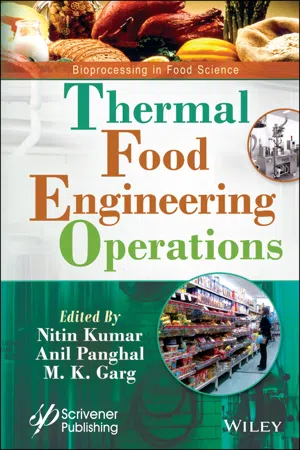
Thermal Food Engineering Operations
eBook - ePub

Thermal Food Engineering Operations

  1. English
  2. ePUB (mobile friendly)
  3. Available on iOS & Android
eBook - ePub

Thermal Food Engineering Operations

About this book

Thermal Food Engineering Operations

Presenting cutting-edge information on new and emerging food engineering processes, Thermal Food Engineering Operations, the first volume in the new series, "Bioprocessing in Food Science, " is an essential reference on the modeling, quality, safety, and technologies associated with food processing operations today.

As the demand for healthy food increases in the current global scenario, manufacturers are searching for new possibilities for occupying a greater share in the rapidly changing food market. Compiled reports and updated knowledge on thermal processing of food products are imperative for commercial enterprises and manufacturing units. In the current scenario, academia, researchers, and food industries are working in a scattered manner and different technologies developed at each level are not compiled to implement for the benefits of different stakeholders. However, advancements in bioprocesses are required at all levels for the betterment of food industries and consumers. This series of groundbreaking edited volumes will be a comprehensive compilation of all the research that has been carried out so far, their practical applications, and the future scope of research and development in the food bioprocessing industry.

This first volume includes all the conventional and novel thermal technologies based on conduction, convection, and radiation principles and covers the basics of microbial inactivation with heat treatments, aseptic processing, retorting, drying, dehydration, combined high-pressure thermal treatments, and safety and quality concerns in food processing. Before studying the novel non-thermal processes and the concept of minimal processing, comprehensive knowledge about the conventional thermal technologies is desired along with benefits, constraints, equipment, and implementation of these technologies. Whether for the engineer, scientist, or student, this series is a must-have for any library.

This outstanding new volume:

  • Discusses food safety and quality and thermal processing, laying the groundwork for further study and research
  • Provides case studies of solid–liquid and supercritical fluid extraction
  • Explores pasteurization, ohmic heating, irradiation, and more
  • Presents cutting-edge information on new and emerging food engineering processes

Audience: Process and chemical engineers, chemists, engineers in other disciplines, managers, researchers, scientists, students, and teachers working in the field of food engineering and processing

Frequently asked questions

Yes, you can cancel anytime from the Subscription tab in your account settings on the Perlego website. Your subscription will stay active until the end of your current billing period. Learn how to cancel your subscription.
No, books cannot be downloaded as external files, such as PDFs, for use outside of Perlego. However, you can download books within the Perlego app for offline reading on mobile or tablet. Learn more here.
Perlego offers two plans: Essential and Complete
  • Essential is ideal for learners and professionals who enjoy exploring a wide range of subjects. Access the Essential Library with 800,000+ trusted titles and best-sellers across business, personal growth, and the humanities. Includes unlimited reading time and Standard Read Aloud voice.
  • Complete: Perfect for advanced learners and researchers needing full, unrestricted access. Unlock 1.4M+ books across hundreds of subjects, including academic and specialized titles. The Complete Plan also includes advanced features like Premium Read Aloud and Research Assistant.
Both plans are available with monthly, semester, or annual billing cycles.
We are an online textbook subscription service, where you can get access to an entire online library for less than the price of a single book per month. With over 1 million books across 1000+ topics, we’ve got you covered! Learn more here.
Look out for the read-aloud symbol on your next book to see if you can listen to it. The read-aloud tool reads text aloud for you, highlighting the text as it is being read. You can pause it, speed it up and slow it down. Learn more here.
Yes! You can use the Perlego app on both iOS or Android devices to read anytime, anywhere — even offline. Perfect for commutes or when you’re on the go.
Please note we cannot support devices running on iOS 13 and Android 7 or earlier. Learn more about using the app.
Yes, you can access Thermal Food Engineering Operations by Nitin Kumar,Anil Panghal,M. K. Garg in PDF and/or ePUB format, as well as other popular books in Technology & Engineering & Food Science. We have over one million books available in our catalogue for you to explore.

1
Novel Thermal Technologies: Trends and Prospects

Amrita Preetam1*, Vipasha1, Sushree Titikshya1, Vivek Kumar1, K.K. Pant2 and S. N. Naik1
1Centre for Rural Development and Technology, IIT Delhi, Delhi, India
2Department of Chemical Engineering, IIT Delhi, Delhi, India
Abstract
Heating is possibly the most traditional way of processing foods. The technologies involved in heating have been continuously developing for the past many years as per consumer need, satisfaction and demand. Techniques such as dielectric heating, ohmic heating, and infrared heating are evolving and can substitute for the conventional heating methods for improving quality and shelf life, and providing a faster production rate. The conventional technologies are primarily based on convective, conductive, and radiative heat transfer. But the new novel thermal methods are mainly relying on the electromagnetic field or electrical conductivity and are having cleaner environmental impacts such as energy saving, water savings, improved efficiencies, fewer emissions, and eventually decreasing dependency on non-renewable resources. The chapter discusses novel thermal technologies. Definitions, basic principles, environmental impacts, current trends, and future perspectives are described along with the mechanism and advantages of the novel thermal technologies. The novel thermal technologies are continuously emerging and evolving as per consumer requirements and need.
Keywords: Novel thermal technologies, infrared heating, ohmic heating, microwave heating, radiofrequency heating

1.1 Introduction

The primary goal for food processors is quality and safety assurance. To ensure microbiological food safety, the use of heat by thermal operation involving drying, sterilization, evaporation, and other methods are common practices. The conventional heating methods rely on principles such as convection, radiation, and conduction [36] that primarily rely on heat generation exterior of the product to be warmed up. But there are limitations attached to it. These conventional ways of processing, due to the decrease in efficiency of heat transfer, by excessive heating because of time reach the thermal center of foods for conducting sufficient heat or losses because of the heat on the surface of equipment and installation. Some of these problems can be resolved by technical solutions such as heat recycling or advanced designing and installation methods but at high expense.
Therefore research has been made for raising the quality and safety and economic aspects of food through technological development. The novel thermal technologies in which the main processing factor is temperature change as the main parameter responsible for food processing can be considered as the promising alternative in food processing as compared to the traditional process. Unlike traditional technologies, novel thermal technologies are based on electromagnet field (EMI) or electric conductivity. Novel thermal technologies are based on the heat generations directly inside the food. The novel thermal technologies have successfully helped in enhancing the effectiveness of heat processing along with ensuring food safety and maintaining nutritional food properties. Infrared heating has also evolved for the processing of food. The thermal technologies involve the equipment plotted to heat the food to process it, whereas in non-thermal techniques the food is virtually processed without the involvement of food. The general definition of common technologies involved in novel thermal techniques and their basic differences are discussed below.
Ohmic heating is also called Joule heating, electrical residence heating. It is a method of heating the food by the passage of an electric current, so heat is generated due to the electrical current. It is a direct method, as the heat energy is directly dissipated into the food. It is primarily used to preserve food. Electric energy is dissipated into heat, which results in quick and uniform heating followed by maintaining the nutritional value and color. The key variable in electrical conductivity is designing of an effective ohmic meter. Ohmic heating uses a normal electrical supply frequency which is of 50-60Hz. Ohmic heating instantly penetrates directly into the food. The applications of ohmic heating include UHT sterilization, pasteurization, and others.
Dielectric heating is another novel process that provides volumetric heating, for uniform sterilization or preserving of food. It is also a direct method and is based on the process of heating the material by causing dielectric motion in its molecule using alternating electric fields, microwave electromagnetic radiation, or radio wave. The intensity of the electric field and the dielectric properties of the product regulate the volumetric power and absorption and the rate of heat generation. Both microwave heating and radiofrequency belong to this category and follow the principle of dielectric heating. The depth of penetration is directly related to frequency in the case of dielectric heating. The thermal conductivity is not so important in dielectric heating. The few application of microwave and radiofrequency are in freeze-drying, baking, sterilization, rendering, frying, and many others.
Infrared heating is mainly utilized to modify the eating characteristics of food by varying its color, texture, flavor, and odor. Radiant heat is less managed and has a broader range of frequencies. The thermal conductivity is a limiting factor in infrared heating. It acts as an indirect method of heating. Infrared is simply absorbed and converted into heat. It has limited penetration depth in food. It has several advantages over conventional methods such as decreased heating time, reduce quality loss, and uniform heating, versatility, easy to operate and compact equipment, and many others. It also has a vast area of application includes drying, frying, baking, cooking, freeze-drying, pasteurization, sterilization, blanching, and many others.
The other technique is non-thermal heating technologies which are based on pulsed light, pulsed electric fields, ultrasound, and gamma radiation, and others, where the temperature may change also but is not the prime parameter for food processing. The purpose of this chapter is to deliver a general outlook of novel thermal technologies in the food processing sector along with their environmental impact, current trends, and future perspective.

1.2 Novel Thermal Technologies: Current Status and Trends

The most common approach for food processing in the last 50 years is thermal processing because a huge amount of microorganisms are removed at elevated temperatures by killing them. Thermal processing protects food by pasteurization, hot air drying, and others, induces variations to improve food quality by baking, blanching, roasting, frying, and cooking. Time and temperature used are the key variable depending on the application used. In the case of thermal processing, sometimes the high temperature may lead to loss of nutrients or bioactive compounds which results in low-processed food and low-grade food.
So in such a situation, novel thermal techniques or with the combination of traditional technologies are used to modify the quality and shelf life while decreasing the change in sensory properties. The food industry is continuously developing in order to fulfill customer demand for food nutrition, natural flavors, food quality, and taste. Innovation and research are continuously growing all over the world to maintain and improve standards. Currently, consumers demand food with the least or no chemical additives and should be minimally processed [37]. These developing technologies are called ‘novel’ technologies because they are successfully fulfilling the needs of consumers and are an improvement of conventional technologies. Depending upon the principle used, it can be thermal or non-thermal. Techniques such as microwave, ultrasound, and pulsed electric field can be an alternative proved by many researchers to develop nutritious and safe food [10, 15, 16]. Such techniques are being used broadly by many innovative food companies [6]. As compared to traditional technologies these new emerging technologies have many benefits over traditional techniques such as more heat and mass transfer, improved product quality, short process and residence time, better functionality, enhanced preservation, and others. The processing of the food is important for taste, nutritional content, texture, and appearance [36]. The benefits of novel processing technologies over traditional techniques are improved functional characteristics and retention of sensory attributes by using the pr...

Table of contents

  1. Cover
  2. Table of Contents
  3. Title Page
  4. Copyright
  5. Preface
  6. 1 Novel Thermal Technologies: Trends and Prospects
  7. 2 Microbial Inactivation with Heat Treatments
  8. 3 Blanching, Pasteurization and Sterilization: Principles and Applications
  9. 4 Aseptic Processing
  10. 5 Spray Drying: Principles and Applications
  11. 6 Solar Drying: Principles and Applications
  12. 7 Fluidized Bed Drying: Recent Developments and Applications
  13. 8 Dehumidifier Assisted Drying: Recent Developments
  14. 9 Refractance Window Drying: Principles and Applications
  15. 10 Ohmic Heating: Principles and Applications
  16. 11 Microwave Food Processing: Principles and Applications
  17. 12 Infrared Radiation: Principles and Applications in Food Processing
  18. 13 Radiofrequency Heating
  19. 14 Quality, Food Safety and Role of Technology in Food Industry
  20. Index
  21. Also of Interest
  22. Wiley End User License Agreement