Biopolymer-Based Food Packaging
eBook - ePub

Biopolymer-Based Food Packaging

Innovations and Technology Applications

  1. English
  2. ePUB (mobile friendly)
  3. Available on iOS & Android
eBook - ePub

Biopolymer-Based Food Packaging

Innovations and Technology Applications

About this book

Biopolymer-Based Food Packaging

Explore the latest developments and advancements in biopolymer-based food packaging

In Biopolymer-Based Food Packaging: Innovations and Technology Applications, a team of accomplished researchers delivers a complete, systematic, and sequential account of the contemporary developments in the application of biopolymers for sustainable food packaging. This book introduces the fabrication, characterization as well as benefits arising from the enhanced functionalities of biopolymer-based food packaging materials.

The authors introduce various polysaccharide, protein, and microbial polymer-based food packaging films and coatings, as well as biopolymer-based blends and nanocomposites. Importance of these materials as active and intelligent food packaging systems is also introduced. Finally, the book explores biopolymer-based edible food packaging, and its efficacy in extending the shelf-life of perishable food items using sustainable materials and processes suitable for the future of circular economies around the world.

Readers will also find:

  • A thorough introduction to the incorporation of nanomaterials as fillers to improve the physico-chemical, mechanical, thermal, barrier, optical, and antimicrobial properties of food packaging nanocomposites
  • Comprehensive discussions of the use of plant-based bioactive compounds, including essential oils, in biopolymer-based food packaging
  • Practical examinations of silver and zinc oxide nanoparticles in food packaging
  • In-depth treatments of polylactic acid-based composites for food packaging applications

Biopolymer-Based Food Packaging: Innovations and Technology Applications is an invaluable resource for academic researchers and professionals in food packaging and related industries, as well as research scholars, graduate students, and entrepreneurs working and studying in the field of food preservation, environmental safety, and human health with a focus on the sustainable future.

Information

Publisher
Wiley
Year
2022
Print ISBN
9781119702252
Edition
1
eBook ISBN
9781119702337

1
An Overview of Natural Biopolymers in Food Packaging

Santosh Kumar 1,*, Indra Bhusan Basumatary 1, Avik Mukherjee1,*, and Joydeep Dutta2,*
1 Department of Food Engineering and Technology, Central Institute of Technology Kokrajhar, Kokrajhar 783370, Assam, India
2 Functional Materials, Department of Applied Physics, SCI School, KTH Royal Institute of Technology, Hannes Alfvéns väg 12, 114 19, Stockholm, Sweden
* Corresponding authors: Santosh Kumar, [email protected]; Avik Mukherjee, [email protected]; Joydeep Dutta, [email protected]

CHAPTER MENU

  1. 1.1 Introduction
  2. 1.2 History and Background
  3. 1.3 Classification
    1. 1.3.1 Polysaccharide-Based Biopolymers
    2. 1.3.2 Protein-Based Biopolymers
    3. 1.3.3 Lipid-Based Biopolymers
    4. 1.3.4 Biopolymers Synthesized from Bio-derived Monomers
  4. 1.4 Advantages and Disadvantages
  5. 1.5 Properties and Applications
  6. 1.6 Conclusion and Perspectives

1.1 Introduction

The prefix “bio” in the term “biopolymer” signifies that these polymers are of biological origin, i.e. inherently produced in living organisms. Biopolymers, bio-based polymers, biodegradable polymers, and bioplastics are used synonymously in specific contexts, but each term has a different meaning. Bio-based polymers are materials produced from natural resources such as plants, animals, and microorganisms that can be biodegradable (e.g. starch, polylactic acid [PLA]) or non-degradable (e.g. biopolyethylene) [1]. Biodegradable polymers are materials that completely degrade when exposed to soil, air, water, and microorganisms over a specific time period. Biodegradable polymers may be natural (e.g. starch, cellulose, proteins, lipids) or synthetically produced (e.g. polycaprolactone and polybutylene succinate). A bioplastic is a plastic polymer manufactured from a natural or renewable source, and it is biodegradable [2]. Biopolymers are primarily composed of repeating units of monomers made of carbon (C), hydrogen (H), oxygen (O), and nitrogen (N) and are found in living organisms such as plants, animals, and microorganisms. Based on this definition, biopolymers include bio-based polymers and natural polymers, including biodegradable polymers such as polysaccharides, proteins, lipids, and polynucleotides (DNA and RNA). However, biopolymers such as DNA and RNA have complex molecular structure, in which monosaccharide, protein/amino acids, and functional groups such as phosphate groups are joined together by complex intramolecular interactions like hydrogen bonding, disulfide bridges, and hydrophobic interactions to create three-dimensional (3D) structure and termed as bio-based heteropolymers or biomacromolecules [3].
The physicochemical properties of biopolymers such as stiffness, elasticity, conductivity of electricity and heat, resistance to corrosion, appearance such as transparency, and color depend on the type(s) of monomer, degree of polymerization, and type(s) of intramolecular bonds. Compared to synthetic polymers obtained from fossil fuels, biopolymers offer the obvious advantage of eco-friendly degradation, which leads to effective waste management and a healthy environment. The biopolymers are excellent candidates for various applications such as food, pharmaceuticals, and cosmetics and in several industries including packaging, agriculture, textiles, and water treatment due to their biocompatibility, non-toxicity, and biodegradability [4–6]. However, impact strength, tensile strength, permeability, and thermal stability of biopolymers are relatively inferior compared to synthetic (i.e. petroleum-based) polymers. Reinforcement of fillers or additives in biopolymers significantly improves the mechanical properties, such as tensile and impact strengths of the resulting composites, and thermal and optical properties [7–9]. Cellulose, chitosan, starch, polyvinyl alcohol (PVA), polylactic acid (PLA), polyglycolic acid (PGA), polycaprolactone (PCL), polyhydroxybutyrate (PHB), polybutylene succinate (PBS), etc. have gained substantial attention as biopolymers in food packaging applications [5, 6, 8].
Synthetic polymers like polyethylene (PE), polypropylene (PP), nylon, polyester (PS), polytetrafluoro-ethylene (PTFE), and epoxy are commonly known as plastic and are derived from petroleum hydrocarbons [10]. These materials are still an integral part of our human life, and they have found their way into our daily routine. The demand for petroleum-based polymers in our commercial world is increasing because of their versatility, high mechanical strength, flexibility, resistivity, transparency, chemical inertness, low mass, and low cost [11]. Moreover, these plastic do not readily react with the product with which they are in contact, and they have excellent resistance to water, gases, temperature, and chemical degradation. Synthetic plastics are made from petroleum hydrocarbon, which is a non-renewable resource, and they emit large quantities of greenhouse gases during production [11]. In addition, burning of plastics can emit toxic chemicals such as dioxins [12]. Plastics that are used for short time periods and single-use plastics should not be made of synthetic plastics due to their low density and slow decomposition....
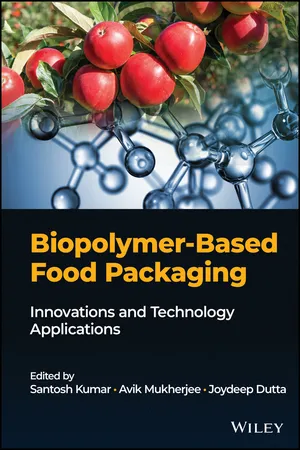
Table of contents

  1. Cover
  2. Title page
  3. Copyright
  4. Table of Contents
  5. List of Contributors
  6. Preface
  7. 1 An Overview of Natural Biopolymers in Food Packaging
  8. 2 Biopolymers: The Chemistry of Food and Packaging
  9. 3 Technologies for Biopolymer-Based Films and Coatings
  10. 4 Chitosan-Based Films and Coatings
  11. 5 Starch-Based Edible Films and Coatings
  12. 6 Protein-Based Films and Coatings
  13. 7 Microbial Polysaccharides (MPs) in Food Packaging
  14. 8 Polylactic Acid (PLA)-Based Composites in Food Packaging
  15. 9 Antimicrobial Agents in Films and Coatings
  16. 10 Nanomaterials in Food Packaging
  17. 11 Silver and Zinc Oxide Nanoparticles in Films and Coatings
  18. 12 Plant-Based Active Compounds in Food Packaging
  19. 13 Essential Oils in Active Films and Coatings
  20. 14 Edible Films and Coatings
  21. Index
  22. End User License Agreement

Trusted by 375,005 students

Access to over 1.5 million titles for a fair monthly price.

Study more efficiently using our study tools.

Frequently asked questions

Yes, you can cancel anytime from the Subscription tab in your account settings on the Perlego website. Your subscription will stay active until the end of your current billing period. Learn how to cancel your subscription
No, books cannot be downloaded as external files, such as PDFs, for use outside of Perlego. However, you can download books within the Perlego app for offline reading on mobile or tablet. Learn how to download books offline
Perlego offers two plans: Essential and Complete
  • Essential is ideal for learners and professionals who enjoy exploring a wide range of subjects. Access the Essential Library with 800,000+ trusted titles and best-sellers across business, personal growth, and the humanities. Includes unlimited reading time and Standard Read Aloud voice.
  • Complete: Perfect for advanced learners and researchers needing full, unrestricted access. Unlock 1.5M+ books across hundreds of subjects, including academic and specialized titles. The Complete Plan also includes advanced features like Premium Read Aloud and Research Assistant.
Both plans are available with monthly, semester, or annual billing cycles.
We are an online textbook subscription service, where you can get access to an entire online library for less than the price of a single book per month. With over 1.5 million books across 990+ topics, we’ve got you covered! Learn about our mission
Look out for the read-aloud symbol on your next book to see if you can listen to it. The read-aloud tool reads text aloud for you, highlighting the text as it is being read. You can pause it, speed it up and slow it down. Learn more about Read Aloud
Yes! You can use the Perlego app on both iOS and Android devices to read anytime, anywhere — even offline. Perfect for commutes or when you’re on the go.
Please note we cannot support devices running on iOS 13 and Android 7 or earlier. Learn more about using the app
Yes, you can access Biopolymer-Based Food Packaging by Santosh Kumar, Avik Mukherjee, Joydeep Dutta, Santosh Kumar,Avik Mukherjee,Joydeep Dutta in PDF and/or ePUB format, as well as other popular books in Technology & Engineering & Food Science. We have over 1.5 million books available in our catalogue for you to explore.