- 243 pages
- English
- ePUB (mobile friendly)
- Available on iOS & Android
eBook - ePub
About this book
"Eagle, a chef and food writer, uses a nine-dish lunch as the occasion to ruminate about cooking, and life" ( New York Times Book Review).
First, Catch is a cookbook without recipes, an invitation to journey through the digressive mind of a chef at work, and a hymn to a singular nine-dish festive spring lunch. In Eagle's kitchen, open shelves reveal colorful jars of vegetables pickling over the course of months, and a soffritto of onions, celery, and carrots cook slowly under a watchful gaze in a skillet heavy enough to double as a murder weapon. Eagle has both the sharp eye of a food scientist as he tries to identify the seventeen unique steps of boiling water, as well as of that of a roving food historian as he ponders what the spice silphium tasted like to the Romans, who over-ate it to worldwide extinction. He is a tour guide to the world of ingredients, a culinary explorer, and thoughtful commentator on the ways immigration, technology, and fashion has changed the way we eat. He is also a food philosopher, asking the question: at what stage does cooking begin? Is it when we begin to apply heat or acid to ingredients? Is it when we gather and arrange what we will cook—and perhaps start to salivate? Or does it start even earlier, in the wandering late-morning thought, "What should I eat for lunch?"
Irreverent and charming, yet also illuminating and brilliantly researched, First, Catch encourages us to slow down and focus on what it means to cook. With this astonishing and beautiful book, Thom Eagle joins the ranks of great food writers like M.F.K. Fisher, Alice Waters, and Samin Nosrat in offering us inspiration to savor, both in and out of the kitchen.
Winner of the Fortnum and Mason's Debut Food Book Award
Shortlisted for the 2018 Andre Simon Food & Drink Book of the Year
BBC Radio 4 Food Programme Best Foodbooks of 2018
Times Best Food Books of 2018
Financial Times Summer Food Books of 2018
"A contemplation of cooking and eating, a return to the great tradition of food writing inspired by M.F.K. Fisher's The Gastronomical Me . . . Eagle writes with a wit and sharpness that can turn a chapter on fermenting pickles into a riff on death and decay while still making it seem like something you would like to put in your mouth." —Mark Haskell Smith, Los Angeles Times
"In two dozen short chapters linked like little sausages, he serves up a bounty of fresh, often tart opinions about food and cooking . . . Eagle is a natural teacher; his enthusiasm and broad view of food preparation is both instructive and inspiring . . . Eagle's prose, while conversational in tone, is as crafted and layered as his cuisine. Never bland, it is also brightly seasoned with strong opinions . . . Rare among food writing, this book is bound to change the way you think about your next meal." —Heller McAlpin, Christian Science Monitor
Information
Topic
ArtSubtopic
Culinary Arts13
ON COOKING WITH WINE AND VINEGAR
Everyone knows that blood is thicker than water, but there is some disagreement about the precise nature of wine. Something old and rich, which reluctantly slides its way down the edges of a swirled glass, can quite easily stain your teeth, your lips, your table and indeed your shirt a dense red, as if you had in fact been feasting on that life-giving forbidden fluid. On the other hand, the wine at the last meal of Jesus of Nazareth, commemorated in the ritual during which, apparently, the drink is turned literally into divine blood, is likely to have been young, weak and further diluted with water. In any case, far from the tannin and jam we are now expected to enjoy with bloody meat, it would likely have been of a sourness most modern drinkers would find distinctly unpalatable. Sourness, of course, we find attractive in lemonade, pickles, ketchups, chutneys and the like, but the particular vinegared sourness that emerges in some wines, ciders, unusually fermented beers, and indeed in vinegar can be off-putting, precisely because it is proximate to decay – but this is only another way of saying that it is alive.
Most of the wine we drink, in common with much of the food we consume, is a dead product, with deterioration and rot its only possibilities for the future. The process of pasteurization, the brief super-heating which, destroying all microbial life, allows for longer storage of fruit juices, milk products, honey and the like, is a part also of the long interference that crushed grapes undergo on their journey into bottles. This includes the addition of farmed yeasts to replace the now-dead natural population, artificial preservatives and, in many cases, a forcible deconstruction of the wine into its constituent parts of alcohol, sugars, water, tannins and the like, in order to be reconstructed in a precisely calibrated fashion, which ensures a consistent and commercially viable end product. Now, there is nothing wrong with safety and consistency. Having access to more-or-less fresh milk without having to acquire it directly from the farm is something we all take for granted, as is the fact that we can go and buy a bottle of wine from the supermarket or the cornershop and know that it will taste exactly the same as it did yesterday, or last week, or probably will next year – which is the problem. For all that winemakers like to talk about the particular terroir of their vineyards and the effect of the vagaries of weather on each year’s particular vintage, the fact is that most of the artificial wines they sell, made with non-native yeasts, their edges blunted with preservatives, are made not as an expression of a particular grape or year but rather in a spirit of industrious commercialism.
If you taste a wine from one of the newer generation of makers, who uses older, indigenous varieties of grape, who ferments, as we did with our pickles, using the bacteria and yeast already swarming over their fruit, and who adds little or no extra material to preserve his finished product in the bottle, the effect can be quite astonishing. Such wines are often, if not always, a little sour, as they would have been at that last supper – as I say, although this is a comparatively recent trend amongst winemakers, the methods they use are ancient – but they are so as part of a more general breadth of flavour, with the extremes still in place, which I think justifies the effort and the expense of seeking them out. It’s not that they’re more expensive than artificial wines as such, but rather that no-one makes the very cheapest kind, which are in any case barely worth the money and certainly not suitable for a more or less celebratory lunch to be shared with friends. If you’re going to drink at lunchtime, you may as well drink something good.
A lunch wine, of course, should be light; light enough firstly that it doesn’t require you to take a nap after two or three glasses, and secondly that it will sit reasonably with everything you intend to eat. While I greatly admire the regimented procession of drinks in various food cultures, from clear aperitifs through darkening wines and into dense brandies and liqueurs, I think dinner is really the place for them. Sticking to one wine at lunch is probably best, even if you have several bottles of it. A pale, chillable red, with the tart notes of unripe berries, would be excellent, although for some people the stigma of rosé is too much to bear; in this case, I find prosecco is always appropriate, especially if you can get hold of the so-called colfondo type, unfiltered, of a biscuity dryness, and only gently sparkling; fizzy enough that drinking it feels like a celebration, but serious enough to accompany you through lunch and beyond – if, that is, you have any left over.
Taste a glass of wine that has been exposed to the air and its multitudes of bacteria for too long and you will taste the possibility of rot, lurking at the edges of your tongue; once you know that the potential is there and which particular threads of flavour lead off towards decay, it can be hard to untaste them even in perfectly good wine. The trick, I suppose, is to learn to enjoy it, however counterintuitive this may seem.
Brewing and vinification of any kind, involving as they do the breakdown and transformation of ripe organic matter by teeming micro-organisms into an often pleasantly psychoactive poison, are really, as with lactofermentation, a process of controlled rot. It is simply one whose products we have learned, both culturally and personally, to enjoy. If we could remember – really physically recall – the revulsion that most of us must have felt on first tasting the most innocuous of wines or beers, and the sheer bloody-mindedness with which we went through mixed drinks, sweet wines, fizzy ciders and cheap lagers to finally arrive at the point where we could honestly enjoy a glass of tannic red, a pint of stout or a Martini, then surely we would be more open to sour beers, orange wines, clouded ciders and medicinal Italian bitters. If, that is, we as a species had the ability to properly bring to mind sensations of pain and disgust, the way we can with guilt and pleasure, then we would not have to re-learn these things again and again as we drift slowly through adulthood. That’s how it seems to me, anyhow, and so I make a point not to dismiss as inedible anything which is clearly not so, whether a product of age, bacteria, visceral animality or simply high modern processing. If there is something other humans enjoy which you do not, then that is merely because there is an area of your palate you have not yet reached; make the effort to acquire the taste or not, as you wish, but don’t attack others for your own incompleteness. A taste that is refined in the sense of narrow is nothing to be proud of.
For example, until recently I had never encountered a bowl of tripe that I truly enjoyed; I found the texture challenging at best, the taste close to non-existent, the appearance – especially of the sort that looks like the ancient rug you keep for your dog – that of something you would not wish to ingest. I knew, of course, that cooks and eaters I respect loved the stuff, that the strange whitened mass lies at the heart of Neapolitan and Roman cuisine, the cooking of provincial France and Turkey and all over the world, but I could never find it in me to enjoy it. Still I persevered, and recently, on a brief trip to Spain, I had, perched on a table in the street in the full glare of the winter sun, a bowl of tripe stew, muddy and rich with chickpeas, blood sausage and paprika, and it was delicious – the tripe, finally, subdued into unctuousness, densely spiced by its companions in the long, slow simmer. The garnish of vinegar-sharp pickled chillies helped, I’m sure, providing a fresh beam through that meaty fug – though perhaps fresh is the wrong word to use, vinegar, of course, being doubly decayed.
The word vinegar itself simply means rotten wine, which is broadly accurate, at least for wine vinegar. It used to be thought that standing wine, exposed to the air, was turned sour by vinegar flies, or perhaps that these tiny insects bred in or were spontaneously spawned by standing wine. Leave a bowl of vinegar uncovered for an hour or two, especially in the summer, and you will see why this belief persisted, as dozens of flies you never knew were there will mysteriously suicide within it; I have no idea why they do this. We now know, of course, that wine, cider, mead, beer, and indeed any other kind of sufficiently weak alcohol, is soured, when exposed to the air, by the largely helpful acetobacter, which, as far as I understand the matter, consumes alcohol and excretes in its place acetic acid, much as yeasts were allowed to consume sugar in exchange for that same alcohol in the first place. As with lactobacteria and indeed yeasts, the acetobacter are everywhere, invisibly present, and in most cases, given the right environment, it is harder not to make vinegar than to do so; you just need to expose as much of the alcohol to the air as possible, though ideally with some covering to stop dust and of course flies from getting in.
If you find this a little haphazard – and it can take a surprisingly long time for a vinegar colony to establish itself – then you can jumpstart the process with one of those bottles of live cider vinegar you get in healthfood shops, which are usually advertised as containing probiotic cultures or else the vinegar mother, the unqualified word ‘bacteria’ still apparently anathema to marketing copywriters. Whereas lactobacteria and yeasts are visible only by the marks they leave upon their world, by the milky sourness and the bubbles of carbon dioxide, you can see a vinegar mother as a distinct entity, a strange cloud of alien matter floating within your bottle; there is something quite pleasing about this. Although there are, I’m sure, quicker ways to go about this, I have found it best to add your new wine only gradually to the live vinegar. The alcohol the acetobacter feed on will, in too high a concentration, swiftly overwhelm them; they can tolerate greater amounts than most bacteria, to be sure, which is why, like the acid-loving lactobacillus, they are so useful, but they are not invincible and too much too quickly will kill them. Begin, then, with a bottle of live vinegar and about an equal amount of your chosen alcohol, and pour them both into one of those drinks-dispenser jars with a tap near the bottom. What alcohol you use does of course depend on both your personal taste and what you think you might often have going spare. My vinegar culture at work is a repository for unfinished bottles of red wine, though I have also made a fairly successful one from sourdough beer; to be honest, though, that particular brew was perhaps halfway towards vinegar anyway. Whatever you choose, leave it for a week or so to settle in and sour before you do anything else to it.
If you intend to use your vinegar for proper shelf-stable laying-up-for-the-winter pickling, then you should find some way of testing it for acidity for your own peace of mind; I’ve got a digital pH meter, but until recently I relied on those rolls of indicator paper you used at school, which should turn a pleasant orange, around three on the scale, when dipped into your vinegar. If, on the other hand, you only wish to use it for dressing, sauces, finishing ragùs and braises, and so on, you can go by taste. It should, of course, taste like vinegar, though do bear in mind that just because it is homemade does not necessarily mean it is very good; most decent vinegars you can buy are aged somewhat, for one thing.
Anyway, when you are happy that your wine has rotted, then you can double it with alcohol and leave again to sour so you end up with four times as much vinegar as you started with. Draw off what you want through the tap, and replace the amount you have taken with more wine; keep this rhythm going and you will never have to buy vinegar again, although you will probably find that you start using it everywhere, little splashes here and there, bringing bursts of sweet and sour decay to your meals.
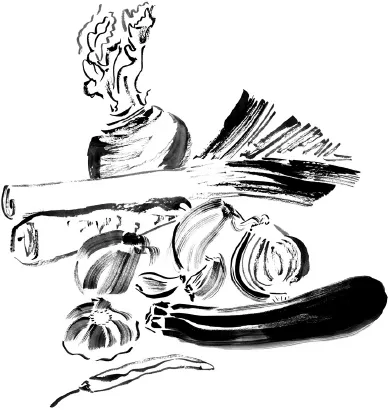
Although it is central to our particular traditions of chutneys, tracklements and sauces, and to the sharp pickles of chip shops and ploughman’s lunches, I think vinegar is perversely under-rated in the British kitchen, to the detriment not only of our own cuisine but also of our understanding of those of other countries. The Sicilian dish caponata, for example, which sits somewhere between a stew and a relish, is often described as merely a heavily seasoned ratatouille, a sun-swollen celebration of aubergine and capsicum; really, though, it is a showcase for vinegar, and can be made with almost any vegetable – such as celery, as I mentioned before – although the other main ingredient is patience. There is a tendency, I find, as with other apparently simple preparations of vegetables, to rush the making of caponata, to cook the whole lot together into one homogenous slop, when really each element should be prepared separately, then combined and left at a warm room temperature, the flavours allowed to mingle and penetrate parts which remain physically distinct.
There are three parts to a caponata, as with most things: the sauce, the vegetable and (for want of a better word) the garnish. Dice two or three onions, those same sweet white ones, as finely as you can, and sweat slowly in good olive oil along with a few cloves of plump garlic (and salt, of course), sliced thinly or crushed, until the whole begins to melt and combine. If this was a summer caponata, you would add tomatoes at this point, good ripe tomatoes cut into chunks, and let them collapse into a sauce, but since – as you’ll remember – this is a spring meal, the onion will form the whole of the bulk, so pay the appropriate attention to its cooking. With this in mind, you can get together the rest of the ingredients, such as they are: honey and vinegar and perhaps a little dried chilli. How much of these things you use is really up to you, especially if you are cooking with that homemade wine vinegar of uncertain strength, but there should be a fair amount of vinegar, say a couple of hundred millilitres or a decent glassful, and then enough honey for the sweetness to balance out the acid. Again, if we were making a summer caponata with its jumble of different ingredients, the glowing amber notes of honey might seem a little too much, and simple white sugar would take its place, but at the end of a long winter and with only a few other ingredients to jostle against, a good honey, which needn’t necessarily be set or runny or single-varietal, but should be good to eat on over-buttered toast, is just the thing. Use chilli if you want to add chilli, which you know better than me, and add the lot, sweet and sour and all, to the melting onions, letting the vinegar bubble and reduce for just a couple of minutes, to keep its raw edge.
So much for the sauce. The celery, which needs peeling if you think it needs peeling, should be cut into little squares about the size of a standard postage stamp, and then treated simply as if you were making almost any kind of meat stew, which is to say you should fry it in a hot pan, in batches and salting as you go, to ensure the chunks of vegetable brown rather than steam, removing each load with a slotted spoon when they are coloured all over, and adding a fresh splash of oil before the next batch goes in; it might seem strange to pay this much attention to a vegetable, but that is a simple matter of refocusing your brain a little or, to put it another way, reassessing your priorities. If you think, as many seem to, that animal protein tastes naturally more complex, more interesting, and essentially more delicious than any product of vegetable, fruit or fungus does, then it really makes sense to pay it less attention in the kitchen. If anything, it makes sense for the meat portion of your meal to be cooked either first, and allowed to braise on the back burner or in the oven, or last, seared over a fierce heat, while you devote the bulk of your time and concentration to the careful seasoning and cooking of supposedly bland vegetables.
That, at any rate, is what I tell myself when cooking pan after pan of neatly diced celery and scooping each load into the sauce waiting to one side off the heat but still warm. Two heads of celery take a surprisingly long time to cook in this way, and it is, I must admit, something of a relief when the process is complete and you can stir the sauce to dress each piece and put the whole lot to bed for the evening, or perhaps the morning, covered and left out of the fridge. A little time before lunch, or whenever you intend to eat your relish, you can begin to finish it off. It will definitely require a small handful of capers and the same of roughly chopped mint leaves, both of which go extremely well with celery and vinegar; it might also need a final adjustment of the levels of salt, sweetness and sour, all of which we experience differently when tasted at room temperature. Even if we had been using a commercially made vinegar, with its edges pasteurized out and its acidity and sweetness carefully regulated, its fresh kick when added cold is very different from the mellowness of its cooked taste, almost as different as it is from the bright tang of lemon juice, which might also be nice, added with a good pinch of sea salt left whole and coarse so you can feel the grains individually against your questing tongue.
I’m not entirely sure where all of this fits into our meal. Sometime before it really gets going, I suppose, caponata being well suited to the antipasto part of the meal, during which the Italians seem to consume most of their vegetables; it’s just as suited, though, to eating alongside a little oily fish, perhaps with the skin still bubbling from the heat of the grill. I’ve read that caponata always used to contain fish, chunks of sardine or mackerel cooked in the sour sauce in a similar manner to escabeche or sarde in saor, and its replacement with aubergine or celery was due only to the increasing poverty of the Sicilians as a succession of invaders and exploiters took the stunning cornucopia of the island and turned it into wealth kept hidden or far away from its inhabitants; this doesn’t seem entirely convincing to me. Although meat is scarcer in Sicily than it is in much of mainland Italy, and still seems to be associated with feast days, the islanders have no shortage of fish, especially oily ones, which they put in every conceivable place and preparation, stuffed like songbirds, tossed through pasta, melted into sauces, and as seasoning on pizzas and in denser breads; more likely, I think, is that caponata has always been a catch-all term for these sweet-and-sour preparations, whether of various vegetables or of seafood, and the fish variety has simply fallen out of fashion. People forget that the history of cuisine is influenced as much by the fickleness of taste as it is by the inexorable currents of history and economics – though where those tastes arise is another matter.
14
ON BOILING FEET AND BONES
Some things, of course, are beyond the rise and fall of fashion, and a look at the goodness, the rich thickness extracted in the long boil of soup- or stock-making, is enough to know that bones are one of them. It is easy to believe that bones, lying as they do in the depths of ourselves, are the repository of the soul, or at least of special, vitally animal instincts; we know things, as they say, in our bones, that even the flickering lizard brain has forgotten. Why do we venerate the broken bones of saints and of heroes? Why do we decorate grand halls, pubs, hotels and museums with those of deer, of rabbits and of dinosaurs? Practically, of course, it is because they are that which does not rot; our one hope, as fragile vertebrates, of immortality, beyond whatever ephemera we leave behind on the earth. Certainly the bones of the animals we use for food are the part of them that lasts the longest, and it is a shame that, for most home cooks, they are the part least likely to be seen, although fashion again seems to be turning against the neat, boneless segments of meat, barely identifiable as animal, which occupy the larger part of supermarket meat shelves and butchers’ counters. Every cook should be able to look at a carcass and, as T.S. Eliot said of Webster, ‘see the skull beneath the skin’ – see it, weigh it, and begin gathering ingredients.
Last summer, in the course of making a rather fine pie, I took four pigs’ heads and boiled them – really boiled them – with onions and carrots and all the usual accompaniments until the skin and flesh began to peel away from cartilage and tooth and bone, their plump, slightly smug faces dissolving into the water to reveal the lean, rangy skull; our fat Large Whites, long domesticated and bred for consistency, are still wild boar somewhere in their genes and in the bones beneath. As the flesh flaked off, first in chunks of skin and fat and then the nuggets of the cheeks and the surprisingly delicate tongue, I scooped out the chunks of meat, leaving the rest to boil for, as I remember, a day and a night. I was left with a milky elixir and, lurking resiliently in it, the bones. It has been common practice...
Table of contents
- Cover
- Title Page
- Copyright
- Dedication
- Contents
- Preamble
- On curing with salt
- On boiling and pickling with water
- On seasoning with water
- On fish and salt water
- On cooking fish in water
- On cooking fish in fire
- On boiling and not boiling vegetables
- On dressing greens with anchovy
- On the cooking of onions
- On wild and domestic celeries
- On almost frying
- On seasoning with salt and fat
- On cooking with wine and vinegar
- On boiling feet and bones
- On cooking flesh
- On the lives and deaths of rabbits
- On the preparation of rabbit
- On a version of rabbit ragù
- On eating
- On following recipes
- On cooking with blood and cooking with eggs
- On cheese and coffee
- On a final pinch of salt
- Acknowledgements
- Back Cover
Trusted by 375,005 students
Access to over 1.5 million titles for a fair monthly price.
Study more efficiently using our study tools.
Frequently asked questions
Yes, you can cancel anytime from the Subscription tab in your account settings on the Perlego website. Your subscription will stay active until the end of your current billing period. Learn how to cancel your subscription
No, books cannot be downloaded as external files, such as PDFs, for use outside of Perlego. However, you can download books within the Perlego app for offline reading on mobile or tablet. Learn how to download books offline
Perlego offers two plans: Essential and Complete
- Essential is ideal for learners and professionals who enjoy exploring a wide range of subjects. Access the Essential Library with 800,000+ trusted titles and best-sellers across business, personal growth, and the humanities. Includes unlimited reading time and Standard Read Aloud voice.
- Complete: Perfect for advanced learners and researchers needing full, unrestricted access. Unlock 1.5M+ books across hundreds of subjects, including academic and specialized titles. The Complete Plan also includes advanced features like Premium Read Aloud and Research Assistant.
We are an online textbook subscription service, where you can get access to an entire online library for less than the price of a single book per month. With over 1.5 million books across 990+ topics, we’ve got you covered! Learn about our mission
Look out for the read-aloud symbol on your next book to see if you can listen to it. The read-aloud tool reads text aloud for you, highlighting the text as it is being read. You can pause it, speed it up and slow it down. Learn more about Read Aloud
Yes! You can use the Perlego app on both iOS and Android devices to read anytime, anywhere — even offline. Perfect for commutes or when you’re on the go.
Please note we cannot support devices running on iOS 13 and Android 7 or earlier. Learn more about using the app
Please note we cannot support devices running on iOS 13 and Android 7 or earlier. Learn more about using the app
Yes, you can access First, Catch by Thom Eagle in PDF and/or ePUB format, as well as other popular books in Art & Culinary Arts. We have over 1.5 million books available in our catalogue for you to explore.