An exciting new strand in The Television Series, the 'Moments in Television' collections celebrate the power and artistry of television, whilst interrogating key critical concepts in television scholarship.
Each 'Moments' book is organised around a provocative binary theme. Sound / image reassesses the synergy between televisual images, and sounds and music, as a key creative interaction warranting closer attention. Through close scrutiny of visual and sonic elements, the book's chosen programmes are persuasively illuminated in new ways.
The book explores an eclectic range of TV fictions, dramatic and comedic. Contributors from diverse perspectives come together to expand and enrich the kind of close analysis most commonly found in television aesthetics. Sustained, detailed programme analyses are sensitively framed within historical, technological, institutional, cultural, creative and art-historical contexts.
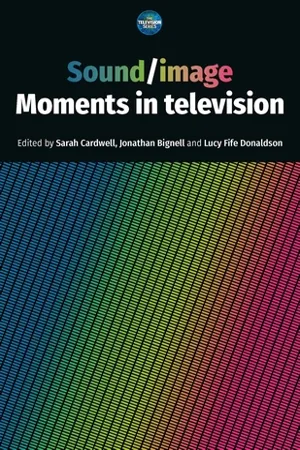
eBook - ePub
Sound / image
Moments in television
- 228 pages
- English
- ePUB (mobile friendly)
- Available on iOS & Android
eBook - ePub
Sound / image
Moments in television
About this book
Information
Subtopic
Television1
Alien or familiar: sounds and images in The Twilight Zone, ‘The Invaders’
Jonathan Bignell
This chapter analyses the unusual and expressive uses of both visual style and sound in an episode of the science fiction series The Twilight Zone, ‘The Invaders’ (CBS, 1961). The episode seems perhaps an odd choice for this volume because, although the use of unconventional, rhetorical camera work and visual design is common in the genre (Britton 2009) and offers much for a consideration of the role of the image, an important aspect of sound is not present at all. The episode has no dialogue, though it has some framing narration spoken direct to camera, and it has little music. Nevertheless, this chapter makes the case that the consequent rebalancing of the usual expressive means available to television is both innovative and compelling. The absence of sound becomes an occasion to think more precisely about what sound does, and by removing some of the usual functions of sound the episode allows us to question the customary hierarchy in which sound is a support for the image. Shifts in the viewer's knowledge of the fictional world depend on how image and sound manipulate our relationship with the female protagonist of ‘The Invaders’ in both conventional and unconventional ways. Her character, who is never named, is played by Agnes Moorehead, whose wordless performance is central to the episode's images and sound. In particular, sounds produced by her vocally, by her body movement and as a result of actions she initiates, as well as sounds coming from alien invaders and their technologies, carry an extraordinary weight because of the lack of other kinds of audio information. Framing narration at the opening and closing of the episode loads those passages of speech which are present with great significance because they are the only words that we see being spoken on-screen, identifying – and, crucially, misidentifying – the nature of the fictional world. In the main body of the episode, lack of the speech which would usually convey information, emotion and tone encourages the viewer to attend to images more intensely than usual, reading details of setting, costume, posture and facial expression for example, to make sense of the action.
In the episode, a middle-aged woman, living alone in a wooden cabin, is disturbed by strange sounds coming from her roof. Upon investigation, she finds a miniature flying saucer there, and two six-inch-high astronauts emerge from it and explore her house. She fights them off, and they defend themselves with miniature ray-guns and the woman's household objects, until she kills one and follows the other back to the spacecraft. She attacks the flying saucer with an axe, and inside it hears the American-accented voice of the second astronaut warning other travellers about the dangerous giants on this planet. She destroys the spacecraft, which is revealed to be a human-made, US-launched exploration ship. Related storylines had appeared in an earlier Twilight Zone episode, ‘Third from the Sun’ (1960), also written by the ‘Invaders’ screenwriter Richard Matheson, which began in a society on the verge of nuclear war from where the protagonists emigrate to another planet that is revealed to be Earth. The placing of human characters in a giants’ world was later the premise of Irwin Allen's Land of the Giants (1968–70) television series, and the idea had been explored in science fiction cinema in The Incredible Shrinking Man (1957), The Amazing Colossal Man (1957) and Attack of the 50 Foot Woman (1958). Whilst elements of ‘The Invaders’ had antecedents and subsequent versions in television and film, this chapter is concerned with the distinctive realisation of the idea in image, sound and performance across only twenty-four intense minutes of television screen time.
Rod Serling's narration, which introduces the series and the episode, and which is spoken in direct address and in vision after The Twilight Zone's surreal opening credit sequence, is a key sonic anchor for the episode and its tone. My analysis of sound begins with Serling's voice and his role as the series showrunner. Subsequently the chapter will assess the shifts in the viewer's knowledge of the fictional world that derive from the camera's relationship with Moorehead's character and the ‘invader’ astronauts. This relationship shifts from an initial alignment with her as vulnerable and humanly familiar, to increasing distance from her character during violent action sequences and as a result of the progression in her visual presentation, as she becomes increasingly dishevelled and vicious. Sound shapes and emphasises this by the strong distinctions between bodily sounds like chewing, panting or gasping on one hand, and the sounds of technological equipment like ray-guns on the other. The bodily sounds are those we would expect from a human protagonist, with whom we would be aligned as viewers, but the twist in the story is that the woman is the alien while the high-tech space travellers are the humans. Serling's framing narration at the opening allows this misidentification of her as human, and his closing narration at the end of the episode reflects on issues of physical scale (the ‘invaders’ are ‘tiny beings from the tiny place called Earth’) in a homily about the hubris of space exploration. So, a key aspect of this chapter's analysis is the manipulation of viewers’ knowledge in the episode, and the ways that visual style works with speech, diegetic sound and music to control this.
Format and experimentation
The Twilight Zone was an American anthology series of half-hour science fiction and fantasy dramas created and produced by Serling's production company Cayuga for the CBS network, broadcast from 1959 to 1964 (Abbott 2006). Its aesthetic innovation and interesting approaches to format and storytelling arise from the specific history of how the programme was made and organised. Serling had a showrunner or author-creator role in the series, with exceptional control over it as the owner of the production company and also its lead writer. He owned half of the intellectual property rights in the series, retaining ownership of the film negatives (rather than selling his product to a broadcaster) and had a contract that gave him writer credit for up to eighty per cent of its episodes (Presnell and McGee 1998). The Twilight Zone was one among the many anthology drama formats in US television of the 1950s and 1960s, but contrasted with the main programming diet offered by CBS. The network was locked in competition with NBC for ratings dominance throughout the decade (Brown 1998), with CBS generally leading by virtue of its filmed genre-based series like the rural comedy The Beverly Hillbillies (1962–71) and the Western Gunsmoke (1955–75). But whilst these successes had a consistent format comprising regular characters and settings, and a consistent approach to their respective genres, The Twilight Zone was a different story each week, with different characters and settings, and a key part of its offer to viewers was precisely its unpredictability. The extraordinary notion of a drama without dialogue, and with only one character, meant ‘The Invaders’ was, paradoxically, characteristic of the series because of its exceptionalism.
The climate of the time, in which the national networks vied for mass audiences by offering long-running filmed dramas with broad appeal, was not conducive to the speculations of science fiction or to stylistic innovation. Whilst CBS rhetoric sometimes suggested that it catered to the better-educated, young, white urban viewers who valued ‘serious’ drama in anthologies like The Twilight Zone (Alvey 2004), until the early 1970s this remained a claim rather than a reality. As William Boddy (1984) argues, Serling's work on filmed anthology series in Hollywood aimed to transfer prestige and seriousness from the single play to the genre series. There was a perception inside and outside the television industry in this period that live one-off plays, shot with electronic cameras rather than on celluloid film, were of higher creative value than filmed series. Serling aimed to demonstrate the seriousness and authorial creativity that could be achieved in filmed genre television, and he had a track record that underpinned this, having himself written many highly praised plays for live video production in the waning years of that form. Serling did not write ‘The Invaders’, but its daring repudiation of dialogue and scant music suited his ambitions for The Twilight Zone's aesthetic experimentation.
Serling was politically liberal, and critical discourse about his work has often supported his own contention that the fantasy genre permitted him and his contributing screenwriters to explore radical social and political ideas metaphorically and thus avoid network and sponsor interference (Engel 1989, Sander 1994, Beeler 2010). But Jon Kraszewski (2008) has shown by referring to archival documents that the CBS network was not averse to the political subtexts of Serling's television work, but instead concerned about the supply of storylines for his long-running series. Serling's initial attempts to privilege creative screenwriting over managerial producing, and to provide himself with the opportunity to write eighty per cent of Twilight Zone episodes, were largely a failure. He never managed to produce the series and also write most of it; he was forced to seek out screenwriters who could supply scripts to meet the demanding production schedule of a long-running series and he was driven to plagiarising published short stories for episode ideas, with consequent legal penalties. That was how ‘The Invaders’ came to be written by Matheson. However, Serling's achievement was to oversee a highly successful format for fantasy television, in which a widely varying range of free-standing fantasy narratives could be accommodated, such as the one discussed here. The failings of Serling's management of his factory of ideas left space for experiments like ‘The Invaders’.
Whilst the style, places represented and performances in Twilight Zone episodes could vary considerably, the demanding shooting schedule for filmed television required the use of a stable team of production staff (directors, designers and camera operators, for example) and extensive production facilities. The majority of the series’ episodes were made on monochrome 35 mm film (there was a brief attempt to cut costs by shooting on video), at a cost of about $50,000 each. They were shot in the interior soundstages and backlot sets at MGM studios in Hollywood, spaces that were generously sized, well-equipped technically and embedded in the studio's cinema production culture. The opportunities and expectations raised by the space of production are among the factors contributing to J. P. Telotte's (2010) argument that The Twilight Zone is ‘cinematic’, which I take in this chapter to be equivalent to a claim for quality and aesthetic interest (Mills 2013), and which I discuss in relation to what television could do in image and sound. In ‘The Invaders’ this means minute attention to the visual style...
Table of contents
- Cover
- Half-title page
- Series page
- Title page
- Copyright page
- Contents
- List of figures
- Notes on contributors
- The Television Series: general editors’ preface
- Moments in Television, the collections: editors’ preface
- Acknowledgements
- Introduction: sound / image
- 1: Alien or familiar: sounds and images in The Twilight Zone, ‘The Invaders’
- 2: Investigating Morse: detecting innovations in sound and image
- 3: Discordant vocals and blinding light: the moment of petrification in Children of the Stones
- 4: ‘Anything is possible now’: jazz music and images of the past in Stephen Poliakoff's Dancing on the Edge
- 5: Non-naturalist realism: sound and image in Alan Clarke's Road
- 6: Feeling sound: audiovisuality and the multisensory in David Lynch's Twin Peaks: The Return
- 7: Bodyguard: the rush of the ride
- 8: Tableaux at the end of the world: living pictures in The Walking Dead
- 9: Silence and faces in Mad Men
- Index
Trusted by 375,005 students
Access to over 1.5 million titles for a fair monthly price.
Study more efficiently using our study tools.
Frequently asked questions
Yes, you can cancel anytime from the Subscription tab in your account settings on the Perlego website. Your subscription will stay active until the end of your current billing period. Learn how to cancel your subscription
No, books cannot be downloaded as external files, such as PDFs, for use outside of Perlego. However, you can download books within the Perlego app for offline reading on mobile or tablet. Learn how to download books offline
Perlego offers two plans: Essential and Complete
- Essential is ideal for learners and professionals who enjoy exploring a wide range of subjects. Access the Essential Library with 800,000+ trusted titles and best-sellers across business, personal growth, and the humanities. Includes unlimited reading time and Standard Read Aloud voice.
- Complete: Perfect for advanced learners and researchers needing full, unrestricted access. Unlock 1.5M+ books across hundreds of subjects, including academic and specialized titles. The Complete Plan also includes advanced features like Premium Read Aloud and Research Assistant.
We are an online textbook subscription service, where you can get access to an entire online library for less than the price of a single book per month. With over 1.5 million books across 990+ topics, we’ve got you covered! Learn about our mission
Look out for the read-aloud symbol on your next book to see if you can listen to it. The read-aloud tool reads text aloud for you, highlighting the text as it is being read. You can pause it, speed it up and slow it down. Learn more about Read Aloud
Yes! You can use the Perlego app on both iOS and Android devices to read anytime, anywhere — even offline. Perfect for commutes or when you’re on the go.
Please note we cannot support devices running on iOS 13 and Android 7 or earlier. Learn more about using the app
Please note we cannot support devices running on iOS 13 and Android 7 or earlier. Learn more about using the app
Yes, you can access Sound / image by Sarah Cardwell, Jonathan Bignell, Lucy Fife Donaldson, Sarah Cardwell,Jonathan Bignell,Lucy Fife Donaldson in PDF and/or ePUB format, as well as other popular books in Media & Performing Arts & Television. We have over 1.5 million books available in our catalogue for you to explore.