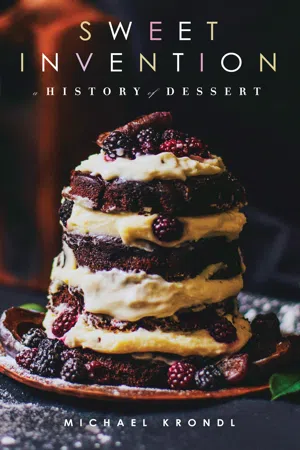
From the sacred fudge served to India's gods to the ephemeral baklava of Istanbul's harems, the towering sugar creations of Renaissance Italy, and the exotically scented macarons of twenty-first century Paris, the world's confectionary arts have not only mirrored social, technological, and political revolutions, they have also, in many ways, been in their vanguard.
Sweet Invention: A History of Dessert captures the stories of sweet makers past and present from India, the Middle East, Italy, France, Vienna, and the United States, as author Michael Krondl meets with confectioners around the globe, savoring and exploring the dessert icons of each tradition. Readers will be tantalized by the rich history of each region's unforgettable desserts and tempted to try their own hand at a time-honored recipe. A fascinating and rewarding read for any lover of sugar, butter, and cream,
Sweet Invention embraces the pleasures of dessert while unveiling the secular, metaphysical, and even sexual uses that societies have found for it.
In Kolkata, the air is always thick with poison and perfume but never more so than on the eve of Kali Puja, the holiday dedicated to Kali, the goddess of destruction and rebirth. That night, the atmosphere fills with the sulfurous plumes of rockets and exploding fireworks. The traffic that gives the city its insistent backbeat of honks and beeps crawls even more slowly than usual so that the noxious exhaust pools at the intersections instead of dissolving into the yellow air. Yet in the narrow alleys, the diesel fumes periodically give way to an altogether different smell, a sweet and sweaty scent that brings to mind breasts and mother’s milk. But it is a very Indian mother’s milk: musky, and perfumed with cardamom and rosewater. The odor oozes from thousands of sweetshops across the metropolis, where cauldrons of sweet cow’s milk and fat buffalo milk are boiled, simmered, curdled, and formed into sweetmeats for this holiday—and for the next.
For Kali Puja, block associations, sports clubs, and everyone else with the time and money put up pandals (temporary shrines). There are perhaps two thousand of these miniature temples set up around the city’s neighborhoods. Kali is everywhere. In a working-class enclave, where every street is bedecked with streamers of colored lights, the warrior mother towers above her temporary shrine, her blue, four-armed body surrounded by an electric violet halo of flowers and mandalas. A collection of fruit and sweetmeat offerings is arranged at her feet. Across town, on a busy commercial strip, the pandal almost blocks the sidewalk, while the black-skinned, naked goddess peruses the passersby, her blood-red tongue protruding as if in surprise. Next to a ferry pontoon dock tugged at by the mud-brown Hooghly River, the shrine is no bigger than a broom closet, yet this diminutive Kali looks pleased, perhaps because one of her acolytes has smeared her mouth with milky sweets.
At the Kalighat temple in south Kolkata, her devotees wait for hours to see her awesome countenance on her holiday. Kali’s most revered shrine is a relatively modest affair, a two-story-high ziggurat that sits at the end of a broad pedestrian street lined with stands selling devotional postcards and tourist gimcracks. As you get closer to the holy structure, there is that sweet, milky smell again, emanating from the shops that crowd around the temple’s two entrances. Here the stands sell just two things, garlands of Kali’s favorite flower, the blood-red hibiscus, and her beloved sweet, a concentrate of milk and sugar called pedha. The shopkeepers spend their day unhurriedly forming great mounds of sweet paste into disks about the size of a silver dollar, pressing a few grains of cardamom into each. The pilgrims, in their festive best, buy these by twos and threes to present to the deity. The vendors wrap each in a cone of leaves and garnish it with a hibiscus blossom. There is something primeval, even elemental, about the sweets—the dense, fudgy concentrate of almost pure fat, protein, and carbohydrate, almost like an emergency military ration or space food more than a sweetmeat. Ancient Hindu texts over two thousand years ago mention much the same sweet offering. The Indian gods are renowned for their sweet tooth. So are their people.
In West Bengal, Kali Puja comes fast on the heels of Durga Puja, a ten-day celebration held in honor of Durga, a sunnier mother goddess. Here too, the deity is regaled with sweetmeats. Her worshippers follow suit, sending boxes of sugary snacks to everyone on their list. Immediately after Kali’s festival comes Bhai Phota, or brother’s day. This, several confectioners tell me, is their busiest day of the year, for it isn’t merely brothers who are blessed with a present of sweets but any male in the vicinity.
Kali Puja also happens to coincide with Diwali, a five-day holiday celebrated throughout India. Diwali has many of the elements of Christmas. Presents are exchanged, and oil lamps (or more commonly these days streamers of electric “Christmas” lights) illuminate homes, businesses, and streets. But mostly people gorge on sweets. According to one study, Indians gain two to three kilograms around the time of Diwali.1 Children get little toys molded out of pure sugar while the adults go in for more elaborate preparations. These vary somewhat according to the region. There are puddings of various kinds. In north India, favorite items include kheer (elsewhere called payesh or payasam), a thick rice pudding with raisins and nuts, as well as other custardlike desserts thickened with wheat germ or almonds. Fritters are popular too. The most widely dispersed are jalebis, those violent yellow strands of tangled dough soaked in syrup. And everywhere there are laddus. To make this ubiquitous dessert, confectioners begin with a thinnish batter (typically based on chickpea flour, though there are variations that use sesame or semolina), which they dribble into hot butter to form little drops. These deep-fried drops, now looking a little like corn kernels, are then soaked in saffron-tinted sugar syrup. This is referred to as bonde. When formed into two-bite-sized balls it is called a laddu.
Even cattle aren’t left out of Diwali. In rural areas, farmers will feed their cows sweetmeats to mark the holiday.2 Needless to say, cows are holy to Hindus and so by extension are butter and milk. The holy texts of India’s most ancient religion are full of references to these sacred fluids. Ghee, or clarified butter, is considered especially precious.
DINING WITH GODS
Ghee is mentioned over and over in the sacred Hindu texts. In the Mahābhārata you read how the gods extracted the nectar of immortality from the deep ocean. This divine greasy fluid, called amrita, takes the form of ghee. The gods, led by Narayana (an avatar of the great god Vishnu), devise a way to get their hands on this ambrosia. They grab hold of a towering mountain, uproot it, and set it down on the immense shell of the tortoise king. Holding this mammoth contraption, they whirl it round and round, a little like a fantastical immersion blender that liquefies everything in its path: the beasts and fishes of the sea as well as the lions, elephants, and other unfortunate creatures are flung off the whirling mountain. Along the way, the trees and herbs and all their sap are churned into the milky sea. This gradually transforms the liquid into ghee, out of which emerges the divine Dhanvantari (yet another avatar of Vishnu) holding up a beaker filled with the liquid of life. The story doesn’t end there, for as the gods continue to churn the sea, poison emerges as well. But this is luckily taken care of by the god Shiva and all’s well that ends well. The gods are assured of their immortality.
Early holy texts are an invaluable source on the culinary tastes of ancient Indian gods and mortals alike. Some of the earliest references to food in India come from the religious poems and songs called the Vedas, which date back as far as 1000 BCE, if not earlier. Many more come from epic works like the Ramayana and Mahābhārata that detail the exploits of the Hindu pantheon. Like any good epic, these stories are full of sex, gore, betrayal, and redemption. There are also plenty of feasts and edible sacrifices.*
Hinduism isn’t a religion in quite the same way as Christianity or Islam. There is no Bible or Koran, or the equivalent of a Catholic mass or Friday prayers. There is no religious hierarchy. A priest, a Brahman, is any male who has been born into the priestly caste. India’s dominant faith is often called a path (dharma in Sanskrit), a way of life, and the details of that life are what really matter. In this context, food, with its rituals and taboos, is central, even if culinary customs do not strictly follow any universally accepted orthodoxy. Unlike in Jewish dietary law, say, where the taboos are highly codified, in India, rules about acceptable foods seem to float in a nebulous cloud of common consensus. Many of the restrictions are determined by class and caste, though age and marital status can come into it as well; Hindu widows, for example, traditionally followed an excruciatingly limited diet, devoid of seasoning or any other potentially “stimulating” flavor. Generally, an orthodox Hindu may only eat with his own caste; however, a lower caste member may always receive food from an upper caste member. It’s one reason why cooking has been the second most popular profession for a Brahman, since he was the only one whose food was acceptable to everyone.3
Contrary to common belief, upper-caste Hindus were not historically vegetarians, and even today the taboo against eating animal flesh is observed to varying degrees. Similarly with the gods. Some, like Kali, are regularly appeased by the sacrifice of a live goat, which is then ritually eaten by the participants.4 Many ceremonies involve food. One of the most basic forms of worship or puja is to present offerings of fruits, sweets, and other delicacies to the idols of the gods. (Puja can refer to both the ritual and the holiday.)
A family portrait of India’s gods can be bewildering to non-Hindus. At the center of the snapshot is four-headed Brahma, the creator. To one side is Shiva the destroyer outfitted in a tiger skin with a necklace of snakes. On the other side is blue-complexioned Vishnu, the preserver, with his wife, variously known as Uma, Parvati, Durga, Lakshmi, and Kali. Then there are their children Ayyappan, Subramanya, Ganesha, and others. But that’s just the nuclear family that fits in the camera frame. The extended clan of Hindu deities numbers in the thousands (or even millions), and, just to make it more confusing, some take on other incarnations or “avatars.” Still, most Hindus have an attachment to one, or at most a few, of their favorite deities.
Vishnu’s most notable avatar (there are ten in all), and certainly the best known in the west, is Krishna. There’s no end of stories told about this transcendent celebrity. In one oft-told tale, the baby Krishna was in mortal danger due to the machinations of his murderous uncle, who had usurped Krishna’s father’s rightful throne. To keep the infant safe, he was secreted away and deposited with a band of cowherds. There he soon grew fat and happy on all the milk and its by-products. He was known to sneak into the houses of milkmaids to steal butter for himself and his companions. In the south of India, you often see the chubby-cheeked baby Krishna with a pot of butter tucked under his left arm even while he nibbles on a ball of butter in his right hand. This taste for butter apparently never left him because there are countless sculptures, paintings, and cheap reproductions that show the now-svelte adolescent god dancing with the never-melting butter ball still in his grasp. According to popular belief, he also has a thing for laddus, presumably because they are fried in his favorite fat.
Each year in the northern Indian province of Uttar Pradesh, his followers celebrate Krishna’s birthday by abstaining all day from food. At midnight they break their fast with a feast of sweetmeats, predictably all based on dairy. Instead of birthday cake, there is bhog kheer, an ancient pudding made by simmering parboiled rice in fresh milk.* Another traditional dessert is shrikand, which is made by straining yogurt and flavoring it with sugar and cardamom, as it was twenty-five hundred years ago when it was called shikarini. Fudgy pedha is served too, much as it is in Kali’s temple.
But Krishna is a veritable ascetic compared with the rotund Ganesha, the affable god prayed to all over India for good fortune and success. He is instantly recognizable for his elephant head and fat belly. Ganesha is notorious for his sweet tooth. Inevitably you’ll see him holding at least one modaka or even a towering plateful of them in one of his palms. The modaka is a steamed (or fried) rice-flour dumpling stuffed with a mixture of unrefined sugar and coconut. One of the many anecdotes told about baby Krishna is how the elephant god introduced the tubby toddler to this, his beloved snack. Evidently Krishna’s mother had put an offering of modaka in front of a Ganesha idol, but, well aware of her young rascal’s thieving ways, she tied her son’s hands behind his back to keep the sweets safe. The good-hearted Ganesha would have none of this. The idol came to life and lifted the sweets with his trunk right into the happy infant’s mouth. Or, according to some versions, maybe what he gave him was actually a laddu. The confusion arises because in early Sanskrit, the term modaka refers to what is now called a laddu.5 In either case, I can’t see baby Krishna objecting. What’s more, Ganesha is not known for turning up his trunk at laddus either. At opposite ends of India, in both Rajasthan and Andhra Pradesh, laddus are regularly offered to the elephant god. In southern India, in the meantime, he supposedly prefers unni-āppam, a spongy fritter made of rice flour, plantain, jackfruit, and jaggery (raw palm sugar).
Ganesha’s gluttony is legendary. Hindu children are told the story of the elephant god who was returning one moonlit night from a banquet where he had stuffed himself with modakas. He had eaten so many sweets that he was fit to burst, quite literally. When he stumbled, his belly exploded, scattering the sweet dumplings across the forest. Miffed, the deity gathered them up and tied up his stomach with a snake. Seeing this, the moon, who had been watching the scene, couldn’t restrain himself and burst into peals of laughter. For once, the amiable Ganesha lost his temper, cursing the moon into eternal darkness. He was later convinced to relent, but even so he forced the moon to wax and wane as a reminder that it isn’t nice to laugh at a god, even a fat and jolly one.
It should be said that not every food presented to supernatural beings takes the form of a sweetmeat. There are gods who are happy with fruit. Others like a nicely spiced vegetable curry, while the more ferocious ones (like Kali) will need to be appeased with blood sacrifice. Some of the more unsavory gods even have a taste for alcohol, tobacco, and hashish.6 That said, most would rather go straight to dessert.
Accordingly, Hindu temples across India specialize in sweets. The Vishnu temple at Srīmushnam in the southern state of Tamil Nadu makes a sort of laddu from ground-up korai, a tuber that Varāha (the boar incarnation of Vishnu) apparently likes to root arou...
Table of contents
Cover
Title
Copyright
Contents
INTRODUCTION
1 SACRED FUDGE India
2 A THOUSAND AND ONE SWEET LAYERS Middle East
3 SUGAR AND SPICE Italy
4 LET THEM EAT CAKE France
5 SCHLAG AND STRAUSS Vienna
6 A DEMOCRACY OF SWEETNESS United States
FINALE CUPCAKES AND MACARONS
ACKNOWLEDGMENTS
NOTES
SELECTED BIBLIOGRAPHY
INDEX
Trusted by 375,005 students
Access to over 1.5 million titles for a fair monthly price.
Study more efficiently using our study tools.
Frequently asked questions
Yes, you can cancel anytime from the Subscription tab in your account settings on the Perlego website. Your subscription will stay active until the end of your current billing period. Learn how to cancel your subscription
No, books cannot be downloaded as external files, such as PDFs, for use outside of Perlego. However, you can download books within the Perlego app for offline reading on mobile or tablet. Learn how to download books offline
Perlego offers two plans: Essential and Complete
Essential is ideal for learners and professionals who enjoy exploring a wide range of subjects. Access the Essential Library with 800,000+ trusted titles and best-sellers across business, personal growth, and the humanities. Includes unlimited reading time and Standard Read Aloud voice.
Complete: Perfect for advanced learners and researchers needing full, unrestricted access. Unlock 1.5M+ books across hundreds of subjects, including academic and specialized titles. The Complete Plan also includes advanced features like Premium Read Aloud and Research Assistant.
Both plans are available with monthly, semester, or annual billing cycles.
We are an online textbook subscription service, where you can get access to an entire online library for less than the price of a single book per month. With over 1.5 million books across 990+ topics, we’ve got you covered! Learn about our mission
Look out for the read-aloud symbol on your next book to see if you can listen to it. The read-aloud tool reads text aloud for you, highlighting the text as it is being read. You can pause it, speed it up and slow it down. Learn more about Read Aloud
Yes! You can use the Perlego app on both iOS and Android devices to read anytime, anywhere — even offline. Perfect for commutes or when you’re on the go. Please note we cannot support devices running on iOS 13 and Android 7 or earlier. Learn more about using the app
Yes, you can access Sweet Invention by Michael Krondl,Michael Krondl in PDF and/or ePUB format, as well as other popular books in Art & Culinary Arts. We have over 1.5 million books available in our catalogue for you to explore.