- 146 pages
- English
- ePUB (mobile friendly)
- Available on iOS & Android
eBook - ePub
About this book
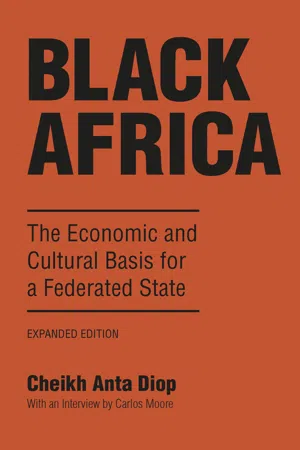
This expanded edition continues Diop's campaign for the political and economic unification of the nations of black Africa. It concludes with a lengthy interview with Diop.
Information
Part I
Historical Unity: The Restoration Of African Historical Consciousness
The time has come to draw practical conclusions from years of studying African problems, to sum them up in formulas that are as clear as possible and easy to apply.
Chapter One
Origins and History of the Black World
In all likelihood, present-day African peoples are in no way invaders come from another continent; they are the aborigines. Recent scientific discoveries that show Africa to be the cradle of humanity increasingly negate the hypothesis of this continent being peopled by outlanders.
From the appearance of homo sapiens—from earliest prehistory until our time—we are able to trace our origins as a people without significant breaks in continuity. In early prehistory, a great South-North movement brought the African peoples of the Great Lakes region into the Nile Basin. They lived there in clusters for millennia.
In prehistoric times, it was they who created the Nilotic Sudanese civilization and what we know as Egypt.
These first Black civilizations were the first civilizations in the world, the development of Europe having been held back by the last Ice Age, a matter of a hundred thousand years.
Beginning in the sixth century BC (525, when Cambyses occupied Egypt) with the end of the independence of the great Black power base, the African peoples, until then drawn to the Nile Valley as by a magnet, fanned out over the continent. Perhaps they then came upon small pockets of populations descended from paleolithic or neolithic infiltrations.
A few centures later, around the first century, they founded the first of the continental civilizations in the West and South: Ghana, Nok-Ifé, Zimbabwe and others.
We now know, thanks to radiocarbon methods, that the earliest sites in Zimbabwe do date back at least as far as the first century of the Christian Era. On the east coast of Africa Roman coins have been discovered at the port of Dunford as well as in Zanzibar, indicating a flourishing sea trade.
The first Nigerian civilization, which Bernard and William Fagg named the Nok civilization, has been traced back to the first millennium BC, the ceramics found there being radiocarbon-dated over a range from 900 BC to 200 AD. The Tarikh es-Sudan tells us that the city of Kukia, on the Niger, former capital of Songhay before Gao, was contemporaneous with the time of the pharaohs. However that may be, we do know with certainty that in the eighth century AD the Empire of Ghana was already in existence, extending over all of West Africa, right to the Atlantic. So we can see that the African states of the Middle Ages had come into being practically when Egyptian-Sudanese antiquity came to its close. The Nilotic Sudan was finally to lose its independence only in the nineteenth century, and its old eastern province of Ethiopia would retain its identity until the Italian occupation of 1936, barring which, it never lost its independence. That being the case, Ethiopia is in point of fact the oldest state in the world. Ghana lasted from about the third century AD until 1240, to be succeeded by Mali from that date to 1464 (accession of Soni-Ali, founder of the Songhay Empire).
The dismembering of these nations was effectively completed in the nineteenth century by the European occupation of Africa. The breaking-up went on apace; what we saw then were tiny kingdoms, each jealous of its own independence, such as those of Cayor in Senegal conquered by General Louis Faidherbe under Napoleon III after a fierce resistance. The kingdoms of East Africa with trading cities on the coast prospered from the end of classical antiquity until the fifteenth and sixteenth centuries when they fell to the Portuguese. These kingdoms maintained a lively trade with India, Siam, and the Chinese Far East, evidenced both by chronicles and by Chinese potteries found there. It is hard for us today to picture the opulence of the authentically Black trading centers of that period. Father Gervase Mathew, of Oxford, in relating Swahili tradition mentions that in these cities there were silver staircases leading to beds of ivory. Such luxurious furnishing are barely imaginable today. The houses, built of stone, rose to five or six stories. The people were authentic jet-black Africans. Their women had shaven heads as in Ghana.
These civilizations were overthrown by the Portuguese who, in the sixteenth century, altered the old trade routes and sea lanes of the Indian Ocean. The conception of African history just briefly sketched is today to all intents and purposes accepted and endorsed by scholars:
Black African culture set for the whole world an example of extraordinary vitality and vigor. All vitalist conceptions, religious as well as philosophic, I am convinced, came from that source. The civilization of ancient Egypt would not have been possible without the great example of Black African culture, and in all likelihood it was nothing but the sublimation thereof.1
The history of the Nilotic Sudan, Egypt and present-day Ethiopia is well known. Until recently, however, the past of West Africa was related quite summarily. We have felt it necessary to bring this past to life through documents we have had at our disposal and by establishing a sociohistorical analysis covering two thousand years.
The old political, social and economic organization of Black Africa over those two thousand years, the military, judicial, and administrative apparatus, the educational set-up, the university and technical levels, the pomp and circumstance of court life, the customs and mores—all details which had been presumed lost in the deep dark past—we were able to bring strikingly and scientifically back to life, especially insofar as West Africa was concerned, in L’ Afrique Noire pré-coloniale (Pre-Colonial Black Africa).2
A similar work should be undertaken for the Benin-Ifé civilization. What would be of special interest there would be the fact that even in its ideological superstructure the civilization of Benin borrowed nothing from either the Semitic or the Aryan worlds. On the other hand, it does display a close relationship with ancient Egypt, as might be expected: Its art, in a certain measure, represents African sculptural classicism.
The same kind of exhumation and revivification work on our history for the period from antiquity to the present can and must be undertaken in a systematic way for all of eastern, central, and southern Africa.
Egyptian, Greek, Roman, Persian, Chinese, and Arabic documents known to exist and with what archeology may add to them allow this to be done in large measure. Nowhere in African history are there holes that cannot be filled in. The empty spaces are only temporary, and the period that affects us runs without a break from Egyptian-Sudanese antiquity and fits right in sequence.
So, historical consciousness is properly restored. The general framework of African history is set out. The evolution of peoples is known in its broad lines, but the research already begun will have to be continued in order to fill the small gaps that still exist, thus reinforcing the framework. One can no longer see “darkest Africa” set against a “deep dark past”; the African can clearly follow his evolution from prehistory to our own day. Historical unity has become manifest.
The psychological unity existing for all those who inhabit the Dark Continent, and which each of us feels, is an elementary fact that needs no demonstration.
Geographical unity likewise is obvious, and it necessarily implies economic unity. The latter is what we shall discuss in the pages devoted to the industrialization of Africa.
A consideration of the structure of the precolonial African family, that of the State, the accompanying philosophical and moral concepts, and the like, reveals a consistent cultural unity, resulting from similar adaptations to the same material and physical conditions of life. This was the subject of my L’Unité culturelle de l’Afrique Noire (The Cultural Unity of Black Africa).3
There is also a common linguistic background. The African languages constitute one linguistic family, as homogeneous as that of the Indo-European tongues. Nothing is easier than to set down the rules that allow transfer from a Zulu language (Bantu) to one of those of West Africa (Serer-Wolof, Peul), or even to ancient Egyptian (cf. L’Afrique Noire pré-coloniale, Part II). However, the old imperial languages, Sarakole in Ghana, Mandingo in Mali, Songhay in Koaga (Gao), have had their areas of extension sharply reduced today. At the apogee of these African empires, the imperial tongues, the languages of trade and government affairs, were the African languages themselves; even after the advent of Islam, Arabic always remained only the language of religion and erudition, as did Latin in Europe of the same period.
With European occupation in the nineteenth century the official African languages were replaced by those of the various “mother countries.” Local dialects surfaced and vied against the older national cultural languages which had virtually submerged them. It became less and less necessary for civil administration, politics or social intercourse to learn the latter. The demands of daily life required learning the European languages; the disrepute of the old linguistic unities in our day reached its depth.
While we may be able to build a Federated African State covering all of the Black Continent on the basis of historical, psychological, economic and geographical unity, we will be forced, in order to complete such national unity and set it on a modern autochthonous cultural base, to recreate our linguistic unity through the choice of an appropriate African tongue promoted to the influence of a modern cultural language.
Linguistic unity dominates all national life. Without it, national cultural unity is but fragile and illusory. The wranglings within a bilingual country, such as Belgium, illustrate the point.
Chapter Two
Linguistic Unity
1. Choice of Language on a Local Scale in the Framework of a Given Territory
Let us take Senegal as an example. Before any choice could be made, the kinship of the various tongues spoken in Senegal had to be demonstrated—which may not be as easily done in other territories. By setting out linguistic rules that would allow passage in a systematic way from Wolof forms to Serer, Peul-Toucouleur and Diola we demonstrated the deep kinship uniting the various segments of the Senegalese population.
The importance of this demonstration is that it shows us a kinship the ignorance of which had kept alive until the present local particularities (Serer, Diola or Toucouleur) at times as effectively uniting as mini-nations. Quite objectively, in a country such as Senegal, Wolof is the obvious choice for a national language, a language of government: All minorities are nearly bilingual, speaking Wolof in addition to their primary language. It can be seen that within the local context cultural languages, such as Peul-Toucouleur, fall into the class of minority groupings, whereas it is quite another matter in regions such as, say, Futa-Jallon or the Northern Cameroons.
2. Elevation of the Selected Language to the Level of a Modern Cultural and Government Language
It is in Wolof that researchers today are trying systematically to introduce all the concepts required to convey the exact sciences (mathematics, physics), philosophy and so on. An appropriate Senegalese government will one day apply a cultural policy aimed at favoring the development of the language in optimal order. It will be necessary to use artificial but effective methods, such as founding literary prizes, translating scientific works, creating a national commission to draw up an academic dictionary and various specialized ones (for mathematics, physics, philosophy, and so on).
Even now, we must start such work on a limited scale, in order to show once and for all that it is indeed possible to raise an African language to the prestige of any of the European cultural languages. What has so far been done and continues in this regard in Wolof has only exemplary value. Similar work must be judiciously carried out in the framework of each territory. The same criteria of selection will have to be applied in determining the territorial language with the same delicate study beforehand of linguistic, ethnic and other considerations in order to reduce any possibility of offending regional sensibilities.
As quickly as possible Wolof should become the language of government used in public and political documents and acts: parliamentary debate, drawing up of the constitution and legal code.
Until now, we have been in a period in which knowledge of the colonizing power’s language was a prerequisite for holding any public office, especially that of deputy or legislator. Participating in debate in the French parliament made this indispensable. It is a paradox to continue such a state of affairs in any given African state. The major part of the population in any territory is still totally without knowledge of French; one can see that to elect people’s representatives on outmoded criteria is patently inadequate and unjust. Using the colonizer’s language is a convenient way to avoid facing the true complaints of the population, who may be illiterate but are not without good sense.
3. Choice of Language on a Continental Scale
When our demonstrations in Wolof have gone far enough, they will have proved that in due time it will be possible appropriately to choose one of the major African tongues and promote it to the level of sole governmental and cultural language for the entire continent. It will cover all territorial languages in the same way that Russian is overlaid on the language of each Socialist Republic within the Soviet Union.
The choice of such language will have to be made by a competent interterritorial commission imbued with deep patriotic feeling foreswearing any hidden chauvinism.
The language thus selected will at first be taught in the secondary schools of all territories, just as if it were an obligatory foreign language in the curriculum. Then, as textbooks on various subjects are completed in this language and adopted in high schools and colleges, the continental language will take the place of European languages as the vehicle for our modern national culture. European languages will not disappear from out schools but will progressively drop back to the position of elective foreign languages learned on a secondary-school level. A citizen of any given territory will be obliged to learn to speak fluently the continental language, while still being able to get secondary and even higher education in the territorial tongue.
Black writers and artists at their Rome convention (Easter, 1959) and the Federation of African Students in France at its July, 1959, seminar at Rennes, both officially adopted this view of the necessity and character of linguistic unity.1
During the transitional period, European languages will continue to be used, but that situation must not be allowed to endure too long, lest it eventually turn Africa into a super-Switzerland. There is nothing to be gained by urging simultaneous perpetuation of French, English, Portuguese, Spanish and Afrikaans, and why opt for exclusive use of either French or English?
We must remain circumspect about subtle efforts to Anglo-Americanize Black Africa, considering how many of the colonies were formerly British. The joint efforts of Great Britain and of the United States especially run counter to established “intellectual” habits and suggest to former French, Portuguese, Spanish, or other colonies that they ought to opt for English, so as to make that tongue the lingua franca of the whole continent. Linguistic unity based on a foreign language, however one may look at it, is cultural abortion. It would irremediably eventuate in the death of the authentic national culture, the end of our deeper intellectual and spiritual life and reduce us to perpetual copycats, having missed out on our historical mission in this world. Anglo-Saxon cultural, economic, social and even political hegemony would thereby be permanently guaranteed throughout Black Africa. We must remain radically opposed to any attempts at cultural assimilation coming from the outside: none is possible without opening the way to the others.
One might say that it makes no difference to a Wolofspeaking African whether he adopts Zulu or English or Portuguese. This is just not so. An African educated in any African language other than his own is less alienated, culturally speaking, than he is when educated in a European language which takes the place of his mother tongue. Likewise, a Frenchman who got an Italian education would be much less alienated than if inculcated with Zulu or Arabic in place of French. Such is the disparity in cultural interest which exists between European and African languages—something we must never lose sight of.
European languages must not be considered diamonds displayed under a glass bell, dazzling us with their brilliance. Our attention must rather be fixed on their historical development. Creatively, we discover that similar paths are open to all.
The influence of language is so great that the various European mother countries feel they can afford to withdraw politically from Africa without great loss as long as their (linguistic) presence remains in the economic, spiritual and cultural spheres. They assume that onetime colonies will officially retain the colonizer’s language; anything else would be disap...
Table of contents
- Cover Page
- Title Page
- Copyright Page
- Contents
- Foreword to the English Edition
- Introduction
- Part I Historical Unity: The Restoration of African Historical Consciousness
- Part II Compendium of Energy Sources
- Part III The Industrialization of Black Africa
- Conclusion
- Appendix: Interviews with Cheikh Anta Diop
- Footnotes
Trusted by 375,005 students
Access to over 1.5 million titles for a fair monthly price.
Study more efficiently using our study tools.
Frequently asked questions
Yes, you can cancel anytime from the Subscription tab in your account settings on the Perlego website. Your subscription will stay active until the end of your current billing period. Learn how to cancel your subscription
No, books cannot be downloaded as external files, such as PDFs, for use outside of Perlego. However, you can download books within the Perlego app for offline reading on mobile or tablet. Learn how to download books offline
Perlego offers two plans: Essential and Complete
- Essential is ideal for learners and professionals who enjoy exploring a wide range of subjects. Access the Essential Library with 800,000+ trusted titles and best-sellers across business, personal growth, and the humanities. Includes unlimited reading time and Standard Read Aloud voice.
- Complete: Perfect for advanced learners and researchers needing full, unrestricted access. Unlock 1.5M+ books across hundreds of subjects, including academic and specialized titles. The Complete Plan also includes advanced features like Premium Read Aloud and Research Assistant.
We are an online textbook subscription service, where you can get access to an entire online library for less than the price of a single book per month. With over 1.5 million books across 990+ topics, we’ve got you covered! Learn about our mission
Look out for the read-aloud symbol on your next book to see if you can listen to it. The read-aloud tool reads text aloud for you, highlighting the text as it is being read. You can pause it, speed it up and slow it down. Learn more about Read Aloud
Yes! You can use the Perlego app on both iOS and Android devices to read anytime, anywhere — even offline. Perfect for commutes or when you’re on the go.
Please note we cannot support devices running on iOS 13 and Android 7 or earlier. Learn more about using the app
Please note we cannot support devices running on iOS 13 and Android 7 or earlier. Learn more about using the app
Yes, you can access Black Africa by Cheikh Anta Diop in PDF and/or ePUB format, as well as other popular books in History & African History. We have over 1.5 million books available in our catalogue for you to explore.