This book locates the philosophy of Ubuntu as the undergirding framework for indigenous dance pedagogies in local communities in Uganda. Through critical examination of the reflections and practices of selected local dance teachers, the volume reveals how issues of inclusion, belonging, and agency are negotiated through a creatively complex interplay between individuality and communality. The analysis frames pedagogies as sites where reflective thought and kinaesthetic practice converge to facilitate ever-evolving individual imagination and community innovations.
eBook - ePub
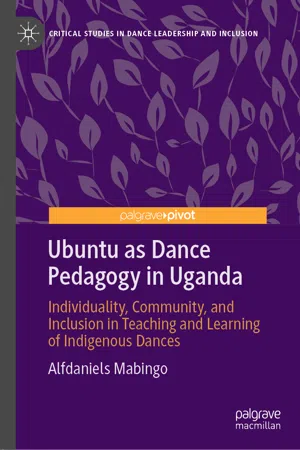
Ubuntu as Dance Pedagogy in Uganda
Individuality, Community, and Inclusion in Teaching and Learning of Indigenous Dances
- English
- ePUB (mobile friendly)
- Available on iOS & Android
eBook - ePub
Ubuntu as Dance Pedagogy in Uganda
Individuality, Community, and Inclusion in Teaching and Learning of Indigenous Dances
About this book
Information
Subtopic
Dance© The Author(s) 2020
A. MabingoUbuntu as Dance Pedagogy in UgandaCritical Studies in Dance Leadership and Inclusionhttps://doi.org/10.1007/978-981-15-5844-3_11. Introduction and Overview of the Book
Alfdaniels Mabingo1
(1)
Makerere University, Kampala, Uganda
Abstract
This chapter provides a general overview of the different sections and the key themes that this book covers. The introduction covers the key issues and experiences that motivated the author to write this book. The chapter highlights continued exclusion of Indigenous Ugandan dances from academia, research, and practices as one of the factors that inspired the writing of the book. The author weaves these issues together with his extensive experience of learning, creating, performing, and teaching Indigenous dances in different communities in Uganda to argue for integration of Indigenous dance epistemologies in literary spaces. With the case of Indigenous dances fully developed, the author introduces the reader to the thematic ideas that each chapter of the book examines.
Keywords
Indigenous dancesUgandaCommunityPracticeDance performanceDance educationWhen I was growing up in my ancestral village, Mbuukiro, central Uganda on the shores of Ennyanja Nalubaale (Lake Victoria), dance and music were part of daily life. Children’s dances, lullabies, folksongs, games, and musical instrumentation formed a passageway through which I entered the world and made meanings out of it (See Snipe, 1998). I remember seeing my mother, Joyce Nakawombe, singing lullabies to my young siblings. I thought it was just play and entertainment. Sometime we would join Maama (as we refer to my mother) to sing the lullabies. Music, games, and dances became another womb that housed, protected, and galvanized us. We never sang or played or danced alone. We were always a community. At our house, we had a small radio, which was only accessible to my parents. Listening to music from the radio was farfetched for us—children. We had to devise means of making the music and be that music. As children, we celebrated songs, movements, games, and instrumental music to find answers to our curiosities, respond to the inner sense of creativity, understand our world, and value and connect with the being of others. Learning, whether from adults or fellow children, was participatory, exploratory, relational, and reflective. It was an experience of constructing meanings of the world, not just an instinctive act of communal cultural and creative conformism and mimicry. Through interhuman pedagogies, dance and music scaffolded me through different life experiences. Music and dance were integral to my sense of existence. Our motto was that a fellow creator in the family and in the village is a friend indeed. We sang when we were fetching water. We danced when we were going to fetch firewood. I whistled when I was grazing cows and goats. I sang when I was sweeping the compound. We danced on our way to school. We would take breaks from gardening to play kazoos. We imitated birds with vocal melodies. We were children creating our own universe. Our creativity and search for novelty was rooted in our ability to imagine, think, do, share, create, express, collaborate, and reinvent. I have always argued that Ubuntu cannot be taught in formal and semi-formal settings. A person is born into Ubuntu. Ubuntu is a lived experience and reality that a person in African Indigenous communities is oriented into before he or she is born. My childhood life exemplified the true meaning and being of Ubuntu: I am because we are and because we are therefore I am.
During this period of my life in the village, I never got an opportunity to academically rationalize the value of dance to my being and existence. When I met fellow students at a boarding middle school who danced differently than me, I started to question the thing called ‘dance’. This is when the reality of cultural diversity and difference dawned on me: our dances were different and our cultures were diverse. At school, Indigenous dances were not encouraged. Many fellow student despised these practices and those who took pride in practicing them. I felt so removed from my village life. Coupled with these middle school encounters are the history books that I read, which revealed to me that early missionaries and colonial administrations banned Indigenous African communities from practicing Indigenous dances and music. My curiosity about the place and value of Indigenous dance in our society and civilization grew further. This book exemplifies my continued search for value, validity, essence, and relevance of Indigenous dance education and pedagogic practices and their implication for local and global scholarly discourses in the ever-changing world.
Over the years, I have studied dance, taught dances, and given presentations in different countries in Europe, North America, Africa, Asia, and the Caribbean. I have also read extensively about dance scholarship, theory, research, and practice. From this exposure, I have discovered that dances from African cultures are still treated as a peripheral subject in academia, research, and practice inside Africa and in global environments. Commonly, these dances are deconstructed with antiquated homogenizing, devaluing, objectifying, marginalizing, dismembering, and exoticizing tokenisms and interpretations (Mills, 1997; Monroe, 2011; see also Gottschild, 2003). How come then that the dance traditions and knowledges, which are so rich, are confined to the fringes of scholarly conversations? Why is it that the complex and diverse dances in African cultures are categorized under the homogenizing labels ‘African dance’ and ‘world dance’ yet other dance forms such as those from Euro-American traditions are identified, taught, and valued as distinct genres worth in-depth analysis? What knowledge is imbedded in dances in African communities, which can position them as epistemological and ontological subjects worth scholarly inquiry, and not just physical exotic objects? How do individuals and communities in Africa leverage their Indigenous dance to interrogate issues of community, inclusion, diversity, and individuality? How do dance practices intersect with Indigenous philosophies to accord people the meaning of being, knowing, thinking, connecting, doing, and becoming? These questions provoked the intellectual labor that culminated into this publication. In this book, I interweave the complex voices of multiple teachers of Indigenous dances and the critical perspectives to develop the analyses. The narratives that are unveiled in this book are extracted from the dance teachers’ memories of their journeys into Indigenous dances and their lived and embodied experiences of developing and applying pedagogies of these dances. I wrote this book at a time when Uganda was undergoing the most profound political, economic, and sociocultural transformation, driven by innovation, advancement in communication and information technology, and cultural exchanges. These changes have had implications for Indigenous dances. This book is a snapshot into phenomena that is complex and evolving.
This book draws on pedagogic constructions of selected teachers of Indigenous dances and the philosophy of Ubuntu to unveil the complex epistemological foundations underlying Indigenous dance education practices. The discussion reveals pedagogic applications and practices of dances teachers who facilitate Indigenous dance activities in nonacademic environments in Uganda. The environments include faith-based communities, nongovernmental organizations, children and youth gathering centers, rural communities, and orphanages, among others. The complexities embedded in the teachers’ rationalizations of the pedagogical epistemologies and philosophies of Indigenous dances are interrogated. Sitting at the intersection of Ubuntu philosophy and pedagogies of Indigenous dances, the analyses unveils how individuality, community, diversity, inclusion, and agency are negotiated in teaching and learning processes. The discussion navigates how the dance pedagogies act as a system of knowing, framework of thinking, process of becoming, medium of connecting, and mechanism of doing. The book expresses that the pedagogy of Indigenous dances is not a single homogeneous story. Pedagogy is deconstructed as a complex inclusive, individualized, storied, musicalized, participatory, reflective, and communalized process and experience undergirded by the Ubuntu worldview. Through pedagogy, local individuals and communities initiate and participate in extensive artistic, educational, and performative activities and initiatives, which seek to contribute to the sustainability and resilience of local cultural innovation and production.
The views covered in this book disclose that Indigenous dances are phenomena that keep evolving depending on the ever-changing social, cultural, and economic shifts in communities. The analyses denote how individual teachers of Indigenous dances position their pedagogies within the environments where issues of identity, belonging, culture, and inclusion are becoming more complex. An internalization of how Ubuntu philosophy functions as the underlying thread within these evolving pedagogic frameworks is made. Teaching and learning processes of Indigenous dances such as Baakisimba-Nankasa-Muwogola, Mwaga, Kizino, Runyege, Ntogoro, Bwola, Akogo, Kitaguriro, Maggunju, Gaze, Mbaga, Otole, and Larakaraka/Lamokowang,1 which originate from varied ethnic communities in Uganda, are used as a reference to deconstruct themes related to pedagogy. In using these dances a frame of analysis, I recognize that there are other diverse dances from Ugandan Indigenous communities with sociocultural and spiritual significance.
The publication comes at a time when diversity as an organizing principle of society and difference as a source for diversified novelty are being eroded by the growing sense of nativism and nationalism. To counter this trend, communities are increasingly engaged in advancing social inclusion agendas within diverse parts of the world. This piece of work amplifies voices that are seeking space in the ongoing conversation on how issues of inclusion, diversity, community, and individual difference can be harmonized in embodied, storied, participatory, and reflective ways. The diverse voices and ideas that are presented in this book are a commitment to the agenda of pluralizing and provoking debates in dance and its associated disciplines. This body of knowledge is also resourceful to artists, arts organizations, students, teachers, policymakers, tertiary institutions, and individuals as it provides valuable viewpoints on issues of community development, inclusion, education, and diversity.
Chapter 2 discusses how Indigenous dance practices in Uganda have transformed. A brief discussion is made on how the Indigenous dances in the precolonial period constituted the sociocultural, political, and spiritual identities of individuals and communities, which was disrupted during colonialism. Coverage is made of how Christianity and colonial systems diminished the value, relevance, and position of Indigenous dances in Indigenous communities. The chapter goes further to explore how local communities embarked on reviving and reinventing the Indigenous dances in postcolonial contexts such as schools, churches, dance troupes, universities, nongovernmental organizations, and other local and global platforms of practice.
In Chapter 3, the subject of Ubuntu worldview is critically theorized against the backdrop of African philosophy. An explanation is made on how different communities in Africa leverage Ubuntu to guide the ways through which people share, generate, distribute, and organize knowledge. The chapter further examines how the Ubuntu aphorism ‘I am because we are and because we are therefore I am,’ frames how Indigenous people identify, construct realities, and structure their knowing, becoming, thinking, and doing. Particularly, the concept of Ubuntugogy as an organizing framework of teaching and learning is discussed. The interaction between individuality and community and how this extends into Indigenous dances and practices is analyzed.
Chapter 4 explores biographical information of the teachers of Indigenous dances that participated in the research study that culminated into this book. The discussion maps the cultural, academic, pedagogic, and social pathways that these dance teachers have taken in the field of dance. The complex stories of each dance teachers are unveiled. An explanation of how the dance journeys of the dance teachers have framed their rationalization of dance and construction of dance pedagogies and teaching philosophies is given.
The discussion in Chapter 5 examines the complexities in contexts and meanings of Indigenous dance practices in Uganda. Drawing on the dance teachers’ experiences of learning Indigenous dances, the discussion looks at how environments such as home environments, village communities, schools, universities, and dance troupes shape the meanings that individuals construct about the Indigenous dances. Issues such as individuality, community, inclusion, interdependences, and agency and how they are activated in the pedagogies are critically deconstructed through the prism of Ubuntu philosophy. The analysis discloses the meanings that the teachers of Indigenous dances have constructed from partaking in dance activities in the different contexts in local communities in Uganda.
Chapter 6 discusses the complex pedagogic applications by teachers of Indigenous da...
Table of contents
- Cover
- Front Matter
- 1. Introduction and Overview of the Book
- 2. Historical, Sociocultural, and Political Contexts of Indigenous Dance Practices in Uganda
- 3. Ubuntu, Indigenous Communities, and Dance Practices in African Cultures
- 4. Biographic Complexities of Selected Indigenous Dance Teachers in Uganda
- 5. Contexts and Meanings of Indigenous Dance Education Practices
- 6. Individuality, Community, Inclusion, and Agency in Indigenous Dance Pedagogies
- 7. Music as a Pedagogic Aid in Indigenous Dance Education
- 8. Diversity, Interethnicity, and Inclusion in Indigenous Dance Pedagogy
- 9. Practice, Pedagogy, People, Process, and Participation (P5): Inclusion and Agency in Indigenous Dances
- 10. Implications of Ubuntu as Pedagogy for Local and Global Education
- 11. Model of a Dance Class Undergirded by Ubuntu Philosophy
- Back Matter
Trusted by 375,005 students
Access to over 1.5 million titles for a fair monthly price.
Study more efficiently using our study tools.
Frequently asked questions
Yes, you can cancel anytime from the Subscription tab in your account settings on the Perlego website. Your subscription will stay active until the end of your current billing period. Learn how to cancel your subscription
No, books cannot be downloaded as external files, such as PDFs, for use outside of Perlego. However, you can download books within the Perlego app for offline reading on mobile or tablet. Learn how to download books offline
Perlego offers two plans: Essential and Complete
- Essential is ideal for learners and professionals who enjoy exploring a wide range of subjects. Access the Essential Library with 800,000+ trusted titles and best-sellers across business, personal growth, and the humanities. Includes unlimited reading time and Standard Read Aloud voice.
- Complete: Perfect for advanced learners and researchers needing full, unrestricted access. Unlock 1.5M+ books across hundreds of subjects, including academic and specialized titles. The Complete Plan also includes advanced features like Premium Read Aloud and Research Assistant.
We are an online textbook subscription service, where you can get access to an entire online library for less than the price of a single book per month. With over 1.5 million books across 990+ topics, we’ve got you covered! Learn about our mission
Look out for the read-aloud symbol on your next book to see if you can listen to it. The read-aloud tool reads text aloud for you, highlighting the text as it is being read. You can pause it, speed it up and slow it down. Learn more about Read Aloud
Yes! You can use the Perlego app on both iOS and Android devices to read anytime, anywhere — even offline. Perfect for commutes or when you’re on the go.
Please note we cannot support devices running on iOS 13 and Android 7 or earlier. Learn more about using the app
Please note we cannot support devices running on iOS 13 and Android 7 or earlier. Learn more about using the app
Yes, you can access Ubuntu as Dance Pedagogy in Uganda by Alfdaniels Mabingo in PDF and/or ePUB format, as well as other popular books in Media & Performing Arts & Dance. We have over 1.5 million books available in our catalogue for you to explore.