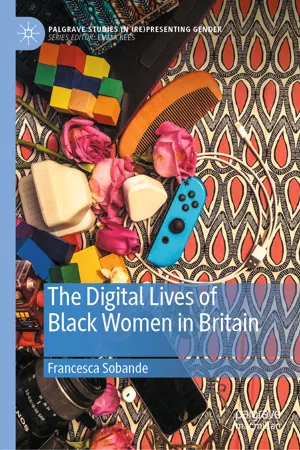
How is digital media implicated in the lives of Black women in Britain? In what ways do such digital experiences involve forms of creativity and cultural production? How are the intersections of anti-Black racism, sexism, and capitalism connected to this? What is the ‘digital’ in the lives of Black women in Britain, and how can it be both a source of joy and pain? How and why are Black women often identified as digital ‘trendsetters’, while being both erased and hyper-visible as creators, knowledge-producers, and social movement builders? These questions buttress The Digital Lives of Black Women in Britain—a book which focuses on issues, experiences, and perspectives that are seldom addressed in media, cultural, and digital studies.
This work is predominantly based on my research which commenced in 2015, but its roots developed prior to the rise of content-sharing sites and social media such as Facebook, Instagram, Twitter, TikTok and YouTube. Since childhood, my mind has homed a patchwork of thoughts on Black people’s depiction on-screen and their involvement in the creation of media. I have memories of North American media imports and television shows from Britain—Comin’ Atcha!, Bump ‘N’ Grind, The Fresh Prince of Bel-Air, Kerching!, Harry and Cosh, Moesha, Desmond’s, My Wife and Kids, EastEnders, 3 Non-Blondes, One on One, Cutting It, Hollyoaks, Waterloo Road, The Crust, Hang Time, Girlfriends, The Story of Tracy Beaker, Sister, Sister…the list goes on.
I watched a lot of TV—I still do, but now mostly online. Often glibly dubbed ‘urban TV’, the channel Trouble was a staple part of my childhood television diet because it offered a broader range of depictions of Black lives than those (un)available through most mainstream media outlets in Britain. As I got older, my pre-teen television musings morphed into meaning-making sparked by different expressions and experiences of Black digital diasporic culture (Everett 2009), as well as my understanding of how Black women in Britain have come together throughout history ‘to record our version of events’ (Bryan et al. 2018, p. 1).
Just as the development of television ‘altered our world’ (Williams 2003, p. 3), so too did the rise of the internet and Wi-Fi connections from the 1990s onwards (McIlwain 2020; Roberts 2019), paired with the popularity of mobile devices which enabled some people to create and communicate online and while on the move. Simple and sturdy mobile phones that were likened to indestructible bricks were gradually crowded out by slicker models with online functions and aesthetic appeal. Screen time was no longer just about the prospect of being at the cinema, in front of a television, or a desktop computer. Instead, it now included the possibility of time spent with friends crowded around one person’s mobile screen and connecting to the internet—possibly at an exorbitant cost—without needing to physically plug in a device.
I passed time on websites such as DressUpGames, Piczo, and DollzMania. I created amusingly bad polyphonic ringtones, marveled at the magnetism of Comic Sans, and made my way through Nintendo 64, Game Boy Advance, and PlayStation games—including gems from the Crash Bandicoot, Pokémon, Sims, and Tony Hawk series. Eventually, I moved on to mining Xanga for the latest ‘noughties’ emo and post-hardcore music demos, in-between wistfully browsing Fueled by Ramen band merchandise when Fall Out Boy had just started to grace the cover of Kerrang! magazine.
During my childhood, the nuances of the different digital experiences of Black girls and Black women in Britain were far from being at the forefront of my mind. This is not to suggest that I was ever oblivious to the particularities of my identity as a Black (and ‘mixed-race’1) girl in a predominantly white society. Rather, as a child exploring the internet, I was not preoccupied with considering connections between people’s digital experiences and their racial and gender identities. Later in life, this shifted.
Since embarking on my research project, the motivation behind writing this book has not changed, including frustration at how Black women’s media experiences and creative and cultural contributions are often structurally dismissed and obstructed. I seek to reflect on the contemporary media experiences of Black women in Britain, especially those connected to internet activity—from enjoyable and enriching online encounters, to participating in digital forms of cultural production and contending with online harassment and abuse. If it is true that ‘[n]othing seems to escape capital’s control, whether affects, emotions and feelings, linguistic skills, or manifestations of desire, dreams or thought’ (Mbembe 2019, p. 43), then efforts to understand the digital experiences of Black women in Britain must reckon with how capitalist frameworks impact them. Consequently, I write these words with the aim of contributing to dialogue about the relationship between anti-Black racism, sexism, capitalism, media, the internet, and the lives of Black women of African descent2 in Britain.
Despite the relatively unchanging nature of the reasons for me doing this work, over the last decade media depictions and the digital experiences of Black women in Britain have changed, at least, to some extent (Adewunmi 2012; Amoah 2019; Gabriel 2016; Sobande 2017; Sobande et al. 2019; Wilson-Ojo 2017). Yet, the digital experiences of Black women in Britain are scarcely considered in scholarship (t)here, including media, cultural, and digital studies. Black people are often excluded—both literally and conceptually—from academia in Britain, in addition to many different institutional and educational environments (Johnson et al. 2018; Johnson 2019). Thus, The Digital Lives of Black Women in Britain was written against a societal backdrop punctuated by the structural omission and oppression of Black people (t)here, and impacted by the interlocking nature of anti-Black racism, sexism, classism, and other forms of discrimination (Bryan et al. 2018; Crenshaw 1989, 2017; Hill Collins 2000; Lewis 1993).
This book considers how media is implicated in Black women’s lives in Britain—ranging from accounts of twentieth-century activism and television representations, to experiences of YouTube, Twitter, and the internet. Drawing on Black feminist approaches, I synthesise critical understandings of digital culture, gender, race, Blackness, and Britain, to offer a text that dances between disciplinary boundaries and focuses on the lives of Black women. In doing so, this work critically contributes to media, cultural, and digital studies, particularly in Britain. Perhaps, it generatively disrupts these research fields and how matters to do with Black lives, anti-Blackness, and, specifically, Black women in Britain, are rarely addressed.
While the focus of my book is the digital lives of Black women in Britain, when addressing associated issues I affirm that digital encounters, embodied experiences, and material conditions are inherently entwined. Can lives ever be ‘digital’? What does, or can, the concept of ‘digital lives’ even mean, resemble and feel like? Any professed clean-cut distinction between online and offline ‘worlds’ and ‘lives’ is always a blurred and illusionary one, at best (Daniels et al...