This book investigates the effects of utilitarian and hedonic shopping behavior, drawing on original empirical research. Consumers have been shown to shop in one of two ways: they are either mainly driven by fun, escapism, and variety, or by need and efficiency. While previous literature has focused on the drivers of hedonic or utilitarian shopping, this book explores the consequences of these styles of shopping and addresses their impact on perceived value, money spent, and willingness to return to the store in future. The author synthesizes theories from previous studies, applying them to two key retailing contexts – intensive distribution and selective distribution. Ultimately, this book highlights the need for retailers to adopt a more consumer-based perspective to improve shopping experiences. It will prove useful for academics who want to gain a better understanding of hedonic and utilitarian behavior, and also offers practitioners with useful insights on how to target different customer segments.
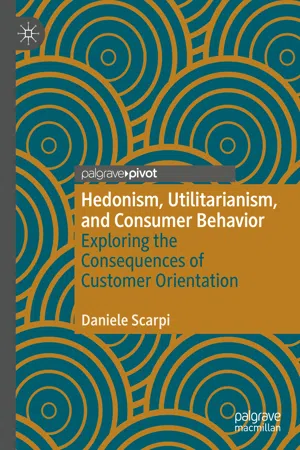
eBook - ePub
Hedonism, Utilitarianism, and Consumer Behavior
Exploring the Consequences of Customer Orientation
- English
- ePUB (mobile friendly)
- Available on iOS & Android
eBook - ePub
Hedonism, Utilitarianism, and Consumer Behavior
Exploring the Consequences of Customer Orientation
About this book
Information
© The Author(s) 2020
D. ScarpiHedonism, Utilitarianism, and Consumer Behaviorhttps://doi.org/10.1007/978-3-030-43876-0_11. Introduction
Daniele Scarpi1
(1)
University of Bologna, Bologna, Bologna, Italy
Abstract
This chapter introduces the volume, highlighting the topic and the main concepts. It addresses shopping orientation focusing on hedonic and utilitarian orientation, briefly introducing what they mean in the academic literature and for practitioners. Next, the chapter details the theoretical, methodological, and managerial implications expected from this volume. Finally, the chapter details the structure of the volume, chapter by chapter, briefly summarizing the content of each part of the volume.
Keywords
PrefaceIntroductionVolume structureContributionDifferent consumers could approach the same shopping environment in a different way, developing a different shopping experience. For instance, some consumers are goal-oriented. This implies that considerations about cognitive-oriented benefits, rational necessity, and needs are often used as the basis of making a purchase. On the other hand, the thrills and fun of shopping experience are the primary reasons why other people purchase goods. In other words, rather than efficiency, they purchase to achieve sensory gratification and excitement (Babin et al. 1994; Wang et al. 2011). Usually, the two shopping orientations are categorized as utilitarianism and hedonism. Therefore, while trying to establish a retail environment, retailers should consider the shopping orientation that the consumers might exhibit. This research investigates which orientation is more valuable for offline retailers. It also seeks to find the impact of a utilitarian orientation and hedonic orientation on a set of managerially relevant outcomes.
The present book is set in the context of fast-fashion retailers in selective distribution and intensive distribution. Rather than mere shopping or store browsing, it will also consider purchasing behavior, since shopping does not necessarily end in a purchase. While the book does not seek to know the reasons behind consumers’ purchase or what makes them develop a hedonic or utilitarian orientation, it investigates the consequences of people having a utilitarian or hedonic orientation in the store. Consequently, it seeks to analyze the influence of the two orientations on four factors that are relevant to theory and management. The four variables include price consciousness, purchased amount, perceived value, and intention to repurchase from the same store (store loyalty in the future). Purchase frequency is also accounted for, as well as consumers’ age and gender.
Consumers tend to have a general disposition toward the act of shopping, which is referred to as shopping orientation. Such a disposition is often reflected through information searches, alternative evaluations, and product selections, and is personalized by a series of opinion statements, interests, and attitudes that concern shopping (Brown et al. 2003). Consumer shopping behavior can be driven by emotions, excitement, and pleasure, and the influence of these elements is commonly considered as crucial, so that shopping orientation is usually discussed in terms of “experiential” and “goal-oriented” (e.g. Wolfinbarger and Gilly 2001) or “hedonic” and “utilitarian” (e.g. Griffin et al. 2000; Scarpi 2012). Rather than achieving a need or completing a task, hedonism is related to playful, joyful, and festive shopping. Therefore, it manifests the experiential part of shopping, which consists of curiosity, escapism, pleasure, and fun. On the contrary, any shopping that is rational and task-oriented denotes utilitarianism, which translates into making rational and efficient shopping. Moreover, it has more to do with needs rather than pleasure, and it is often described in terms of performance such as achievement and success (Chaudhuri et al. 2010; Scarpi et al. 2014).
For utilitarian consumers, who consider shopping as a necessary action to perform quickly, convenience is the major expected benefit. On the other hand, consumers who relish shopping tend to gain added value from exploring huge stores, enjoying in-store music or videos and large assortments. Consumers who shop for pleasure or as a leisure activity, otherwise known as “recreational shoppers,” show a more positive behavior toward shopping compared to those who neither like nor dislike the experience of shopping, also known as “economic shoppers”.” Thus, there exists a positive relationship between the hedonic value of consumers’ shopping experiences and the experience of “flow” (Lee and Tan 2003; Chaudhuri et al. 2010). Nevertheless, there is a coexistence of the two shopping orientations in shopping environments, be they physical stores (Scarpi et al. 2014), websites (Sénécal et al. 2002), or virtual-reality settings (Pizzi et al. 2019).
A better understanding of the impact of specific orientation to shopping could be of advantage to retailers. Such an understanding could also assist managers in planning a better sales strategy, as well as designing and implementing of environments that foster positive interaction experience among customers. More so, it will help businesses in segmenting their buyers based on their shopping orientation.
Accordingly, this book aims at contributing to the advancement of the knowledge about consumer behavior in retailing, and more specifically about consumers’ hedonic and utilitarian shopping orientation. This research stems from the desire to develop content in the extant literature, and from the author’s personal belief that today’s research on hedonic and utilitarian shopping orientation does not fully reflect the role of the distribution channels and the effects of shopping orientation.
Thus, the main purpose of this book is to develop a broad theoretical framework that incorporates the different perspectives and activities associated with the management of distribution channels, to provide useful, empirically founded suggestions to retailers. In particular, this book focuses on the fast-fashion industry and is aimed at offline retailers in intensive distribution and specialty distribution.
Based on a broad overview of extant literature, the book proposes a summary of the various perspectives and the different models proposed over time. Following the development of studies on the topic of hedonic and utilitarian shopping orientation, and considering the results of recent studies, this book proposes a model of structural equations to measure the impact of hedonism and utilitarianism in the different distribution channels considered.
1.1 Book Structure
This book consists of eight chapters:
Chapter 1 introduces the topic and structure of the book.
Chapter 2 provides a broad critical summary of the literature on hedonic and utilitarian shopping orientation, in which the theoretical background on which the book is based is analyzed in great detail. In addition it presents previous studies and more recent developments, reviewing the most relevant contributions, the methods used, and the different approaches. It also introduces ideas for the development of future research. Finally, it concludes by addressing some questions and issues that still remain open, such as contradictions, considerations, and insights, reviewing the concepts of mood, value, and shopping atmosphere.
Chapter 3 presents the development and design of the research. Thus, it addresses the constructs considered in the analysis, briefly reviews the main constructs excluded from the analysis, and introduces the distribution channels and the considered industry (fast fashion), leading to—based on the considerations presented in Chaps. 1 and 2—the advancement of specific hypotheses.
Chapter 4 lays out the research design, focusing on measuring the considered variables, describing the sampling process and the tools used for data collection. It then focuses on the concepts of reliability and validity of the measures, the tools for estimating statistical relationships between variables, and the criteria that will be followed for analyzing the data and testing the hypotheses.
Chapter 5 is dedicated to the analysis of the data, and to the verification of the hypotheses advanced for the considered distribution channels. In particular, it implements, estimates, and evaluates the model in the context of intensive distribution, verifying the hypotheses specifically formulated for this distribution channel. Finally, it presents the conclusions and main findings for intensive distribution.
Chapter 6 is dedicated to the analysis of the data, and to the verification of the hypotheses advanced for the considered distribution chann...
Table of contents
- Cover
- Front Matter
- 1. Introduction
- 2. A Literature Review of Hedonic and Utilitarian Shopping Orientation
- 3. Hypotheses and Conceptual Model Development for Hedonism, Utilitarianism, and Consumer Behavior
- 4. Tools and Measurements for Exploring the Consequences of Shopper Orientation
- 5. Hedonism and Utilitarianism in Intensive Distribution
- 6. Hedonism and Utilitarianism in Selective Distribution
- 7. Comparison of the Distribution Channels
- 8. Implications of Hedonism and Utilitarianism for Retailers
- Back Matter
Trusted by 375,005 students
Access to over 1.5 million titles for a fair monthly price.
Study more efficiently using our study tools.
Frequently asked questions
Yes, you can cancel anytime from the Subscription tab in your account settings on the Perlego website. Your subscription will stay active until the end of your current billing period. Learn how to cancel your subscription
No, books cannot be downloaded as external files, such as PDFs, for use outside of Perlego. However, you can download books within the Perlego app for offline reading on mobile or tablet. Learn how to download books offline
Perlego offers two plans: Essential and Complete
- Essential is ideal for learners and professionals who enjoy exploring a wide range of subjects. Access the Essential Library with 800,000+ trusted titles and best-sellers across business, personal growth, and the humanities. Includes unlimited reading time and Standard Read Aloud voice.
- Complete: Perfect for advanced learners and researchers needing full, unrestricted access. Unlock 1.5M+ books across hundreds of subjects, including academic and specialized titles. The Complete Plan also includes advanced features like Premium Read Aloud and Research Assistant.
We are an online textbook subscription service, where you can get access to an entire online library for less than the price of a single book per month. With over 1.5 million books across 990+ topics, we’ve got you covered! Learn about our mission
Look out for the read-aloud symbol on your next book to see if you can listen to it. The read-aloud tool reads text aloud for you, highlighting the text as it is being read. You can pause it, speed it up and slow it down. Learn more about Read Aloud
Yes! You can use the Perlego app on both iOS and Android devices to read anytime, anywhere — even offline. Perfect for commutes or when you’re on the go.
Please note we cannot support devices running on iOS 13 and Android 7 or earlier. Learn more about using the app
Please note we cannot support devices running on iOS 13 and Android 7 or earlier. Learn more about using the app
Yes, you can access Hedonism, Utilitarianism, and Consumer Behavior by Daniele Scarpi in PDF and/or ePUB format, as well as other popular books in Business & Marketing. We have over 1.5 million books available in our catalogue for you to explore.