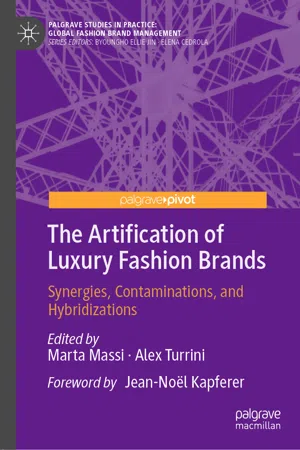
Despite being vastly different both socially and economically, art and fashion are increasingly converging to collaborate in mutually advantageous ways. This book discusses the mutual benefits of collaboration through analysis of successful case studies, including corporate art collections and museums, patronage and sponsorship initiatives, and art-based brand management in the fashion sector. It provides a categorization of the strategies that fashion firms employ when they join the art world and illustrates how art and fashion brands can interact strategically at different levels. This book will be a valuable resource to researchers, providing an enhanced understanding of the potential of artification for managing brands and products.
eBook - ePub
The Artification of Luxury Fashion Brands
Synergies, Contaminations, and Hybridizations
- English
- ePUB (mobile friendly)
- Available on iOS & Android
eBook - ePub
The Artification of Luxury Fashion Brands
Synergies, Contaminations, and Hybridizations
About this book
Information
© The Author(s) 2020
M. Massi, A. Turrini (eds.)The Artification of Luxury Fashion BrandsPalgrave Studies in Practice: Global Fashion Brand Management https://doi.org/10.1007/978-3-030-26121-4_11. When Fashion Meets Art: The Artification of Luxury Fashion Brands
Marta Massi1 and Alex Turrini2
(1)
Desautels Faculty of Management, McGill University, Montréal, Canada
(2)
Bocconi University, Milan, Italy
“Just a little while ago, as I was crossing the boulevard very hastily and jumping about in the mud, through that moving chaos in which death comes galloping toward you from all sides at once, I moved abruptly and my halo slipped from my head into the mire on the pavement” (Baudelaire 1869)
Abstract
This introductory chapter provides the theoretical foundation for the phenomenon of artification—that is, the transformation of nonart into art—which has been increasingly strategically employed by luxury fashion brands in recent times. The chapter provides context and background to position the case studies analyzed in the following chapters of the book. First, it reviews the literature on artification, tracing the origins of the concept and illustrating its transdisciplinary nature. Second, it lays the groundwork for the identification of the benefits of artification for luxury fashion brands and art institutions. In particular, it illustrates how two apparently far-removed sectors, such as art and luxury fashion, are increasingly interacting and collaborating to achieve mutual benefits. Finally, the chapter proposes a classification of artification processes based on different degrees of interaction between the luxury fashion and art sectors. Notably, the authors identify synergies, contaminations, and hybridizations as incremental stages of the artification of luxury fashion brands.
Keywords
ArtificationContaminationsHybridizationsLuxury fashion brandsSynergiesIntroduction
Fashion and art are two distinct systems both socially and economically (Caves, 2000; Geczy & Karaminas, 2012). They have “different modalities of reception [and] presentation” and are “subject to different responses within the economy” (Jelinek, 2018, p. 296). Art fits into the so-called high-culture production field, while fashion is a creativity-based industry (Jelinek, 2018; Steele, 2012a, 2012b). For some scholars, fashion products are mere commodities “with a commercial nature” (Jelinek, 2018, p. 294). For others, fashion is a “form of visual art, a creation of images with the visible self as its medium” (Maynard, 2012; Miller, 2007; Simon, 1995; Wilson, 1987, p. 9). Albeit often perceived as two worlds apart, art and fashion are increasingly converging in mutually advantageous ways, especially when it comes to luxury, one of the fastest-growing sectors: in 2018, the market for personal luxury goods was €260 billion, with a growth of 6% (Bain & Company, 2018).
This book deals with the artification of luxury fashion brands, that is, their transformation into art (Kapferer, 2014, p. 371). Having been hotly debated lately, the phenomenon of artification has attracted both the praise of those who see in it an opportunity to purify luxury goods from their long-stigmatized link to unnecessary excess and amorality (Dubois, Laurent, & Czellar, 2001; Kapferer, 2014) and the criticism of those who view it as a desecration of art. Despite strong criticism, mainly based on the assumption that artification is instrumental only for achieving marketing and sales goals (to the detriment of artistic integrity), there are many upsides to artification processes in the context of luxury fashion brands.
The overall purpose of this book is to explore the ways in which the luxury fashion industry and the art world might join forces, both strengthening the luxury brand reputation and supporting the flourishing of the arts and the economic sustainability of nonprofit arts organizations. In particular, the authors aim to delve into the synergies, contaminations, and hybridizations between luxury fashion brands and art. This book investigates such phenomena by presenting different case studies of fashion businesses “artifying” their brands by establishing various types of interactions with the art world.
In this chapter, we propose an overall framework distinguishing among several levels of artification processes in the luxury fashion industry. The chapter is organized as follows. First, we review the concept of artification, illustrating its multidisciplinary nature and highlighting the mutual benefits for luxury fashion companies and art organizations that engage in artification processes. Second, we propose a classification of artification processes based on different degrees of interaction between the luxury fashion and art sectors. In particular, we identify synergies, contaminations, and hybridizations as incremental stages of the artification process.
The Concept of Artification
Albeit apparently recalling a negative or derogatory meaning—mainly for its association to the idea of the “fabrication of what is artificial” and as “commoditization, destructive of the authenticity of things”1—the term “artification” must be employed in mere descriptive terms (Shapiro, 2004a, p. 1). In her seminal article, Shapiro describes artification as “the transformation of non-art into art [that is] a transfiguration of people, objects and action” (Shapiro, 2004a, p. 1).2
Artification can be read as a consequence of “a general objectification of culture occurring in many societies” (Shapiro, 2004b, p. 2) and of the blurring between high and low culture characterizing the so-called “culture society” (Morato, 2003; Shapiro, 2004b), where the boundaries of art are not well-defined (Shapiro, 2004b). As Shapiro (2004b, pp. 2–3) puts it, there are two basic assumptions on which the artification concept is based: (1) the belief in the superior value of artworks, conceived as outcomes of a process rather than as objects. Artification does not deal with the intrinsic nature of art but with the activity through which art is generated (Heinich & Shapiro, 2012b); and (2) the multiplication of legitimizing bodies. Once, legitimation was the prerogative of a few privileged bodies (e.g., the Academy of France) who used to discern what held artistic value and what did not. In contrast, the power to legitimate an object has now become the right of multiple legitimating bodies, including the audience, newspapers, collectors, gallery or festival directors, sponsors, etc. (Shapiro, 2004b, pp. 2–3).
Therefore, artification can be regarded as a consequence of the cultural democratization characterizing the postmodern era (Shapiro, 2004b), which allows for “countless possibilities in the world of art and architecture” (Firat & Venkatesh, 1995, p. 242), also giving those who were once considered outsiders and marginalized groups a chance to enter the art world. Thanks to artification, genres such as breakdance, hip pop, video art, and computer art acquired artistic dignity and value (Shapiro, 2004b).
Rooted in many fields and allowing for multiple levels of analysis, artification dynamics have been studied by different disciplines. From a biological stance, artification is the individual attempt to assure the survival and evolution of the species (Dissanayake, 2011) From a sociological standpoint, artification is used by individuals to achieve the right to self-expression and authenticity (Shapiro & Heinrich, 2012) From a socioeconomic viewpoint, artification is the consequence of the individual’s reaction to crucial changes occurring in important institutions (i.e., family, workplace, etc.) and an attempt of individuals to use art to restore their identi...
Table of contents
- Cover
- Front Matter
- 1. When Fashion Meets Art: The Artification of Luxury Fashion Brands
- 2. Sergio Rossi and Its Magic Kingdom: Artistic Interventions, Brand Identity Renewal, and Stakeholder Awareness
- 3. Trussardi Art and Fashion: A Long-Distance Relationship?
- 4. Guccification: Redefining Luxury Through Art—The Gucci Revolution
- 5. Christian Dior: The Art of Haute Couture
- 6. Balenciaga: The Master of Haute Couture
- Back Matter
Trusted by 375,005 students
Access to over 1.5 million titles for a fair monthly price.
Study more efficiently using our study tools.
Frequently asked questions
Yes, you can cancel anytime from the Subscription tab in your account settings on the Perlego website. Your subscription will stay active until the end of your current billing period. Learn how to cancel your subscription
No, books cannot be downloaded as external files, such as PDFs, for use outside of Perlego. However, you can download books within the Perlego app for offline reading on mobile or tablet. Learn how to download books offline
Perlego offers two plans: Essential and Complete
- Essential is ideal for learners and professionals who enjoy exploring a wide range of subjects. Access the Essential Library with 800,000+ trusted titles and best-sellers across business, personal growth, and the humanities. Includes unlimited reading time and Standard Read Aloud voice.
- Complete: Perfect for advanced learners and researchers needing full, unrestricted access. Unlock 1.5M+ books across hundreds of subjects, including academic and specialized titles. The Complete Plan also includes advanced features like Premium Read Aloud and Research Assistant.
We are an online textbook subscription service, where you can get access to an entire online library for less than the price of a single book per month. With over 1.5 million books across 990+ topics, we’ve got you covered! Learn about our mission
Look out for the read-aloud symbol on your next book to see if you can listen to it. The read-aloud tool reads text aloud for you, highlighting the text as it is being read. You can pause it, speed it up and slow it down. Learn more about Read Aloud
Yes! You can use the Perlego app on both iOS and Android devices to read anytime, anywhere — even offline. Perfect for commutes or when you’re on the go.
Please note we cannot support devices running on iOS 13 and Android 7 or earlier. Learn more about using the app
Please note we cannot support devices running on iOS 13 and Android 7 or earlier. Learn more about using the app
Yes, you can access The Artification of Luxury Fashion Brands by Marta Massi, Alex Turrini, Marta Massi,Alex Turrini in PDF and/or ePUB format, as well as other popular books in Business & Art Theory & Criticism. We have over 1.5 million books available in our catalogue for you to explore.